

Run this farm biosecurity checklist today: map your property, restrict who and what moves across it, and quarantine every new or returning animal for at least two weeks. Those three actions stop most disease introductions before they start. Species-specific risks still deserve a veterinarian’s input, and a downloadable plan template turns this checklist into a working document instead of a one-time exercise.
TL;DR:
- Mapping and clearly defining zones, including a quarantine area located outside the perimeter buffer zone, are essential for controlling cross-contamination.
- Properly training staff and enforcing strict vehicle and visitor movement protocols prevent most disease introductions.
- Regular maintenance of disinfectant solutions, placement of boot baths, and dedicated equipment for quarantine animals are crucial for effective sanitation.
- Sealing feed and water sources and controlling pests like rodents and wild birds help reduce pathogen transmission risk.
- Implementing fixed fencing and controlled entry points transforms policies into physical barriers, significantly strengthening farm biosecurity.
Table of Contents
- Farm Biosecurity Checklist by Category
- How Do You Map Zones and Movement Risks?
- What’s the Right Quarantine Protocol for New Animals?
- Cleaning, Disinfection, and Vehicle Hygiene
- Controlling Feed, Water, Manure, and Pests
- Turning Your Checklist Into a One-Page Biosecurity Plan
- Field Notes: What Actually Works and What Fails
- Why Small Repeatable Routines Beat One-Time Fixes
- Strengthen Your Perimeter Controls With the Right Fencing
- Sources
Farm Biosecurity Checklist by Category
Print this and walk your property with it. Answer yes or no for each item, then circle whatever gets a “no” first.
Access and perimeter
- Is there a single, controlled entry point for vehicles and visitors?
- Are gates closed and locked when not actively in use?
- Is signage posted showing biosecurity rules before someone reaches the animals?
Zones and farm map
- Do you have a drawn map showing clean areas versus high-traffic or “dirty” areas?
- Is there a marked line of separation between production and non-production zones?
Personnel and visitors
- Does every visitor sign in and get briefed before entering animal areas?
- Is there a named biosecurity coordinator responsible for enforcing the rules?
Vehicles and equipment
- Do delivery trucks and service vehicles follow a fixed, pre-communicated route?
- Is shared equipment cleaned between uses on different sites or pens?
Animals and movement
- Are new arrivals logged with source, date, and health status?
- Do returning animals (from shows, sales, breeding) get treated as new arrivals?
Quarantine
- Is there a dedicated quarantine pen physically separate from the main herd or flock?
Cleaning and disinfection
- Are boot baths stocked, fresh, and placed at zone entry points?
Feed and water
- Is feed stored in rodent-proof, sealed containers?
Manure and carcass disposal
- Is there an approved, documented method for both, located away from production zones?
Records and training
- Has every worker been trained on the protocols in the last 12 months?
Farmers most often skip three things: logging returning animals as if they were low-risk, letting delivery drivers wander past the marked entry point, and treating boot baths as decoration instead of maintaining the disinfectant strength inside them.
How Do You Map Zones and Movement Risks?
A property map is the backbone of any farm biosecurity plan, and it takes less than an hour to sketch.
- Draw your property boundary and mark the entry point vehicles use.
- Shade “clean” zones (animal housing, feed storage) separately from “dirty” zones (manure storage, dead-stock handling, parking).
- Mark the Line of Separation (LOS), the boundary animals and contaminated items should not cross, and the Perimeter Buffer Area (PBA), the space around your production zone where outside vehicles and people need permission to enter.
- Set fixed routes for delivery trucks and service providers, and share the map with them in advance so nobody improvises a shortcut through the barn.
Labeling clean versus dirty zones this way gives you a physical or functional barrier that controls exactly who and what crosses into animal areas.
Pro Tip: Put your quarantine pen at the far edge of the PBA, not just inside it. A pen ten feet from the perimeter fence is still inside your buffer zone in every way that matters for airflow and foot traffic.
What’s the Right Quarantine Protocol for New Animals?
Every new animal is a potential carrier until proven otherwise, no matter how healthy it looks or how clean the seller’s operation seemed.
- Hold new and returning animals separate for a quarantine period recommended by your veterinarian, and longer for higher-risk species or unknown health histories.
- Place the quarantine area downwind and without shared airspace with your main herd or flock whenever your layout allows it.
- Use dedicated boots, tools, and feed buckets for quarantined animals. Do not rotate the same equipment between quarantine and the main group.
- Record the source, arrival date, and any visible health issues at intake.
- Call a veterinarian if an animal shows respiratory symptoms, diarrhea, lameness, or unexplained weight loss during the hold period.
Building your plan alongside a vet matters more than it sounds. Species carry different vulnerabilities, and a generic quarantine window that works fine for cattle can be too short for poultry exposed to certain respiratory pathogens.
Cleaning, Disinfection, and Vehicle Hygiene
Disinfectant sprayed onto a dirty surface is close to wasted effort. Manure, bedding, and dirt shield pathogens from the chemical underneath them, so the order of operations matters as much as the product you choose.
- Remove all visible organic matter first, then wash the surface, then apply disinfectant.
- Follow the label’s contact time and dilution rate exactly. Wiping it off early cuts its effectiveness.
- Install a vehicle wash-down station at the edge of your Perimeter Buffer Area, before trucks reach the clean zone.
- Put boot baths at every zone entry point, not just the main gate, and change the solution when it looks murky.
- Wear gloves and eye protection when mixing concentrated disinfectants, and route runoff away from water sources and pasture.
That two-step clean-then-disinfect sequence is the single most skipped step on real farms, mostly because skipping straight to spraying feels faster.
Controlling Feed, Water, Manure, and Pests
Rodents, wild birds, and contaminated feed move pathogens just as effectively as a visitor’s boots do, and they’re harder to notice until the damage is done.
- Store feed in sealed, rodent-proof containers, and clean feeding equipment between batches.
- Check water sources regularly for contamination, especially after heavy rain or flooding near the source.
- Keep feeding areas free of spilled feed that draws rodents and wild birds.
- Use an approved carcass disposal method (composting, burial, or licensed removal, depending on your jurisdiction), and keep the disposal site well away from production and water areas.
- Set bait stations or traps along building perimeters and check them on a schedule, not just when you notice a problem.
Turning Your Checklist Into a One-Page Biosecurity Plan
A checklist tells you where the gaps are. A plan is what keeps you closing them.
- Start with a property information page: address, species raised, herd or flock size, and key contacts.
- Attach the farm map you sketched earlier, with zones and the LOS marked.
- List protocols for visitor management, vehicle movement, feed handling, and cleaning, each in a sentence or two, not a legal document.
- Name a biosecurity coordinator responsible for enforcement and record-keeping.
- Set a review date, once a year at minimum, plus a review trigger after any disease incident or new-animal introduction.
- Rank your checklist’s “no” answers by risk and tackle the top three within 30 days.
A customized plan built from a checklist turns a vague intention into a dated, assigned action list, which is the difference between a plan that works and one that sits in a drawer.
Field Notes: What Actually Works and What Fails
Boot baths fail less from the wrong chemical and more from placement. Put them where people naturally stop anyway, like a gate or barn door, and compliance jumps without a single reminder.
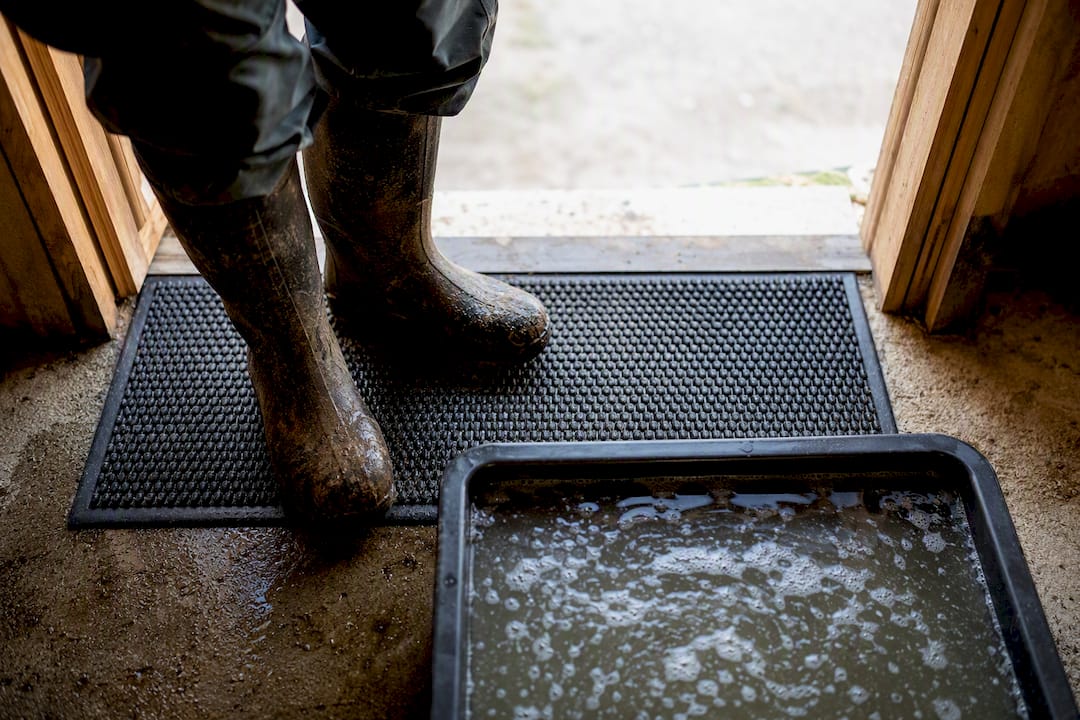
The most common failure pattern isn’t ignorance. It’s mixed traffic: the same truck delivering feed also hauling out manure, the same boots crossing from the sick pen to the nursery. Cheap temporary fencing or a simple gate at the PBA boundary fixes more of this than any written rule does, because it makes the wrong path physically harder than the right one.
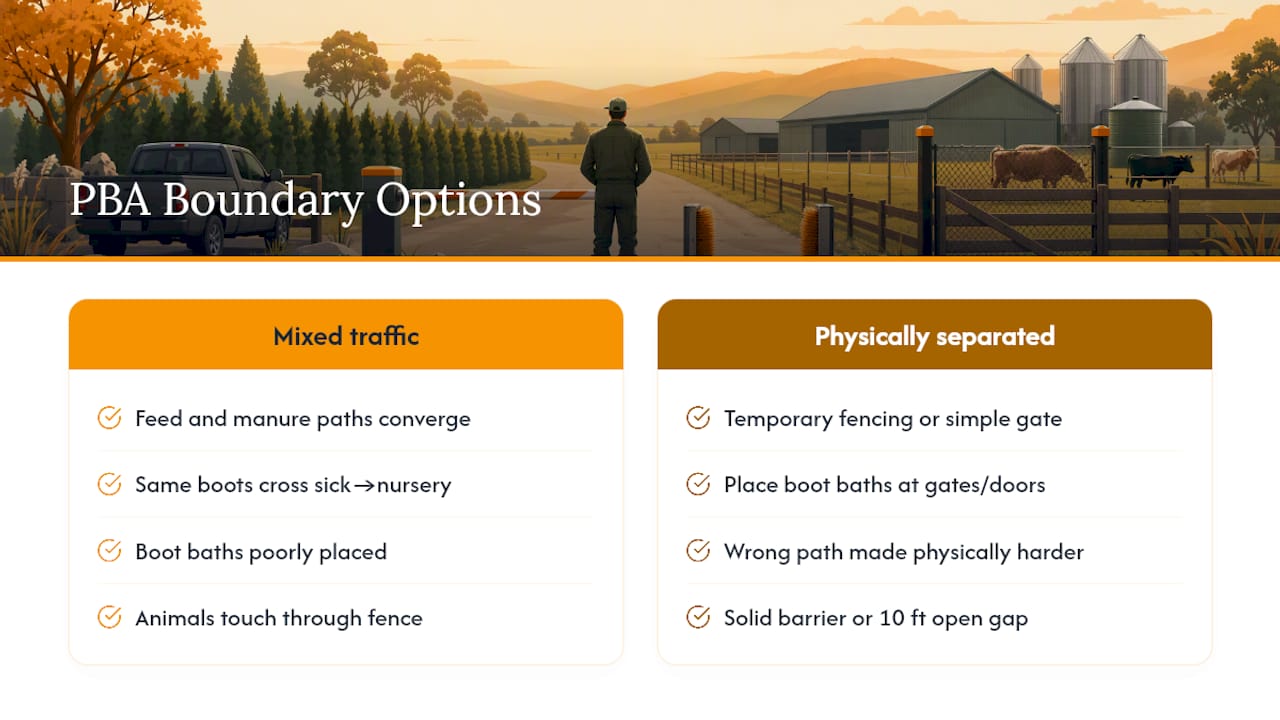
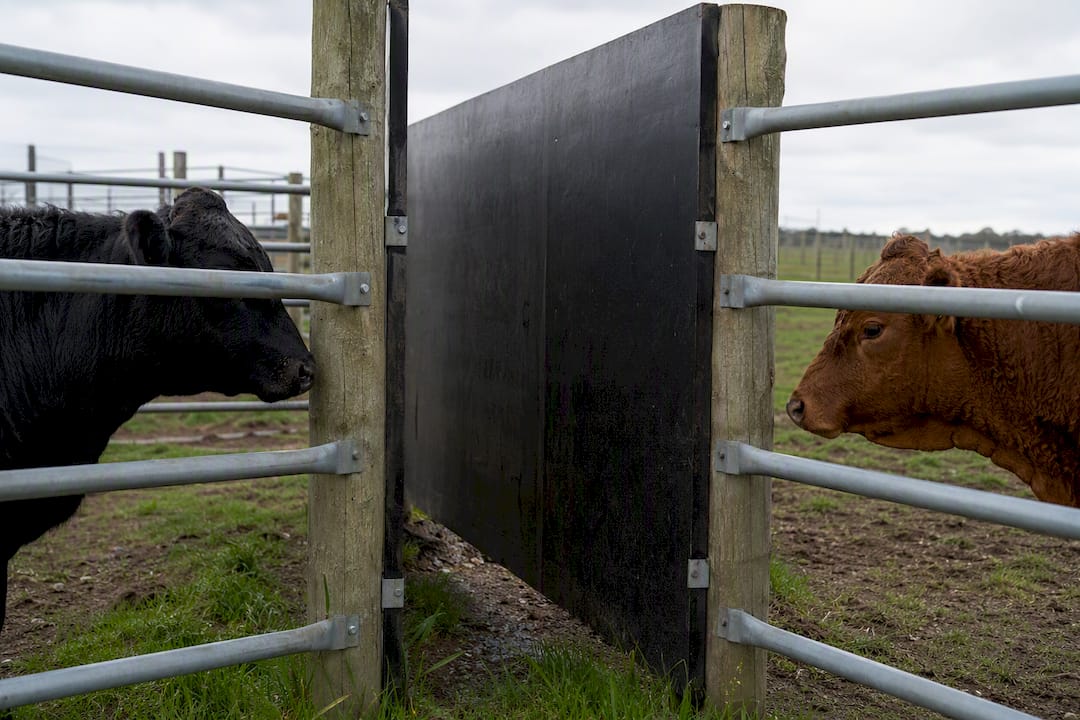
Pro Tip: If your quarantine pen shares a fence line with the main herd, animals can still touch noses through the wire. A solid barrier, or at least ten feet of open ground, closes that gap.
Call a vet or biosecurity specialist when a new pathogen shows up in your region, not just when your own animals get sick. Regional outbreaks change what “normal” precautions should look like.
Why Small Repeatable Routines Beat One-Time Fixes
Most farms don’t fail biosecurity because they lack knowledge. They fail because the good habits stop after the first busy week. A map, visitor sign-in sheet, and a real quarantine pen are a single weekend project. Assign one action to each person on your team, and it stays alive past week one.
— Juiced
Strengthen Your Perimeter Controls With the Right Fencing
A checklist tells you where movement risks live. Fencing and gates are what actually stop them. A solid gate at your Perimeter Buffer Area, a dedicated fence line around the quarantine pen, and clearly separated traffic paths turn the rules on your printed checklist into something animals and vehicles physically cannot ignore.
Fencefast stocks the fence equipment and fence tools and fasteners you need to build that separation without hiring a contractor for a weekend project. Whether you’re closing off a quarantine area, securing a single controlled entry point, or separating clean and dirty zones with a low-cost temporary barrier, the hardware is the same category you’d use for any fencing job, just placed with biosecurity in mind.
If you’re not sure where a fence line should sit relative to your farm map, design consulting services can review your layout and suggest placement. Request a quote and get your perimeter plan moving before your next new-animal arrival.
Sources
- Farm biosecurity planning and templates | Agriculture Victoria
- National Farm-Level Biosecurity Planning Guide — Proactive management
- Make a customized biosecurity plan - Farm Biosecurity (CFSPH)
- Quarantine and biosecurity best practices (PMC)

