

Proper animal handling reduces stress, lowers pain and injury, and translates directly into fewer sick animals, better weight gain, and safer working conditions for handlers. It also protects product value: rough handling causes PSE (pale, soft, exudative) pork and DFD (dark, firm, dry) beef, both of which get docked at the scale. Government welfare guidance and university livestock research back all of it up.
TL;DR:
- Proper animal handling relies on reading behavior and using pressure-release cues to guide movement without panic, reducing stress and injury.
- Facilities should incorporate curved alleys, solid sides, non-slip flooring, and good lighting, with regular maintenance to prevent handling problems.
- Monitoring indicators such as exit speed, vocalization, and carcass quality helps track improvement and identify early signs of handling issues.
- Small, consistent changes like moving slower, acclimating animals, and fixing chokepoints can significantly improve handling efficiency and animal welfare.
- Hardware quality, proper fencing, and consulting experts like Fencefast can effectively eliminate bottlenecks that cause animals to balk.
Table of Contents
- What Proper Animal Handling Actually Means
- The Real Payoff: Welfare, Productivity, Quality, and Safety
- Low-Stress Handling Techniques That Actually Work
- Facilities and Equipment That Reduce Stress
- Tracking Whether Your Handling Changes Are Working
- A Simple Checklist to Start Improving Handling This Week
- Why FenceFast Understands the Fencing Side of This Equation
- What Changing How You Handle Animals Actually Feels Like
- Put These Handling Improvements Into Practice
- Sources
What Proper Animal Handling Actually Means
Animal handling is any interaction where a person moves, restrains, sorts, or works around livestock, and “proper” handling means doing that in a way the animal understands and can respond to without panic. It relies on reading behavior rather than forcing compliance, using flight zone, point of balance, and pressure-release cues to guide movement instead of chasing or shoving. The animal steps forward because the pressure eases when it does, not because it’s cornered.
That’s the foundation behind humane handling guidance from the HSA, which treats voluntary cooperation as the goal, not a bonus.
A few rules make this practical fast:
- Do approach at an angle, from behind the point of balance, so the animal moves forward naturally.
- Do give animals a way out. A dead-end alley invites panic.
- Don’t yell, hit, or use an electric prod as your first tool. It should be your last.
- Don’t rush weaning, loading, or sorting. Rushed events are where injuries happen.
The Real Payoff: Welfare, Productivity, Quality, and Safety
Improper handling doesn’t just look bad. It costs money in four specific ways.
Welfare improves fastest. Calm handling cuts pain and chronic stress, which lowers disease susceptibility and reduces how often you need antibiotics. Government welfare strategy links high welfare standards directly to lower long-term production costs.
Productivity follows welfare closely. University trials comparing calm versus rough handling found handled cattle gained weight faster and produced heavier carcasses than stressed counterparts.
Product quality is where handling failures show up on the scale sheet. Stress hormones released right before slaughter cause PSE in pork and DFD in beef, both of which get graded down or rejected outright.
Safety and cost round it out:
- Fewer kicks, crushing incidents, and chute injuries for handlers
- Less broken equipment from panicked animals
- Shorter handling time per head, which saves labor
Statistic Callout: Calm-handled cattle in university comparisons showed measurably higher rates of gain and heavier carcass weights than stressed groups. That gap compounds across a whole herd, every season.
Low-Stress Handling Techniques That Actually Work
Good handling comes down to a short list of habits, applied consistently.
- Move slow and quiet. Fast movements and loud noise trigger flight responses; calm handlers get calmer animals.
- Work behind the point of balance, at the animal’s shoulder, to encourage forward movement without force.
- Acclimate animals before big events. Walk cattle through the chute a few times before the first vaccination day, and weaning or transport stress drops noticeably.
- Use restraint equipment correctly and minimally. A squeeze chute should hold, not crush. Electric prods belong in a drawer, not a handler’s back pocket.
- Adjust for species. Pigs respond poorly to sudden light changes and tight groups; sheep flock and follow, so a single trained leader animal can move the whole group; cattle need clear sightlines and a visible escape route.
Rough handling and overcrowding create what researchers call a fear-force cycle: an animal balks, the handler pushes harder, the animal panics more. Breaking that cycle is almost always about handler behavior, not the animal’s temperament.
Facilities and Equipment That Reduce Stress
Design and maintenance matter as much as technique. Curved alleys keep animals from seeing what’s ahead until they’re already committed to moving forward, which cuts balking. Solid sides block distractions outside the chute. Non-slip flooring and even lighting (animals resist moving from bright to dark or the reverse) round out the basics.
Maintenance issues cause more handling problems than most owners realize. A noisy latch, a sharp edge, or a slick ramp will make an animal balk every single time, and it’s often blamed on the animal’s temper instead of the gate.
- Check latches for noise and smooth operation monthly.
- Inspect flooring for wear, moisture buildup, or missing grip strips.
- Confirm gates and fencing systems close fully and don’t leave gaps animals can exploit during sorting.
Pro Tip: Walk your own alley and chute at animal eye level before you blame a “difficult” animal. Shadows, glare, and gaps you never notice standing upright are often exactly what’s stopping the herd.
Tracking Whether Your Handling Changes Are Working
You can’t manage what you don’t measure. Three categories of indicators tell you if handling changes are paying off.
Animal indicators: vocalization during handling, exit speed from the chute, visible injuries, and morbidity rates over time.
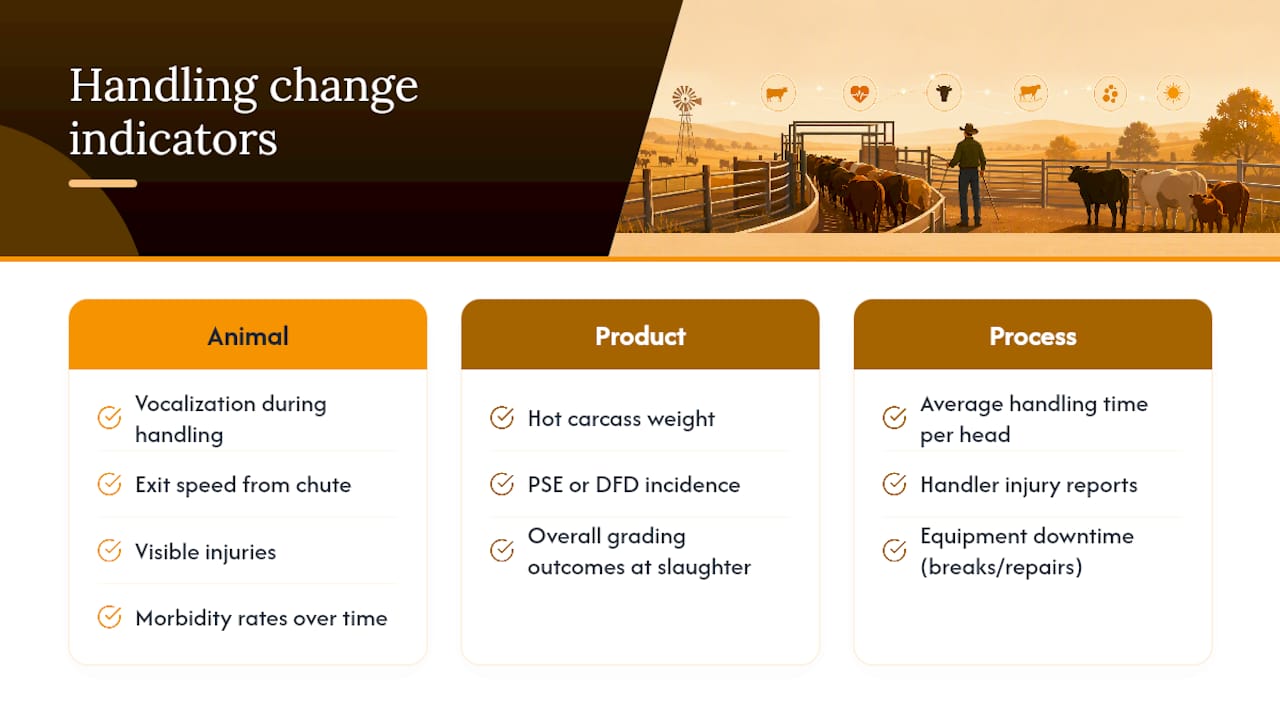
Product indicators: hot carcass weight, incidence of PSE or DFD grading, and overall grading outcomes at slaughter.
Process indicators: average handling time per head, handler injury reports, and equipment downtime from breakage or repairs.
Statistic Callout: A slowing exit speed or rising vocalization rate during routine handling is often the earliest warning sign of a facility or technique problem, showing up well before injury reports or grading data confirm it.
A Simple Checklist to Start Improving Handling This Week
- Record a baseline. Time how long it takes to move ten animals through your chute right now, before changing anything.
- Run a five-minute daily drill. Practice pressure-release cues on a small group before trying it on the whole herd.
- Walk the facility checklist. Check gates, flooring traction, lighting transitions, and noise sources before your next handling event.
- Ask these questions before buying equipment: Will this latch stay quiet after a season of use? Does this flooring hold traction when wet? Is this gate durable enough for daily cycling?
- Track your baseline against the new numbers after 30 days. Small, measurable tests beat a full facility overhaul you never finish.
Pro Tip: Start with the one bottleneck your animals balk at most. Fixing a single chokepoint often improves flow more than a dozen minor tweaks scattered across the whole facility.
Why FenceFast Understands the Fencing Side of This Equation
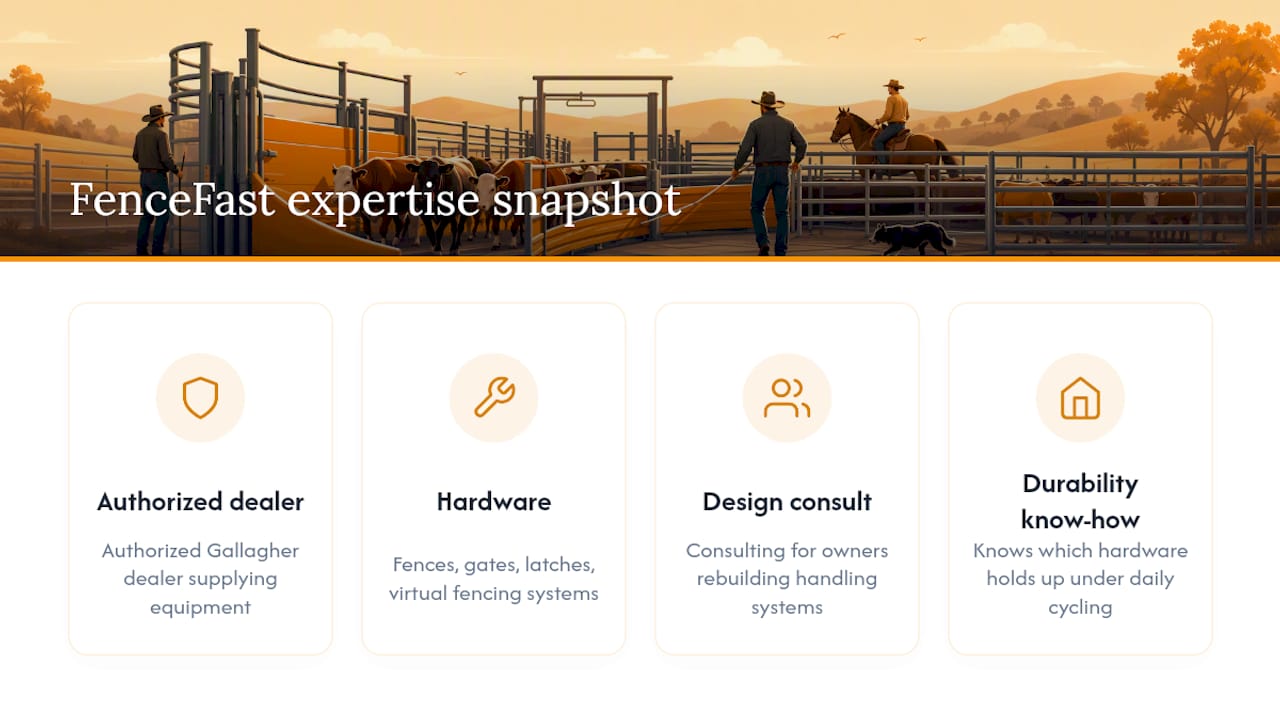
Escape points and bottlenecks usually trace back to fencing and gate choices, not animal behavior. Fencefast has extensive experience as an authorized Gallagher dealer, supplying fence equipment, gates, latches, and virtual fencing systems, plus design consulting for owners rebuilding handling systems from the ground up. That’s a long enough track record to know which hardware holds up under daily cycling and which doesn’t.
What Changing How You Handle Animals Actually Feels Like
Handlers who switch from force to pressure-release almost always report the same thing: less time per animal, fewer bruises, calmer sorting days. The lesson is simple. Fix your worst chokepoint first, then watch your handling time drop before you spend a dollar on anything else.
— Juiced
Put These Handling Improvements Into Practice
Better handling starts with fixing what’s actually causing the balking, and for most farms that’s a gate, latch, or alley that’s working against you instead of with you. Fencefast stocks the fence equipment that fixes chokepoints, from gates to latches, plus the fence tools and fasteners needed to keep them quiet and reliable through daily use.
If you’re not sure where your setup is falling short, Fencefast’s design consulting can walk through your layout and flag the fixes worth doing first. Start by checking your current fencing and containment setup against your handling times, then order the parts that close the gaps.
Sources
- HSA: humane handling guidance
- Cattle handling and stockmanship influence on animal performance — UW Livestock
- Gov

