

Every solid fencing job rests on five obligations: plan the layout around real management objectives, build to durable material and bracing standards, size and ground the electric system correctly, document plans and test readings, and protect your crew and the public throughout construction. Skip any one of those and you’re building a callback, not a fence. Fencefast supplies the parts, specs, and design support to help contractors meet every one of them without guesswork.
TL;DR:
- Confirm whether the fence is permanent or portable and its intended lifespan before starting, to avoid scope changes and disputes.
- Proper planning includes detailed job plans, layout maps, material quantities, and embedded dimensions to prevent construction errors and client disagreements.
- Use high-tensile wire for long, durable runs and ensure corners, gates, and braces are reinforced with the right assembly to prevent failure.
- Match energizer capacity and voltage to fence length, vegetation, and species, with extra capacity for long or brush-contact runs, and always verify grounding.
- Document all safety, legal, and maintenance procedures thoroughly to protect crews, meet regulations, and ensure smooth project closeout.
Table of Contents
- Agricultural Contractor Guidelines: Your Pre‑Work Checklist
- Planning and Job Documentation That Hold Up
- Materials and Construction Standards That Actually Last
- Electric System Sizing, Voltage, and Grounding
- Crew and Site Safety Standards
- Operation and Maintenance Schedule
- Project Closeout and Client Deliverables
- Legal Compliance and Labor Standards on the Job
- Insurance and Risk Management for Fencing Contractors
- Client Communication and Contract Terms
- Equipment Selection for Different Fencing Jobs
- How Fencefast Supports Contractors and Installers
- Where to Get Parts and Design Support for Your Next Job
- Sources
Agricultural Contractor Guidelines: Your Pre‑Work Checklist
Before a post goes in the ground, confirm the scope in writing. These are the items that separate a smooth job from a change‑order nightmare.
- Confirm whether the fence is permanent or portable, its expected lifespan, and the client’s actual management goals (rotational grazing, predator exclusion, boundary marking).
- Call for utility locates and pull permits before digging; map gates, lanes, and water crossings against the client’s equipment routes.
- Walk the soil and topography to decide post embedment depth and grounding approach, then pick a power source (mains, battery, or solar).
- Put the ongoing maintenance responsibility in writing and build an operation and maintenance handover plan into the contract.
Get these four items locked before your crew touches a shovel, and most disputes never happen.
Planning and Job Documentation That Hold Up
The Conservation Practice Standard Fence (Code 382) requires job plans and specifications before construction starts, and that requirement exists because undocumented fences are the ones that end up in disputes. A usable plan is not a sketch on a napkin. It needs to survive a client walk‑through and a warranty claim two years later.
- Layout map showing fence lines, gate and cattle guard positions, water crossings, and lane widths sized for the equipment that will use them.
- Post and brace schedule listing spacing, embedment depth, and brace type at every corner and gate.
- Material quantities for wire, posts, insulators, and hardware, tied to the specific product SKUs ordered.
- Expected service life stated in writing, since a temporary paddock divider and a 20‑year boundary fence call for different materials entirely.
Route lanes and gates along natural contours where possible. Cutting straight lines across a slope invites erosion and turns every heavy rain into a maintenance call, according to pasture and fencing planning guidance from the University of Maine Extension. Designing one water source or lane to serve multiple paddocks also cuts material costs and simplifies the maintenance schedule down the road.
Before you close out planning, get client sign‑off on the layout, confirm your utility‑locate tickets are on file, and set up a folder (digital or physical) where as‑built drawings and test readings will live for the life of the fence.
Materials and Construction Standards That Actually Last
Wire choice should follow the job, not habit. High‑tensile wire suits long runs where durability and low maintenance matter most. Woven wire earns its cost where predator exclusion or tight containment for smaller livestock is the priority. Barbed wire remains a reasonable, economical choice for straightforward boundary lines with cattle.
The USDA eFOTG technical notes on fence criteria lay out typical specs contractors should treat as working minimums:
Corners, gates, and brace assemblies are where fences actually fail, not the mid‑span wire. Use H‑brace or double‑H assemblies on long runs or high‑tension lines. Long, heavily tensioned high‑tensile runs need the extra rigidity of a double‑span brace or corner posts will slowly walk out of the ground during tensioning, a failure mode confirmed by the eFOTG brace‑sizing guidance linked above.
- Embed corner and brace posts deeper than line posts, and use larger‑diameter posts at every stress point.
- On steep slopes, shorten post spacing and anchor braces more aggressively to resist sliding soil.
- At flood‑prone crossings, SD range technical notes recommend breakaway sections or floating water‑gap panels that give way before they take the main fence line with them.
- Where wildlife movement matters, raise the bottom wire or add a smooth wire at the base to reduce entanglement.
Electric System Sizing, Voltage, and Grounding
An undersized energizer is the most common reason a “finished” fence still lets livestock through. Match joule output to fence length, vegetation load, and species, then size the solar panel to match: state implementation guidance calls for roughly 7 watts of panel per joule in high‑sun regions and 10 watts per joule in low‑sun regions, with a larger array or winter tilt needed for year‑round operation.
Minimum voltage varies by species, and heavy vegetation or long wire runs both reduce voltage. Guidelines suggest using sufficient voltage for reliable behavioral control, adjusting by species.
- Add extra joule capacity for any run over a mile or through brush that will contact the wire.
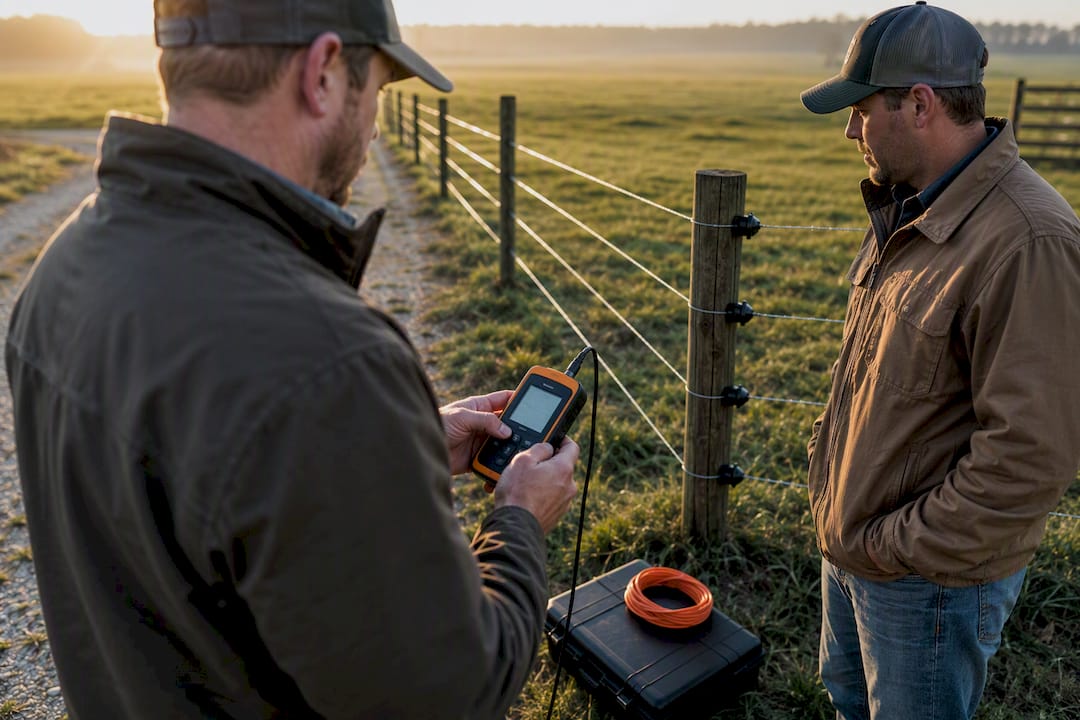
Pro Tip: Carry a digital voltmeter on every service call. Weak voltage almost always traces back to grounding, not the energizer itself.
Grounding is where most underperforming systems actually break down. State job‑sheet specifications call for a grounding gallery totaling around 18 linear feet of rod, using rods at least 6 feet long, spaced apart and wired in series to the energizer’s ground terminal. In dry or sandy soil, expect to add rods in the field even if the initial design met spec on paper. Add surge protection ahead of any mains‑powered energizer, and keep buried crossings at gates separate from overhead runs to avoid induced surge damage during storms, per Montana NRCS power fence job sheet guidance. Fencefast’s grounding technique guide walks through gallery layout in more detail for crews troubleshooting a weak system.
Crew and Site Safety Standards
Every safety standard for farm contracting starts with PPE that fits the actual hazard, not a generic checklist. Gloves, eye protection, and steel‑toe boots are baseline for wire and post‑driver work. Post drivers and chain saws each carry their own manufacturer safe‑operation procedures your crew needs to know cold, not read for the first time on site.
- Restrain both ends of any cut high‑tensile wire, or pin the loose end 3 to 4 inches into the soil, since a released end can whip back with real force.
- Use dedicated high‑tensile cutters rather than standard pliers.
- Stop all work immediately during lightning or approaching storms, consistent with WorkSafeBC’s fence construction safety guidance.
- Post visible warning signage on electrified fences near public access points and gates.
Log every safety check and incident, however minor. That record protects your crew and becomes part of the file you hand the client at closeout.
Operation and Maintenance Schedule
A fence without a maintenance plan is a liability wearing a warranty tag. Build the inspection cadence into the contract, not as an afterthought.
- Routine inspections (monthly or seasonally depending on livestock pressure): check wire tension, ground rod connections, visible wire damage, and gate operation.
- Post‑storm checks: walk the full line after any major weather event looking for wire breaks, downed stays, damaged braces, and vegetation contact.
- Voltage and ground readings: record with a digital voltmeter at each visit and compare against the acceptance threshold set at installation.
- Client handover document: hand over the inspection schedule, target voltage range, and a plain description of common quick fixes.
Offer a maintenance contract with service intervals scaled to fence type. High‑traffic electric perimeter fencing needs more frequent checks than a low‑tension interior cross‑fence. Fencefast’s electric fence setup guide covers the testing steps worth repeating at every scheduled visit.
Project Closeout and Client Deliverables
Closeout is where documentation either protects you or costs you. Hand the client a complete package, not a verbal rundown.
- As‑built plan matched to what was actually installed, not just the original design.
- Energizer model, joule rating, and voltage settings recorded in writing.
- Grounding layout with rod count, spacing, and final voltmeter test readings.
- Photos of brace assemblies, grounding installation, and any special construction (water gaps, wildlife crossings).
- Material receipts, utility‑locate confirmation, and any permits pulled for the job.
- Signed client acceptance form.
Retain a copy of everything for at least as long as the warranty period, and longer if the job was funded through a cost‑share or grant program, since those programs often require records on request.
Legal Compliance and Labor Standards on the Job
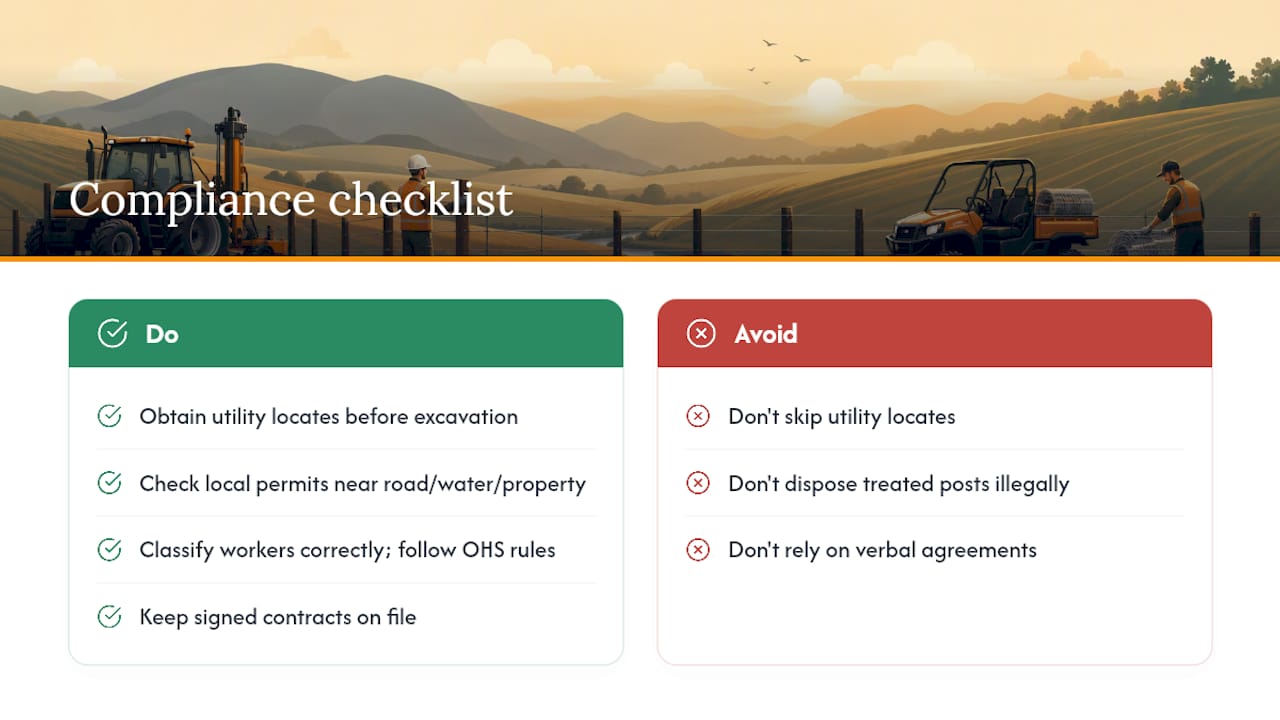
Agricultural contracting regulations vary by province and by the type of work performed, but a few compliance basics apply almost everywhere fencing crews operate. Utility locates before excavation are typically a legal requirement, not a courtesy, and skipping that step can expose a contractor to liability for damaged lines regardless of intent. Permits may apply depending on the fence’s proximity to roadways, waterways, or property lines, so confirming local requirements before quoting a job protects both the contractor and the client.
Labor rules for contractor crews cover standard employment basics: proper classification of workers, adherence to provincial or state occupational health and safety rules, and compliance with equipment operation regulations for machinery like post drivers and augers. Contractor responsibilities in agriculture also extend to correctly disposing of old fencing materials, since some jurisdictions regulate treated‑post disposal and wire recycling.
Keep signed contracts on file that spell out scope, materials, and timeline. A written agreement is your strongest protection if a client disputes work after the fact, and it is the first document most agricultural contracting regulations assume exists when a dispute reaches a formal complaint or claim. Contractors working across provincial or state lines should also confirm whether local licensing or registration applies to fencing or electrical work specifically, since electric fence installation sometimes falls under separate rules from general fencing.
None of this replaces qualified legal advice for your specific jurisdiction, but treating compliance as part of the bid process, not an afterthought, keeps small jobs from becoming expensive problems.
Insurance and Risk Management for Fencing Contractors
General liability coverage is the floor, not the ceiling, for a fencing contractor. A single failed brace or an electric fence installed too close to a public path can turn into a real claim, and standard liability coverage should be sized to the actual risk of the jobs you take on, not a generic minimum.
Equipment coverage matters separately from liability. Post drivers, augers, and specialized high‑tensile tensioning tools represent real capital, and theft or damage on a remote job site is common enough that many contractors carry inland marine or equipment‑specific policies rather than relying on a general commercial policy alone.
Workers’ compensation coverage, where applicable, protects both the crew and the contractor if someone is injured handling high‑tensile wire or operating a post driver. Given how often fencing work involves exactly those hazards, this is not an area to under‑insure to save on premiums.
Risk management on the job itself starts before the contract is signed. Site assessments that flag underground utilities, unstable soil, or proximity to public roads should shape the bid and the schedule, not just the execution. Weather monitoring during electric fence installation matters too. A crew caught mid‑job during a lightning event is both a safety risk and a liability exposure if work continues after conditions turn dangerous.
Review insurance coverage annually as the business scales. A contractor moving from small acreage jobs into larger commercial ranch or virtual‑fencing installations is taking on a different risk profile, and a policy written for the smaller scope may not respond fully to a claim on the larger one.
Client Communication and Contract Terms
Farm management contracting advice consistently comes back to one point: most disputes trace back to unclear scope, not bad workmanship. A contract that spells out exact fence length, material specifications, gate count, and completion timeline in writing removes the ambiguity that turns into a disagreement at closeout.
Set expectations on weather delays before the job starts. Fencing work stops for lightning and often slows significantly in heavy rain or frozen ground, and a client who understands that upfront is far less likely to push back on a revised timeline mid‑job.
Payment terms deserve the same clarity as material specs. Deposit structure, progress payments tied to milestones, and final payment terms should all be in the signed agreement before the first post goes in the ground. Change orders for scope adjustments, whether the client wants an extra gate or a longer run than originally quoted, should be documented in writing with updated pricing, not handled as a verbal add‑on.
Regular updates during longer jobs build trust and reduce the number of surprise phone calls. A quick photo update after grounding installation or brace construction shows the client tangible progress and gives you documented proof of workmanship if a dispute arises later. Closing walkthroughs, where the contractor demonstrates the finished system’s voltage readings and explains the maintenance schedule directly to the client, tend to produce far fewer callback disputes than a job that simply ends with an invoice.
Equipment Selection for Different Fencing Jobs
Matching equipment to the actual job saves both time and money, and it is one of the clearest signs of an experienced contractor versus a crew winging it. Post drivers vary significantly in capacity, and a machine sized for softwood line posts in loose soil will struggle or fail on rocky ground or dense hardwood corner posts.
High‑tensile wire tensioning requires dedicated tools, not improvised alternatives. Standard fence stretchers and pliers cannot safely manage the tension high‑tensile systems require, and using the wrong tool is one of the more common causes of on‑site injury described in state safety guidance.
For virtual fencing and GPS collar installations, equipment needs shift entirely toward base station placement tools, signal testing devices, and the software interface used to define paddock boundaries. This is a different skill set from traditional wire fencing, and contractors expanding into virtual fencing should budget for the learning curve as much as the equipment itself.
Vehicle and trailer capacity matters more than most new contractors expect. Hauling posts, wire spools, and a post driver to a remote site requires equipment rated for the actual load, and undersized transport is a common source of delay on larger jobs. Auger attachments, whether skid‑steer or tractor‑mounted, should match the soil conditions of the region a contractor typically works in, since a single auger setup rarely performs well across sandy, rocky, and clay‑heavy sites alike.
How Fencefast Supports Contractors and Installers
The company has a long-standing partnership with Gallagher, which influences how it works with contractors as well as farmers. Crews handling both traditional wire systems and Gallagher eShepherd virtual fencing need parts and specs that match the standards covered above, and that’s the gap Fencefast fills.
If you’re speccing a job, Fencefast’s how‑to library and design consulting are worth checking before you finalize a bid, particularly for grounding layouts and energizer sizing where getting it wrong is expensive to fix twice.
— Juiced
Where to Get Parts and Design Support for Your Next Job
Fencefast is built for exactly the work covered above: sourcing the right posts, brace hardware, and energizers before a job starts, not scrambling mid‑install. The fence equipment collection covers chargers, insulators, and posts sized to the specs contractors actually need, while the fence tools and fasteners collection rounds out the staples, clips, and hardware most crews reorder every season.

As an authorized Gallagher dealer, Fencefast also supports contractors moving into eShepherd virtual fencing, from base station setup to app‑based herd management, with design consulting available for jobs that need grounding or layout guidance before the first post goes in. If you’re bidding a job this season, start by reviewing the fence equipment catalog and requesting a design consult for anything involving electric or virtual systems.
Sources
- Conservation Practice Standard Fence (Code 382)
- General fence criteria and typical cross‑fencing tables (USDA eFOTG, 2019)

