

Farm biosecurity cuts disease incidence, lowers medicine bills, and protects your ability to sell and move animals when it matters most. A full, science-based program has produced an 8.0% PRRSV incidence risk over three years, against far higher rates in partially protected herds. The rest of this article breaks down where those gains come from and how to capture them on your own operation.
TL;DR:
- Implementing comprehensive biosecurity can reduce disease incidence risk by a significant margin, with studies showing an 8% PRRSV incidence over three years.
- Low-cost measures like boot baths, visitor logs, and dedicated clothing can lead to measurable mortality reductions and is easily scalable for small farms.
- Structural improvements such as perimeter fencing and quarantine pens provide critical barriers, but must be complemented by consistent daily operational routines.
- Building and maintaining a biosecurity plan requires mapping risks, assigning responsibilities, and regularly reviewing protocols with veterinary oversight.
- Fencing and containment tools, including virtual fencing and RFID tracking, are essential components that safeguard against indirect disease routes and support operational discipline.
Table of Contents
- What Farm Biosecurity Benefits Actually Look Like
- The Economic Case for Biosecurity Investment
- How Biosecurity Changes Animal Health Outcomes
- Structural vs. Operational Biosecurity Measures
- Building a Biosecurity Plan You’ll Actually Maintain
- Where Fencing and Containment Fit the Biosecurity Picture
- Start Small, Stay Consistent
- Fencefast’s Role in Your Biosecurity Plan
- Sources
What Farm Biosecurity Benefits Actually Look Like
Most farmers already sense that keeping disease out beats treating it. The research just puts numbers behind the instinct. Biosecurity advantages break into three buckets, and they compound: healthier animals need less medicine, which means lower costs, which means more flexibility to sell, move stock, and expand without a disease event wiping out a season’s margin.
Government and industry guidance groups the concrete wins like this:
- Disease avoidance: fewer new infections entering the herd and slower spread if something does get in, largely thanks to quarantine and movement control
- Productivity gains: lower mortality, better feed conversion, and steadier growth rates across the herd
- Cost reduction: fewer medicine purchases, fewer forced culls, less labor spent nursing sick animals
- Operational freedom: fewer movement restrictions and stronger market access when buyers or processors ask about your health status
That last point gets underrated. A herd with a clean disease history and documented protocols moves through sales, inspections, and insurance renewals with far less friction than one that can’t show a paper trail.
The Economic Case for Biosecurity Investment
Biosecurity is a return on investment, not just a cost center. A multi-country economic review found that farms with stronger biosecurity practices show improved productivity and reduced disease losses, and that targeted subsidies and training measurably raise adoption rates among producers who’d otherwise skip it.
The upfront barrier isn’t usually money. It’s time and know-how. Research on adoption patterns found that labor and information gaps hold farmers back more than the cost of fencing or footbaths themselves. That’s a fixable problem with the right checklist.
Two examples make the math concrete:
- A herd that avoids one significant disease outbreak can skip weeks of antibiotic treatment across dozens of animals, plus the labor hours spent administering it.
- Preventing even a handful of forced culls from a preventable outbreak often outweighs the entire annual cost of upgraded perimeter fencing and dedicated boots and clothing.
Risk-based insurance products increasingly reward documented biosecurity plans with lower premiums, which shifts the math further in favor of acting early rather than after an outbreak.
How Biosecurity Changes Animal Health Outcomes
The clearest evidence comes from swine biosecurity trials. Herds running a comprehensive, science-based program sustained an 8.0% PRRSV incidence risk over three years, while partial programs, missing even one or two protocol steps, saw notably higher disease breakthrough. Gaps in a program don’t just weaken it proportionally; they create entry points disease exploits fully.
Lower disease incidence has a direct knock-on effect: less need for antimicrobials. A global review on farm biosecurity and antimicrobial use found that better containment and hygiene practices reduce how often antibiotics are needed in the first place, which matters beyond your own farm gate. The World Health Organization lists antimicrobial resistance among its top global health threats, and reduced agricultural antibiotic use is part of that broader stewardship effort.
Healthier stock also means fewer welfare issues tied to chronic illness. Animals that aren’t fighting recurring infections put more energy into growth, reproduction, and general condition. That’s the productivity side of the same coin.
Structural vs. Operational Biosecurity Measures
Biosecurity splits into two categories, and mixing them up is where a lot of farms lose ground. Structural measures are the physical infrastructure: perimeter fencing, pen separation, dedicated loading zones, controlled entry points. Operational measures are the daily habits: boot baths, dedicated clothing per zone, cleaning trailers between loads, and working through the farm in a set order, healthiest animals first, sick or new arrivals last.
Extension guidance is blunt about this: fencing without discipline in daily routines won’t stop disease. The infrastructure creates the opportunity; the habits deliver the result.
A practical rollout looks like this:
- Immediate, low-cost wins: boot baths at entry points, dedicated coveralls for sick pens, a visitor log, hand-washing stations.
- Moderate investments: vehicle cleaning stations, defined traffic patterns for feed and manure handling, signage marking clean versus dirty zones.
- Structural projects: upgraded perimeter fencing, isolated quarantine pens, separate loading chutes for outgoing versus incoming stock.
Smallholder studies back up starting cheap: simple interventions like boot baths and dedicated clothing paired with hands-on training produced measurable mortality drops without major capital spend.
Pro Tip: Work your farm in the same order every single day, healthiest and youngest animals first, sick or newly arrived animals last. It costs nothing and it’s one of the most effective habits you can build.
Building a Biosecurity Plan You’ll Actually Maintain
A plan that lives in a binder nobody opens isn’t a plan. Start with a risk assessment, then build routines around what you find.
- Map your risk points. Walk the farm and note every place animals, vehicles, or visitors cross a boundary: gates, loading areas, feed delivery, shared equipment.
- Write or update quarantine protocols. Set a minimum hold period for new or returning animals, and keep a movement log so you can trace exposure if something goes wrong.
- Assign ownership. One person checks boot baths are stocked, one person logs visitors, one person tracks vaccination and treatment records. Split it up or it won’t happen.
- Set a review cadence. Revisit the plan quarterly with your veterinarian, not just after something breaks.
Tying this to an integrated livestock management approach helps these steps stick instead of drifting once calving or harvest season gets busy.
Where Fencing and Containment Fit the Biosecurity Picture
Most disease doesn’t walk straight through your gate. It rides in on a delivery truck, a neighbor’s stray dog, or a wandering deer that shares a fence line with your herd for ten minutes. Solid perimeter control cuts off exactly those indirect routes, vehicle traffic, wildlife contact, nose-to-nose exposure at boundary fences, before they become a problem.
That’s the practical link between fencing and farm health management. A few ways this shows up on real operations:
- Perimeter fencing that keeps wildlife and neighboring herds from direct contact along shared boundaries
- Dedicated loading and unloading zones that separate incoming stock from the general herd
- Virtual fencing and GPS collar systems that let you isolate a paddock or quarantine zone without building new physical infrastructure
- RFID and traceability tools that make movement records faster to keep and easier to trust
None of that replaces good daily habits. It just makes the structural half of the job easier to get right the first time. For more on the health side of containment design, see this guide to fencing and animal health.
Start Small, Stay Consistent
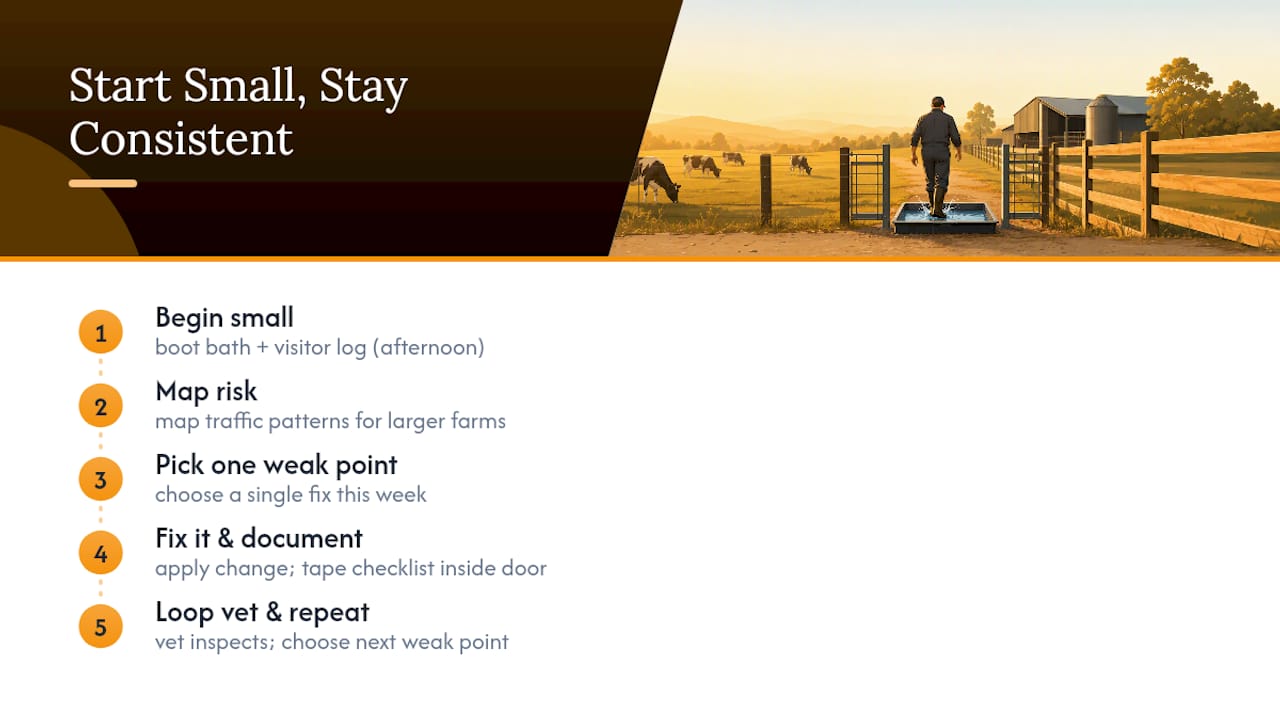
If you run a small operation, the fastest win is a boot bath and a visitor log, both cost almost nothing and take an afternoon to set up. Larger operations get more mileage from mapping traffic patterns first, since that’s where most exposure happens at scale.
Either way, treat biosecurity as something you tune, not something you finish. Pick one weak point this week, fix it, and loop in your veterinarian on what to check next. A simple checklist taped inside the barn door does more for consistency than any elaborate plan nobody rereads.
— Juiced
Fencefast’s Role in Your Biosecurity Plan
Fencefast is the practical route to the structural half of your biosecurity plan, without the guesswork of piecing together fencing, gates, and monitoring gear from scattered suppliers. As an authorized Gallagher dealer for over 26 years, Fencefast builds containment systems for farms that need to control movement, not just mark boundaries.
Whether you’re closing a gap in perimeter fencing, setting up a quarantine pen, or exploring Gallagher eShepherd virtual fencing to isolate paddocks without new posts and wire, Fencefast’s design consulting team can map the right combination for your layout. Browse fence equipment for structural upgrades, or check fence tools and fasteners if you’re maintaining what you already have. Fencefast also guides producers through OFCAF and BMP grant programs for virtual fencing adoption, which can offset a meaningful chunk of setup cost. Reach out through Fencefast’s site to start a consultation on your specific containment needs.
Sources
- Agriculture (MDPI) — Economic perspectives on farm biosecurity
- Can improved farm biosecurity reduce the need for antimicrobials? — PMC

