

TL;DR:
- Proper cattle containment requires selecting the right fencing type based on land, cattle size, and grazing needs. Combining durable physical fences with virtual or electric options enhances security, flexibility, and grazing management. Consistent maintenance, farmer training, and strategic planning are essential to prevent escape and ensure long-term herd safety.
Cattle escaping their designated areas is one of the most expensive and dangerous problems a livestock manager can face. Knowing how to contain cattle effectively protects your herd, neighboring land, and your operation’s bottom line. Whether you’re dealing with a persistent fence-pusher, planning a new pasture rotation, or exploring GPS-based collar systems, the right containment strategy depends on your land, your cattle class, and how you plan to manage grazing long-term. This guide covers both traditional physical fencing and modern virtual fencing approaches so you can build a system that actually holds.
Table of Contents
- Key takeaways
- How to contain cattle: tools and materials you need first
- Installing physical fences for cattle containment
- Managing virtual fencing for flexible containment
- Troubleshooting common containment problems
- My take on where cattle containment is heading
- Get the right containment setup with Fencefast
- FAQ
Key takeaways
| Point | Details |
|---|---|
| Match fence to cattle class | No single fence works for every situation; select materials based on animal size, temperament, and terrain. |
| High-tensile wire cuts long-term costs | High-tensile wire holds tension longer and requires fewer posts than barbed wire, reducing maintenance expenses. |
| Virtual fencing enables flexible grazing | GPS collar systems let you adjust pasture boundaries remotely without reinstalling physical fence lines. |
| Train cattle before relying on electric | Animals that respect the hot wire require fewer strands, making your electric fence setup far more efficient. |
| Combine systems for best results | Using physical perimeter fences alongside virtual interior boundaries gives you security and rotational flexibility. |
How to contain cattle: tools and materials you need first
Before you drive a single post, you need to know what you’re working with. The materials you choose will determine how long your fence lasts, how much labor it demands, and whether your cattle stay put under pressure.
Fencing material options
The three most common physical fencing materials for cattle are barbed wire, high-tensile smooth wire, and electric fencing. Each has a place depending on your operation.
- Barbed wire is the traditional choice for permanent perimeter fencing. It’s relatively inexpensive per foot and widely available, but it requires more posts and more maintenance over time.
- High-tensile smooth wire holds tension longer and is engineered for strength, which means fewer posts and lower long-term costs compared to barbed wire. It’s increasingly the go-to for cattle operations that want a permanent, low-maintenance solution.
- Electric fencing shines for interior divisions and rotational grazing. Portable electric systems let you divide pastures quickly without permanent cross-fencing, making them especially practical for strip grazing and forage management.
- Virtual fencing uses GPS-enabled neckbands and a software platform to define boundaries without any wire at all. We cover this in depth below.
Tools for installation and maintenance
You’ll need a post driver or tractor-mounted auger for setting posts, a wire stretcher for achieving proper tension, fencing pliers, staples or clips appropriate for your wire type, and a voltage tester if you’re running electric. For virtual systems, the setup centers on the neckband hardware, a base station, and access to the management app.
| Tool or material | Best use | Key consideration |
|---|---|---|
| Barbed wire | Permanent perimeter | High maintenance; risk of injury to cattle |
| High-tensile wire | Permanent perimeter/cross fencing | Lower post count; requires proper tensioning |
| Portable electric | Rotational grazing | Easy to move; requires energizer power source |
| GPS neckbands | Virtual boundary management | Requires cellular or radio coverage |
| Post driver | All physical fencing | Match tool to post size and soil type |
Pro Tip: Before purchasing wire, walk your fence line and note any low areas, rocky ground, or creek crossings. These spots will dictate your post depth, spacing, and whether you need extra bracing.
Installing physical fences for cattle containment
Physical fencing is still the backbone of cattle containment for most operations, and doing it right from the start saves you significant repair time and cost later.
Step 1: Assess and plan your fence line
Walk the entire perimeter and mark obstacles such as wet areas, slopes, and tree lines. Identify where corner posts will go, since these carry the most load and need the most attention. Draw a rough map and calculate your total linear footage before ordering materials.
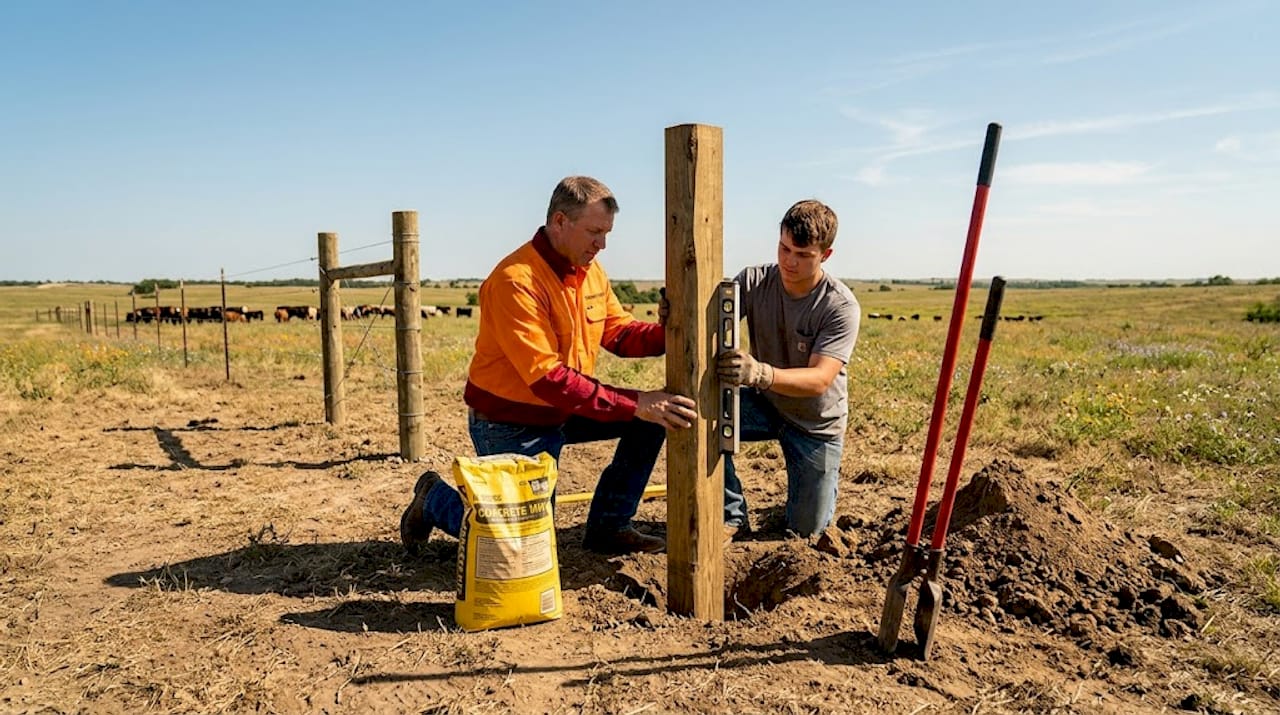
Step 2: Set corner and brace posts first
Corners are where fences fail. Corner posts must be anchored with concrete or driven deeply enough to withstand the lateral pressure cattle create. A standard H-brace uses two posts connected by a horizontal rail and a diagonal wire to distribute tension. For any run longer than 600 feet, install a line brace in the middle to prevent sag.
Step 3: Set line posts at appropriate spacing
For barbed wire and high-tensile wire, line posts are typically spaced 15 to 20 feet apart on flat ground. On hillsides or curves, reduce spacing to 10 to 12 feet to maintain even tension and prevent the fence from pulling away from the terrain. In rocky ground where driving posts is difficult, use rock anchors or surface-mount post brackets rather than compromising on depth.
Step 4: Attach and tension your wire
Run your wire from one corner to the other before stapling or clipping. Using a wire stretcher, bring each strand to the proper tension before fastening. Barbed wire typically runs at around 150 to 200 pounds of tension. High-tensile wire often requires 200 to 250 pounds. Overtensioning causes brittleness and breakage. Undertensioning causes sag that cattle will eventually push through.
Step 5: Check for gaps and finish
Properly leveling ground beneath corral panels and securely anchoring posts prevents escape routes caused by gaps or pressure damage. Walk the finished fence line at ground level, looking for dips where small cattle could push under. Backfill low spots and add ground-level wire where needed.
Pro Tip: On uneven terrain, use “riding” posts (posts that follow the ground contour) between your main line posts to keep the bottom wire tight to the ground. This single step prevents more escapes than any other technique on rough pasture.
| Fence type | Posts per 100 ft | Avg. wire strands | Relative durability |
|---|---|---|---|
| Barbed wire | 6 to 8 | 4 | Moderate |
| High-tensile smooth | 4 to 5 | 5 | High |
| Electric (portable) | 3 to 4 | 1 to 2 | Low to moderate |
Knowing how to fence cattle pasture effectively starts with choosing the right material for the section, not just the operation as a whole. Perimeter lines often warrant high-tensile wire while interior rotational divisions work perfectly with portable electric.
Managing virtual fencing for flexible containment
Virtual fencing represents a genuine shift in how cattle managers think about grazing control. Instead of moving wire, you move a boundary on a screen.
How virtual fencing systems work
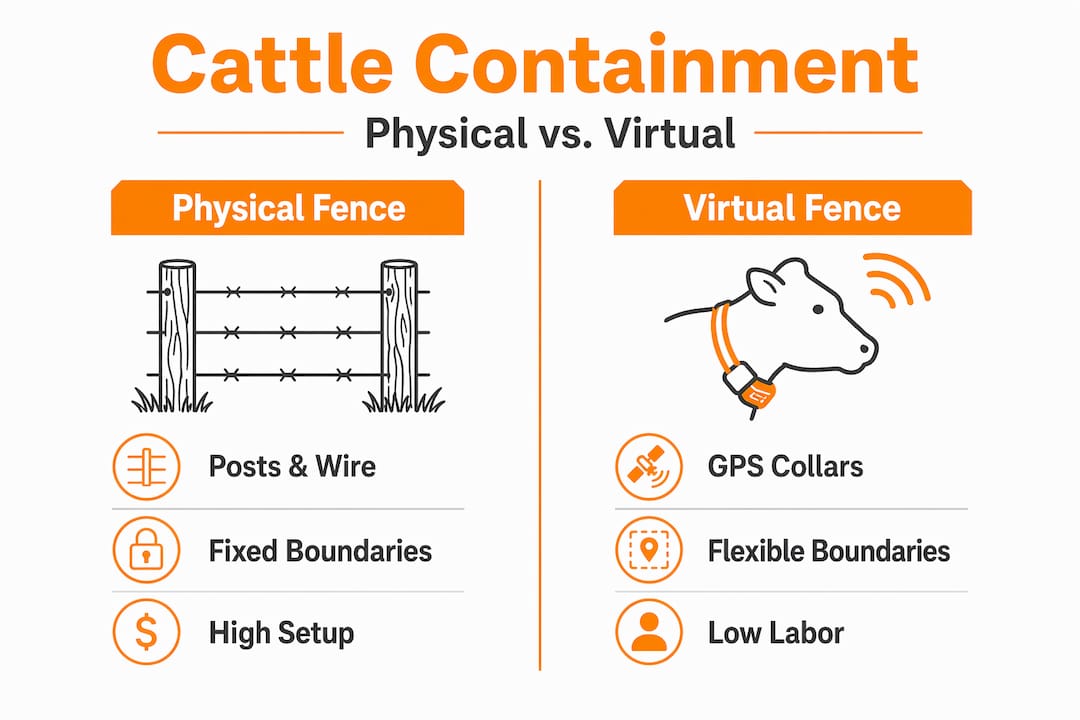
Each animal wears a GPS-enabled neckband that communicates with a base station on your property. When a cow approaches the virtual boundary you’ve set in the app, she receives an auditory warning. If she continues forward, a brief electrical pulse discourages crossing. Cattle learn the system quickly, typically within a few days of wearing the collar.
The key advantages for cattle containment and grazing management include:
- Remote boundary adjustment without any physical labor
- Ability to create rotational grazing strips precisely sized for forage availability
- Real-time GPS tracking of each animal’s location
- Data logging that improves future grazing planning
Virtual fencing improves grazing management by allowing remote boundary adjustment and better forage utilization. Grazing plans can adapt easily without physical reinstallation of fences. That flexibility is especially valuable during drought or when forage growth is uneven across a large property.
Important limitations to know before committing
Virtual fencing is not a universal replacement for physical fencing. GPS collar systems are not recommended for calves under 500 pounds due to fit issues. If your operation includes cows with young calves, you’ll need physical fencing to keep calves contained since they won’t be wearing collars.
Coverage is another real consideration. Hilly or wooded areas can limit communication between collars and base stations, reducing the system’s reliability. Before investing in virtual fencing infrastructure, confirm that your terrain and cellular or radio coverage support consistent collar communication.
Pro Tip: Check collar fit every two to three weeks on growing heifers and young cattle. Frequent collar adjustment is necessary for growing animals to maintain effectiveness throughout the grazing season.
Physical fencing remains essential in many operations, but integrating virtual fencing can reduce labor and fence material costs significantly. The strongest operations use a physical perimeter fence with virtual interior boundaries, giving them the security of wire where it matters most and the flexibility of GPS control everywhere else. For a deeper look at how these two systems compare, the Fencefast guide on virtual fencing for cattle is worth reading before you buy.
Troubleshooting common containment problems
Even a well-built fence fails if cattle are motivated enough, untrained, or if maintenance slips. Here’s where most operations run into trouble and how to fix it.
Training cattle to respect electric fencing
This step is skipped more often than any other, and it causes more fence failures than poor installation. Cattle trained to respect electric fences learn to avoid the hot wire quickly, meaning even a single strand can be effective containment. To train your herd, run a temporary training strand inside a secure physical fence and let cattle make contact at low risk. Once they respect the wire, you can rely on the psychological barrier more than the physical one.
For detailed strategies on adapting electric fencing to different cattle behaviors and terrain types, the Fencefast guide on electric fencing for cattle covers the specifics.
Common containment failures and fixes
- Sagging wire: Recheck tension after the first full season. Wire stretches under temperature changes. Retighten before winter and again in spring.
- Gaps at ground level: Particularly common along creek beds and low spots. Add a strand of barbed wire close to the ground or use hog panels in problem areas.
- Fence-pushing cattle: Usually a sign of overcrowding or inadequate forage. Address the grazing pressure first; then reinforce the fence with an offset hot wire strand.
- Damaged corner posts: Inspect brace posts and diagonal wires quarterly. A corner that starts to lean will fail quickly under load.
Seasonal maintenance checklist
Before spring turnout, walk every foot of your perimeter fence. Check voltage on all electric strands, test all gate latches, and mark any posts that have shifted over winter. A two-hour walkthrough prevents a two-day cattle roundup.
Pro Tip: Set a calendar reminder every 90 days for a fence voltage test. Vegetation grounding out a hot wire is the most common reason electric fences stop working, and it’s often invisible from a distance.
No single fence setup fits every operation. Success depends on matching your fence type to your livestock class, land type, and the pressure your cattle put on the fence. Effective cattle management techniques always account for the animal’s behavior, not just the hardware.
My take on where cattle containment is heading
I’ve spent enough time around cattle operations to know that most fence failures aren’t a product problem. They’re a planning problem. Managers choose a fence type because that’s what their neighbor runs, or what was already on the property, rather than because it fits their specific cattle class and grazing system.
The most effective approach I’ve seen is layered: a solid high-tensile perimeter to handle the serious pressure, combined with portable electric or virtual interior divisions for rotational flexibility. That combination enables data-driven grazing decisions and repurposes labor time that used to go toward moving temporary wire.
Virtual fencing gets dismissed as too expensive by a lot of ranchers. I understand the hesitation. The upfront cost is real. But when you calculate the labor hours saved on cross-fencing alone over three to five years, the math often flips. And the grazing precision you gain is something physical wire simply cannot give you.
My advice: don’t wait for your current system to fail completely before evaluating alternatives. Walk your fence line today with fresh eyes. Ask whether the system you have is actually supporting your grazing goals or just barely keeping cattle in. That honest assessment is where every smart upgrade starts.
— Juiced
Get the right containment setup with Fencefast
Whether you’re building a perimeter from scratch or adding virtual boundaries to an existing operation, Fencefast has the products and expertise to support your plan.

Fencefast carries a full range of fencing components including high-tensile wire, staples, energizers, solar power supplies, and gate hardware for physical fencing projects of any scale. For operations ready to explore GPS-based containment, Fencefast is an authorized Gallagher dealer offering eShepherd virtual fencing neckbands, base stations, and app-based herd management tools. The team also provides design consulting, virtual fencing setup guidance, and information on Canadian government grant programs that can offset your investment. Explore the full product selection and get started at Fencefast.
FAQ
What is the most effective way to contain cattle?
The most effective cattle containment combines a solid physical perimeter fence with electric or virtual interior divisions. This gives you security on the boundary and flexibility for rotational grazing inside.
How many strands of wire do I need to fence cattle?
Most cattle operations use four to five strands of barbed or high-tensile wire. If cattle are trained to respect electric fencing, even a single hot strand can serve as an effective interior division.
Can virtual fencing fully replace physical fencing?
Not entirely. Virtual fencing is not suitable for calves under 500 pounds, and its effectiveness depends on terrain and cellular coverage. It works best as an interior management tool alongside a physical perimeter fence.
How far apart should fence posts be for cattle?
On flat ground, space line posts 15 to 20 feet apart for barbed or high-tensile wire. Reduce spacing to 10 to 12 feet on slopes or curves to maintain consistent tension and prevent sag.
How do I stop cattle from pushing through a fence?
Address forage availability first since most fence-pushing is driven by hunger or overcrowding. Then add an offset electric strand on the inside of the fence to create a psychological barrier that stops cattle before they make contact with the physical wire.
Recommended
- How eShepherd Virtual Fencing Streamlines Cattle Management – FenceFast Ltd.
- Virtual Fencing for BC Ranches: Boost Grazing, Cut Costs – FenceFast Ltd.
- Best practices for rural fencing: Secure your livestock and land – FenceFast Ltd.
- What is virtual fencing for cattle? Herd control explained – FenceFast Ltd.

