

TL;DR:
- Virtual fencing uses GPS collars to define and manage herd boundaries digitally.
- It offers labor savings, improved grazing control, and can reduce fencing costs.
- Successful implementation requires careful site assessment, animal training, and understanding terrain and connectivity.
Many Canadian cattle producers still believe that a visible, physical fence is the only reliable way to control a herd. That assumption is being challenged fast. Virtual fencing for cattle uses GPS-enabled collars to define invisible boundaries, guide animal movement, and replace wire and posts with software and signals. This article breaks down exactly how the technology works, what it means for Canadian operations, and how to decide whether it fits your land, herd, and management goals.
Table of Contents
- How virtual fencing technology works
- Key benefits for Canadian cattle producers
- Comparing GPS-based and radio-based virtual fencing
- Considerations before implementing virtual fencing
- Our perspective: The future of cattle management is invisible
- Explore innovative fencing solutions for your herd
- Frequently asked questions
Key Takeaways
| Point | Details |
|---|---|
| Invisible barrier control | Virtual fencing uses GPS or radio to control cattle herds without physical fences. |
| Flexible for Canadian terrain | This technology adapts well to diverse, rugged environments but requires evaluating signal coverage first. |
| Significant labor savings | Producers save considerable time and effort compared to installing and maintaining traditional fences. |
| System selection matters | Choosing the right system—GPS-based or radio-based—depends on your pasture’s landscape and grazing goals. |
How virtual fencing technology works
At its core, virtual fencing replaces a physical barrier with a digital one. Each animal wears a GPS-enabled collar that tracks its location and communicates with a central system. When a cow approaches a programmed boundary, the collar first plays an audio cue. If the animal keeps moving toward the boundary, it receives a mild electrical impulse. Most cattle learn quickly to turn back at the sound alone, which means the impulse becomes rare after the initial training period.
The collars rely on different network types depending on the system. Here is a quick breakdown:
- GPS and cellular networks: Used by systems like Nofence. Collars connect to cellular towers, so coverage depends on your carrier’s signal in the area.
- GPS and LAN (local area network): Some systems use a base station on the property to relay data, reducing dependence on cellular infrastructure.
- Radio-based networks: These use radio frequency signals from fixed base stations, which can cover large areas without relying on cellular coverage.
Location accuracy typically ranges from 10 to 35 feet depending on hardware quality and network type. That level of precision is enough for most rotational grazing scenarios, though it does mean boundaries need to account for that margin when set near sensitive areas like water sources or crops.
The most common systems available to Canadian producers include Nofence, Gallagher eShepherd, and Vence. Each uses a slightly different combination of hardware and software, but all share the same foundational logic: define a boundary in an app, deploy collared animals, and monitor from your phone or computer.
| Feature | Nofence | Gallagher eShepherd | Vence |
|---|---|---|---|
| Network type | Cellular | LAN/base station | Cellular |
| Collar power | Solar | Solar | Solar |
| App control | Yes | Yes | Yes |
| Best for | Rotational grazing | Large herds | Mixed terrain |
For producers curious about virtual fencing myths that might be holding them back, it is worth separating fact from fiction before making any decisions. Understanding fencing basics for Canadian farms also provides useful context for how virtual systems compare to traditional setups.
Pro Tip: Dense tree cover and hilly terrain can interfere with GPS signal. Before committing to a cellular-based system, test your coverage across the full grazing area, not just near the yard.
For a broader look at what to evaluate before purchasing, the virtual fencing considerations resource from the Grazing Lands Alliance covers practical factors worth reviewing.
Key benefits for Canadian cattle producers
Once you understand how the technology works, the advantages for Canadian operations become very clear. The benefits go well beyond novelty.
Labor savings are the most immediate win. Moving cattle to a new paddock no longer requires riding out, setting temporary posts, or stringing wire. A producer can redraw a boundary in an app and the herd responds. That kind of flexibility is especially valuable during busy seasons like calving or haying.
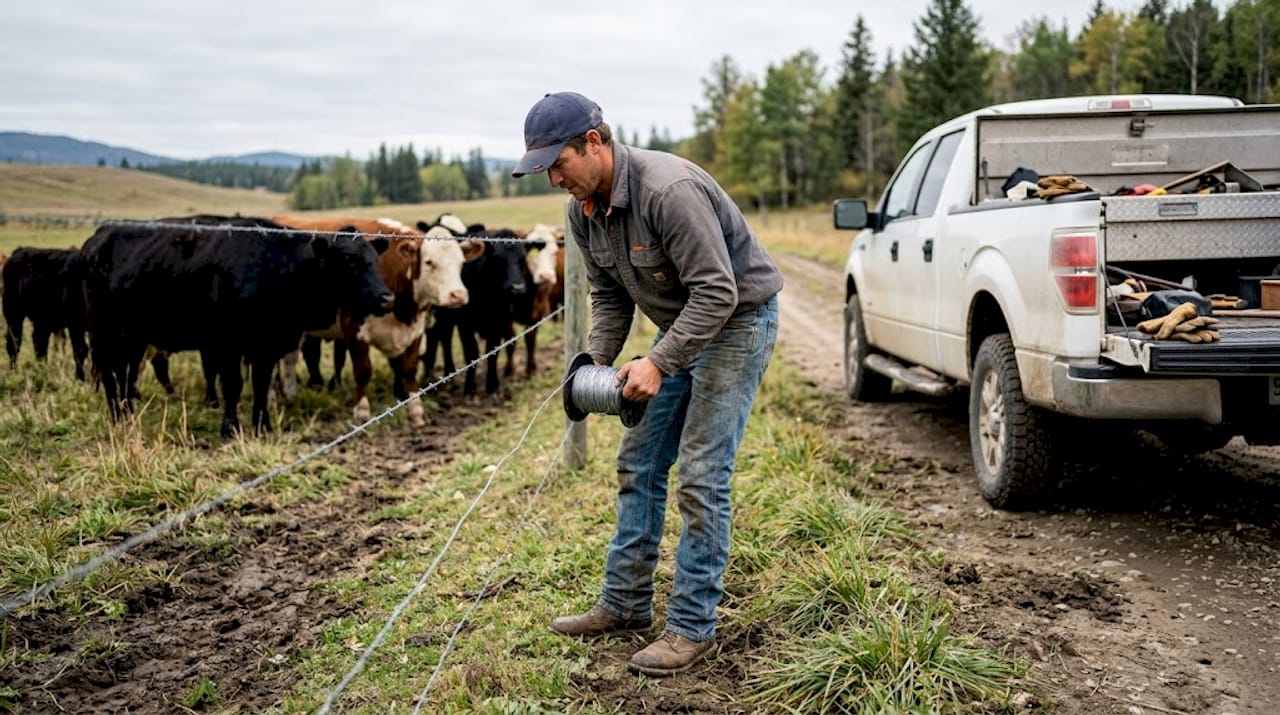
Grazing management improves significantly. Virtual fencing makes intensive rotational grazing far easier to manage. You can shift paddocks daily without any physical work, which allows pastures to rest and recover on a tighter schedule. This leads to better forage utilization and healthier soil over time.
Research backs this up in Canadian conditions. Nofence performed effectively in Alberta, supporting rotational grazing and herd control even through cold climate challenges. That is a meaningful data point for producers in the Prairies or northern regions who might wonder whether the technology holds up in harsh winters.
Key advantages worth noting:
- Reduced physical fencing costs over time, especially across large or irregular parcels
- Real-time herd location monitoring from any device
- Flexible boundary adjustments for bale grazing and swath grazing scenarios
- Easier management of multiple paddocks without additional labor
- Potential access to government grants like OFCAF and BMP programs for adoption costs
Statistic callout: Producers using virtual fencing report significant reductions in time spent moving and checking cattle, with some operations cutting fencing-related labor by more than half during the grazing season.
For producers already using portable livestock fencing, virtual fencing can work alongside or eventually replace temporary setups. If you are newer to managed grazing, reviewing essential fencing solutions first will help you understand where virtual tools fit in the broader picture.
Pro Tip: Before investing, map your cellular coverage across every corner of your grazing land. Gaps in coverage can create blind spots that undermine the system’s reliability.
Comparing GPS-based and radio-based virtual fencing
Not all virtual fencing systems are built the same way, and the differences matter when you are choosing one for a specific Canadian landscape.
GPS-based systems connect collars to satellites and cellular or LAN networks. They offer flexible boundary drawing and work well across large, varied landscapes. However, GPS-based systems can struggle in areas with heavy canopy or hilly terrain, while radio-based systems perform well in open, flat terrain where signal transmission is unobstructed.
| Factor | GPS-based | Radio-based |
|---|---|---|
| Boundary flexibility | High | Moderate |
| Accuracy | 10-35 feet | Variable by setup |
| Terrain performance | Struggles with hills/canopy | Strong on flat, open land |
| Infrastructure needed | Cellular or LAN | Fixed base stations |
| Typical cost | Higher upfront | Lower per unit |
| Best Canadian fit | Mixed or rugged terrain | Prairie and open range |
To choose the right system, work through these three steps:
- Map your terrain and connectivity. Identify areas with poor cellular signal, heavy tree cover, or significant elevation changes. This determines whether GPS-cellular or a base-station approach makes more sense.
- Assess your herd size and movement patterns. Larger herds spread across wide areas may benefit more from GPS flexibility, while smaller operations on open land can do well with radio-based options.
- Calculate total cost of ownership. Factor in collar costs, subscription fees, base station hardware, and potential grant offsets. The NRCS virtual fence facts sheet provides a useful framework for cost comparisons.
“The right system is the one that fits your land first and your management style second. No single platform wins everywhere, and Canadian geography demands honest self-assessment before purchase.”
Producers managing sheep alongside cattle may also want to look at fencing solutions for sheep to understand how multi-species operations can be managed. And if you are still relying on temporary fencing for grazing, understanding how virtual tools compare will help you plan a transition.
Considerations before implementing virtual fencing
Success with virtual fencing depends heavily on preparation. Producers who skip the planning phase often run into avoidable problems during the first season.
Start with a site and system fit checklist:
- Cellular or radio coverage: Test signal strength across the full grazing area, not just near buildings.
- Topography: Identify hills, valleys, or dense bush that could interfere with GPS accuracy.
- Herd behavior: Cattle that are flighty or unaccustomed to handling may need a longer training period.
- Integration with existing practices: Consider how virtual boundaries will work alongside any remaining physical infrastructure.
Producers should assess cellular coverage, terrain, and integration with local management practices before committing to a system. Skipping this step is the most common reason early adopters run into trouble.
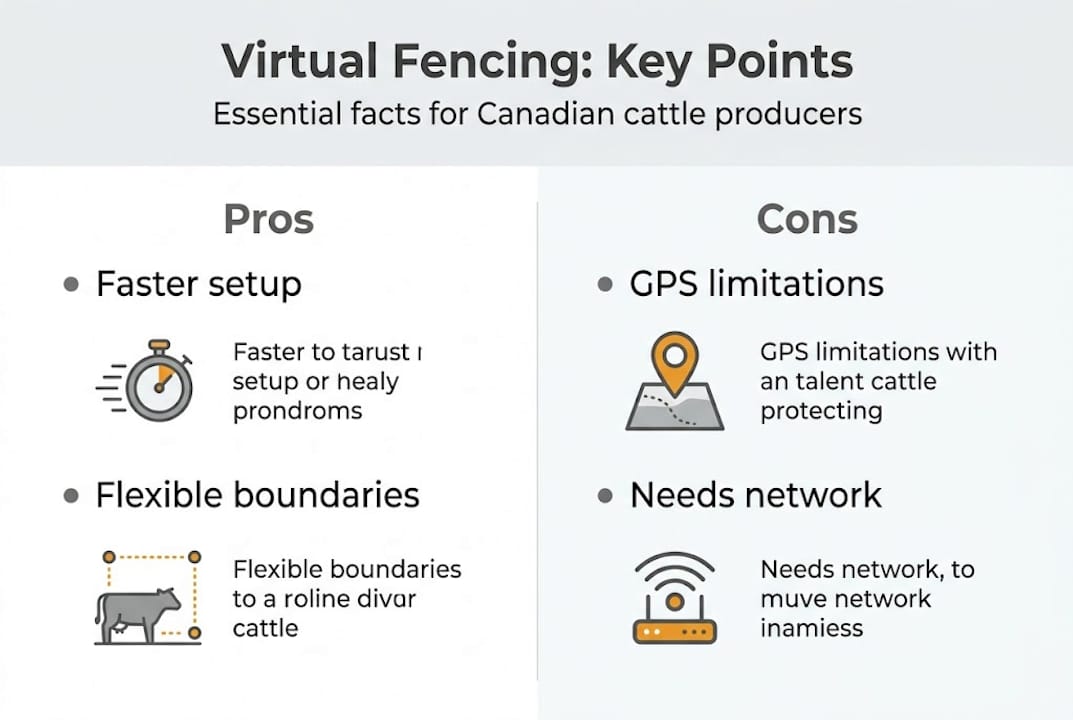
Animal training is a critical phase. Most systems recommend a stepwise acclimation process where cattle are introduced to the collar cues in a small, familiar area before being moved to open pasture. This typically takes one to two weeks and dramatically reduces the chance of animals breaking through virtual boundaries out of confusion or panic.
Signal dropouts are another real risk. If a collar loses connectivity, it may default to a safe mode that holds the last known boundary or shuts off the impulse entirely. Knowing how your chosen system handles dropouts before deployment protects both your animals and your operation.
“Think of the first season as a learning year. The data you collect on animal behavior and system performance will make every subsequent season more efficient.”
Ongoing monitoring is not optional. Virtual fencing requires regular app check-ins, collar battery or solar panel inspections, and occasional firmware updates. It is less physical labor than traditional fencing, but it is not zero effort. Reviewing the virtual fencing myths guide can help set realistic expectations, and smart fencing ideas offers practical ways to blend virtual and physical systems during the transition.
Our perspective: The future of cattle management is invisible
Here is something the traditional fencing industry does not say out loud: physical barriers are as much a habit as they are a necessity. Generations of producers built operations around wire and posts because that was the only option. Virtual fencing does not just remove the wire. It removes the assumption that cattle management has to be labor-intensive and geographically rigid.
The producers who will thrive over the next decade are the ones who pilot this technology now, while adoption is still low and learning curves are still manageable. Waiting for the technology to become mainstream means missing the competitive window. Those who adopt early gain real operational data, develop grazing strategies that others are still theorizing about, and position themselves for grant funding that may not be available forever.
Relying only on physical barriers also limits what you can do with your land. Modern livestock control tools allow you to manage pasture recovery, reduce overgrazing, and respond to weather or forage conditions in real time. That flexibility is not a luxury. In a changing climate with unpredictable growing seasons, it is becoming a necessity.
Explore innovative fencing solutions for your herd
If this technology has you thinking differently about how you manage your cattle, the next step is finding the right products and guidance for your specific operation.
At FenceFast, we carry a full range of fencing solutions from traditional to cutting-edge virtual systems. Whether you are looking for a reliable Gallagher Live Lite setup or need a quality Hayes crimping tool for your physical fence infrastructure, we have you covered. Our team can help you evaluate your terrain, choose the right system, and connect you with available grant programs. Browse our full lineup of fencing solutions and get in touch with a specialist who understands Canadian cattle operations.
Frequently asked questions
Is virtual fencing safe and humane for cattle?
Yes. Most systems guide cattle with audio and low-level impulses rather than harsh physical barriers, and a structured training phase helps animals adapt quickly with minimal stress.
Can virtual fencing work in cold or remote parts of Canada?
Research shows that Nofence succeeded in Alberta conditions, supporting cattle in cold climates, provided terrain and connectivity are properly evaluated before deployment.
How accurate are virtual fencing systems?
Most collars offer 10-35 feet of location precision, which is sufficient for rotational grazing but requires boundary placement to account for that margin near sensitive areas.
What does setup involve for a Canadian cattle operation?
Site assessment and animal training are the two most important steps, and most systems can be installed with basic technical support from the provider or an authorized dealer.

