

TL;DR:
- Choosing fencing for forested land in Canada requires materials that withstand harsh weather, wildlife threats, and uneven terrain to last decades. Natural rot-resistant species like Western Red Cedar and Black Locust offer high durability with minimal maintenance, while fixed knot wire fences provide long-span strength for rugged boundaries. Prioritizing ecological impact and future costs ensures sustainable, low-maintenance fencing solutions tailored to specific terrain and wildlife pressures.
Choosing fencing for forested or semi-forested land in Canada is nothing like picking a fence for a flat pasture. You are dealing with uneven terrain, frost heave, relentless moisture, and a rotating cast of wildlife threats from deer and elk to bears and coyotes. The right forestry fencing solutions list looks different for a cattle rancher in the British Columbia Interior than it does for a grain farmer in Northern Ontario managing crop edges. This guide cuts through the noise and gives you a practical, terrain-honest breakdown of the best fencing solutions for forests so you can make a decision that holds up for decades, not just seasons.
Table of Contents
- Key criteria for effective forestry fencing in Canada
- Top forestry fencing solutions: materials and constructions
- Comparison of forestry fencing solutions for durability and cost
- How to choose the right forestry fencing solution for your Canadian farm or ranch
- Rethinking forestry fencing choices: Insights from Canadian farm experience
- Find your ideal forestry fencing solution at FenceFast Ltd.
- Frequently asked questions
Key criteria for effective forestry fencing in Canada
Before you commit to any material or design, you need a clear checklist of what your fence actually has to survive. Canadian conditions are unforgiving, and fencing that performs well in Tennessee will fail fast in Alberta.
Here are the core criteria to evaluate before selecting any forest fencing option:
- Weather and freeze-thaw tolerance: Posts must resist frost heave and remain structurally sound after repeated freeze-thaw cycles. This alone eliminates a number of softwood species from serious consideration in the Prairies and Northern regions.
- Wildlife impact resistance: Your fence needs to handle pressure from deer, elk, moose, and in some areas, bears. This means tensile strength matters as much as post durability.
- Terrain compatibility: Rocky, rooted, or sloped ground affects post-setting depth and spacing. Fencing on a forested hillside requires different engineering than straight-line pasture work.
- Maintenance load: What can you realistically inspect and repair every season? Remote fence lines reward low-maintenance materials. Understanding fence post materials for Canadian farms helps you make this call with real numbers.
- Regulatory alignment: Federal and provincial guidelines govern certain agricultural and riparian fencing. Fencing near waterways or within conservation zones may require specific materials or setups.
- Long-term cost: Initial price is rarely the real cost. Factor in treatment frequency, post replacement rates, and labor for repairs over a 15 to 25-year window.
When you are choosing fence posts for farms, these criteria determine whether you are building a fence or just a temporary obstacle.
Having outlined the main selection criteria, let’s explore specific forestry fencing solutions that meet these needs.
Top forestry fencing solutions: materials and constructions
This is where most guides stop at “wood or wire” and call it done. The reality is that the species and construction method you choose within each category makes an enormous difference in performance and lifespan.
Western Red Cedar is the go-to for Pacific Northwest and Mountain West operations. It is naturally resistant to moisture and insects, and it handles the wet coastal climate without the chemical dependency that other softwoods require. Cedar splits cleanly for post shaping and stays stable in soils with high organic content, which is exactly what forested properties tend to have.
Pressure-treated Southern Yellow Pine comes in cheaper upfront and is widely available across Canada through agricultural suppliers. The pressure treatment process forces preservatives deep into the wood grain, making it suitable for ground contact. The catch is that you need corrosion-resistant fasteners throughout, because standard galvanized hardware will degrade against the treatment chemicals over time.
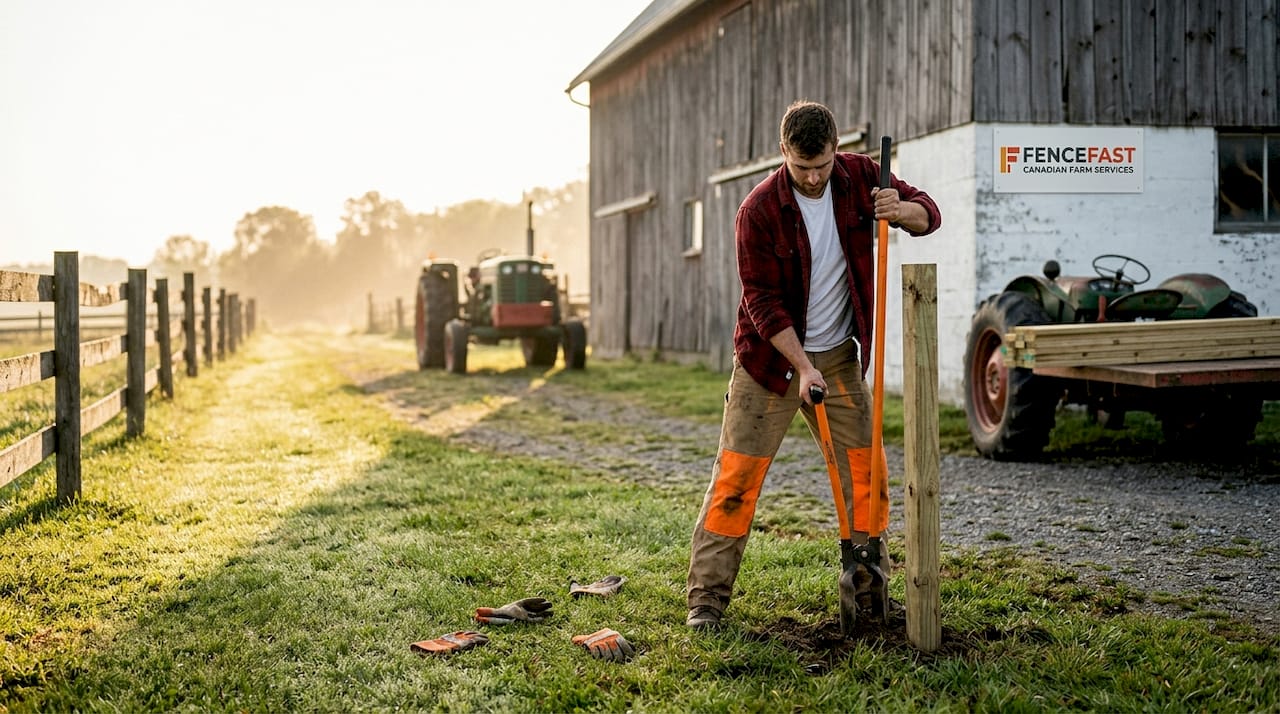
Black Locust is the underdog of Canadian agricultural fencing, and frankly it deserves more attention. Naturally rot-resistant without any chemical treatment, Black Locust posts are appropriate when you want to avoid introducing preservatives near watercourses or in soil-sensitive ecosystems. The wood is exceptionally hard, which also makes it resistant to mechanical damage from livestock rubbing and wildlife pressure. It is not as widely stocked as cedar or pine, but the sourcing effort pays off in longevity.
Douglas Fir requires treatment to achieve meaningful decay resistance but works well as framing-grade fence boards in drier western regions. Think of it as a secondary material for fence rails and boards rather than your primary post choice in wet or high-moisture environments.
Fixed Knot Wire Fence (A1 DuraKnot style) changes the equation entirely for long boundary lines. This is not standard woven wire. The high tensile strength and corrosion resistance of fixed knot construction means the fence holds its shape under pressure, resists sagging over long spans, and stays functional with minimal maintenance. For rugged or forested perimeters where you cannot walk the line every week, it is the most reliable wire option available.
Here is a quick breakdown of each type’s core strengths:
- Western Red Cedar: Natural moisture resistance, no treatment required, stable in organic soils
- Pressure-treated Southern Yellow Pine: Lower initial cost, widely available, requires corrosion-resistant hardware
- Black Locust: No chemical treatment needed, high hardness, excellent for eco-sensitive sites
- Douglas Fir: Cost-effective for boards and rails, requires treatment for posts
- Fixed Knot Wire: High tensile strength, long span capability, low maintenance for remote lines
For detailed wildlife threat planning, wildlife fencing solutions and temporary fencing options are worth reviewing alongside your permanent fence plan.
Pro Tip: Consider Black Locust posts to reduce chemical treatments and increase longevity in harsh Canadian climates. They are harder to source but save significant money on retreatment over a 20-year horizon.
With this understanding of key fencing types, let’s compare their features to identify what best fits your farm’s needs.
Comparison of forestry fencing solutions for durability and cost
Numbers make decisions clearer. Use this comparison to identify which fencing materials for forestry match your priorities across the key variables.
| Fencing type | Durability (years) | Maintenance level | Relative cost | Best use case |
|---|---|---|---|---|
| Western Red Cedar posts | 20 to 30 | Low | Moderate | Wet coastal and mountain terrain |
| Pressure-treated Yellow Pine | 15 to 25 | Moderate | Low to moderate | General agricultural boundary |
| Black Locust posts | 25 to 40 | Very low | Moderate (hard to source) | Eco-sensitive or riparian zones |
| Douglas Fir (treated) | 10 to 20 | Moderate to high | Low | Dry climates, rail and board use |
| Fixed Knot Wire Fence | 30 to 50 | Very low | Higher upfront | Long forest boundaries, wildlife pressure |
A few points worth emphasizing beyond the table:
- Pressure-treated pine is cost-effective short-term but demands corrosion-resistant fasteners throughout. Skipping this step accelerates structural failure.
- High-tensile wire fences demand more upfront investment in posts, anchors, and tensioning hardware, but the return over a 30-year lifespan is compelling. A single replacement cycle for a wood fence often exceeds the original cost of wire installation.
- Maintenance timelines matter for farm labor planning. A fence that requires treatment every three years is a real operational cost, not just a material cost.
For a broader fencing material comparison across farm types, that resource breaks down cost-per-meter scenarios that are directly applicable to Canadian installations.
Now that we’ve compared the options, let’s discuss how to decide which forestry fence best suits your farm’s unique situation.
How to choose the right forestry fencing solution for your Canadian farm or ranch
This is where the rubber meets the frozen ground. Walk through these steps before you order a single post or roll of wire.
- Assess terrain, climate, and wildlife threats. Walk your entire fence line. Note soil moisture, slope, rock density, and any evidence of wildlife pressure. This one step will disqualify several material options immediately.
- Determine livestock containment needs and fence height requirements. Cattle require different heights and wire spacing than horses. Pigs require something different again. Match your fence spec to the species, not just the property.
- Compare material durability and treatment options for longevity. Use the table above as a starting point, then factor in your specific climate zone. A Black Locust post in zone 3b behaves differently than one in zone 7.
- Budget for installation, maintenance, and potential repairs. Agricultural fencing systems should align with established standards for cross-fencing and pasture management to ensure effective livestock control. Build those standards into your cost model.
- Consider ease of long-term maintenance and local availability of materials. A superior material that takes six weeks to source becomes a liability when you need an emergency repair mid-season. Balance quality with supply chain reality.
When you are building a choosing durable agricultural fencing plan, think in decades. And if you are working with irregular terrain, post and rail fencing options provide useful guidance on fitting traditional designs to non-standard layouts.
Pro Tip: Choose fixed knot wire fences when dealing with rugged or large forested perimeters requiring low maintenance. The tension system compensates for terrain irregularities that would cause conventional wire to sag and fail.
Rethinking forestry fencing choices: Insights from Canadian farm experience
Here is the opinion that most fencing guides will not say out loud: the cheapest fence always ends up being the most expensive one.
We hear this constantly from farmers who went with pressure-treated pine because the upfront number looked good, then spent the next decade retreating, replacing, and patching. The true cost of a fence is not what you pay at the supplier. It is the total labor and materials over its entire service life, divided by the years it actually performs. When you run that math, naturally rot-resistant species like Black Locust and fixed knot wire systems routinely beat out lower-cost alternatives by a significant margin.
There is also an ecological calculation that rarely makes it into buying decisions. Chemical treatments prolong post life but introduce preservatives into the soil around your fence line. In forested or riparian areas, that matters. Choosing sustainable fence post materials is not just an environmental preference; it protects your soil health and keeps you compliant if regulations around chemical use near water tighten, which they have been doing steadily in most Canadian provinces.
The other thing experienced ranchers will tell you is that maintenance tolerance is a personality variable. If you are managing 500 acres mostly solo, a fence that needs annual treatment is realistically a fence that does not get treated. Plan honestly. A higher upfront investment in low-maintenance materials is often the only realistic path to a fence that still functions 20 years from now.
Integrating your fencing decisions with conservation goals is not idealism. Forested properties that maintain healthy soil ecosystems, intact waterway buffers, and reduced chemical inputs are more productive farms over the long run. Your fence is part of that ecosystem, whether you account for it or not.
Find your ideal forestry fencing solution at FenceFast Ltd.
You now have the criteria, the materials comparison, and the decision framework. The next step is getting the right products into your hands, and that is where we come in.
At FenceFast Ltd., we supply Canadian farmers and ranchers with a full range of fencing materials built for real agricultural conditions, from high-tensile fixed knot wire to post hardware and electric fencing components. We carry everything you need to execute the fence plan that came out of this guide, with the added advantage of expert consultation to match products to your specific terrain, livestock, and climate zone. Our team understands Canadian conditions because we have been outfitting Canadian operations for over 26 years. Reach out before you start ordering and we can help you avoid the costly missteps that come from picking materials in isolation.
Frequently asked questions
What are the most durable wood species for forestry fence posts in Canada?
Black Locust and Western Red Cedar rank at the top, with Black Locust offering exceptional rot resistance without requiring any chemical treatment, making it well suited for untreated post applications in demanding agricultural settings.
How does fixed knot wire fencing benefit forest boundary protection?
Fixed knot wire fencing uses high-tensile wires secured with fixed knots rather than woven loops, giving it greater strength and shape retention under pressure. The high tensile design makes it ideal for remote or rugged forest boundaries where maintenance access is limited.
What maintenance is needed for wood fences used in forestry applications?
Wood fences, particularly untreated cedar and Douglas Fir, require periodic application of penetrating oils or sealants to slow UV degradation and moisture intrusion. How often depends on your climate zone and the wood species used.
Are there fencing options that avoid chemical treatments for ecological reasons?
Yes. Naturally rot-resistant species like Black Locust allow you to skip chemical preservatives entirely, which reduces environmental impact near waterways and soil-sensitive zones on forested properties.
How can I protect my farm from wildlife intrusion effectively?
Combining fixed knot wire fencing with secure post installation and adequate height provides reliable barriers against deer, elk, and other wildlife. Fixed knot fencing outperforms conventional woven wire on long, rugged perimeters where consistent tension and shape retention are critical.
Recommended
- Agricultural fencing in Canada: choosing durable solutions – FenceFast Ltd.
- Compare top fencing materials for Canadian farms – FenceFast Ltd.
- Best practices for rural fencing: Secure your livestock and land – FenceFast Ltd.
- Fence installation steps for Canadian farms: A practical guide – FenceFast Ltd.

