

TL;DR:
- Fencing regulations in Canada vary by province and livestock species, requiring different standards to ensure compliance and animal safety. Proper documentation, species-specific materials, and adherence to height and design guidelines are essential to prevent legal disputes and animal escapes. Virtual fencing offers innovative benefits but depends on technology support and is limited to cattle, while traditional fencing remains vital for all livestock.
Getting fencing wrong in Canada is expensive in more ways than one. Beyond the cost of replacing inadequate materials, animal species fencing requirements vary by province and livestock type, meaning a fence that legally passes for cattle in Alberta may leave you non-compliant for horses in Ontario. Escaped animals, neighbor disputes, and denied funding applications are all downstream consequences of treating fencing as a one-size-fits-all purchase. This guide breaks down what each species actually needs, what the law expects, and how to match the right fencing system to the animals you run.
Table of Contents
- Understanding Canadian fencing requirements by animal species
- Fencing requirements and best materials for major livestock species
- Electric fencing: voltage, configuration, and species-specific installation
- The rise of virtual fencing: technology, benefits, and species considerations
- Comparing fencing options: traditional, electric, and virtual for Canadian livestock
- Our perspective: the species-first mistake most farmers make
- Build your fencing system with the right support
- Frequently asked questions
Key Takeaways
| Point | Details |
|---|---|
| Species-specific fencing | Fencing requirements differ by livestock species to ensure safety and legal compliance on Canadian farms. |
| Provincial regulation varies | Each Canadian province sets unique fencing rules, so verify local codes before installing fences. |
| Electric fencing essentials | Proper voltage, grounding, and strand configuration are critical for safe and effective electric fences. |
| Virtual fencing limits | Virtual fencing works best for cattle and supplements but does not replace physical fences for all species. |
| Winter fence care | Regular winter inspections and grounding maintenance keep electric fences reliable through Canadian winters. |
Understanding Canadian fencing requirements by animal species
Fencing regulations in Canada are not federal. Each province sets its own rules through acts like Ontario’s Line Fences Act, Alberta’s Stray Animals Act, and British Columbia’s Range Act. What this means practically is that the fence your neighbor runs legally may not meet the standard your province requires for your specific livestock.
Canadian fencing regulations vary by province, animal type, and documentation practices, with provincial acts setting specific fence height and material standards for different livestock. This matters beyond simple compliance: proper documentation protects you in disputes, and documented fencing is often required to access programs like OFCAF and BMP grants.
Key compliance points every Canadian farmer should know:
- Height and material standards are species-specific and legally defined in most provinces
- Written notice to neighbors is mandatory before starting boundary fence construction in provinces like Ontario, typically 30 days minimum
- Cost-sharing agreements for boundary fences are often required or encouraged under provincial law
- Documentation of fence construction, materials, and location protects you in legal disputes and insurance claims
- Annual code review is worth building into your operations calendar because provincial regulations do get updated
The practical takeaway: never assume last year’s fence design is still compliant. Pull the current provincial act before you drive a single post.
Fencing requirements and best materials for major livestock species
Species-specific fencing requirements exist because animals differ in how they test fences, how they escape, and what injuries they sustain from certain materials. A barbed wire fence that effectively contains cattle can lacerate a horse badly enough to end its working life.
Here is a breakdown of minimum standards and recommended materials by species:
| Species | Minimum height | Recommended material | Key design notes |
|---|---|---|---|
| Cattle | 1.2 m | Barbed wire or high-tensile wire | 4 to 5 strands, sturdy corner posts |
| Horses | 1.4 m | Board rail or electric tape | No barbed wire; smooth materials reduce injury risk |
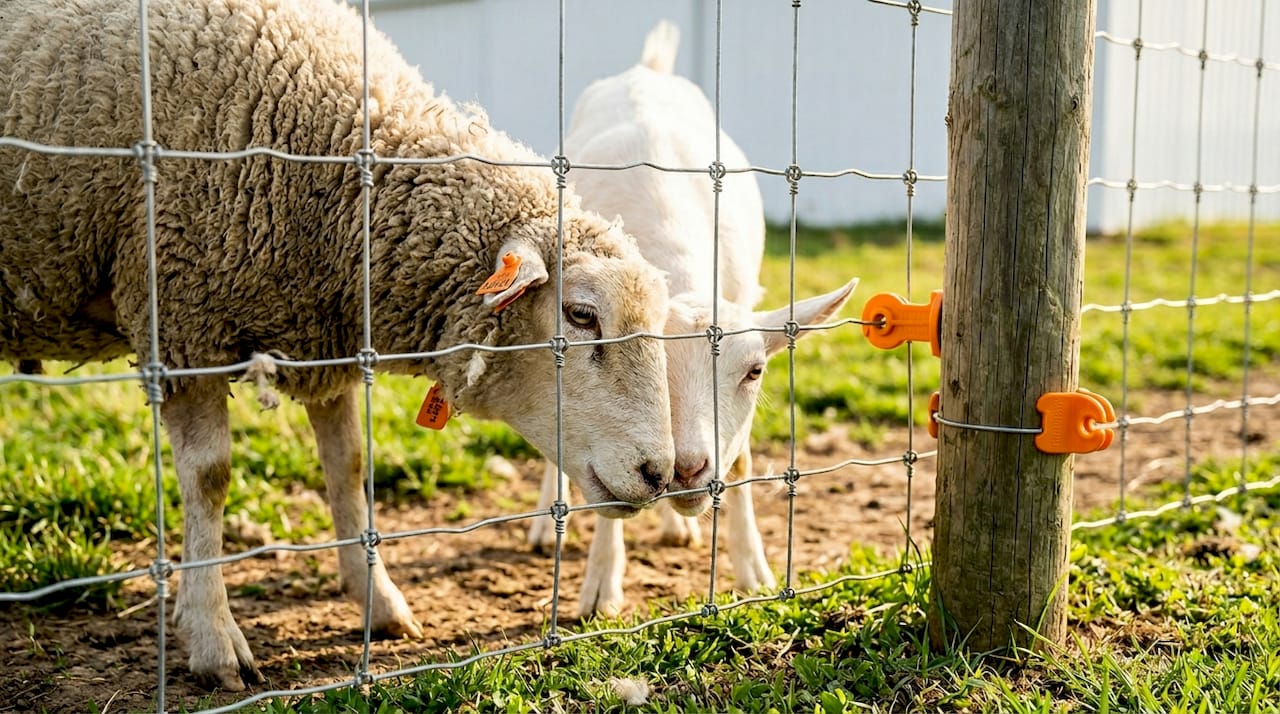
| Sheep | 1.0 to 1.2 m | Woven wire (field fence) | Small spacing to prevent head entrapment |
| Goats | 1.2 m | Woven wire with electric offset | Tighter spacing than sheep; they climb and push |
| Pigs | 0.9 to 1.0 m | Woven wire or hog panels | Bottom strand within 5 cm of ground to prevent rooting under |
| Poultry | 1.8 m fully enclosed | Hardware cloth or welded wire | Buried apron required; predator-proofed gates |
Minimum fence heights vary by species: cattle require 1.2 m with barbed or high-tensile wire, horses 1.4 m with board rail or electric tape, sheep 1.0 to 1.2 m with woven wire, and poultry 1.8 m fully enclosed.
Cattle are strong but relatively predictable. High-tensile wire with appropriate tension and a four to five strand configuration handles them well. Barbed wire works, but smooth high-tensile is increasingly preferred for reducing injury when cattle press against fences during fly season or when sorting.
Horses require the most careful material selection. Board rail is the gold standard, but electric tape at appropriate voltage is a practical and widely used alternative. The single rule that cannot be broken: no barbed wire around horses. Period.
Sheep and goats need close strand spacing, no more than 15 cm in the lower portion of the fence, to prevent head entrapment. Goats specifically will exploit any weakness, including climbing and using fence corners as ladders. An offset electric wire strand 10 cm inside the fence line and 30 cm off the ground does more to deter goat pressure than almost any other modification.
Poultry fencing has the strictest predator-proofing requirements of any livestock category. Poultry fencing must include buried aprons and hard-to-breach gates to prevent predator entry and frost heave escape gaps. Bury a 30 cm galvanized apron outward at a 90-degree angle at the base of the fence. In Canadian climates, frost heave is a genuine risk and will create gaps under fence lines if this step is skipped.
Pro Tip: Gate posts are where most fencing systems fail over time. Use posts at least 50% larger in diameter than your line posts, set them at least 90 cm deep, and brace them with a diagonal brace wire or wooden compression brace. A sagging gate creates an escape route that no amount of good fence line will compensate for.
Following rural fencing best practices also means accounting for terrain, seasonal frost, and snow loading when planning post depth and spacing across your property.
Electric fencing: voltage, configuration, and species-specific installation
Electric fencing is not just a cost-saving measure; used correctly, it is often more effective at containing animals than physical fences alone because it trains behavioral avoidance rather than just creating a physical barrier.
Electric fences must maintain voltages between 2,000 and 5,000 volts depending on livestock, use 3 to 5 strands at specified heights, and have properly installed ground rods to ensure reliable livestock control and safety. The voltage requirement is not a suggestion: drop below 2,000 volts and most animals will test the fence regularly. Above 5,000 volts and you risk injury to smaller animals and handling hazards for workers.
Here is how configuration differs across species:
| Species | Recommended voltage | Strand count | Key strand heights |
|---|---|---|---|
| Beef cattle | 3,000 to 5,000 V | 3 to 5 strands | 30, 60, 90 cm |
| Dairy cattle | 3,000 to 4,000 V | 3 to 4 strands | 25, 50, 75 cm |
| Horses | 2,000 to 3,000 V | 2 to 4 strands | 50, 90, 130 cm |
| Sheep | 3,000 to 5,000 V | 4 to 5 strands | 15, 30, 50, 75 cm |
| Pigs | 3,000 to 4,000 V | 2 to 3 strands | 15, 30, 50 cm |
Grounding is where electric fence safety and setup most commonly breaks down for Canadian farmers. Inadequate grounding due to dry or frozen soil is the leading cause of electric fence failures; testing voltage at multiple points localizes issues effectively. Install at least three galvanized ground rods, each 1.8 m long, spaced 3 m apart. In dry prairie summers or frozen Prairie winters, you may need additional rods or a dedicated ground-return system.
Operational checklist for maintaining effective electric fencing:
- Test voltage at the energizer, fence midpoint, and far end at least monthly
- Clear vegetation within 30 cm of all fence lines after every rain event in summer
- Check connections for corrosion before and after winter
- Inspect insulators for cracking, especially after UV exposure through a full summer season
- Post warning signs every 50 m along public-facing fence runs
Pro Tip: In winter electric fence maintenance, the single most overlooked issue is a fence line that reads good voltage at the energizer but is leaking badly at midpoint through snow-loaded vegetation. Walk the entire fence line with a digital voltmeter after the first heavy snowfall each season before you assume everything is fine.
The rise of virtual fencing: technology, benefits, and species considerations
Virtual fencing is not science fiction anymore. It is running commercially on cattle operations across Canada right now, and it changes the economics of rotational grazing in ways that traditional fencing simply cannot match.
The system works through GPS-enabled collars with audio and mild electric stimuli to contain cattle, reducing interior hard fencing needs but requiring good connectivity and species-specific collar setups. The sequence matters: the collar first issues an audio warning, then a mild pulse if the animal continues toward the boundary. Cattle learn quickly, typically within a few days of introduction to the system.
Benefits that make virtual fencing genuinely worth evaluating:
- Flexible boundary adjustment without physical labor, enabling tight rotational grazing intervals
- Dramatic reduction in interior fence materials, posts, and installation costs
- Real-time location data on individual animals visible through a phone app
- Ability to split paddocks and create exclusion zones around waterways or sensitive areas without a single post
That said, horses and sheep need traditional fencing since collar-based stimuli vary in effectiveness by species, and the behavioral response that makes cattle trainable does not translate predictably to other species.
Virtual fencing should always complement your legal physical perimeter fence, not replace it. Provincial regulations require physical boundary fences between properties regardless of what technology you run inside your operation.
Before committing to a full rollout, review virtual fencing basics and understand the infrastructure side: base station placement, cellular or satellite connectivity, collar charging logistics, and battery management across a herd. There are also virtual fencing myths worth reading before you form an opinion based on secondhand accounts.
Pilot at a scale of 20 to 30 head before expanding. This gives you real data on connectivity performance, animal response, and labor requirements on your specific terrain before you have made a system-wide commitment.
Comparing fencing options: traditional, electric, and virtual for Canadian livestock
Choosing the right fencing approach means weighing cost, species suitability, compliance, and the practical realities of your land and labor situation. No single system wins across every category.
| Factor | Traditional physical | Electric | Virtual |
|---|---|---|---|
| Upfront cost | High | Medium | High (tech and setup) |
| Ongoing labor | Low | Medium (maintenance) | Low (remote management) |
| Legal compliance | Always satisfies requirements | Satisfies with proper setup | Does not replace boundary fences |
| Species suitability | All species | Most species | Cattle primarily |
| Flexibility | Low | Medium | High |
| Connectivity required | No | No | Yes |
Virtual fencing provides flexible management but depends on technology and is currently best suited for cattle; traditional fencing ensures legal compliance and works reliably for all species.
Decision factors worth prioritizing by situation:
- Large cattle operations with rotational grazing goals: Hybrid approach wins. Physical perimeter, virtual interior boundaries.
- Horse operations: Physical fencing only. Board rail with electric tape as a secondary deterrent.
- Mixed species farms: Physical fencing is non-negotiable. Electric supplementation varies by species zone.
- Remote terrain with poor connectivity: Traditional or electric fencing. Virtual fencing needs reliable signal.
- Budget-constrained operations: Electric fencing delivers the best containment per dollar spent when properly maintained.
Review the full rural fencing comparison for additional context on materials, maintenance cycles, and terrain considerations before finalizing your approach.
Our perspective: the species-first mistake most farmers make
After 26 years supplying fencing to Canadian farms, we have seen the same mistake repeat itself: farmers start with a budget and a material, then work backward to justify it for their animals. The right sequence runs the other direction entirely.
Start with the animal. Understand how it tests fences, where it is likely to escape, and what materials injure it. Then identify the legal minimum your province requires. Then match a material and system to both those constraints. Budget comes last, not first.
The farms that spend the least on fencing over a decade are not the ones who bought cheap materials. They are the ones who bought the right materials the first time and did not spend those years repairing, replacing, and dealing with escaped animals or neighbor disputes. A board rail fence built properly for a horse operation lasts 20 to 30 years with routine maintenance. A strand of barbed wire that injures a horse can generate veterinary costs that exceed the cost of the entire fence in a single incident.
The same logic applies to virtual fencing adoption. The farmers who get real value out of it are the ones who piloted carefully, understood their connectivity situation before purchasing, and used it to solve a specific grazing management problem. The ones who struggle are the ones who bought the system first and then tried to figure out what problem it solved.
Fencing decisions are long-term decisions. Treat them like infrastructure, not supplies.
Build your fencing system with the right support
Whether you are upgrading an existing perimeter, starting a new rotational grazing system, or exploring virtual fencing for your cattle herd, having access to the right products and expertise makes the difference between a fence that holds and one that keeps you busy with repairs.

At FenceFast, we carry everything from electric fencing components and Gallagher eShepherd virtual fencing systems to woven wire, high-tensile wire, and poultry enclosure materials suited to Canadian conditions. As an authorized Gallagher dealer with over 26 years in the industry, we can walk you through species-specific configurations, help you understand available government funding through OFCAF and BMP programs, and ship directly to your farm across Canada. If you are ready to build a fencing system that actually fits your animals and your province, we are ready to help.
Frequently asked questions
What are the minimum fence height requirements for different livestock in Canada?
Fence heights vary by species: cattle need at least 1.2 meters, horses 1.4 meters, sheep 1.0 to 1.2 meters, and poultry require fully enclosed fencing about 1.8 meters high to meet Canadian provincial standards.
Can virtual fencing replace traditional fencing for all livestock types?
No. Virtual fencing works best for cattle and may not effectively contain horses, sheep, or goats due to behavioral differences and collar compatibility limitations. Provincial law also requires physical boundary fences regardless of what interior system you use.
How should electric fences be maintained during Canadian winters?
Winterizing electric fences requires thorough vegetation clearing, ground rod inspection, checking for loose or corroded connections, and regular voltage testing at multiple points along the fence line to maintain performance in frozen or snow-covered soil.
What are the legal requirements for notifying neighbors before building boundary fences?
In Ontario, written notice at least 30 days before starting boundary fence work is required under the Line Fences Act, giving neighbors time to review the proposal and establish cost-sharing agreements. Requirements vary by province, so check your local act before breaking ground.
Recommended
- Animal fencing basics: Essential solutions for Canadian farms – FenceFast Ltd.
- Canada fencing requirements: Stay compliant and protect livestock – FenceFast Ltd.
- Fence installation steps for Canadian farms: A practical guide – FenceFast Ltd.
- Fencing laws in Canada: a guide for livestock owners – FenceFast Ltd.

