

Keeping large herds safely contained across sprawling Canadian pastures is no simple task. The choice of fencing wire directly affects livestock management, animal safety, and operational efficiency. Whether you are handling cattle, sheep, or goats, finding a durable agricultural fencing wire solution helps protect animals from predators, prevent escapes, and streamline grazing zones. This guide offers practical insights to help farmers select the right wire for long-term performance and reliable containment.
Table of Contents
- What Is Agricultural Fencing Wire?
- Types of Fencing Wire for Livestock Needs
- Durability and Performance Factors Examined
- Installation Methods and Best Practices
- Cost Considerations and Value Comparison
Key Takeaways
| Point | Details |
|---|---|
| Choosing the Right Wire Type | Tailor your wire fencing choice to the specific livestock type and environmental challenges to ensure optimal management and safety. |
| Performance and Durability Considerations | Evaluate material composition, tensile strength, and maintenance needs as they significantly impact long-term fencing effectiveness. |
| Installation Best Practices | A thorough site assessment and strategic installation approach are crucial for building durable fencing systems that endure environmental stresses. |
| Cost Analysis for Sustainability | Consider the full cost spectrum, including installation and maintenance, to select fencing solutions that offer both immediate and long-term value. |
What Is Agricultural Fencing Wire?
Agricultural fencing wire is a critical infrastructure component designed to manage, contain, and protect livestock across Canadian farmlands. Unlike traditional boundaries, these specialized wire systems serve multiple essential functions beyond simple property demarcation. Agricultural fencing represents a complex solution engineered to address specific animal management challenges in diverse terrains and environmental conditions.
At its core, agricultural fencing wire consists of carefully manufactured metal strands designed to withstand extreme weather, animal pressure, and long-term environmental exposure. The wire types vary significantly based on specific agricultural needs, including:
- High tensile wire: Offers superior strength and flexibility
- Barbed wire: Provides additional deterrence for animal movement
- Smooth wire: Used for less aggressive containment scenarios
- Electrified wire: Delivers additional security and animal control
The fundamental purpose of agricultural fencing wire extends beyond simple containment. These systems protect livestock from predators, prevent animals from wandering onto highways or neighboring properties, and help farmers efficiently manage grazing areas and breeding zones. Professional farmers understand that selecting the right wire involves considering multiple factors such as animal type, terrain complexity, budget constraints, and long-term durability.
Wire gauge, tensile strength, and coating materials become critical selection criteria that directly impact fence performance. Farmers must evaluate these technical specifications to ensure their chosen fencing solution matches their specific agricultural management strategy.
Pro tip: Always conduct a comprehensive property survey and consult local agricultural extension services before investing in fencing wire to understand precise terrain and livestock requirements.
Types of Fencing Wire for Livestock Needs
Livestock fencing is a complex system with multiple wire types designed to meet specific agricultural challenges. Livestock fencing options range from physical barriers to psychological deterrents, each tailored to different animal management strategies and environmental conditions.
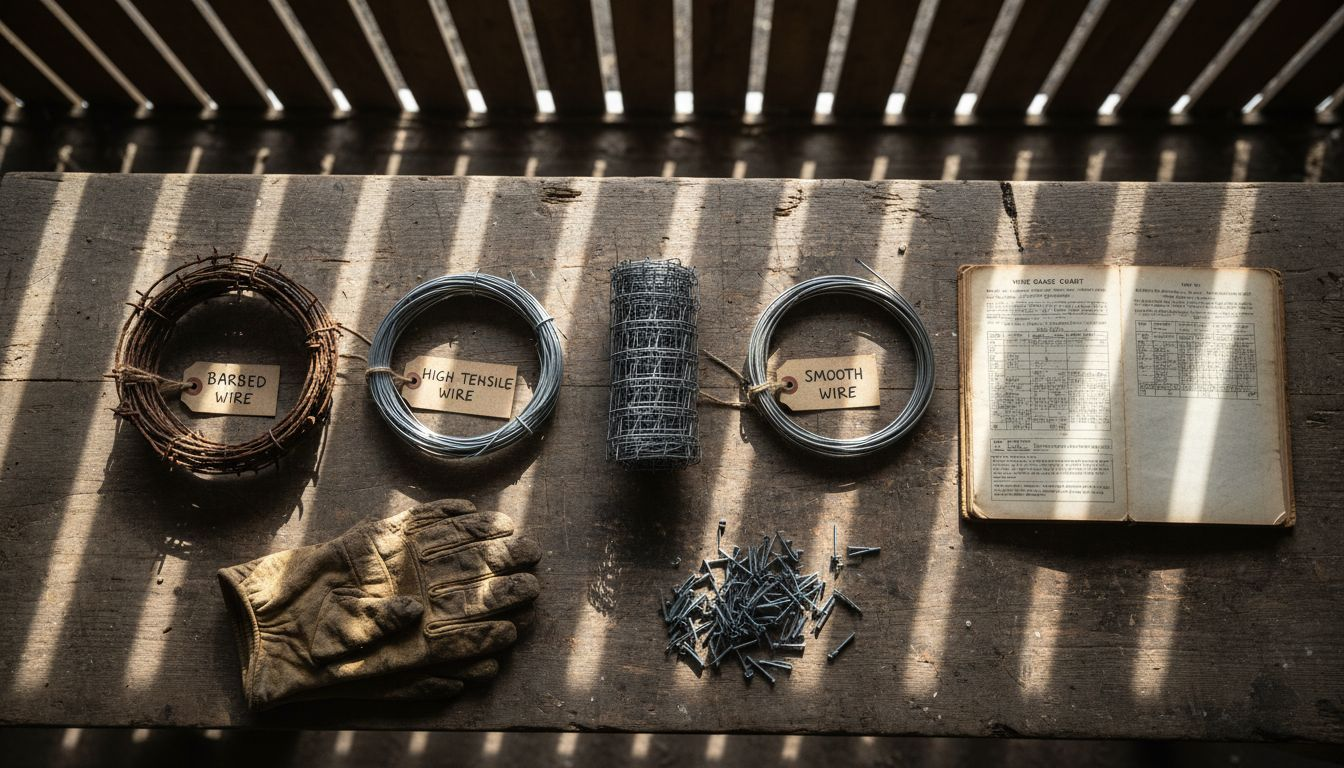
Farmers have several primary wire fencing categories to choose from:
- Barbed Wire: Classic containment method with metal strands featuring sharp points
- Woven Wire: Dense mesh providing comprehensive animal enclosure
- High-Tensile Wire: Offers superior strength and long-term durability
- Electric Wire: Psychological barrier delivering mild shock for animal training
- Smooth Wire: Minimalist approach with clean, uninterrupted metal strands
Each wire type presents unique advantages depending on livestock species and farm requirements. Cattle operations might prioritize different fencing characteristics compared to sheep or goat management. Tensile strength, wire gauge, and spacing between strands become critical selection parameters that directly impact fence effectiveness.
Professional farmers recognize that wire selection involves more than simple containment. Factors like predator protection, grazing area management, and long-term maintenance costs significantly influence wire type decisions. Understanding the nuanced differences between physical and psychological fencing helps ranchers make informed infrastructure investments that balance animal safety with operational efficiency.
Pro tip: Consult local agricultural extension services and conduct a comprehensive property survey before selecting your fencing wire to ensure optimal match with your specific livestock and terrain requirements.
Here is a comparison highlighting suitable fencing wire options for different common livestock:
| Livestock Type | Recommended Wire Type | Key Consideration |
|---|---|---|
| Cattle | High-tensile wire | Withstands heavy pressure |
| Sheep | Woven wire | Prevents small animal escape |
| Goats | Electric wire | Discourages climbing/escaping |
| Horses | Smooth wire | Reduces injury risk |
Durability and Performance Factors Examined
Fencing performance and durability represent critical considerations for Canadian farmers investing in agricultural infrastructure. The longevity and effectiveness of fencing wire depend on multiple sophisticated engineering and environmental factors that extend far beyond simple material selection.
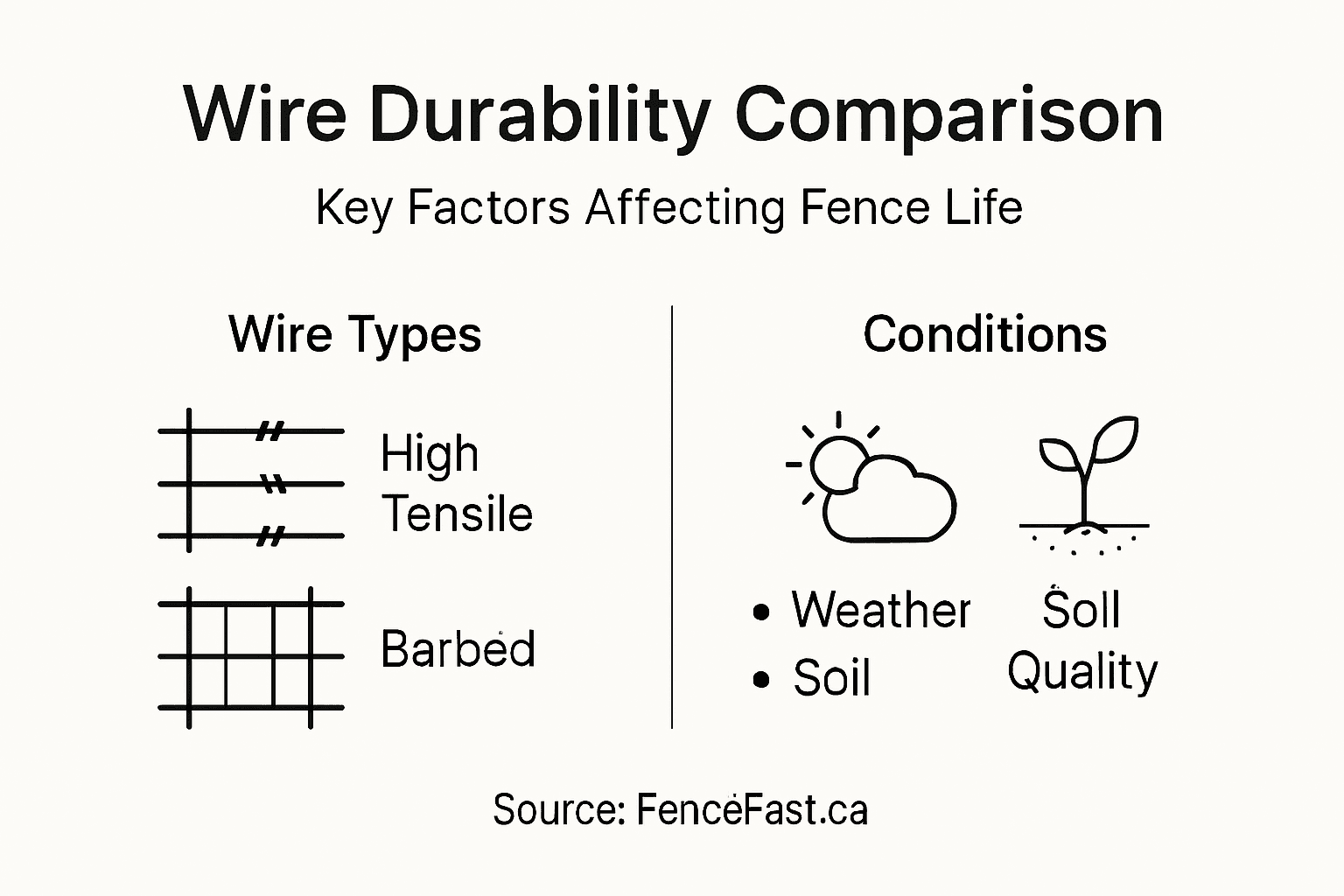
Key performance metrics for agricultural fencing wire include:
- Material Composition: Resistance to corrosion and environmental degradation
- Tensile Strength: Ability to withstand animal pressure and external forces
- Elasticity: Wire’s capacity to flex without permanent deformation
- Coating Quality: Protection against rust and environmental damage
- Maintenance Requirements: Long-term operational sustainability
Professional ranchers understand that wire performance involves complex interactions between material science and practical agricultural demands. High-tensile wire, for instance, offers superior strength and elasticity, allowing fences to absorb significant animal impact without catastrophic failure. Electric fencing introduces an additional psychological dimension, creating barriers through mild shock conditioning that trains livestock to respect boundary limits.
Environmental challenges in Canadian agricultural regions demand extraordinary wire durability. Extreme temperature fluctuations, moisture variations, and potential mechanical stress require fencing solutions engineered with exceptional resilience. Wire gauge, tensile rating, and protective coating become critical selection parameters that directly influence long-term fence performance and overall farm infrastructure reliability.
Pro tip: Invest in professional wire testing and consult agricultural engineering experts to ensure your fencing wire matches the specific environmental challenges of your specific livestock operation.
Installation Methods and Best Practices
Fencing installation best practices demand meticulous planning and execution for successful agricultural infrastructure development. Professional farmers understand that proper wire fencing installation involves far more than simply connecting wire to posts - it requires strategic approach and comprehensive preparation.
Critical pre-installation steps include:
- Site Clearance: Remove debris, brush, and old fencing materials
- Terrain Assessment: Evaluate ground conditions and potential challenges
- Material Inventory: Confirm all necessary components are available
- Safety Equipment Preparation: Gather protective gear and installation tools
- Layout Mapping: Precisely plan fence line and boundary markers
Professional installation requires understanding multiple technical considerations. Wire tension, post spacing, and grounding techniques become paramount for creating a robust and reliable fence system. Proper installation means maintaining consistent wire height, ensuring electrical continuity for electric fences, and creating robust connection points that can withstand significant animal and environmental stress.
Safety remains a fundamental concern during agricultural fencing projects. Installers must maintain safe distances from utility lines, use appropriate personal protective equipment, and follow local regulatory guidelines. Electric fencing installations demand additional precautions, including proper grounding, clear warning signage, and systematic voltage testing to ensure animal and human safety.
Pro tip: Consult local agricultural extension services and conduct a comprehensive site survey before beginning your fencing installation to identify potential challenges and optimize your approach.
Cost Considerations and Value Comparison
Fencing cost analysis reveals that agricultural wire fencing represents a complex financial investment far beyond simple material expenses. Canadian farmers must evaluate multiple economic factors when selecting appropriate fencing solutions, considering not just upfront costs but long-term operational sustainability.
Comprehensive cost breakdown for agricultural fencing includes:
- Material Expenses: Wire, posts, connectors, and electrical components
- Labor Costs: Installation time and professional expertise requirements
- Maintenance Investments: Annual repair, replacement, and preservation expenses
- Operational Efficiency: Potential productivity gains from effective livestock management
- Durability Factors: Long-term performance and replacement frequency
Professional ranchers recognize that cost-effective fencing involves strategic decision-making beyond simple price comparisons. Different wire types present unique financial profiles - high-tensile wire might demonstrate higher initial investment but lower long-term maintenance costs compared to traditional barbed wire systems. Electric fencing introduces additional complexity, with upfront technology expenses balanced against potential labor and management savings.
Advanced agricultural operations increasingly consider innovative approaches like virtual fencing technologies. While these systems require significant initial investment, they offer potential long-term benefits in livestock management flexibility and reduced manual labor. Comprehensive cost evaluation must include not just immediate expenses but potential operational efficiency gains and technological adaptability.
The table below summarizes factors that influence long-term fencing costs:
| Cost Factor | Short-Term Impact | Long-Term Impact |
|---|---|---|
| Material Quality | Raises initial price | Reduces replacement frequency |
| Labor Investment | Increases upfront | Lowers future repair demand |
| Maintenance Needs | Minimal early costs | Adds ongoing expenses |
| Technology Choice | Expensive to adopt | May boost operational savings |
Pro tip: Develop a comprehensive five-year financial projection that accounts for installation, maintenance, and potential productivity improvements when selecting your agricultural fencing solution.
Simplify Your Agricultural Fencing Wire Needs with FenceFast.ca
Choosing the right agricultural fencing wire requires careful consideration of factors like wire gauge, tensile strength, and durability to protect your livestock effectively. Whether you need high-tensile wire for cattle, woven wire for sheep, or electric wire to discourage goats from escaping, it is crucial to invest in trusted products that stand up to Canadian environmental challenges. FenceFast.ca understands these challenges and offers a comprehensive selection of fencing wire, electric fencing systems, and essential accessories designed specifically for rural farms and ranches.

Explore the wide range of fencing components and livestock management supplies available at FenceFast.ca to build secure, durable fencing tailored for your specific needs. With expert design consulting and nationwide shipping, you can confidently upgrade your fencing infrastructure today. Don’t wait to protect your valuable livestock and improve your farm’s productivity – visit our site now to find the perfect fencing solution and get started on your next project.
Frequently Asked Questions
What is agricultural fencing wire used for?
Agricultural fencing wire is designed to manage and contain livestock, protect against predators, and prevent animals from straying onto roads or neighboring properties. It also aids farmers in efficiently managing grazing and breeding zones.
What types of agricultural fencing wire are available?
Common types of agricultural fencing wire include high tensile wire, barbed wire, smooth wire, woven wire, and electrified wire. Each type serves specific purposes based on livestock needs, terrain, and security requirements.
How do I choose the right fencing wire for my livestock?
When selecting fencing wire, consider the type of livestock, the environment, wire gauge, tensile strength, and long-term durability. Understanding these factors will help you make an informed decision tailored to your specific needs.
What factors affect the durability and performance of agricultural fencing wire?
Key factors include material composition, tensile strength, elasticity, coating quality, and maintenance requirements. These elements determine how well the fencing will withstand environmental stresses and the pressures exerted by livestock.

