

Most Canadian farmers assume solar fence chargers fail in winter. Wrong. The Gallagher S10 operates effectively with partial shading thanks to 12V battery storage that powers your fence for up to 10 days without sunlight. This article reveals how understanding the S10’s features solves common fencing challenges across Canadian farms, from voltage output to winter reliability, helping you make confident equipment decisions.
Table of Contents
- Introduction To Gallagher S10 Solar Fence Charger
- Technical Overview And Fence Performance Features
- Solar Efficiency And Environmental Adaptability In Canada
- Common Misconceptions And User Errors
- Comparison With Other Solar Fence Chargers
- Installation And Maintenance Best Practices
- Economic And Practical Benefits For Canadian Farmers
- Conclusion And Recommendations
- Discover Reliable Electric Fence Solutions At FenceFast Ltd.
Key Takeaways
| Point | Details |
|---|---|
| Battery Backup | Powers fences up to 10 days without sunlight, ideal for Canadian winters. |
| Low-Impedance Tech | Delivers stronger pulses through vegetation and fence faults. |
| Cost Savings | Reduces electricity costs by up to 70% versus grid-powered chargers. |
| Versatile Application | Suitable for cattle, bison, and mixed livestock operations. |
| Weather Adaptable | 12V battery and solar panel maintain performance in harsh conditions. |
Introduction to Gallagher S10 Solar Fence Charger
The Gallagher S10 is designed for large livestock and versatile fence types, making it perfectly suited for Canadian agricultural environments. This solar fence charger targets operations managing cattle, bison, horses, and other large animals across multi-acre pastures. Its robust design handles permanent perimeter fencing, rotational grazing systems, and temporary paddock divisions.
Canadian farms benefit significantly from the S10’s adaptability to remote locations. Grid power access remains limited or cost-prohibitive across rural territories. Solar charging eliminates infrastructure costs while maintaining consistent fence performance. The unit’s portability supports seasonal grazing rotations without electrical hookups.
Key applications for the S10 include:
- Permanent perimeter fencing for cattle ranches
- Rotational grazing systems requiring flexible fence placement
- Bison containment in remote wilderness areas
- Horse pasture management across multiple paddocks
- Mixed livestock operations with varying containment needs
The S10 fills the gap between basic solar units and industrial-grade chargers. It provides sufficient power for operations managing 50 to 200 head of large livestock. This sweet spot makes it accessible for mid-sized farms while delivering professional-grade performance. Explore Gallagher solar fence charger options to compare capabilities across the product line.
Technical Overview and Fence Performance Features
The Gallagher S10 delivers 10,000-volt output with low-impedance technology and a 12V rechargeable battery optimized for Canadian solar conditions. This voltage level provides ample shock strength to deter large livestock without causing harm. The pulse frequency maintains animal respect for fence boundaries through consistent, memorable encounters.
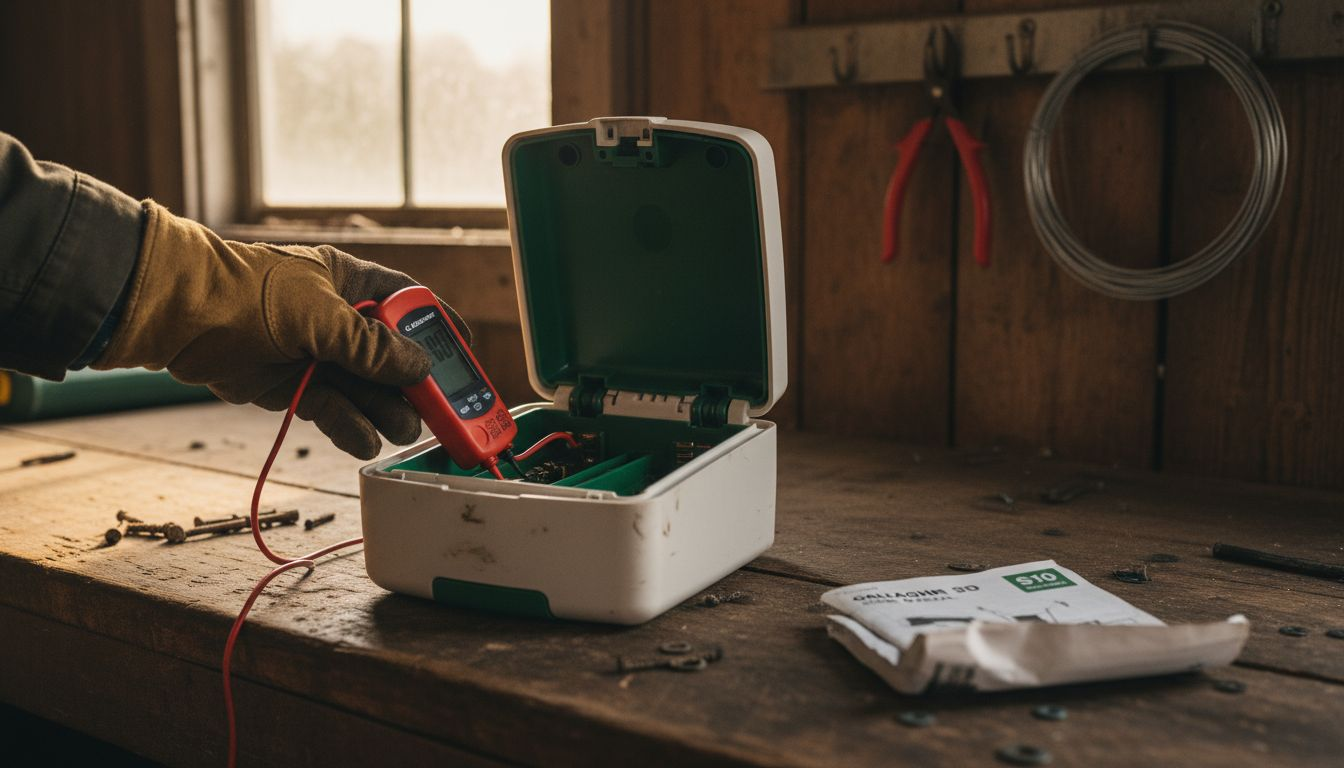
Low-impedance technology allows stronger pulses through vegetation and fence faults. Traditional chargers lose effectiveness when vegetation touches wires or insulators crack. The S10’s advanced circuitry pushes pulses through these obstacles, maintaining deterrent strength even when fence conditions degrade between maintenance visits. This technology reduces labor spent clearing fence lines and troubleshooting weak spots.
Battery and solar specifications enable extended backup periods:
- 12V deep-cycle rechargeable battery stores 10+ days of charge
- 10-watt solar panel charges battery even in partial shade
- Weatherproof housing protects electronics from moisture and temperature extremes
- Built-in voltage regulator prevents overcharging and battery damage
- LED indicators display battery status and fence pulse activity
The combination of high voltage output and low impedance creates fence systems that remain effective despite challenging conditions. Farmers spend less time troubleshooting and more time managing livestock. The S10’s reliable pulse delivery maintains herd containment even when weather or vegetation creates fence line challenges. For operations requiring more power, consider advanced Gallagher solar chargers with higher joule ratings.
Solar Efficiency and Environmental Adaptability in Canada
The S10’s battery can power fences up to 10 days without sunlight, addressing concerns about Canadian winters and extended cloudy periods. This backup capacity covers typical weather patterns across most regions. Prairie farms experience sunny winter days that recharge batteries between storms. Coastal operations benefit from milder temperatures that improve battery efficiency despite cloudier skies.
Canadian winters impact solar charging but don’t eliminate it. Snow reflects sunlight onto panels, sometimes increasing charge rates. Cold temperatures actually improve solar panel efficiency compared to summer heat. The battery’s chemical composition maintains performance down to temperatures well below freezing. Position panels where snow naturally slides off or plan periodic clearing after heavy accumulations.
Installing the S10 at a 45-degree south-facing angle maximizes solar absorption and charging efficiency in Canadian latitudes. This angle balances summer and winter sun paths. Mount the panel where morning and afternoon sun hit unobstructed. Trees, buildings, and terrain features that cast shadows reduce charging capacity.
Optimal installation practices include:
- Clear 180-degree southern exposure from sunrise to sunset
- Mount panel 4 to 6 feet above ground to avoid snow burial
- Angle panel to encourage snow shedding
- Position battery box in insulated housing for extreme cold regions
- Run wiring through conduit to prevent animal damage
Pro Tip: Check your panel’s shadow pattern at different times during installation day. What looks unobstructed at noon might receive morning shade from buildings or afternoon shade from tree lines. Full-day sun exposure dramatically improves winter performance.
Partial shading reduces but doesn’t eliminate charging. The S10’s battery acts as a buffer, storing excess charge from sunny periods to compensate for cloudy stretches. This design philosophy matches Canadian weather patterns better than systems requiring constant direct sunlight. Learn more about solar fence charger maintenance tips for seasonal care. Additional solar panel installation guidelines provide region-specific recommendations.
Common Misconceptions and User Errors
The myth that solar chargers need constant direct sunlight persists despite battery storage enabling operation even when chargers receive partial sunlight. Many farmers avoid solar options assuming cloudy days equal dead fences. The S10’s battery storage breaks this misconception. It charges during sunny periods and draws from reserves during cloudy stretches, creating consistent fence performance regardless of daily weather fluctuations.
Battery technology transforms solar chargers from weather-dependent to weather-resilient. The 12V deep-cycle battery stores multiple days of charge. Even a few hours of partial sun per week maintains adequate power levels. This reality makes solar fencing viable across Canada’s diverse climate zones, from southern Ontario’s humid summers to Alberta’s cold, dry winters.
Common installation errors like shading and improper angles reduce charger efficiency. Farmers often mount panels conveniently rather than optimally. Placing the unit near existing infrastructure seems logical but frequently results in shade from buildings, equipment, or trees. Prioritize sun exposure over convenience during site selection.
Frequent user errors include:
- Mounting panels facing east or west instead of south
- Installing at incorrect angles for local latitude
- Positioning too close to buildings that cast shadows
- Neglecting seasonal vegetation growth that creates new shade
- Failing to clean dust and debris from panel surface
- Using undersized wire that increases resistance and voltage loss
Pro Tip: Walk your proposed installation site at sunrise, midday, and sunset before mounting equipment. Notice where shadows fall throughout the day. This simple check prevents the most common efficiency killer: unexpected shade.
Maintenance neglect causes preventable performance issues. Dust accumulation blocks sunlight. Corroded connections increase resistance. Vegetation encroaching on fence lines drains charge. Schedule quarterly inspections covering panel cleaning, connection tightening, and fence line walking. These simple tasks prevent gradual degradation that erodes system effectiveness. Review common solar charger misconceptions to avoid setup mistakes.
Comparison with Other Solar Fence Chargers
The Gallagher S10 offers higher voltage output and longer battery backup compared to competitor models. This advantage becomes clear when examining specifications side by side. Budget solar chargers sacrifice voltage or battery capacity to reduce cost. Premium models add features most mid-sized operations don’t require. The S10 occupies the optimal middle ground.
| Feature | Gallagher S10 | Budget Competitor | Premium Competitor |
|---|---|---|---|
| Voltage Output | 10,000V | 7,000V | 12,000V |
| Battery Backup | 10 days | 3-5 days | 14 days |
| Low-Impedance Tech | Yes | No | Yes |
| Solar Panel Watts | 10W | 5W | 15W |
| Suitable Fence Length | Up to 25 miles | Up to 10 miles | Up to 40 miles |
| Price Range | Mid | Low | High |
Technology differentiators separate adequate from excellent. Low-impedance circuitry maintains pulse strength through vegetation and minor faults. Budget units lose effectiveness as fence conditions decline. The S10 delivers consistent performance between maintenance visits. This reliability reduces labor costs and improves livestock containment.
Cost versus long-term savings analysis favors the S10. Initial purchase price sits higher than basic models but lower than premium units. Operating costs remain minimal since solar charging eliminates electricity bills. The extended battery backup reduces battery replacement frequency compared to cheaper models with smaller batteries. Durable construction extends service life, spreading the initial investment across many years.
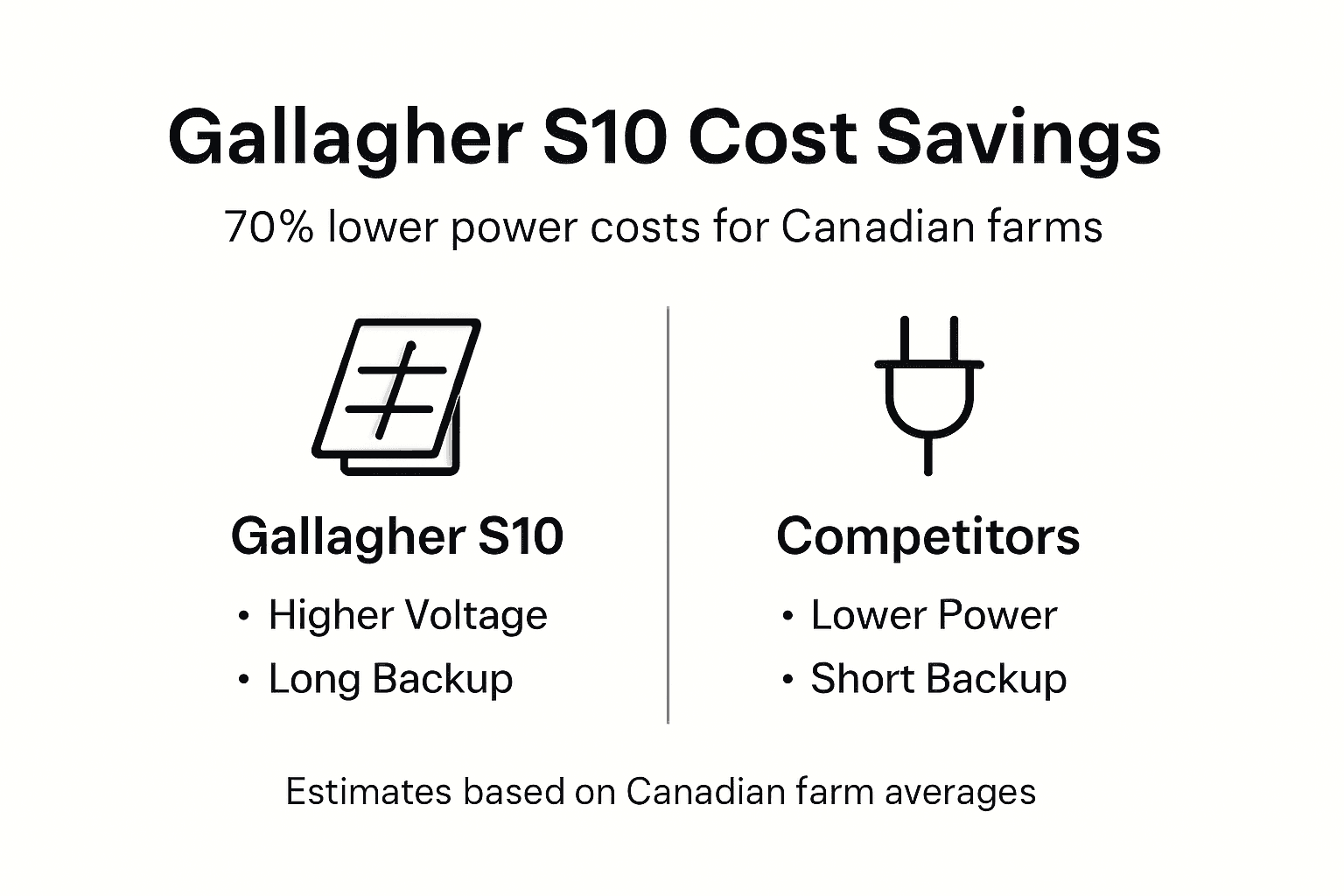
Calculate total cost of ownership over five years, not just purchase price. The S10’s reliability and efficiency create savings through reduced maintenance, fewer escaped animals, and eliminated electricity costs. Most operators recover the price difference versus budget models within two seasons through operational savings alone. For larger operations, explore higher-powered Gallagher models that support extended fence lines.
Installation and Maintenance Best Practices
Proper installation ensures the S10 performs optimally from day one. Follow these steps for reliable long-term operation. First, select a site with maximum southern sun exposure throughout the year. Walk the area at different times to identify shade sources. Second, install the solar panel facing south at a 45-degree angle to maximize solar gain in Canadian latitudes. Mount the panel securely on a post or dedicated stand 4 to 6 feet above ground level.
Installation sequence:
- Choose installation location with full southern sun exposure
- Mount solar panel at 45-degree angle facing true south
- Position battery box in weatherproof, insulated housing
- Connect solar panel to charge controller and battery
- Run fence wire connections using appropriate gauge wire
- Install proper grounding rod system per manufacturer specs
- Test voltage output before connecting to fence system
- Connect to fence and verify pulse strength along entire length
Recommend battery replacement every 3 to 5 years depending on usage intensity and climate conditions. Deep-cycle batteries degrade gradually. Performance decline appears as shorter backup periods and slower recharge times. Replace proactively before complete failure to avoid unexpected fence outages. Mark installation date on the battery box for tracking.
Routine maintenance preserves system performance. Clean the solar panel quarterly to remove dust, pollen, and debris. Check fence voltage monthly using a digital tester. Walk fence lines seasonally to clear encroaching vegetation and identify damage. Inspect all electrical connections for corrosion or looseness. Tighten or clean as needed.
Pro Tip: Keep a maintenance log noting inspection dates, voltage readings, and issues found. Patterns emerge over time showing seasonal challenges or gradual degradation. This data helps you schedule proactive maintenance before problems impact livestock containment.
Troubleshooting common S10 issues starts with systematic checking. Low voltage often indicates vegetation contact, broken insulators, or corroded connections. Battery not charging suggests dirty panel, damaged solar cells, or faulty charge controller. Intermittent operation points to loose connections or failing battery. Methodically test each component to isolate problems. Stock basic replacement parts like insulators and connectors for quick repairs. Find quality fence installation tools to simplify maintenance tasks. Consult detailed solar panel installation guides for advanced troubleshooting.
Economic and Practical Benefits for Canadian Farmers
Using solar fence chargers can reduce electricity costs by up to 70% compared to grid-powered units. This savings compounds over the charger’s operational lifespan. Grid-powered systems require trenching, electrical installation, and monthly utility bills. Solar eliminates infrastructure costs and ongoing expenses. For remote pastures, avoided trenching costs alone often exceed the S10’s purchase price.
Labor savings emerge from improved reliability. Gallagher S10 users report up to 60% less labor on fence repairs compared to conventional chargers. Low-impedance technology maintains deterrent strength despite minor faults. Animals respect boundaries consistently. Fewer fence checks and emergency repairs free time for productive farm activities. Less time fixing fences means more time managing livestock, maintaining equipment, or pursuing additional income streams.
Livestock safety improvements reduce injury and loss. Consistent fence voltage prevents animals from testing boundaries. Fewer escape attempts mean fewer injuries from fence entanglement or road accidents. Containment reliability reduces neighbor conflicts over wandering livestock. These intangible benefits add value beyond direct cost savings.
Practical advantages include:
- Zero electricity costs after initial investment
- Portable setup supports rotational grazing flexibility
- Reliable containment reduces livestock loss and injury
- Less maintenance labor frees time for other farm tasks
- Improved animal respect for boundaries reduces fence damage
- No dependence on grid infrastructure in remote locations
Long-term ROI calculation reveals compelling value. Typical payback period runs 2 to 3 years through combined electricity savings and reduced labor. After payback, the S10 delivers pure savings for its remaining operational life, often 10+ years with proper maintenance. Factor in avoided costs from escaped livestock, reduced fence repairs, and eliminated emergency service calls. The financial case becomes overwhelming.
Operational ease matters as much as economics. Solar fencing eliminates worries about power outages affecting livestock containment. Remote pastures become viable without costly infrastructure. Rotational grazing flexibility improves without electrical planning constraints. These practical benefits enhance farm operations beyond simple cost analysis. Explore basic electric fencing principles to maximize your system’s effectiveness.
Conclusion and Recommendations
The Gallagher S10 solar fence charger delivers reliable performance for Canadian farms through superior technology, weather adaptability, and economic advantages. Its 10,000-volt output with low-impedance circuitry maintains livestock containment despite vegetation and minor faults. The 12V battery provides up to 10 days of backup power, ensuring consistent operation through winter weather and cloudy periods. Installation at optimal angles maximizes solar efficiency across Canada’s diverse climate zones.
This charger suits mid-sized operations managing 50 to 200 head of large livestock across multi-acre pastures. It excels in rotational grazing systems, remote locations, and situations where grid power remains unavailable or cost-prohibitive. Farms experiencing frequent fence failures, high electricity costs, or labor-intensive maintenance will see immediate benefits from switching to the S10.
Identify if the S10 fits your operation by assessing fence length, livestock type, and power availability. Operations with under 25 miles of fence and large animals find this model ideal. Smaller properties with light livestock pressure might consider lower-powered units. Larger ranches requiring extended fence coverage should evaluate higher-capacity Gallagher models.
Contact trusted suppliers like FenceFast Ltd. for expert guidance on selecting appropriate equipment for your specific needs. Professional installation ensures optimal performance from day one. Proper setup and maintenance deliver years of reliable service, protecting your investment in livestock and infrastructure.
Discover Reliable Electric Fence Solutions at FenceFast Ltd.
Ready to upgrade your farm’s fencing system? FenceFast Ltd. offers comprehensive solutions beyond the Gallagher S10, including complete electric fencing systems, installation equipment, and expert guidance tailored to Canadian agricultural needs. Our premium fence installation equipment ensures professional results whether you’re building new fences or upgrading existing systems.

Explore our comprehensive electric fencing guides covering everything from basic principles to advanced troubleshooting. Compare different charger models through our expert electric fence system comparisons to find the perfect match for your operation. We ship nationwide across Canada, bringing professional-grade fencing solutions directly to your farm. Browse our catalog today and discover how quality equipment transforms livestock management into a streamlined, cost-effective operation.
FAQ
What livestock is the Gallagher S10 ideal for?
The S10 works best for large livestock such as cattle, bison, and horses requiring strong deterrent voltage. It supports mixed operations efficiently, handling rotational grazing and permanent perimeter fencing across diverse agricultural settings.
How does the Gallagher S10 perform during Canadian winters?
Battery backup enables operation for up to 10 days without sunlight, covering typical winter weather patterns. Low-impedance technology maintains pulse strength even in harsh conditions, while cold temperatures actually improve solar panel efficiency.
What maintenance is required for the Gallagher S10?
Replace the 12V battery every 3 to 5 years depending on usage intensity. Quarterly tasks include cleaning solar panels, inspecting electrical connections, testing fence voltage, and clearing vegetation from fence lines.
Can the Gallagher S10 work in shaded or partially cloudy conditions?
Battery storage supports charging and powering fences even in partial shade by storing excess charge from sunny periods. Optimal solar panel placement at 45-degree south-facing angles improves performance despite variable sunlight throughout Canadian seasons.
Recommended
- Gallagher S20 Solar Fence Charger: Reliable Power for Farms – FenceFast Ltd.
- Gallagher S100 Solar Fence Charger: Reliable Power for Remote Fencing – FenceFast Ltd.
- Gallagher S40 Solar Fence Charger: Secure Livestock – FenceFast Ltd.
- Gallagher Solar Fence Charger: Reliable Livestock Control – FenceFast Ltd.

