

For most backyard flocks, portable electric poultry netting is the best moveable fencing option, since it combines predator deterrence with the ability to relocate the whole enclosure in minutes. If your yard has heavy fox, raccoon, or dog pressure, choose electrified netting over non-electric mesh; if predator risk is low and you’re mainly protecting garden beds, lightweight non-electric netting or modular panels work fine. Whatever you pick, don’t go below four feet of height with a 12 to 18 inch ground skirt, the two specs that separate a fence that works from one that just looks like it does.
Key Takeaways
The most reliable moveable chicken fence pairs at least four feet of height with a 12 to 18 inch ground skirt, regardless of whether the fence is electrified.
| Point | Details |
|---|---|
| Match fence type to predator risk | Choose electric netting for high predator pressure; non-electric mesh only for low-risk garden protection. |
| Hold the line on height | Use four feet minimum, five feet for flighty or lightweight breeds prone to clearing lower fences. |
| Never skip the skirt | Lay a 12 to 18 inch ground apron flat and staked to stop digging predators fast. |
| Maintain electric systems weekly | Test voltage, clear vegetation from live wires, and check insulators to prevent silent failures. |
| Buy hardware built for repeated moves | Fencefast supplies posts, netting, and energizers designed to hold up through seasonal relocations, plus design consulting for predator-specific setups. |
Table of Contents
- Types of Moveable Fencing for Chickens
- Weighing the Trade-Offs of Each Fence Type
- Key Specs and Sizing for a Moveable Chicken Fence
- Predator-Proofing a Fence That Moves
- How to Set Up, Tension, and Move a Fence Safely
- Maintenance and Safety Checks for Moveable Fencing
- Costs and a Buying Checklist for Moveable Fencing
- Matching the Fence to Your Use Case
- What Working Fence Installers Know That Manuals Don’t
- Frequently Asked Questions
- Sources
Types of Moveable Fencing for Chickens
Every moveable poultry fencing solution falls into one of four categories, and knowing which one you’re looking at saves you from buying the wrong tool for the job.
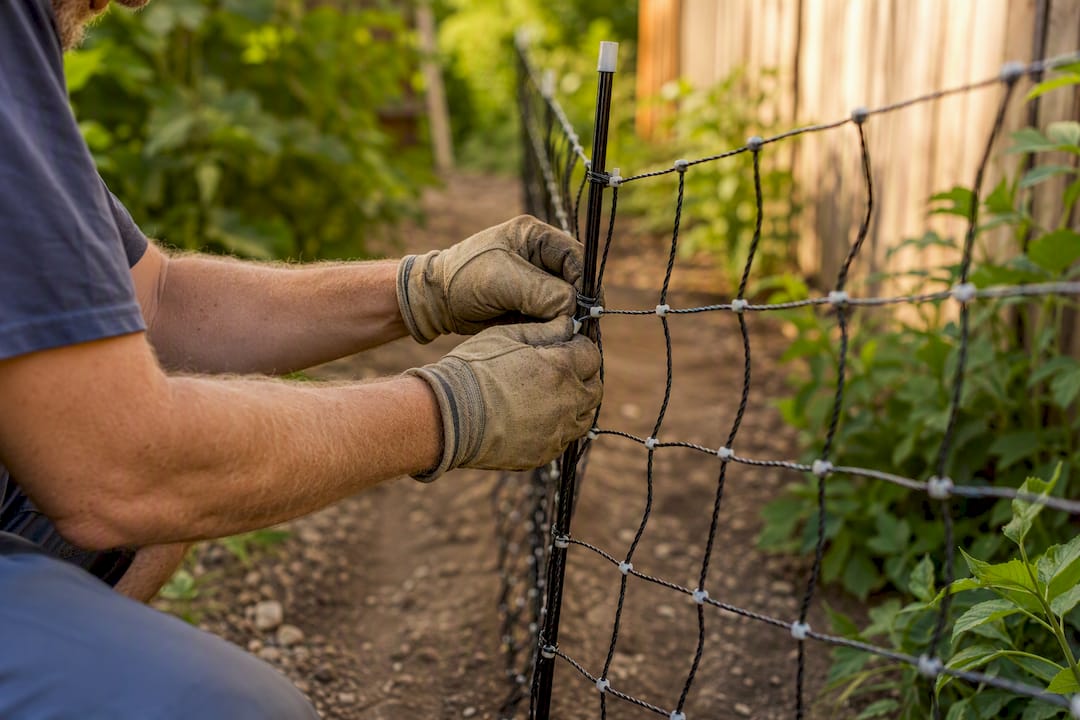
Portable electric netting is the workhorse of rotational grazing. It ships as a roll with integrated posts, sets up in under 15 minutes, and delivers a real predator deterrent through a mild shock. The catch: it needs an energizer, and portable electric netting requires regular maintenance to stay effective, since sagging or grounded-out sections stop delivering current.
Non-electric poultry netting (hex mesh or lightweight plastic mesh) costs less and needs no power source. It’s the easiest option to grab and move on a whim, but it offers no active deterrent, just a physical barrier a determined predator can push through or climb over.

Modular panels and chicken tractors trade some portability for rigidity. Panels connect with pins or hinges into a rectangle or run you can lift and shift as a unit; tractors add a built-in shelter on skids or wheels. Heavier to move, but far more predator-resistant than netting alone.
Semi-permanent panel systems sit at the far end of the spectrum. They stay in one spot for a season or more, only “moveable” in the sense that you can relocate them with enough effort. Best for a run you rotate a couple times a year rather than daily.
- Daily rotational grazing: electric netting
- Garden bed protection: non-electric netting or light panels
- Quarantine or broody pens: small modular panel enclosure
- Predator-heavy properties: electric netting with reinforced skirt, or a fixed run
Weighing the Trade-Offs of Each Fence Type
Portability and predator resistance pull in opposite directions, and that tension defines almost every buying decision in this category.
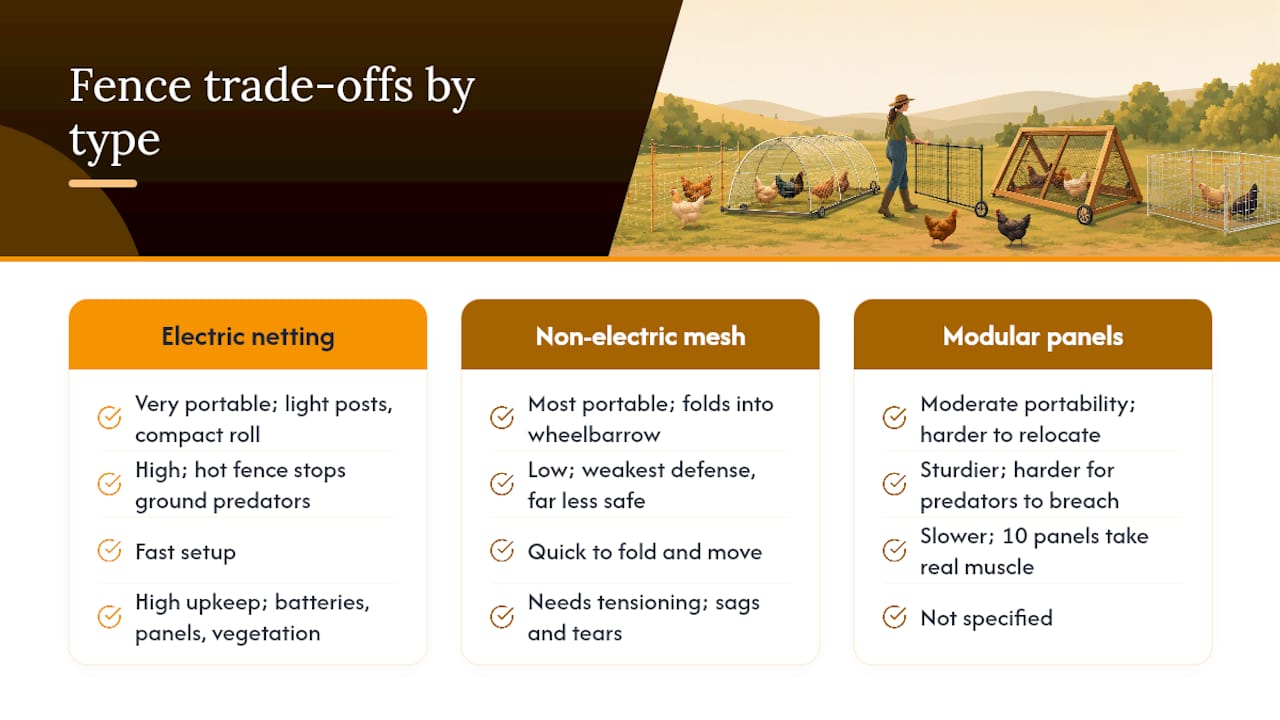
Electric netting wins on setup speed and flock safety but loses points on upkeep. The posts are light, the roll packs down small, and a hot fence stops most ground predators cold. The trade-off is real maintenance: batteries die, solar panels get shaded out, and vegetation grounds out the current if you don’t mow the fence line.
Non-electric hex or plastic mesh is the cheapest entry point and the fastest to fold up and toss in a wheelbarrow. It’s also the weakest defense. Backyard Chickens forum members note that cheap non-electric options are in high demand, but the same threads warn these setups are far less predator-safe than electrified or heavier mesh alternatives. Hex netting also sags and tears with repeated moves if it isn’t properly tensioned.
Modular panels sit in the middle. They’re sturdier and harder for a predator to breach, but a run built from 10 panels takes real muscle to relocate compared to rolling up a net.
Pro Tip: If you’re torn between electric and non-electric netting, buy electric and disconnect the energizer on low-risk days. You get the option of protection without betting your flock on a fence that offers none.
Key Specs and Sizing for a Moveable Chicken Fence
Order the wrong height or mesh size and you’ll be re-fencing within a month, so get these four numbers right before you buy anything.
Height: Go with a minimum recommended height as a baseline. A four-foot minimum is the standard recommendation, but lightweight and flighty breeds routinely clear that with a running start. Leghorns, hybrids bred for high activity, and any bird that’s been startled by a dog once will test a four-foot fence hard. For those breeds, step up to five feet or plan on clipping a wing.
Mesh size: Look for openings small enough to stop a chicken’s head from poking through (roughly 2 to 3 inches or smaller for the lower sections) and tight enough to exclude weasels and small mustelids, which can squeeze through surprisingly small gaps.
Post and gate spacing: Standard electric netting posts land every 12 feet along the roll; for panel systems, check that gate openings are wide enough to wheel a feeder or wheelbarrow through without squeezing.
Ground skirt: A 12 to 18 inch skirt laid flat along the outside of the fence line, pinned down with landscape staples or weighted with rocks, stops diggers before they get started.
- Minimum height: the recommended baseline height, higher for flighty breeds
- Mesh openings: small enough near ground level to prevent poultry escape and entry by small predators
- Post spacing: roughly every 12 feet on standard netting
- Skirt/apron width: 12–18 inches, staked flat
For a full walkthrough of the safety specs that matter most, Fencefast’s guide on essential poultry fencing requirements covers the details buyers most often skip.
Predator-Proofing a Fence That Moves
A moveable fence has one structural weakness a permanent fence doesn’t: it’s rarely buried, so the ground line is where predators focus their effort.
The apron solves most of that problem. A 12 to 18 inch skirt pinned flat against the outside base does double duty: a digging fox or dog hits mesh before it hits open dirt, and it gives up faster than it would against a fence buried the traditional way. The Old Farmer’s Almanac recommends this approach specifically because burying a fence you intend to move again next month isn’t practical.
For climbers and flyers, add a single strand of electrified wire along the top of a non-electric panel setup, or rely on the full-height charge if you’re already running electric netting. Raccoons are the main climbing threat in most regions; a hot top wire stops them faster than height alone.
For side pressure from foxes and coyotes, tighter mesh near the ground and a fully charged perimeter matter more than fence height. Badgers and groundhogs are almost purely a digging problem, which the apron addresses directly.
Pro Tip: If you’re finding fresh digging attempts at the same spot more than twice a week, that’s your sign to stop patching the skirt and start planning a permanent, buried-wire enclosure for that section of yard.
How to Set Up, Tension, and Move a Fence Safely
A clean setup routine prevents the two most common failures: a sagging fence that predators walk through, and a torn net that costs you a full section.
- Walk the intended perimeter first and clear debris, thick grass, and low branches that could tangle netting or ground out an electrified line.
- Place corner posts first, then intermediate posts, pushing each one to full depth. In sandy or loose soil, angle corner posts slightly outward for extra hold; in rocky ground, you may need a step-in post with a wider foot.
- Stretch the netting or panel run between posts before locking it down, correcting slack now rather than after the fence is standing. Hex netting and mesh sag badly without proper tensioning, so this step matters more than it looks.
- Lay the ground skirt flat along the exterior base and pin it every 18 to 24 inches with landscape staples.
- Connect the energizer if you’re running electric netting, and test with a voltmeter before letting birds near it.
When it’s time to move the fence: disassemble in reverse order, pull skirt staples first, then posts, then coil netting loosely to avoid kinking the mesh. Inspect connectors and insulators for cracks while everything’s laid out, and recharge or swap batteries on the energizer before the next setup.
- Clear the path before you plant a single post
- Tension netting before locking posts in place
- Pin the skirt down every 18–24 inches
- Test voltage before releasing birds into a new electric enclosure
Maintenance and Safety Checks for Moveable Fencing
A moveable fence earns its keep only if you check it as often as you move it. Skipping inspections is how a working fence quietly turns into decoration.
For daily rotational setups, a quick visual walk each time you move the fence catches most problems: torn mesh, a leaning post, a skirt corner that’s popped loose overnight. For semi-permanent panel runs, a weekly check is enough, focused on gate latches, connector pins, and ground anchors working loose from weather.
Electric systems need their own routine. Check insulators for cracks, keep grass and weeds trimmed away from the hot line since vegetation is the single most common cause of voltage loss, and test output with a voltmeter at least weekly. A hot-hot (positive-negative) configuration performs better than a single-hot setup on dry, sandy, or frozen ground, since it doesn’t depend on soil conductivity to complete the circuit. Fencefast’s electric fencing guide for chickens breaks down grounding setups in more detail if your soil runs dry for long stretches.
Pro Tip: Keep a cheap voltmeter clipped inside your feed bin. A 30-second test before you walk away from a freshly moved fence beats finding out at 2 a.m. that the line’s gone cold.
Costs and a Buying Checklist for Moveable Fencing
Budget shapes this decision as much as predator risk does, so know roughly what you’re getting for your money before you shop.
Entry-level non-electric netting is the cheapest way into moveable poultry fencing, though quality varies enormously and cheap hex mesh tends to sag and tear within a season or two. Mid-range portable electric netting costs more upfront because you’re also buying an energizer, but it delivers active predator deterrence that non-electric mesh simply can’t. Heavier modular or semi-permanent panel systems sit at the top of the price range, justified by durability and resistance to determined predators rather than portability.
Prioritize your budget in this order:
- Correct height and a real ground skirt, non-negotiable regardless of fence type
- Sturdy, properly spaced posts that won’t lean under wind or bird pressure
- Gates wide enough for your equipment, not just your body
- Energizer output matched to your fence length, with battery or solar backup if power access is unreliable
Buy new for netting, posts, and energizers, since failure points here directly affect flock safety. Secondhand panels, gate hardware, and support stakes are usually fine if they’re not rusted through.
Matching the Fence to Your Use Case
The right fence depends on four questions: how much predator risk you’re facing, how often you’ll move it, how many birds you’re containing, and what your ground looks like underfoot.
For daily rotational grazing on pasture, portable electric netting at four to five feet with a full skirt is the standard setup, moved to fresh ground every one to a few days. For garden bed protection, where you’re keeping birds out rather than predators away, lightweight non-electric netting or short panels do the job without the hassle of an energizer. For quarantine or a broody hen, a small modular panel enclosure, easily moved to a shaded or sheltered spot, beats netting because it’s more contained and easier to check on.
Pro Tip: When in doubt, size up on predator protection and down on portability. A fence you move less often but trust completely beats one you move daily and worry about every night.
What Working Fence Installers Know That Manuals Don’t
Three habits separate a fence that performs from one that just gets installed. First, test energizer output with a voltmeter every time you relocate a fence, not just when something seems wrong; voltage drops silently long before it fails visibly. Second, mark posts with bright flagging tape before you take a fence down, so reassembly in a new spot doesn’t turn into guesswork. Third, store netting out of direct UV exposure between uses. Sun exposure breaks down the plastic in mesh and netting faster than daily handling ever will.
Fencefast has spent over two decades supplying fencing hardware to Canadian farms and rural properties, and that experience shows up in the small details, like insulator quality and post durability, that separate fencing that lasts from fencing that needs replacing every other season. If you’re planning a system from scratch, Fencefast’s design consulting can help you match specs to your actual property before you order a single roll.
A Practical Note on Priorities
I’d rather see a keeper spend an extra week researching predator behavior than an extra hour comparing prices between two similar nets. The fence that saves your flock is the one built for the threat you actually have, not the cheapest one that technically qualifies as a fence. If you want help sizing a system to your property, Fencefast’s design consulting is worth a conversation before you buy.
Get Your Moveable Fencing Sorted Before the Next Predator Test
Fencefast sells the two things that actually matter in this category: fencing hardware built to hold voltage and shape after repeated moves, and design advice that tells you what specs your specific property needs before you spend a dollar. Fencefast’s portable livestock fence solutions cover the lightweight posts, gates, and flexible layouts that make daily relocation manageable rather than a chore, and the site’s electric fencing guide for chickens walks through energizer and grounding choices for properties with dry or sandy soil.

Whether you’re setting up your first rotational paddock or replacing hex netting that’s torn through for the third time, Fencefast’s shop has the posts, netting, and energizer components in stock with nationwide shipping, and the design consulting team can help spec out a full system for your specific predator risk and flock size. Start with a quick look at what’s available for your setup and get a system that’s built to last more than one season.
Frequently Asked Questions
How tall does a moveable chicken fence need to be? Four feet is the standard minimum. Flighty or lightweight breeds often clear four feet easily, so plan on five feet or wing clipping if your flock includes active flyers.
How do I stop chickens from escaping a portable fence? Height is the first fix, but stressed or bored birds are more likely to test a fence they’d otherwise ignore. Give them enough space and enrichment inside the enclosure, and clip one wing on persistent flyers if raising the fence isn’t practical.
What if I don’t want a permanent fence at all? Portable electric netting or modular panels give you full flexibility without pouring a single post in concrete. You lose some of the ruggedness of a fixed run, but you gain the ability to rotate pasture and rearrange your yard as needs change.
Do I really need an electrified fence, or will non-electric netting work? It depends entirely on your local predator pressure. Non-electric netting works fine for garden protection or low-risk yards, but it offers no active deterrent, so anywhere with regular fox, raccoon, or loose-dog activity calls for an electrified option.
Sources
- A Fence for Chickens - Backyard Poultry
- How to Build a Predator-Proof Chicken Run | The Old Farmer’s Almanac
- Chicken Fencing | Keeping Chickens: A Beginners Guide
- Do they make a cheap NON electric movable poultry fencing?

