

For most livestock operations, the best portable fence idea is a polywire or polytape setup on step-in posts, paired with a mobile water point, for daily or weekly paddock moves. If your budget and cell coverage allow it, GPS virtual fencing beats physical fence for large or remote acreage. The evidence for pairing fence with water is blunt: pasture beyond 800 to 1,000 feet from a water source gets poorly grazed, no matter how good your fence is.
Here’s the one-line decision rule:
- Small herd, tight labor: electric netting or 6-strand polywire on step-in posts.
- Larger cattle operation, wide paddocks: 9-strand polywire or polytape on geared reels.
- Remote or rugged terrain, hundreds of acres: virtual fencing collars, if the upfront cost pencils out against building miles of physical fence.
Key Takeaways
Portable electric fencing paired with mobile water solves most rotational grazing problems at low cost, while virtual fencing pays off once physical fence mileage gets expensive.
| Point | Details |
|---|---|
| Match fence to distance needs | Six-strand polywire holds charge to about half a mile; 9-strand extends to three-quarters of a mile or more. |
| Water drives pasture use | Grass beyond 800 to 1,000 feet from water gets grazed poorly no matter how good the fence is. |
| Energizer size matters most | A 12-volt battery or solar energizer sized for vegetation load prevents the most common fence failures. |
| Weigh labor against capital cost | Physical fence runs upward of $15,000 per mile, so virtual fencing can be cheaper on large, remote acreage. |
| Fencefast supplies both paths | Fencefast sells polywire, energizers, reels, and mobile water gear, plus Gallagher virtual fencing as an authorized dealer. |
Table of Contents
- Top Portable Fence Ideas and Where Each One Fits
- What Equipment Do You Need to Set Up Portable Fencing?
- How Do You Choose the Right Portable Fence for Your Farm?
- Training Livestock and Keeping the Fence Safe
- Pairing Mobile Water With Your Portable Fence
- What Portable Fencing Actually Teaches You Over a Season
- How Fencefast Can Help You Build Your Portable Fencing System
- Sources
Top Portable Fence Ideas and Where Each One Fits
Not every portable fence idea suits every farm. Here’s a working rundown of the systems ranchers actually use, and where each earns its keep.
Polywire (6-strand or 9-strand) is the workhorse of rotational grazing. Six-strand wire holds a charge effectively up to about half a mile, while 9-strand extends that to three-quarters of a mile or more, according to Mississippi State’s fencing guide. It’s light, cheap, and fast to roll out for strip grazing, but voltage drops over distance, so long runs need a stronger energizer.
Polytape (6 filaments or more) trades a little conductivity for visibility. Cattle and horses see the wide tape far more easily than thin wire, which shortens training time. The trade off is durability: tape typically lasts 5 to 7 years versus up to a decade for well-maintained polywire, mostly because wind abrasion frays the ribbon faster than round wire.
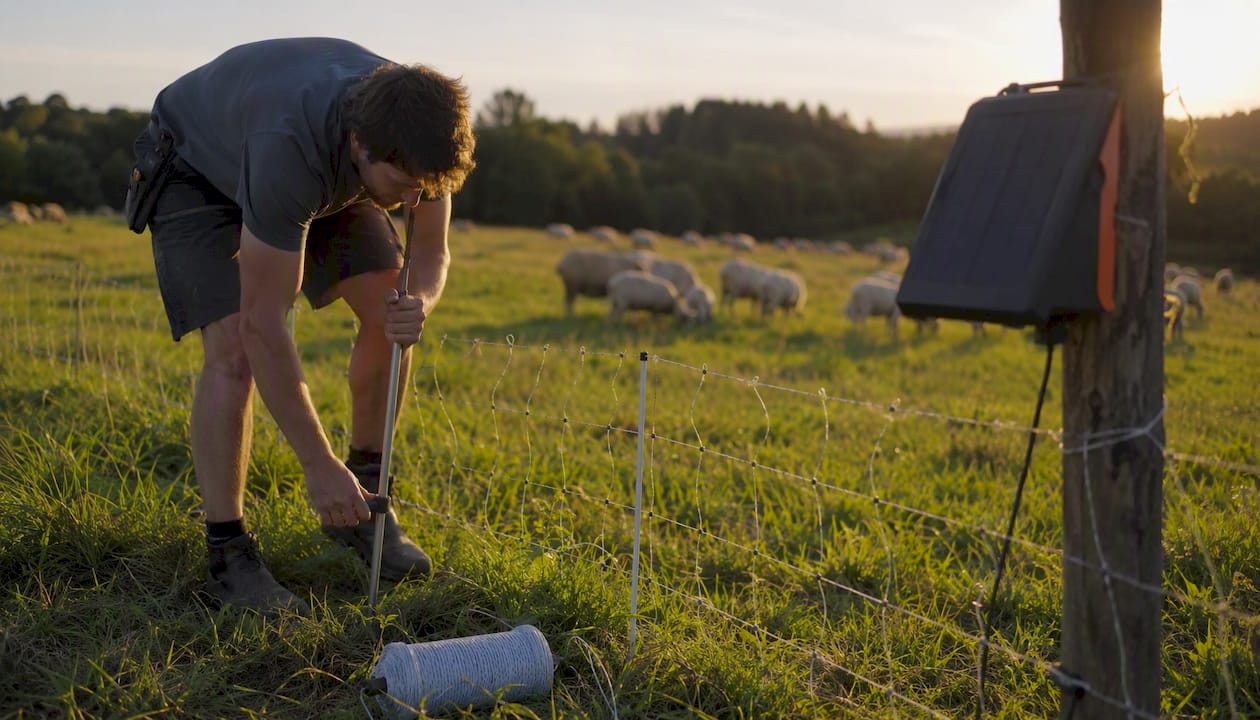
Electric netting is the fastest way to build a full paddock from scratch. It’s the go-to for sheep, goats, and even lightweight cattle work where you need a physical boundary on all four sides in twenty minutes, not just a couple of strands.
Corral panels and portable gates aren’t for grazing rotation. They’re for the jobs where netting and wire fall short: loading chutes, sorting pens, or holding animals for a few hours during processing.
Step-in posts and fiberrod posts are what make any of the above genuinely portable. A crew that’s practiced can move a quarter-mile of polywire on step-in posts in under fifteen minutes. Fiberglass rod posts add rigidity for corners and longer runs where step-ins alone would sag.
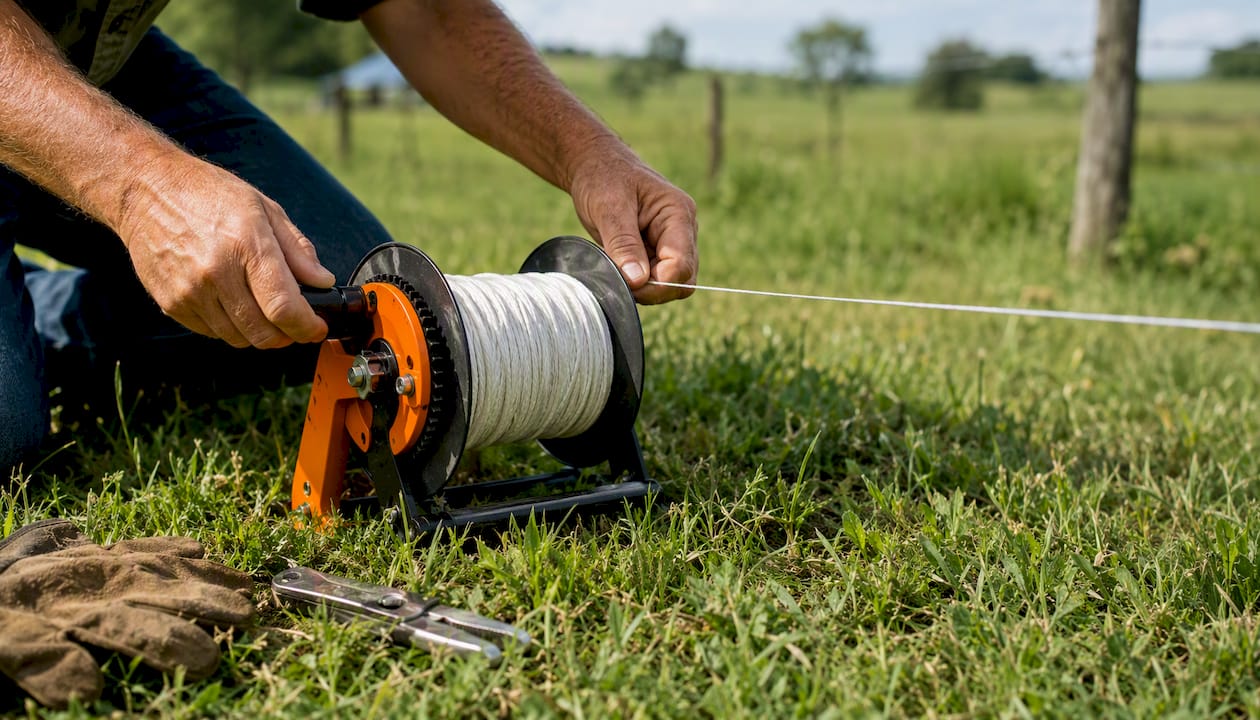
Reels determine how fast that move actually happens. A basic 1:1 reel works fine for short, infrequent moves. Geared reels, especially 3:1 retrieval models with a cog-and-lock lever, cut winding time dramatically and stop wire from unspooling itself in the truck bed, per Iowa Beef Center’s portable fencing guide.
Virtual fencing (GPS collars) belongs on the list once your operation outgrows what wire and posts can efficiently cover. It skips physical infrastructure entirely and lets you draw and redraw paddock lines from an app, which matters most on rugged or remote ground where running interior fence is genuinely painful.
Pro Tip: Match your reel to your paddock width before you buy, not after. A 1,000-foot reel is dead weight if you’re only moving 200 feet of wire at a time, and it’s the wrong tool if your paddocks stretch a quarter mile.
What Equipment Do You Need to Set Up Portable Fencing?
Get the power source wrong and nothing else on this list matters. An underpowered energizer is one of the most common reasons a portable fence fails to hold livestock, especially once summer grass starts touching the line and bleeding off charge.
Energizers should be sized for worst-case vegetation, not clean-fence conditions. A 12-volt battery or solar-capable energizer generally outperforms smaller mains units once wire length and weed contact climb, because it has the reserve output to push through that resistance instead of shorting out.
Power sources break down into three practical categories: mains power for fixed perimeter work, deep-cycle battery units for remote paddocks, and solar-charged batteries for sites you’ll be running for weeks or months without access to an outlet.
Reels, posts, and insulators round out the kit. Step-in posts handle most flat, moderate ground; fiberrod posts and dedicated anchor posts take the strain at corners and gate ends where tension is highest. Insulators matter more than people think. A cracked or UV-degraded insulator is a slow, silent power leak that’s hard to spot without a tester.
Grounding is the piece most new users skip, and it’s the piece that causes the most head-scratching troubleshooting later. A poor ground system can cut effective fence voltage in half even with a strong energizer.
| Component | Recommended spec range |
|---|---|
| Energizer | 12V battery or solar, sized above minimum for vegetation load |
| Polywire reel | Geared (3:1) for frequent moves, 1:1 for occasional use |
| Wire capacity per reel | Match to typical paddock width, not maximum spool size |
| Ground rods | Multiple rods, especially in dry or sandy soil |
Pro Tip: Carry a fence tester every time you check the herd. It turns a 45-minute hunt for a short into a two-minute walk down the line.
How Do You Choose the Right Portable Fence for Your Farm?
The right system depends on six factors working together, not any single one in isolation:
- Herd size and species — sheep and goats need netting; cattle can often run on wire alone once trained.
- Terrain and vegetation — heavy brush demands more energizer output and shorter wire runs.
- Paddock size and move frequency — daily moves favor light, fast setups like electric netting on step-ins; weekly moves can justify longer polywire runs.
- Water availability — if water sits more than 800 to 1,000 feet from the paddock, plan a mobile water solution alongside the fence, not after it.
- Labor availability — a one-person operation should weight everything toward speed of setup and teardown.
- Budget and long-term costs — physical fence is cheap per foot but adds up in labor over years; virtual fencing flips that equation.
Picture three farms. A small sheep operation running forty ewes on eight acres does best with electric netting, since fast full-boundary setup matters more than distance. A 200-head cow-calf operation crossing large hay fields does better on 9-strand polywire and geared reels, where the cost per mile stays low even across long runs. A remote ranch with cattle spread across rugged, brushy quarter sections might make more economic sense running virtual fencing collars, since building a 4-wire metal fence has become very expensive to install per mile. and that gap only grows on difficult terrain.
Training Livestock and Keeping the Fence Safe
Animals that meet a hot wire early, ideally as calves or during routine handling, generally respect a single strand for the rest of their lives. That early lesson is what lets you run lighter, more portable materials later instead of heavier permanent fence.
Build a short maintenance habit into your rotation:
- Walk the line before every move and clear vegetation touching the wire.
- Check insulators for cracks, especially after storms.
- Test battery voltage or solar output monthly during grazing season.
- Winterize water lines and freeze-prone components before the first hard frost.
Pro Tip: Post visible warning signage anywhere a portable fence crosses near a public road or trail, and avoid setting up new low-visibility tape lines right before dusk. Both are cheap insurance against a very bad phone call.
Pairing Mobile Water With Your Portable Fence
A fence without water nearby just moves the underused-pasture problem instead of solving it. Here’s a simple sequence for getting water where the animals actually are:
- Run aboveground PE pipe (3/4 or 1 inch) with quick couplers from your main line to the new paddock.
- Set a portable trough on runners or a small wagon so it moves with the fence in minutes, not hours.
- Where there’s no pressurized line, use a gravity-fed reservoir or a solar-powered pump kit pulling from surface water.
Solar pump kits work well for low-demand setups, generally under 2,000 gallons a day with modest lift, which covers most single-paddock rotations without needing a generator on site.
Cold country adds one more step. A Freeze Miser or similar temperature-actuated valve keeps exposed lines from bursting once temperatures drop, and it’s far cheaper than replacing split pipe every spring.
- Locate troughs on firm, well-drained ground to cut trampling near the water point.
- Move the trough slightly with each rotation instead of letting animals wear one spot bare.
Pro Tip: Site your water point at the paddock’s edge closest to your pipeline, not dead center. It shaves real time off every future move.
What Portable Fencing Actually Teaches You Over a Season
The biggest trade-off in portable fencing isn’t cost versus quality. It’s labor versus capital: cheap wire saves cash but costs you time every single move, while virtual fencing flips that trade in the other direction.
Try tracking your own move time for two weeks straight. That number tells you more than any spec sheet.
How Fencefast Can Help You Build Your Portable Fencing System
Whether you’re stringing your first quarter mile of polywire or scoping out GPS collars for a few hundred head, Fencefast carries the gear that makes portable fencing actually portable: energizers sized for real vegetation loads, polywire and polytape, geared reels, step-in posts, and mobile water kits built for quick paddock changes.
As an authorized Gallagher dealer with 26 years in the business, Fencefast also supports virtual fencing deployments directly, including the eShepherd collar system, base station setup, and app-based herd management for operations ready to move past physical interior fence. If you’re not sure whether your farm needs a stronger energizer, a different reel, or a full switch to virtual boundaries, visit Fencefast to browse portable fencing categories or request design consulting before you buy a single roll of wire.
Sources
- Using Temporary Watering and Fencing in a Rotational Grazing System
- Virtual Fencing Using E-Collars vs. Physical Fencing Cost Comparison on New Mexico Cattle Ranches
- Livestock Fencing Systems for Pasture Management

