

For daily rotational moves, polywire or polytape with step-in posts is the fastest, most cost-effective portable livestock fencing for cattle. For sheep and goats, electric netting or multi-strand polytape does a better job of containing animals that test fences low and often.
Your starter kit by situation:
- Cattle, rotational grazing: 1 joule AC or solar energizer, a suitable length of polywire based on the paddock size, an appropriate number of ring-top step-in posts for your layout, 1 geared reel
- Sheep and goats: Premier1 Cattle QuikFence electric netting (164-foot rolls), a 1–2 joule energizer, and a reel stand like a TaraPost
- Horses or untrained stock: White Gallagher polytape (1.5-inch or wider), step-in posts, and a high-output energizer
- Emergency containment or handling: Portable galvanized panels (portable galvanized panels of typical size for handling and containment) as a physical barrier, no energizer needed
Size your energizer generously. Polywire and polytape carry more resistance than high-tensile wire, so a fence that looks like 2 miles of single strand may load your energizer like 4 miles once you account for multiple strands and vegetation contact. When in doubt, go one size up.
Pro Tip: Train cattle on a hot wire before you rely on a single-strand polywire system. Untrained animals will walk through it the first time they feel pressure from the herd.
Key Takeaways
Temporary livestock fencing works best when you match wire type to species, size the energizer to total fence load, and train animals before relying on lighter single-strand systems.
| Point | Details |
|---|---|
| Match wire to species | Polywire for trained cattle; polytape for horses; electric netting for sheep and goats. |
| Size energizer by load | Multiply strands by linear feet; polywire carries more resistance than steel, so size up. |
| Train stock first | One session in a small pen with a hot wire prevents most field escapes with lighter systems. |
| Prioritize grounding | Three or more ground rods, spaced 10 feet apart, prevent the most common cause of fence failure. |
| Pair water with fencing | Plan portable water access for every paddock; a paddock without water can’t be used in rotation. |
Table of Contents
- What types of temporary livestock fence work best for your animals?
- What components does every portable fencing system need?
- How do you choose the right energizer and grounding setup?
- How to set up a temporary electric fence step by step
- Why fence visibility and animal training determine whether lighter systems hold
- Routine maintenance, common faults, and quick fixes
- How much fence do you need, and what does it cost?
- Your buying checklist by herd size
- Research-backed evidence: how temporary fencing improves grazing and farm economics
- Preventing escapes: what works for each animal type
- What working farmers actually learn after a few seasons
- Ready to build your portable fencing kit?
- Sources
What types of temporary livestock fence work best for your animals?
Matching the right fencing type to your animals and terrain is the single decision that determines whether a portable system holds or fails.
Polywire
Polywire is the workhorse of rotational grazing. It’s light, spools fast onto a geared reel, and costs less per foot than any other electrified option. The tradeoff is visibility: polywire is thin and hard for animals to see, especially in low light or against tall grass. Cattle that have been trained to respect a hot wire will honor it. Untrained stock, horses, and small ruminants often don’t see it until they’ve already pushed through.
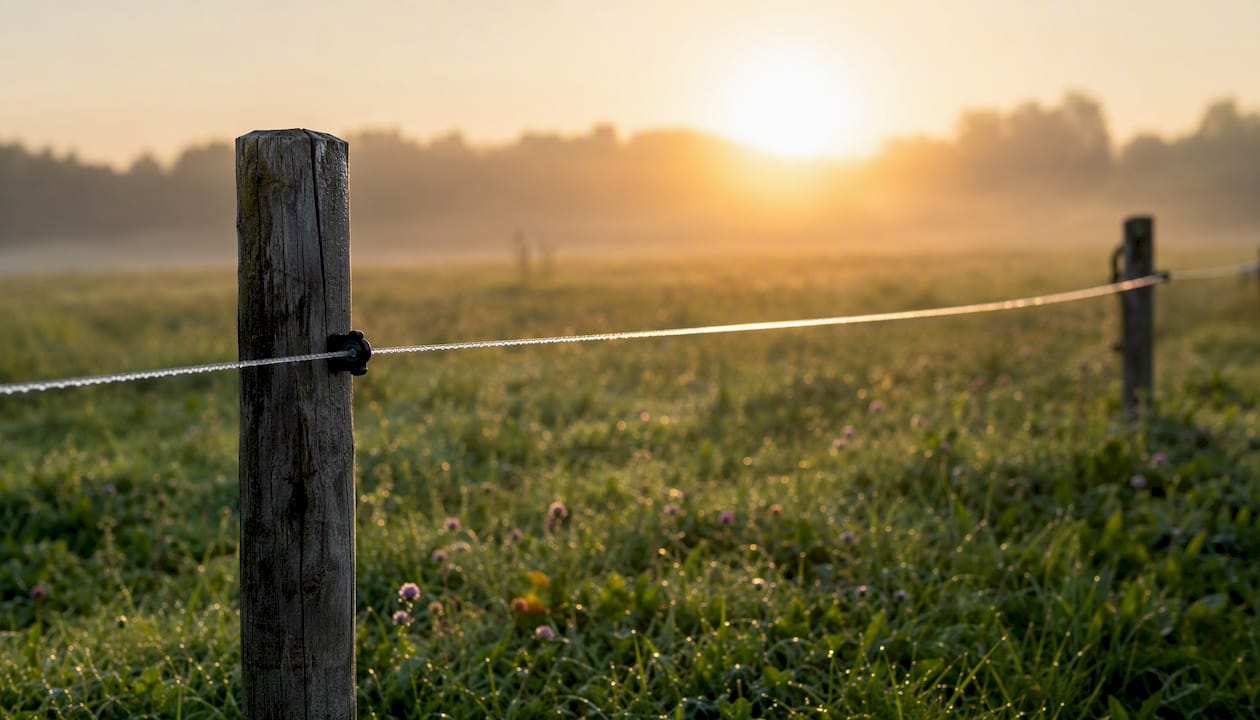
Effective powered distance on polywire is shorter than on steel wire because of higher conductor resistance. Long runs (over 1,500 feet of single strand) benefit from a permanent perimeter hot wire that you tap into, rather than running all the power from one end. Virginia Tech’s extension guide on rotational grazing systems recommends exactly this approach for large paddock layouts.
Polytape
Gallagher polytape and similar products trade some portability for visibility. The wide white or yellow tape is easy for animals to see, which matters enormously for horses and any stock you’re moving into a new paddock for the first time. It’s also more wind-resistant than polywire at lower tensions. The downside: it tangles more easily than polywire if you rush the reel-in, and it degrades faster under UV exposure over multiple seasons.
Use polytape as your first strand when training new animals, or as the primary wire for horses. A single strand of 1.5-inch white tape at nose height is often enough to hold a trained horse that would walk through polywire without hesitation.
Electric netting
Premier1’s Cattle QuikFence and similar electric netting products are the go-to for sheep, goats, and young calves. The netting stands 35–42 inches tall with multiple horizontal strands, which closes off the low gaps that small ruminants exploit. Setup takes longer than single-strand systems, roughly 15–20 minutes per 164-foot roll versus 5 minutes for a polywire run, but the containment reliability for goats in particular is worth it.
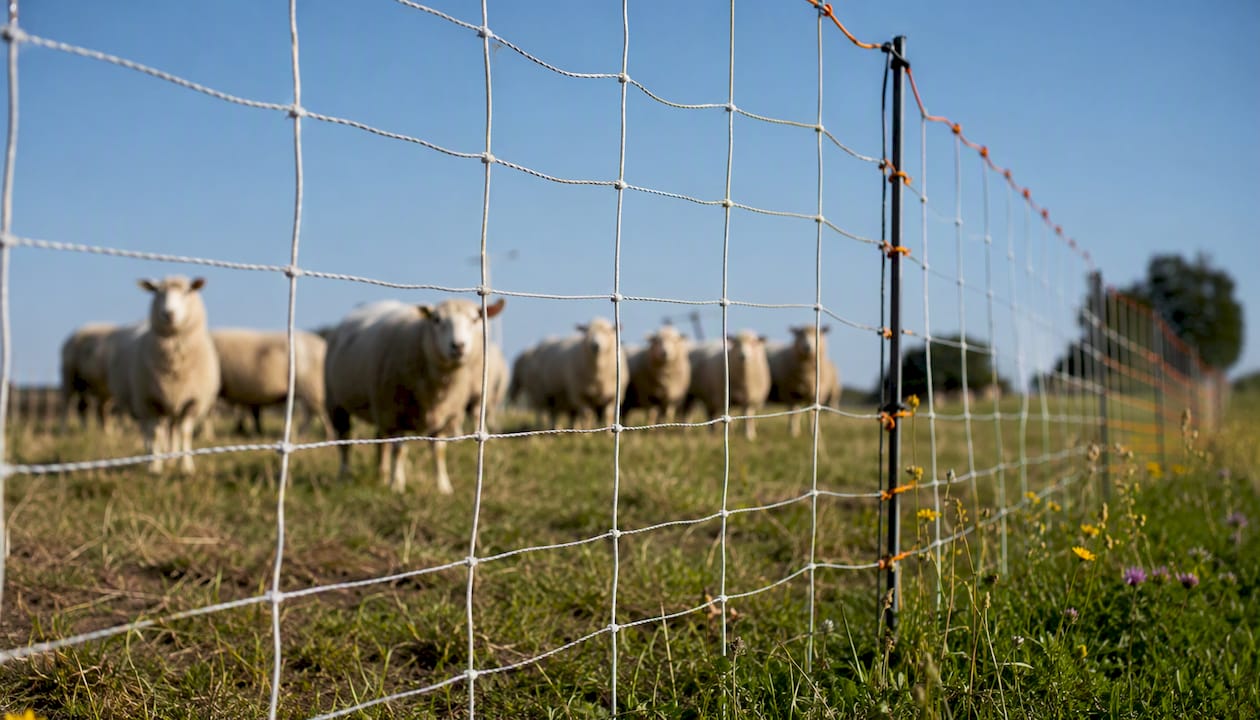
The main hazard with netting: animals can get tangled in it if the voltage drops. Keep the energizer sized up and the netting taut. Sagging netting is a trap.
Portable panels
Galvanized portable panels (also called cattle panels or corral panels) are a physical barrier, not a psychological one. They don’t need an energizer, they hold calves and aggressive animals that electric fencing won’t, and they’re the right choice for crowding pens, loading areas, and temporary handling facilities. They’re heavy, they take a truck to move, and they’re expensive per linear foot compared to wire systems. Use them where you need absolute containment, not where you need to move fence every day.
Species-fit summary:
- Cattle (trained): Single-strand polywire, 1–2 strands polytape
- Cattle (untrained/calves): 2–3 strands polywire or polytape, or netting
- Sheep: Electric netting, or 3–4 strands polywire starting low (6 inches off ground)
- Goats: Electric netting only; they will find every gap in a strand system
- Horses: Wide polytape, high-output energizer, never polywire alone
- Mixed herds: Netting for the small ruminants, add a polytape strand above for cattle
What components does every portable fencing system need?
Getting the hardware right saves you from the most common field frustrations: posts that won’t stay in hard ground, reels that jam mid-run, and connectors that corrode and bleed voltage.
Posts:
- Ring-top step-in posts (O’Brien style) accept polywire or polytape through the ring without threading, which makes moving fence fast. They work well in soft to medium soils.
- Tapered step-in posts with integrated insulators are more stable in loose or sandy soils and hold multiple wire heights for multi-strand setups.
- Carry a post driver for hard or rocky ground. Trying to step in posts by hand on a dry August day will break posts and your patience.
Reels:
A geared reel with a 3:1 retrieval ratio winds wire three times faster than a basic spool and dramatically reduces the time and arm fatigue of daily moves. The locking mechanism matters as much as the gear ratio. Cheap plastic locks crack in cold weather and let the reel spin free mid-run, dumping your wire on the ground. Taragate and TaraPost reel stands hold the reel upright at the end post, which keeps it off the ground and makes one-person operation practical. Look for a reel rated for the wire diameter you’re using — a reel designed for polywire will bind on polytape.
Pro Tip: Mount your reel on an ATV rack or a TaraPost stand at the anchor post. Walking backward while winding is slower and harder on your back than letting the reel do the work from a fixed point.
Other components to have on hand:
- Bungee gate handles (at least 4 per paddock) for quick entry and exit without disconnecting the wire
- Polywire connectors and laces for joining rolls end-to-end
- Jumper leads to tap temporary lines into a permanent perimeter hot wire
- Insulated end fittings to terminate polywire at the reel anchor post
- Spare insulators for any permanent posts you’re clipping temporary lines to
How do you choose the right energizer and grounding setup?
The energizer and ground system are where most temporary fences fail. Get these right and everything else is manageable.
According to Alabama Cooperative Extension, a complete electric fence circuit has three parts: the energizer, the hot wire, and the ground. Weak grounding is the most common cause of a fence that tests low even when the energizer is working fine.
Energizer types
AC (plug-in) energizers deliver the most consistent output and are the right choice for a barn-based system where you’re running temporary lines out from a permanent perimeter wire. They’re not portable in the field sense, but they’re the most reliable and cost-effective per joule.
12V battery energizers run off a standard deep-cycle battery and are genuinely portable. A fully charged 100Ah battery will run a 1-joule energizer for several weeks between charges. They’re the standard choice for paddocks more than 500 feet from a power outlet.
Solar energizers combine the battery and charger in one unit. They work well in sunny climates from spring through fall. In cloudy winters or heavily shaded pastures, they underperform. A solar unit with a built-in battery backup handles a few overcast days without issue; a solar panel alone does not.
Sizing rules
Energizer output is rated in joules (stored energy) and miles of fence. Those mile ratings assume a single strand of steel wire with no vegetation contact. For polywire or polytape, cut the rated distance roughly in half. For multi-strand systems, divide by the number of strands. A fence with 3 strands of polywire running 1,000 feet loads the energizer like 3,000 feet of single-strand wire.
Pro Tip: Test voltage at the farthest point from the energizer, not at the connection. You want at least 3,000 volts at the end of the line for cattle, and 4,000+ for goats and horses. Use a digital fence tester, not a blade of grass.
Grounding
Drive at least three 6-foot galvanized ground rods, spaced 10 feet apart, connected in series with ground wire. In dry soils, add more rods or water the ground around them. Never share a ground rod with a building’s electrical system. Separate the fence ground from any mains ground by at least 50 feet.
For temporary lines tapped into a permanent perimeter wire, the perimeter’s ground system covers the temporary run. For isolated portable setups, the portable energizer needs its own ground rods at the energizer location.
How to set up a temporary electric fence step by step
One person can set up a 1,000-foot paddock in under 30 minutes once the system is familiar. Here’s the sequence that works.
Before you start:
- Confirm water access is inside the new paddock or plan a portable trough
- Walk the line and flag any obstacles (wet spots, brush, utility lines)
- Check that your energizer is charged or plugged in and your reel is wound
Setup steps:
- Anchor the reel post. Drive a sturdy step-in post or T-post at the starting corner. Attach the TaraPost or reel stand. This is your tension anchor.
- Attach the wire to the reel post. Use an insulated end fitting or lace the polywire through the ring-top insulator and tie off.
- Walk the line. Carry the reel and step in posts every 30–50 feet. On corners, use a corner post with an insulator to redirect the wire without losing tension.
- Complete the rectangle. Return to the anchor post and attach the wire end to the reel. Apply light tension — polywire should be taut but not stretched tight.
- Install gate handles. Clip bungee gate handles at each entry point. They double as tension relief on long runs.
- Connect to the energizer. Attach the hot lead from the energizer to the wire. Attach the ground lead to your ground rods.
- Test voltage. Walk to the farthest post and test with a digital tester. For cattle, you want 3,000 volts minimum. If you’re reading below that, check for vegetation contact and ground rod connections before assuming the energizer is undersized.
- Move animals in. Open the gate handle, move stock, close it. Watch them for the first 10 minutes.
Temporary fencing for pasture management (UGA Extension) notes that vegetation contact and dry soils are the two most common causes of voltage drop, so clearing a strip under the wire before setup pays off on problem pastures.
Teardown: Wind the wire back onto the reel before pulling posts. Pulling posts first leaves wire on the ground where it tangles in equipment and gets damaged. Store reels off the ground in a dry location.
A properly sized and grounded energizer should deliver consistent voltage even in wet conditions. If yours doesn’t, the ground system is the first place to check, not the energizer.
Why fence visibility and animal training determine whether lighter systems hold
A single strand of polywire at 5,000 volts will hold a herd of trained cattle all day. That same wire will fail against untrained yearlings in 20 minutes. The difference isn’t the hardware.
High-visibility materials like white polytape or bright-colored polywire improve livestock acceptance and reduce accidental contact, especially when animals are moved into a new paddock. White tape against green grass reads clearly to cattle. Polywire against a brown winter pasture is nearly invisible.
Training untrained cattle
Run a single strand of polytape across a small pen at nose height, connected to a working energizer. Let animals approach it on their own. One solid contact is usually enough to establish respect. Do this before you rely on a single-strand system in a large open paddock. Trying to train animals in the field, where they can run through the fence and keep going, teaches them the wrong lesson.
For small ruminants, training is harder because goats and sheep test fences low and persistently. Electric netting works because it presents a physical barrier at multiple heights simultaneously, not because goats suddenly respect electricity.
Daily routines that reinforce fence respect
Move animals at the same time each day. Hungry animals moved to fresh grass are focused on grazing, not fence-testing. Animals that have been standing in a grazed-out paddock for too long get bored and start pushing. Frequent moves on a consistent schedule are the single best behavioral management tool you have.
Pro Tip: Flag the ends of your temporary fence runs with surveyor’s tape or orange flagging. It helps you see the fence line from a distance, helps visitors avoid walking into it, and makes it easier to spot a post that’s been knocked over.
Routine maintenance, common faults, and quick fixes
Most temporary fence failures come down to three things: vegetation shorting the wire, a poor ground connection, or a broken connector. All three are easy to find and fix if you’re checking regularly.
Common faults and fixes:
- Low voltage at the tester: Walk the line and look for grass or weeds touching the wire. Clear vegetation under the wire with a string trimmer or herbicide strip. If clearing vegetation doesn’t fix it, test the ground rods next.
- No voltage at all: Check the energizer display. If it shows output, the fault is in the wire or connections. Walk from the energizer outward, testing every 200 feet, until voltage drops. The fault is between the last good reading and the next one.
- Intermittent voltage: Usually a loose connector or a lace that’s worked loose at a junction. Check every splice point.
- Good voltage at the energizer, poor voltage at the far end: Long polywire run with high resistance. Add a jumper from the permanent perimeter hot wire mid-fence, or shorten the run.
Use a digital fence tester, not a neon tester or a blade of grass. A digital tester gives you an actual voltage reading so you can track whether a fence is degrading over time, not just whether it’s on or off. UGA Extension’s pasture management guide recommends testing at the farthest point from the energizer as your standard check.
Seasonal notes:
- In winter, frozen ground dramatically increases soil resistance and reduces grounding effectiveness. Drive extra ground rods in a low spot where soil stays moist, or use a ground-return wire system (a second wire connected to the energizer’s ground terminal) to complete the circuit through the fence itself rather than through the soil.
- Remove polywire and netting before heavy snow loads accumulate. Snow weight breaks posts and stretches wire.
- UV degradation shortens polywire life. Store reels indoors between grazing seasons.
Pro Tip: Keep a repair kit in your truck: a spool of polywire, 6 spare step-in posts, a handful of connectors, a gate handle, and a digital tester. A 10-minute repair in the field beats a 2-hour livestock roundup.
How much fence do you need, and what does it cost?
Sizing your system
To size your energizer, calculate total energized wire length: multiply the linear feet of fence by the number of strands. Calculate total energized wire length by multiplying linear feet by the number of strands; add extra length for connectors and resistance.
For rotational grazing, you’ll typically be running 4–8 paddocks simultaneously. Size your energizer for the total wire you’ll have energized at once, not just one paddock.
Cost categories
When temporary fencing makes financial sense:
- Strip grazing and rotational systems where paddock boundaries change weekly
- Emergency repairs while permanent fence is being rebuilt
- Subdividing large permanent paddocks without digging posts
- Seasonal grazing on leased or rented land
When you’re fencing the same line year-round for 10+ years, permanent high-tensile wire costs less over time. Temporary systems earn their keep through flexibility, not longevity.
Durability and disposal: Quality polywire lasts 5–10 seasons with proper storage. Cheap polywire degrades in 2–3. Polytape has a similar lifespan but is more susceptible to UV damage if left out year-round. Electric netting typically lasts 7–10 years with careful handling. Poly products are generally not recyclable through standard municipal programs; check with your county extension office or agricultural waste programs for disposal options.
Your buying checklist by herd size
Small hobby herd (1–10 head, cattle or mixed)
- 1-joule solar or battery energizer
- a length of polywire or polytape suitable for the paddock size
- a reasonable number of ring-top step-in posts
- 1 geared reel
- 4 bungee gate handles
- 3 ground rods and ground wire
- Digital fence tester
Mid-size commercial operation (10–50 head)
- an AC or solar energizer with a suitable joule rating and battery backup
- a length of polywire suitable for the number of paddocks
- an appropriate number of step-in posts
- 2–3 geared reels
- multiple gate handles for quick fence access
- several ground rods spaced appropriately
- Jumper leads for tapping permanent perimeter wire
- Spare connectors and laces
Larger cattle groups (50+ head)
- 3–5 joule AC energizer on a permanent perimeter hot wire
- Polywire for subdivision lines, tapped into the perimeter
- a large number of step-in posts appropriate for extensive fencing
- multiple geared reels on appropriate stands
- a portable 12V backup energizer for isolated paddocks
- Full repair kit in the field vehicle
Where to invest vs. where to save:
- Invest: Energizer and reels. A cheap energizer that underperforms costs you in escapes and fence failures. A cheap reel that jams costs you time every single day.
- Save carefully: Some polywire brands are comparable to premium brands at lower cost. Test a roll before buying 10.
- Upgrade for daily moves: Add a second reel so one is always wound and ready while you’re deploying the other.
Research-backed evidence: how temporary fencing improves grazing and farm economics
Temporary fencing works because it changes animal behavior at the pasture level. When you subdivide a large paddock into smaller strips, cattle graze more uniformly instead of selectively grazing the best plants and trampling the rest. That uniform grazing pressure, followed by adequate rest, produces more forage per acre over a season than continuous grazing on the same land.
Virginia Tech’s extension research frames temporary electric fencing as primarily a psychological barrier, and that framing matters: the fence doesn’t need to be physically strong, it needs to be reliably hot and consistently respected. Moving animals every one to three days maximizes forage utilization and keeps animals on fresh grass, which improves daily gain and reduces parasite pressure.
The labor math works out better than most farmers expect. NC State Extension’s “power of one wire” research documents that producers who move temporary fences regularly report reduced hay feeding costs and better daily livestock monitoring as direct offsets to the time spent moving fence. The daily check-in that comes with moving animals becomes an animal health inspection by default.
Water access is the constraint that limits how intensively you can rotate. University of Kentucky’s flexible fencing and watering guide recommends planning water and fencing together from the start, using PE pipe with quick-couplers and movable troughs so water moves with the animals. A paddock without water access isn’t a paddock you can use, regardless of how good the fence is.
Producers using temporary subdivision fencing consistently report that the system pays for itself within one to two grazing seasons through reduced hay consumption and improved forage utilization, according to NC State Extension.
Planning tips for high-intensity grazing:
- Map your paddocks before the season starts. Know how many days of grazing each paddock provides at your stocking rate.
- Plan water access for every paddock in the rotation, not just the ones closest to the barn.
- Start with fewer, larger paddocks and subdivide further as you get comfortable with the system.
- Keep a grazing chart. Knowing when each paddock was last grazed and how long it’s rested is what separates managed rotational grazing from moving animals around randomly.
Preventing escapes: what works for each animal type
The fence that holds one species reliably will fail another. Matching your containment strategy to how each animal actually behaves under pressure is what keeps livestock where they belong.
Cattle respond well to a single strand of polywire at nose height (about 30 inches for mature cows) once trained. The risk with cattle is a mob pushing through a fence when spooked or when a dominant animal decides to test it. Two strands, one at 20 inches and one at 36 inches, significantly reduces breakthrough risk for mixed-age groups. Calves need a low strand at 10–12 inches or electric netting, because they’ll duck under a single strand without touching it.
Sheep are persistent testers and will find any gap. Three to four strands starting at 6 inches off the ground, or electric netting, are the minimum. Sheep also follow each other through a breach instantly, so one escape becomes a full herd escape in seconds. Check netting tension daily.
Goats are the hardest to contain with electric fencing. They learn quickly that a brief shock is worth fresh grass on the other side. Electric netting at full voltage, kept taut and free of vegetation contact, is the only reliable temporary option. Some producers add a second strand of polytape above the netting for added deterrence.
Horses are sensitive to electric shock but also prone to panic-running through fences they can’t see. Wide white polytape at 36–42 inches is the standard. Never use polywire alone for horses. A horse that spooks and runs through polywire can wrap it around a leg, which is a serious injury risk.
Mixed herds require layered systems: netting at the base for small ruminants, a polytape strand above for cattle and horses. It’s more hardware to move, but it’s the only approach that reliably contains every animal in the group.
ACES extension guidance makes the point clearly: training stock to respect a hot wire before relying on lighter systems is a prerequisite, not an optional step. Animals that have never been shocked will test every fence you put up.
What working farmers actually learn after a few seasons
The gap between how temporary fencing looks on paper and how it works in a wet October is real, and it’s worth naming.
The first thing that breaks isn’t the wire or the posts. It’s the reel lock. Cheap reels fail at the locking mechanism, usually in cold weather, and a reel that won’t hold tension means a fence that sags and shorts on vegetation by afternoon. Buy one good reel before you buy three cheap ones.
The second thing farmers underestimate is the time investment in training stock. A well-trained herd makes daily moves a 20-minute job. An untrained herd makes it a 2-hour problem. That training time at the start of the season is the best investment you’ll make in the whole system.
Practical shortcuts that experienced graziers use: mount reels on ATV racks so you’re driving the fence line instead of walking it; precharge a portable battery energizer box the night before a move so it’s ready to go in the morning; mark fence ends with flagging tape so you can see the line from 200 feet away.
The honest trade-off is this: temporary fencing gives you flexibility and better pasture management, and it asks for consistent labor and attention in return. The NC State Extension’s research backs up what experienced graziers report: the labor pays off in reduced hay costs and healthier animals. But it only pays off if you actually move the fence on schedule. A temporary fence that stays in one place for six weeks is just an expensive permanent fence.
Ready to build your portable fencing kit?
Fencefast carries the full range of Gallagher polybraid, polytape, step-in posts, geared reels, TaraPost reel stands, and energizers, along with Premier1 electric netting and portable panel options. As an authorized Gallagher dealer with a 26-year partnership, Fencefast can help you match energizer output to your fence load, select the right wire type for your species, and put together a starter or daily-move kit that fits your operation.
Whether you’re setting up a three-paddock rotation for a small beef herd or building a 12-paddock system for a commercial sheep operation, the team at Fencefast offers design consulting and can answer questions about warranty, return policy, and bulk pricing before you order. Before you buy, ask your supplier: What’s the warranty on the energizer? Can I return posts that don’t work in my soil type? Are there volume discounts on polywire?
Browse energizers, reels, and complete portable fencing kits at Fencefast and get your rotation started this season.
Sources
These publications back the technical claims in this guide and supply diagrams, sizing worksheets, and training protocols worth bookmarking.
- Using Temporary Watering and Fencing in a Rotational Grazing System (Virginia Tech SPES-710)
- The power of one wire (NC State Extension)
- Temporary fencing for pasture management (UGA Extension)
- Flexible Fencing and Watering Systems for Rotational Grazing (University of Kentucky)
- Temporary electric fencing basics (ACES, Alabama Cooperative Extension System)
- Livestock fencing systems for pasture management (Mississippi State Extension)

