

RFID livestock tracking combines an electronic ear tag, a reader, and management software to identify individual animals and log their data automatically. The tag stores an ID number, the reader captures it within range, and the software turns that scan into a usable record: weight, treatment, movement, or sale history.
The payoff is faster, more accurate recordkeeping. You stop chasing paper tags and squinting at faded numbers in the chute. You get traceability that actually holds up when a health event or export requirement asks “where has this animal been?”
There’s a regulatory trigger, too. USDA/APHIS rules require official electronic ID for cattle in certain interstate movements, dairy operations, and exhibitions. If that applies to you, your first move isn’t buying gear. It’s confirming your tags meet ISO 11784/11785 standards and checking whether your operation needs official USDA tags before you touch a reader.
Before you shop for equipment, do three things:
- Check whether your interstate movement, dairy status, or show schedule triggers the USDA official ID requirement
- Confirm any tags you’re considering are ISO 11784/11785 compliant
- Decide whether you need official EID tags alone, or official tags paired with a visual management tag
Key Takeaways
RFID livestock tracking works because it turns a passive tag, a compatible reader, and offline-capable software into automatic, traceable per-animal records that manual logs can’t match.
| Point | Details |
|---|---|
| Confirm compliance status first | Check if USDA/APHIS official EID rules apply to your interstate movement, dairy, or exhibition animals before buying gear. |
| Standardize on ISO compliance | Require ISO 11784/11785 support on every tag and reader to avoid vendor lock-in down the road. |
| Match equipment to volume | Handheld readers suit small herds; panel or portal readers pay off at higher daily throughput. |
| Choose offline-capable software | Pick platforms that cache reads locally and sync later, since rural connectivity drops out often. |
| Start with FenceFast for setup support | FenceFast, a 26-year authorized Gallagher dealer, offers RFID equipment, design consulting, and grant guidance for Canadian producers. |
Table of Contents
- How RFID Livestock Tracking Works
- Choosing Tag Types and Frequencies for Your Herd
- What Equipment and Software You Actually Need
- USDA and APHIS Compliance Basics for Official Tags
- How to Choose the Right RFID System
- Rolling Out RFID: A Step-by-Step Implementation Plan
- What RFID Systems Cost and How to Budget for One
- Where RFID Pays Off on a Working Farm
- Why FenceFast Backs This Approach
- Real-World RFID Adoption Patterns Across Livestock Operations
- Where to Go for Official Rules and Technical Detail
- The Case Against Waiting on RFID
- Get Your RFID System Set Up Right the First Time
- Frequently Asked Questions About RFID Livestock Tracking
- Sources
How RFID Livestock Tracking Works
Every read is a three-way handshake. The tag holds a fixed ID number encoded on a microchip. The reader emits a radio signal that powers a passive tag (there’s no battery inside), and the tag responds with its ID. The reader passes that number to software, which matches it to an animal record and timestamps the event.
Most livestock tags are passive, not active. Passive tags have no internal power source, they only respond when a reader’s field activates them, which is why they last for years without maintenance and why read range depends heavily on reader strength rather than tag battery life. Active tags, with their own power supply, show up more in GPS collars and virtual fencing units than in basic ear-tag identification.
The read window matters more than most new buyers expect. A handheld wand reader might need the tag within 6 to 12 inches. A panel reader mounted on a chute can catch a tag moving past at a normal walking pace. Reader choice shapes your whole workflow, not just your budget.
- Tag holds a unique ID, encoded to ISO 11784/11785 standard
- Reader’s radio field powers the tag and captures the ID
- Software receives the ID, timestamps it, and links it to that animal’s record
Read speed and accuracy hinge on standards compliance. Cattle Daily’s guide to cattle RFID notes that RFID’s core value comes from the tag, reader, and software working as one system, and that mismatched, non-standard equipment is the most common cause of missed or duplicate reads in the field.
Choosing Tag Types and Frequencies for Your Herd
Not every tag suits every job. Frequency and form factor decide whether a tag survives your environment and reads reliably at your chute speed.
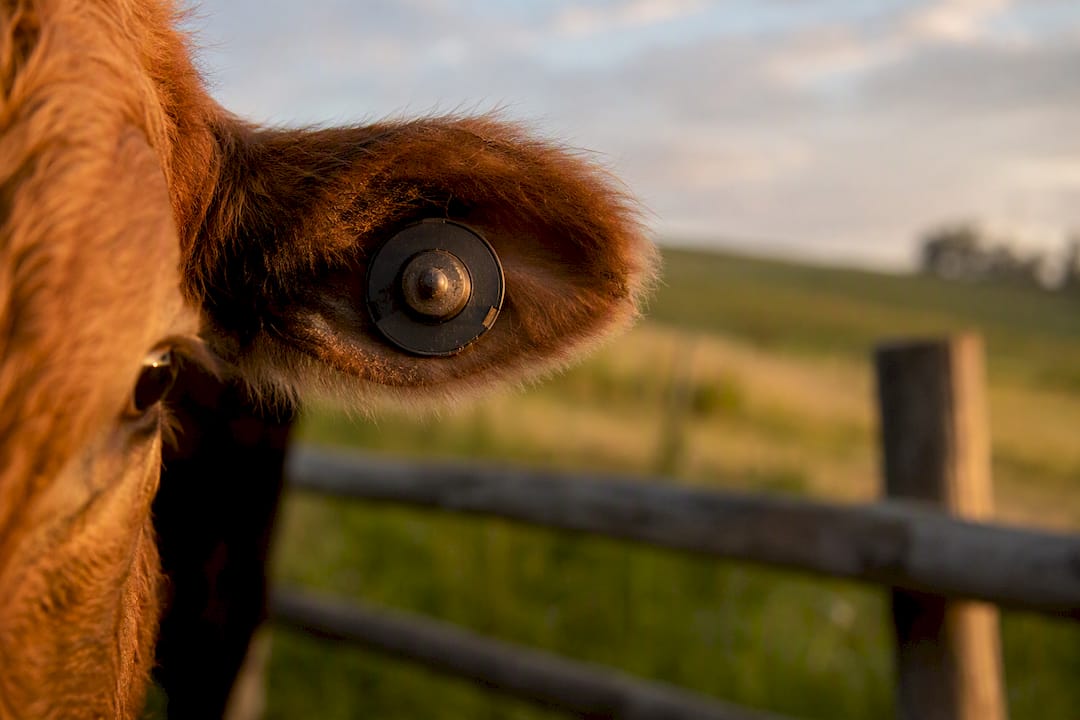
Low frequency (LF) tags are the workhorse for cattle and hogs. They tolerate water, mud, and body tissue well, which is why LF has dominated implantable and rugged ear-tag applications for decades. The tradeoff is range: most LF reads happen within a few inches to about a foot.
High frequency (HF/NFC) shows up less often in pasture settings. It’s common in companion-animal microchips and some niche indoor applications, but the read range and environmental tolerance don’t compete with LF or UHF for herd-scale outdoor use.
Ultra-high frequency (UHF), particularly Gen2 UHF, reads at much longer range, sometimes several feet or more, which makes it attractive for portal readers and high-throughput sorting. USDA’s official 840 tags use a specific numbering convention rather than a proprietary Gen2 scheme, so confirm compatibility before you assume a UHF reader will work with official tags.
Form factor matters as much as frequency. Ear tags dominate cattle and sheep operations because they’re visible and easy to apply. Bolus (rumen) tags resist loss but need specialized readers. Whatever you pick, insist on ISO 11784/11785 compliance, since proprietary tag formats lock you into one vendor’s readers for the life of the herd.
- LF: short range, excellent moisture and tissue tolerance, standard for cattle and swine
- HF/NFC: niche, mostly companion-animal or indoor use
- UHF/Gen2: longer range, faster throughput, growing use in portal and panel systems
- Bolus tags: high retention, require compatible specialized readers
Pro Tip: Pair your official USDA EID tag with a large, numbered visual management tag in the other ear. You get compliance and a number your crew can read from six feet away without pulling out a scanner.
What Equipment and Software You Actually Need
Three reader types cover almost every farm workflow. Handheld readers work like a wand: touch it near the tag, get an ID, log it manually or into a connected app. They’re cheap, portable, and ideal for small herds or spot checks. A model like the Gallagher HR5 handheld EID reader pairs with herd apps over Bluetooth so every scan lands directly in your records.
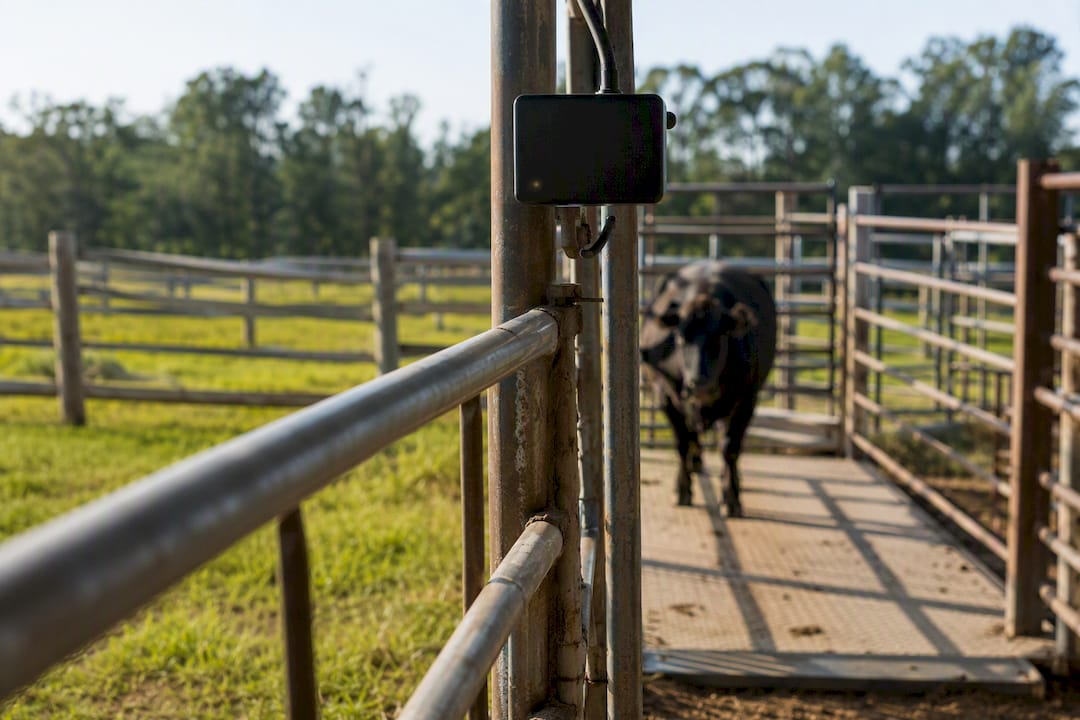
Panel readers mount on a chute or alley and catch every animal passing through without you lifting a wand. Portal readers go a step further, reading animals moving through a wide gate or loading ramp at UHF range.
When comparing specs, check:
- Whether the reader supports both FDX-B and HDX tag protocols (you don’t want to discover incompatibility after buying tags)
- Bluetooth or wired connectivity to your phone, tablet, or scale head
- IP rating for dust and water resistance, since chute environments are rough on electronics
On the software side, don’t settle for a cloud-only tool. Offline-capable software that caches reads locally and syncs when you regain signal is close to essential on rural properties where cell coverage drops out at the barn. Look for reporting features, scale integration, and export options that feed your existing farm management or ERP system.
A working example: pair a panel reader with a scale head at the chute, and every animal that walks through gets a weight logged against its ID automatically. Over a season, that builds a per-animal growth curve without anyone touching a clipboard.
USDA and APHIS Compliance Basics for Official Tags
USDA’s electronic ID rule doesn’t apply to every producer, but it does apply broadly to cattle and bison moving interstate under specific classes, dairy cattle, and animals headed to exhibitions or shows. Cornell Cooperative Extension’s dairy and livestock program lays out the mandatory EID requirement clearly for producers in those categories.
An “official” tag isn’t just any RFID ear tag. It carries the US shield, uses the 840 prefix in a 15-digit numbering format, and is built to be tamper-evident so a removed or swapped tag is obvious on inspection. That combination is what regulators and receiving states check for.
Getting official tags means going through your state veterinarian’s office or an APHIS-authorized tag distributor, not a general ag supply catalog. Correctly linking each tag number to your premises ID at that point is what makes the traceability system function during a disease investigation.
Before moving animals interstate, run this checklist:
- Confirm whether your class of animal and destination state require official EID
- Order official 840 tags through your state vet or an APHIS-approved distributor
- Register or confirm your premises ID and link it to the tags you’ll apply
- Apply tags before the animals leave the property, not at the point of sale
- Keep a paper or digital log matching each tag number to the animal it identifies
How to Choose the Right RFID System
Start with your species and environment, not the flashiest reader on a vendor’s site. Cattle in muddy pens favor rugged LF ear tags. High-throughput sale barns or feedlots often justify UHF panel or portal readers because of the read range and speed.
Reader type should follow your daily volume. A 40-cow operation checking calves at branding time doesn’t need a $3,000 portal system. A 2,000-head feedlot processing pens daily probably can’t survive on a handheld wand alone.
Two non-negotiables belong on every shortlist:
- ISO 11784/11785 compliance on every tag and reader, so you’re never locked into one manufacturer’s ecosystem
- Offline-capable software, because syncing later beats losing a day’s scans to a dead cell signal
Budget honestly, and phase the rollout if you need to. Buy the reader and starter tag batch this season, add a panel reader or scale integration next season once you’ve confirmed the workflow earns its keep. FenceFast’s practical RFID guide for livestock owners walks through sizing a starter setup to your actual herd size rather than an idealized one.
- Match tag frequency and form to your species and terrain
- Size reader throughput to your actual daily animal volume, not peak season guesses
- Require ISO compliance and offline sync as baseline features, not upsells
- Roll out in phases: core tagging and handheld reads first, automation second
Pro Tip: Ask any vendor point blank whether their reader supports both FDX-B and HDX. If they hesitate, that’s a signal to keep shopping.
Rolling Out RFID: A Step-by-Step Implementation Plan
Map your workflow before you buy anything. Walk your chute, alley, and handling areas and mark exactly where an animal would pass a reader: entry to the chute, the scale, the loading ramp. Those are your read points.
- Map read points. Identify every location where identifying an animal automatically would save time or improve records.
- Tag at the right moment. Apply official EID tags at birth or processing, whichever your compliance category requires, and log the tag number against the animal immediately.
- Place and test readers. Mount panel readers at consistent height and angle, then run confirmatory test reads against a known group of tagged animals before trusting the system live.
- Validate with sampling. Compare a subset of automated reads against a manual visual check. IEEE’s technical survey on RFID for animal tracking recommends this step specifically to catch systematic miss-reads before they corrupt weeks of data.
- Train staff on the workflow, not just the hardware. Someone needs to know what to do when a read fails, not just how to scan a tag.
- Set a maintenance schedule. Check antenna connections, battery levels on handhelds, and software sync logs monthly.
Pro Tip: Run your validation sampling for at least a full working day, not just a few test animals in a quiet pen. Chute noise, mud, and animal movement all affect real-world read rates differently than a calm demo.
What RFID Systems Cost and How to Budget for One
A basic starter setup, an official EID tag, a handheld Bluetooth reader, and a basic herd app, runs under $700 in equipment before tag costs. That’s a realistic entry point for a small cow-calf operation just meeting compliance.
Costs climb as throughput and automation increase. Panel readers cost more than handhelds. Installed portal systems with multiple antennas cost more still, and every additional integration point (scale heads, existing farm software, ERP connections) adds setup time and expense.
You can control the climb. Phase the rollout instead of buying everything at once. Pair official EID tags with a cheap visual management tag rather than buying two separate electronic systems. Check whether provincial or federal grant programs, including virtual fencing and animal management adoption grants some producers access through programs like OFCAF, can offset part of the equipment cost.
- Starter kit (handheld reader + app + official tags): under $700 in equipment
- Panel reader systems: higher upfront cost, scales with throughput needs
- Portal/multi-antenna installs: highest cost, justified mainly by high-volume operations
- Grant programs can offset a meaningful share of adoption costs for eligible producers
Where RFID Pays Off on a Working Farm
Traceability is the obvious win, but the speed matters as much as the record itself. When a health event hits, pulling every animal’s movement and contact history in minutes instead of days changes how fast you can respond and how much of the herd you have to quarantine.
Treatment and vaccination tracking solves a quieter, costlier problem: withdrawal window mistakes. An animal-level record of what was given and when protects you at sale and during any audit.
Automated weighing tied to individual IDs builds a performance history that supports marketing claims and can justify premiums at sale, since buyers increasingly want documented gain data, not a verbal assurance.
- Faster, targeted response during a disease event instead of a blanket quarantine
- Accurate withdrawal-window tracking that protects you at sale time
- Weight and performance history that supports premium marketing claims
- Reduced labor from automated sorting instead of manual reads at every gate
- A foundation for future integrations like GPS-based virtual fencing and supply-chain reporting
RFID, in practice, pushes herd management from reactive guesswork toward decisions built on an actual per-animal record.
Why FenceFast Backs This Approach
FenceFast has spent 26 years as an authorized Gallagher dealer, selling the fencing, virtual fencing, and RFID equipment that Canadian producers actually run in the field, not theoretical specs from a catalog. That’s the same product category this article covers: ear tags, handheld and panel readers, and the software that ties reads to usable records.
Beyond selling equipment, FenceFast offers design consulting for producers sorting out reader placement and workflow before they spend a dollar, plus setup guidance for pairing RFID with existing handling systems. The team also helps producers navigate funding programs like OFCAF and BMP grants that can offset adoption costs.
That combination, matching equipment to your actual herd size, confirming ISO compliance up front, and helping you sequence a rollout, is what keeps a first-time RFID buyer from ending up with mismatched gear six months in.
- 26 years as an authorized Gallagher dealer serving Canadian producers
- Design consulting for chute layout, reader placement, and workflow mapping
- Grant program guidance for OFCAF and BMP virtual fencing and equipment adoption funding
- Product range spanning ear tags, handheld and panel readers, and virtual fencing collars
Real-World RFID Adoption Patterns Across Livestock Operations
Dairy operations were early, heavy adopters of electronic ID, largely because milk parlors already demanded per-animal data for production tracking, and RFID slotted naturally into that existing recordkeeping habit. Cow-calf and feedlot operations adopted more gradually, often starting with compliance-driven tagging for interstate sales before expanding into weight tracking and health records once the basic workflow proved out.
Feedlots running high animal volumes through daily processing have leaned toward panel and portal readers, since the labor savings from not manually reading tags at every pass justifies the higher upfront cost. Smaller cow-calf operations, by contrast, tend to stick with handheld readers for years, only upgrading to panel systems once herd size or labor constraints make manual scanning impractical.
A common pattern across operation sizes: producers who paired official EID tags with a visual management tag from day one report fewer sorting errors at sale time, since crews can confirm an animal’s identity at a glance without pulling out a scanner for every head. That small workflow habit, adopted early, tends to save more labor over a season than any single piece of hardware.
The throughline across these examples is consistency. Operations that treat RFID as a full system, tag, reader, software, working together from the start tend to get more usable data faster than those that add pieces piecemeal and try to reconcile mismatched records later.
Where to Go for Official Rules and Technical Detail
- Cornell Cooperative Extension’s RFID and dairy program for USDA/APHIS official tag rules
- IEEE’s survey on RFID for animal tracking for standards and technical deployment detail
- Cattle Daily’s RFID guide for practical tag selection and starter-cost guidance
- Atlas RFID Store’s USDA mandate overview for regulatory timeline context
The Case Against Waiting on RFID
The conventional advice treats RFID as a compliance checkbox: get the official tag, satisfy the rule, move on. That undersells what the system does. The real value shows up in the software layer, the per-animal history that builds quietly in the background every time a tag gets scanned.
Where most producers stumble isn’t the tag or the reader. It’s buying software that demands constant connectivity, then discovering half their property has no signal. Offline caching isn’t a nice extra feature; it’s the difference between a system you trust and one you fight with every week.
Prioritize this in your first 30 days: confirm your compliance category, buy ISO-compliant tags and a reader that supports offline sync, and start scanning at one workflow point, whether that’s the chute or the scale. Expand from there. Producers who try to automate everything at once tend to abandon the project by week three. Producers who nail one workflow first tend to still be using the system a year later.
Get Your RFID System Set Up Right the First Time
Buying tags and a reader is the easy part. Making sure they’re ISO-compliant, matched to your herd size, and set up to feed usable records into your workflow is where most first-time buyers stumble. FenceFast has spent 26 years as an authorized Gallagher dealer helping Canadian producers avoid exactly that mismatch, pairing the right reader type with the right tag frequency before you spend a dollar on equipment that doesn’t fit your operation.
Whether you’re outfitting a 40 head cow-calf herd with a handheld reader or planning a portal system for a high-volume feedlot, FenceFast’s design consulting can walk you through reader placement, software integration, and available grant funding like OFCAF before you commit to hardware. Browse the full RFID and animal management catalog to compare starter kits and request a setup consultation tailored to your herd size and handling layout.
Frequently Asked Questions About RFID Livestock Tracking
Does every producer need USDA official EID tags? No. The requirement applies mainly to cattle and bison moving interstate under specific classes, dairy cattle, and animals headed to exhibitions. Check with your state veterinarian if you’re unsure whether your operation qualifies.
Can I use RFID tags without any USDA compliance requirement? Yes. Many producers use standard RFID ear tags purely for internal herd management, weight tracking, and treatment records, with no interstate movement or dairy trigger involved. ISO 11784/11785 compliance is still worth requiring for interoperability.
What’s the difference between LF and UHF tags for cattle? LF tags offer shorter read range but excellent tolerance for moisture and tissue, making them standard for ear tags and boluses. UHF tags read at longer range and support higher-throughput portal systems but need compatibility checks against official tag numbering formats.
How long does it take to implement a basic RFID system? A starter setup with a handheld reader and official tags can be operational within days once tags arrive. Panel or portal systems with software integration typically take a few weeks to install, test, and validate properly.
Do I need internet access at the chute for RFID to work? No, if you choose offline-capable software. Reads get cached locally on your handheld or tablet and sync automatically once you’re back in cell or WiFi range, which matters most for remote pasture operations.
Sources
- RFID Tags for Cattle: Complete Guide - Cattle Daily
- RFID - Southwest New York Dairy, Livestock & Field Crops Program - Cornell Cooperative Extension
- RFID Technology for Animal Tracking: A Survey - IEEE Xplore
- The role of RFID in livestock management - RFID Journal

