

TL;DR:
- RFID is essential for animal traceability and management, with specific tag types suited for different species. Proper implementation depends on correct placement, testing, and software integration, which ensures reliable data and regulatory compliance. Emerging sensor technologies and telemetry systems enhance early health detection and reduce labor, transforming livestock management practices.
Radio frequency identification (RFID) is defined as a technology that assigns a unique electronic identity to each animal through a microchip and antenna, enabling instant, contactless identification. Understanding RFID for animals means knowing that it operates at 134.2 kHz, complies with ISO 11784/11785 standards, and forms the backbone of traceability systems like the USDA Animal Identification Number (AIN) and Australia’s National Livestock Identification System (NLIS). For farmers and ranchers, RFID is not optional equipment. It is the foundation of herd record management, disease traceability, theft prevention, and regulatory compliance. Fencefast carries the livestock management tools that work alongside these systems, making adoption straightforward for Canadian producers.
What are the key RFID tag types used for different livestock species?
RFID tags for animals come in five main formats, and the right choice depends on the species, the environment, and how the animal will be scanned.
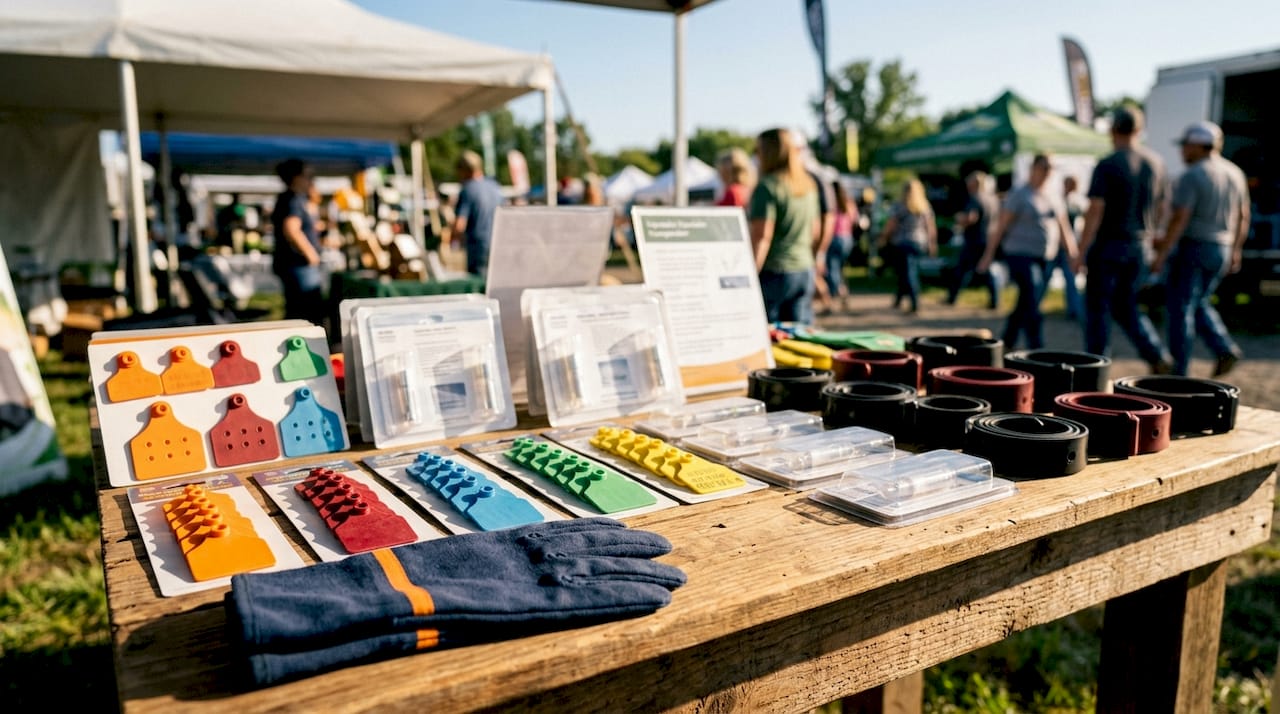
Button ear tags are the most common format for cattle and sheep. They clip through the ear and offer a read range of 0–60 cm, which covers most chute, gate, and weigh station setups. They are visible, replaceable, and easy to scan with a handheld wand or panel reader.
Injectable transponders are glass-encased chips inserted under the skin, typically in the neck or ear base. They are used for horses, pigs, and companion animals. Because they are internal, they cannot be removed without surgery, making them the strongest option for theft prevention and permanent identification.
Rumen boluses are cylindrical tags swallowed by the animal and retained in the reticulum. Cattle and sheep tolerate them well. Because the bolus sits deep inside the animal, it is nearly impossible to lose or tamper with, and it reads reliably through the body wall with a close-range wand.
Leg bands suit poultry and some small ruminants. They are lightweight, low-cost, and practical for birds that cannot tolerate ear tags. Read range is shorter than ear tags, typically under 20 cm.
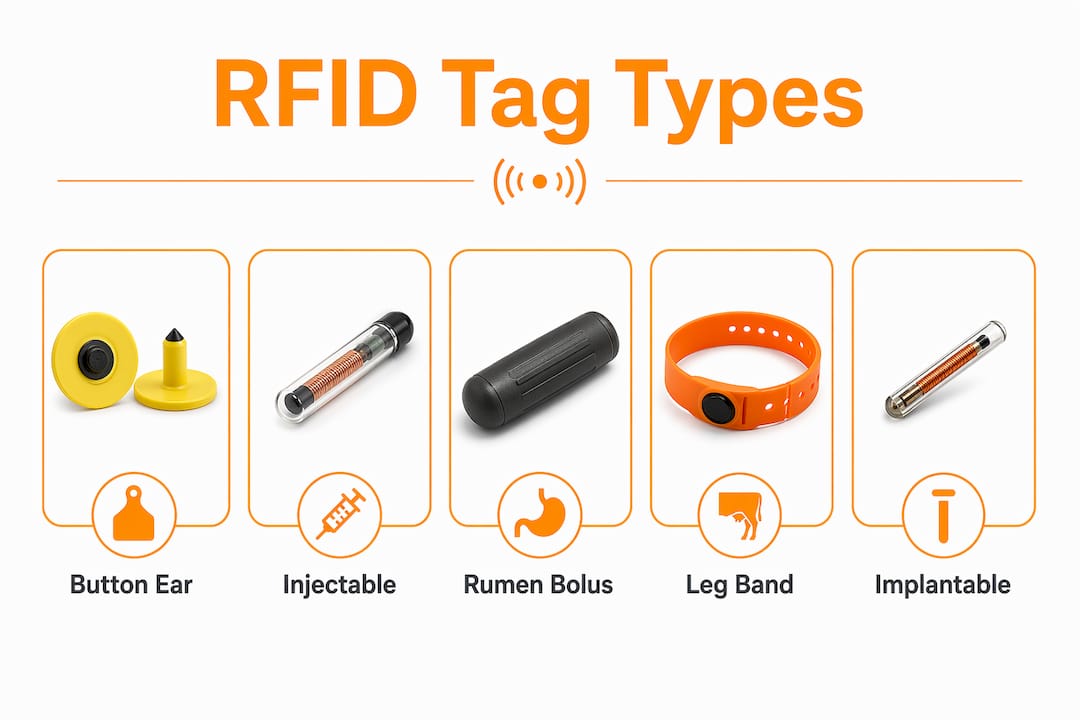
Implantable chips are similar to injectable transponders but designed for long-term use in horses and companion animals. They follow the same ISO 11784/11785 standard as livestock tags, so a single compliant reader can scan them all.
| Tag type | Placement | Best species | Approx. read range |
|---|---|---|---|
| Button ear tag | Ear | Cattle, sheep, goats | 0–60 cm |
| Injectable transponder | Under skin | Horses, pigs, pets | 0–15 cm |
| Rumen bolus | Reticulum | Cattle, sheep | 0–30 cm |
| Leg band | Leg | Poultry, small ruminants | 0–20 cm |
| Implantable chip | Under skin | Horses, companion animals | 0–15 cm |
Pro Tip: Place button ear tags in the mid-position of the left ear, away from the ear’s edge and base. Correct tag placement significantly reduces tag loss and non-reads, keeping your traceability records intact.
How does RFID technology work for animals?
RFID animal tracking systems operate at 134.2 kHz low frequency, which is the global standard for livestock. Low frequency penetrates tissue, mud, and water far better than ultra-high frequency (UHF), making it reliable in the field conditions farmers actually face.
When a reader emits a radio field, the tag’s antenna harvests that energy and powers the chip. The chip then transmits its unique code back to the reader. That code follows the ISO 11784 structure, a 64-bit format that produces a 15-digit national ID number. That number is what traceability systems like USDA AIN and NLIS use to link an animal to its health records, movement history, and ownership data.
Two transmission protocols govern how tags communicate:
- FDX (Full-Duplex): The tag transmits while the reader field is active. Reads are fast, but FDX tags are more susceptible to electrical interference from nearby equipment.
- HDX (Half-Duplex): The tag stores energy and transmits after the reader field switches off. HDX performs better in high-interference environments like metal-sided barns or near electric fencing, and it typically delivers a longer read range.
- ISO 11785 defines the communication protocol that governs both FDX and HDX, so a compliant reader handles both tag types without reconfiguration.
- 15-digit national IDs are not arbitrary numbers. They encode the country code, species code, and individual animal number, giving every tag a globally unique identity.
- Reader power directly affects read range. A panel reader in a loading alley reads tags at full range. A handheld wand used at an angle or through thick fleece may read at half that distance.
Pro Tip: Before deploying tags across your full herd, test reader and tag compatibility on a small group of 10–20 animals. Mud, thick fur, and poor tag orientation can all cause read failures that a pilot test will catch before they become a herd-wide problem.
What are the practical benefits of RFID in livestock management?
RFID delivers its clearest value at the points where animals move: loading alleys, weigh stations, drafting gates, and veterinary chutes. At each of these points, a panel reader captures every animal’s ID automatically, without any manual recording. That data feeds directly into herd management software, building a real-time record of weights, movements, and treatments.
Automated drafting gates take this further. When an animal walks through, the gate reads its tag and sorts it left or right based on pre-set criteria, such as weight threshold or vaccination status. One person can draft a large mob in the time it used to take three. That labor saving compounds across every mustering cycle.
Health monitoring is where RFID pays off most for animal welfare. Vaccination records, calving dates, breeding history, and treatment logs all attach to the animal’s unique ID. When a vet needs to know an animal’s full history, the answer is one scan away, not a search through paper records.
The practical benefits for farmers and ranchers include:
- Instant identity verification at weigh stations, loading docks, and sale yards, eliminating manual recording errors.
- Automated drafting based on weight, health status, or breeding criteria, reducing labor requirements significantly.
- Complete health records linked to each animal’s ID, supporting faster veterinary decisions and accurate treatment histories.
- Theft mitigation through permanent, tamper-resistant identification that links animals to registered owners in national databases.
- Regulatory compliance with USDA, NLIS, and Canadian traceability programs, avoiding fines and enabling rapid disease traceability.
- Data-driven breeding decisions by linking performance data, weight gain records, and genetic information to individual animals over time.
Fencefast’s livestock identification resources cover how these benefits apply across cattle, sheep, and other species common to Canadian operations.
What emerging RFID technologies are shaping animal management?
RFID is no longer just an identification tool. The technology is shifting toward behavior sensing, with tags that carry accelerometers, temperature sensors, and activity monitors alongside the standard ID chip. A tag that detects reduced movement or abnormal feeding patterns can flag a health issue before visible symptoms appear. That is precision livestock farming in practice.
LoRaWAN telemetry extends the concept further. Instead of requiring a handler to walk through the herd with a wand, fixed base stations read tags continuously across large areas. LoRaWAN systems reduce manual scanning labor by over 60 hours per week in large-scale or remote operations. The cost savings are substantial: manual scanning in harsh conditions can exceed $2,300 per week, and automated telemetry offsets that directly.
Key developments worth watching:
- Sensor-integrated ear tags that combine RFID identification with accelerometers to detect lameness, estrus, and early illness.
- Hub-based telemetry networks that connect to cloud dashboards, giving producers real-time movement data without expensive proprietary infrastructure.
- Affordable local network systems that bring high-resolution tracking to smaller farms that cannot justify enterprise-level platforms.
- GPS-RFID hybrid tags that add location data to identity data, enabling virtual boundary alerts alongside health monitoring.
The cost barrier for these systems is falling. Hub-based telemetry now offers effective animal monitoring at a fraction of what high-cost proprietary systems charged five years ago. Smaller operations can now access the same data quality that was previously available only to large feedlots. Fencefast’s coverage of GPS livestock tracking in Canada explains how these systems integrate with existing farm infrastructure.
What are common challenges and best practices for RFID implementation?
The biggest mistake farmers make with RFID is treating it as a hardware purchase. Data integrity and software integration are the highest-cost and highest-complexity elements of any RFID system. A tag that scans correctly but links to an incomplete or duplicate record provides almost no management value. The hardware is the easy part.
Tag loss is a real operational cost. Button ear tags can be torn out during handling or caught on fencing. Replacement protocols need to be part of your standard operating procedure, not an afterthought. When a tag is replaced, the new ID must be linked to the animal’s existing record in your management software immediately.
Common implementation pitfalls and how to avoid them:
- Skipping the pilot test. Always test reader and tag compatibility on a small group before full deployment. Environmental factors like metal infrastructure and electric fencing can interfere with reads.
- Ignoring regional regulations. USDA AIN requirements, Canadian traceability programs, and NLIS each have specific tag and record-keeping rules. Non-compliance can result in animals being rejected at sale.
- Underestimating software costs. Budget for herd management software, data backup, and staff training alongside the hardware.
- Poor tag placement. Tags placed too close to the ear edge tear out more frequently. Mid-ear placement on the left ear is the accepted standard for cattle and sheep.
Pro Tip: Link every RFID scan event to a timestamped record in your herd management software. Accurate records tied to RFID IDs are what regulators check during a disease investigation, and gaps in the record can cost you far more than the time it takes to maintain them.
Key Takeaways
RFID animal tracking works because ISO 11784/11785 standards, correct tag placement, and integrated herd management software combine to deliver reliable identification, compliance, and labor savings across every stage of livestock production.
| Point | Details |
|---|---|
| Standards matter | ISO 11784/11785 at 134.2 kHz is the global standard; use only compliant tags and readers. |
| Tag type drives results | Match the tag format to the species and environment to reduce loss and improve read rates. |
| Software is the real investment | Data integrity and herd management software deliver more value than hardware alone. |
| Emerging sensors add health insight | Accelerometer-equipped tags detect early illness and behavior changes before symptoms appear. |
| Pilot testing prevents failures | Test reader and tag compatibility on a small group before deploying across the full herd. |
What I’ve learned from watching farms adopt RFID
Most producers I talk to underestimate how much RFID changes their relationship with data. They buy the tags, install a panel reader at the chute, and expect the system to run itself. It does not. The farms that get the most from RFID are the ones that treat it as a data discipline, not just a compliance checkbox.
The shift from ID-only tags to sensor-integrated tags is the development I find most significant right now. Knowing which animal walked through the gate is useful. Knowing that the same animal has been lying down for 14 hours and eating less than usual is genuinely valuable. That kind of early warning changes how you deploy labor and how quickly you catch health problems.
My honest observation on cost: smaller operations often hesitate because they price out enterprise-level systems and walk away. That is the wrong comparison. Hub-based telemetry and affordable local networks have changed the math. A 200-head cow-calf operation can now get meaningful monitoring data without the infrastructure cost that scared them off three years ago.
The regulation trend is also clear. Traceability requirements are tightening across North America. Producers who build good RFID habits now will spend far less time scrambling when the next compliance deadline arrives. The ones who wait will pay more, both in hardware and in the labor required to backfill records.
— Juiced
How Fencefast supports your livestock management setup
Fencefast carries the animal management tools and livestock handling equipment that work alongside RFID tracking systems on Canadian farms and ranches.
Whether you are setting up a new identification system or adding automated drafting and weighing equipment to an existing operation, Fencefast has the products and the expertise to help you get it right. As an authorized Gallagher dealer with 26 years of experience, Fencefast also supports integration with Gallagher eShepherd virtual fencing technology, which pairs GPS-based herd control with the kind of individual animal data that RFID systems generate. Visit Fencefast to browse livestock management solutions and get guidance on building a system that fits your operation’s size and budget.
FAQ
What frequency does animal RFID use?
Animal RFID systems operate at 134.2 kHz, as defined by ISO 11784/11785. This low frequency penetrates tissue and withstands wet, muddy field conditions better than higher frequencies.
What is the difference between FDX and HDX tags?
FDX tags transmit while the reader field is active, making reads faster. HDX tags store energy and transmit after the field switches off, which improves reliability in high-interference environments like metal barns.
How far can an RFID reader scan an animal tag?
Read range depends on tag type and reader power. Button ear tags typically read at 0–60 cm, while injectable transponders and rumen boluses read at shorter ranges of 0–30 cm.
Do I need special software to use RFID for livestock?
Yes. RFID hardware alone provides limited value. Herd management software links each scan to health records, weights, and movement history, which is where the real management benefit comes from.
Is RFID tagging required by law for cattle in Canada?
Canadian cattle traceability regulations require approved RFID ear tags for cattle moving between premises. Requirements vary by province, so checking with your provincial authority confirms the specific rules for your operation.

