

TL;DR:
- RFID allows quick, accurate livestock identification without manual recording.
- Canadian regulations require approved RFID tags and timely digital reporting.
- Successful RFID adoption involves careful planning, staff training, and regional community learning.
Scanning a hundred animals in the time it takes to read this sentence isn’t a futuristic promise. It’s what modern RFID systems deliver on Canadian farms right now. RFID tags for livestock are typically low-frequency passive transponders embedded in ear tags, following ISO 11784/11785 standards, read by handheld or fixed readers up to 12 meters in some systems. For Canadian ranchers juggling compliance deadlines, disease traceability, and herd health, understanding how RFID works, what it costs, and how to roll it out effectively could be one of the most practical decisions you make this season.
Table of Contents
- What is RFID in animal management?
- RFID benefits for Canadian farms and ranches
- Costs, challenges, and the regulatory landscape
- Best practices to implement RFID on your operation
- The overlooked reality: Why RFID’s potential is often missed
- Ready to transform livestock management with RFID?
- Frequently asked questions
Key Takeaways
| Point | Details |
|---|---|
| RFID accelerates tracking | RFID tags allow you to manage and record data on hundreds of animals in seconds, unlike traditional methods. |
| Compliance is critical | Canadian regulations require CCIA-approved ear tags and timely digital reporting to systems like CLTS. |
| Initial investment varies | Startup costs can range from $3,000 to $5,000 for a mid-sized herd, but efficiency gains are significant. |
| Plan your rollout | Pilot testing, peer learning, and a phased approach ensure smoother RFID adoption, especially on complex or remote properties. |
What is RFID in animal management?
RFID stands for radio-frequency identification. At its core, it’s a system that uses radio waves to read tiny electronic tags attached to animals, without requiring line-of-sight or manual input. A reader sends out a signal, the tag responds with a unique ID number, and that data flows into your herd management records instantly.
For livestock, the standard in Canada is low-frequency (134.2 kHz) passive tags that meet ISO 11784/11785 requirements. These tags contain no battery. They draw power from the reader’s electromagnetic field, which makes them durable and long-lasting. The Canadian Cattle Identification Agency (CCIA) approves tags for cattle, bison, and sheep, and those CCIA-approved tags are what you need to stay legally compliant.
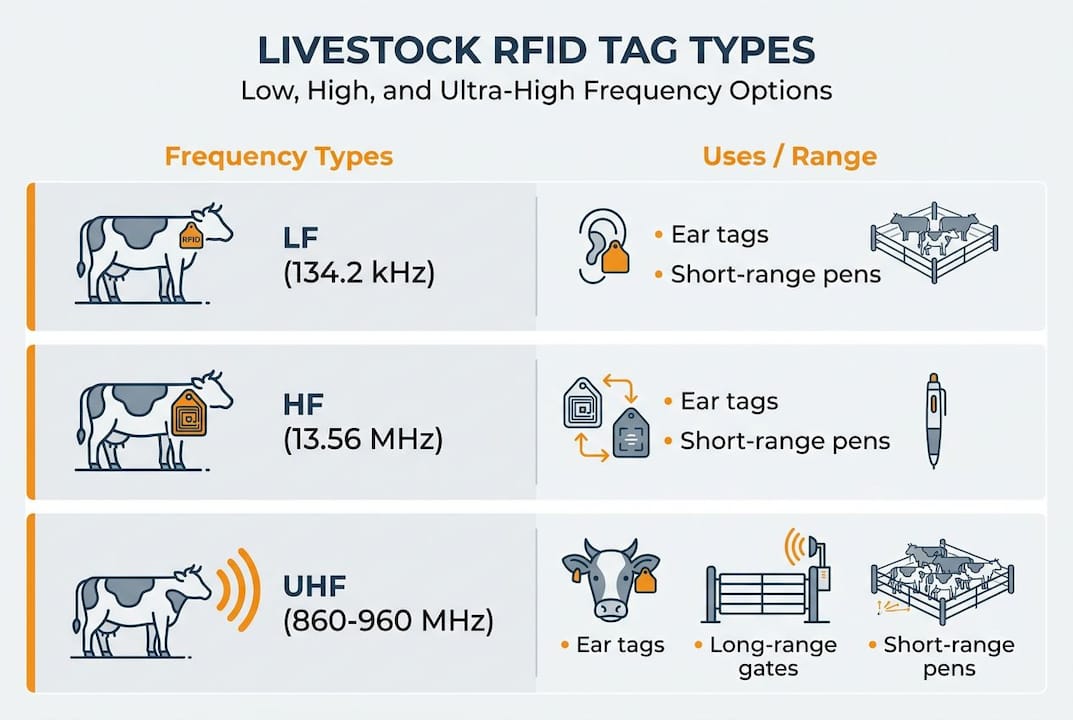
Beyond LF, there are also high-frequency (HF, 13.56 MHz) and ultra-high-frequency (UHF, 860-960 MHz) tags, each with different applications. Here’s a quick breakdown:
| Frequency | Read range | Typical use | Notes |
|---|---|---|---|
| LF (134.2 kHz) | Up to 1 meter | Livestock ear tags | ISO standard, CCIA-approved |
| HF (13.56 MHz) | Up to 1 meter | Lab samples, short-range ID | Less common in livestock |
| UHF (860-960 MHz) | Up to 12 meters | Fixed panel readers, chutes | Higher throughput, some interference |
For livestock identification best practices, LF remains the go-to for regulatory compliance in Canada, while UHF is growing in popularity for high-volume sorting systems at feedlots.
Compared to traditional visual tags, RFID delivers measurable advantages:
- Speed: Scan entire groups without stopping individual animals
- Accuracy: Eliminates transcription errors from manual number recording
- Data capture: Ties each animal’s ID to health records, weights, and movements automatically
- Durability: Passive tags have no battery to fail
- Traceability: Every scan creates a timestamped, digital audit trail
Visual tags require a person to read, write, and log a number. One muddy tag or one distracted worker can break the chain. RFID removes that fragility from the process.
RFID benefits for Canadian farms and ranches
With the basics covered, let’s see why RFID delivers greater value than traditional options.
Speed alone is striking. Systems track more than 100 animals per second, which means moving a large herd through a chute and capturing every ID takes minutes rather than hours. That’s time you get back for other work.
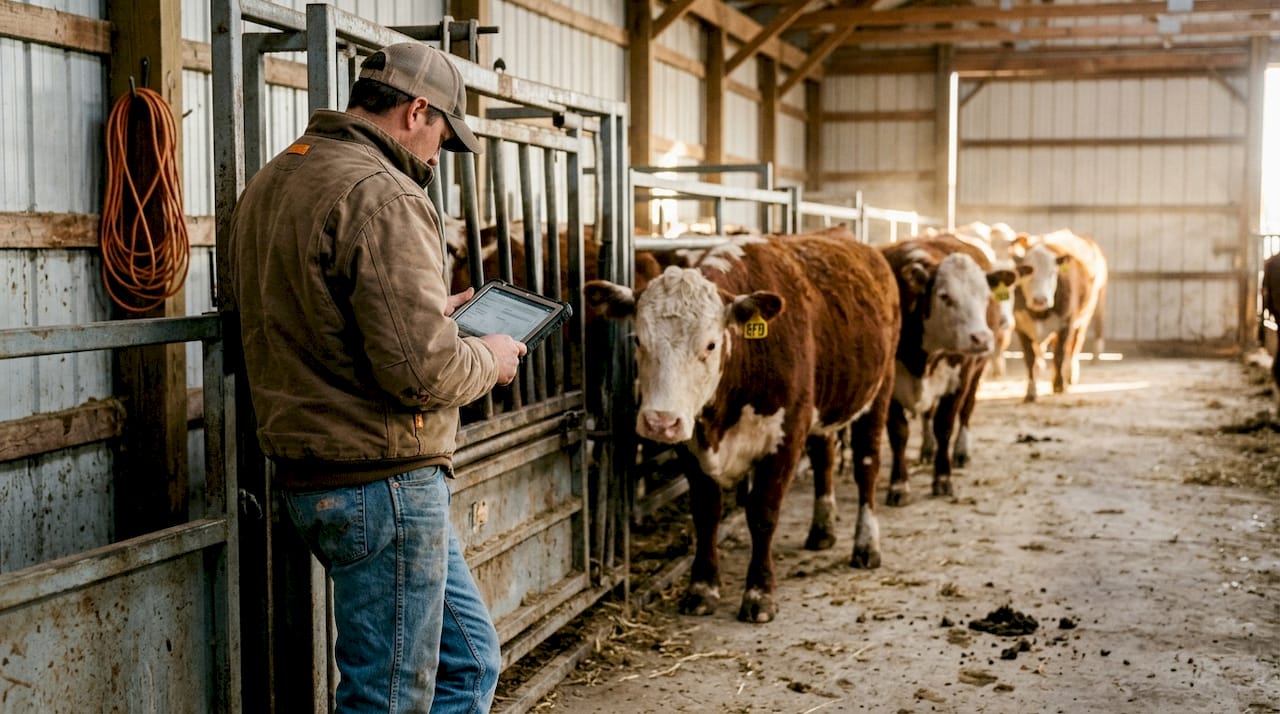
But the real operational value goes deeper than speed. RFID makes disease response faster and more reliable. When an animal tests positive for a reportable illness, you can pull the complete movement history, pen locations, and contact animals within minutes. Without RFID, that same process might take days of cross-referencing paper records, which costs both time and containment. Canada’s new traceability rules reflect exactly this need, emphasizing rapid digital reporting to protect the national herd.
Here’s how RFID data capture streamlines your day-to-day operations:
- Scan on arrival: Every animal entering your operation is logged automatically at the gate reader
- Record treatments: Tie vaccination and medication records directly to individual animal IDs
- Track weights: Pair RFID with a scale head to auto-capture weights at each weigh event
- Report movements: Upload to CLTS (Canadian Livestock Tracking System) digitally, with three-step records that reduce paperwork significantly
- Audit inventory: Run a full herd count without manual tallying
The CLTS MOBO app is worth calling out specifically. It allows you to report animal movements from your phone, meeting federal reporting requirements without paper forms or office visits. For producers managing multiple sites, this is a genuine time-saver.
For efficient RFID solutions on smaller operations, even a basic handheld reader and a modest set of approved tags delivers meaningful returns. You don’t need a full fixed-reader chute system to start benefiting.
Pro Tip: Before committing to a full setup, run a pilot with a subset of your herd for 60 to 90 days. This gives you real data on read rates, tag retention, and workflow fit before scaling. The comparison between RFID and visual tags becomes clearest when you test both side by side.
Costs, challenges, and the regulatory landscape
RFID isn’t just about new tech. Costs and regulations matter just as much.
Initial setup for a 500-head herd runs roughly $3,000 to $5,000, covering tags, a basic reader, and software. For larger feedlot operations with fixed panel readers, automatic drafting gates, and multiple read points, costs scale considerably higher. Smaller cow-calf operations with 50 to 100 head can start for much less, especially if they’re only adding a handheld reader to CCIA-approved tags they already use.
| Operation size | Estimated setup cost | Key components | CLTS integration |
|---|---|---|---|
| Small (under 100 head) | $500-$1,500 | Handheld reader, approved tags | Manual upload |
| Mid-size (100-500 head) | $3,000-$5,000 | Handheld + basic chute reader | MOBO app |
| Large (500+ head) | $10,000+ | Fixed panels, auto-draft, software | Full API integration |
| Wildlife research | Varies | PIT tags, specialized readers | Custom databases |
On the regulatory side, Canada’s traceability landscape is changing. Here are the key points that affect your operation:
- Premises ID (PID): Every operation must register a unique premises identifier
- 7-day reporting window: Animal movements must be reported to CLTS within seven days
- Tag testing: Only CCIA-approved tags meet federal standards
- 2026 rule updates: Expanded species coverage and tighter reporting timelines were proposed, though some elements were paused following producer concern
That pause matters. As reported by CBC, small producers and elderly farmers pushed back hard on the digital burden and potential costs of the proposed 2026 changes. The concern wasn’t with traceability itself but with the pace and support available for operations that aren’t well-resourced for rapid digital adoption.
Tag retention is another practical concern. Studies on tag retention rates show that even high-quality tags can fail in rough terrain or dense brush, which is a real issue for range cattle in western Canada. Factor replacement costs and re-tagging protocols into your planning.
For guidance on how Canadian fencing regulations intersect with your broader operation setup, it helps to think about RFID as part of a larger infrastructure decision, not a standalone purchase.
Best practices to implement RFID on your operation
With costs and requirements in mind, how should you approach adopting RFID?
A structured rollout reduces both wasted spending and frustration. Follow this process:
- Needs analysis: Define what you need RFID to do. Compliance only? Health monitoring? Weight integration? Your goal shapes your system.
- Pilot test: Start with a manageable group. Pilot tests are recommended especially for remote or rugged Canadian terrains where reader performance can vary.
- System selection: Choose readers and tags that match your operation size, chute setup, and software environment.
- Staff training: Even simple systems require consistent scanning habits. One untrained worker can create gaps in your data.
- Software integration: Integrating with herd management software enables genomics tracking, health records, and automated compliance reports that multiply the value of every scan.
- Compliance check: Confirm your tags are CCIA-approved and your reporting processes align with current ear tag compliance requirements before going live.
For data quality, consistent placement matters. Tags applied to the correct ear in the right location retain better and read more reliably. Keep a log of re-tags and note which animals have lost tags more than once, as this can indicate a fitting issue or an animal with unusual ear anatomy.
Pro Tip: Check with your provincial agriculture office or commodity group for cost-share programs before purchasing. Several provinces and industry organizations offer partial funding or training grants for RFID adoption, which can cut your startup cost significantly.
For operations near wildlife corridors, RFID also serves a monitoring role. Passive integrated transponder (PIT) devices are used for deer, elk, and other wildlife, and the data protocols overlap with livestock systems more than many producers realize. Explore wildlife and RFID use cases if your land management includes both domestic and wild animals.
Finally, don’t overlook fencing and durability strategies as part of your RFID plan. Fixed reader placement often depends on controlled animal flow, and that means your chute, gate, and pen layout need to be reliable before the technology can shine.
The overlooked reality: Why RFID’s potential is often missed
Most guides frame RFID as a hardware problem. Buy the right tags, get the right reader, and the system works. That framing misses the bigger picture entirely.
The operations that get the most from RFID aren’t necessarily the ones with the most expensive equipment. They’re the ones that invested time in changing how they work. That means retraining staff habits, building new record-keeping routines, and actually using the data the system generates. A scan that doesn’t feed into a decision is just a beep.
We’ve also seen that so-called plug-and-play promises fall apart in real conditions. Dense brush, rocky terrain, and extreme cold all affect read reliability. When that happens without preparation, producers blame the technology rather than the deployment plan.
What actually works is a community-based approach. Talking to neighboring operations that are six months ahead of you on RFID gives you context no product manual can provide. Regional peer networks, producer group meetings, and commodity association forums are where honest lessons get shared. If you’re serious about management outcomes with RFID, spend as much time learning from other producers as you do researching hardware.
Flexible, human-centered rollouts outperform rigid technical implementations every time.
Ready to transform livestock management with RFID?
If you’ve made it this far, you’re already ahead of most producers when it comes to understanding what RFID can actually do for your operation. The next step is putting that knowledge to work.
At FenceFast, we carry RFID livestock solutions alongside the fencing and animal management supplies that make your whole operation run better. Whether you’re just getting started with electronic identification or looking to pair your existing tags with a more reliable chute setup, we can help. You can also browse electric fence accessories to round out your infrastructure and keep your herd where it belongs. Reach out to our team for product guidance tailored to your herd size, terrain, and compliance needs.
Frequently asked questions
What kind of RFID tags are legal for livestock in Canada?
Canadian law requires CCIA-approved, ISO 11784/11785-compliant RFID ear tags for cattle, sheep, and bison. Using non-approved tags does not satisfy federal traceability requirements.
How far can RFID readers detect livestock tags?
Most fixed or handheld readers detect tags from a few centimeters up to 12 meters away in some systems. Read range depends on the frequency used and whether the reader is handheld or fixed-panel.
How much does it cost to implement RFID for a mid-sized Canadian cattle herd?
Initial setup for a 500-head herd typically costs between $3,000 and $5,000, with ongoing tag replacement and compliance fees to budget for each year.
What is CLTS and how does it relate to RFID?
CLTS (Canadian Livestock Tracking System) is the national traceability platform, and RFID tags streamline the required movement reporting that producers must submit digitally within seven days of animal movements.
Are government grants available for RFID adoption?
Some Canadian provinces and industry groups offer cost-share programs or training grants. Government support for RFID was a central issue raised during the 2026 traceability rule consultations, so contact your local ag office for current opportunities.
Recommended
- Portable fencing advantages for Canadian farms: boost efficiency – FenceFast Ltd.
- Portable fence systems for livestock control in Canada 2026 – FenceFast Ltd.
- RFID for Animal Tracking: Efficient Solutions for 2025 – FenceFast Ltd.
- Livestock Identification Methods: Best Practices for Owners – FenceFast Ltd.

