

TL;DR:
- Fencing laws in rural areas depend on local open-range or closed-range doctrines, affecting liability and cost responsibilities. Properly understanding and complying with jurisdiction-specific standards, boundary surveys, and neighbor agreements can prevent costly disputes and legal issues. Adequate documentation, inspections, and early communication are essential for legally compliant fencing and effective land management.
Rural property fencing laws define who must build, maintain, and pay for fences that contain livestock and establish property boundaries. These laws are not uniform across North America. They shift dramatically based on whether your county operates under open-range or closed-range doctrine, your state’s agricultural statutes, and local zoning ordinances. Getting this wrong costs money, damages neighbor relationships, and can expose you to livestock trespass liability. This article breaks down the legal framework, state-specific standards from Texas, Colorado, and New Mexico, and the practical steps every rural landowner needs to take before driving a single post.
How do open-range and closed-range laws affect fencing responsibilities?
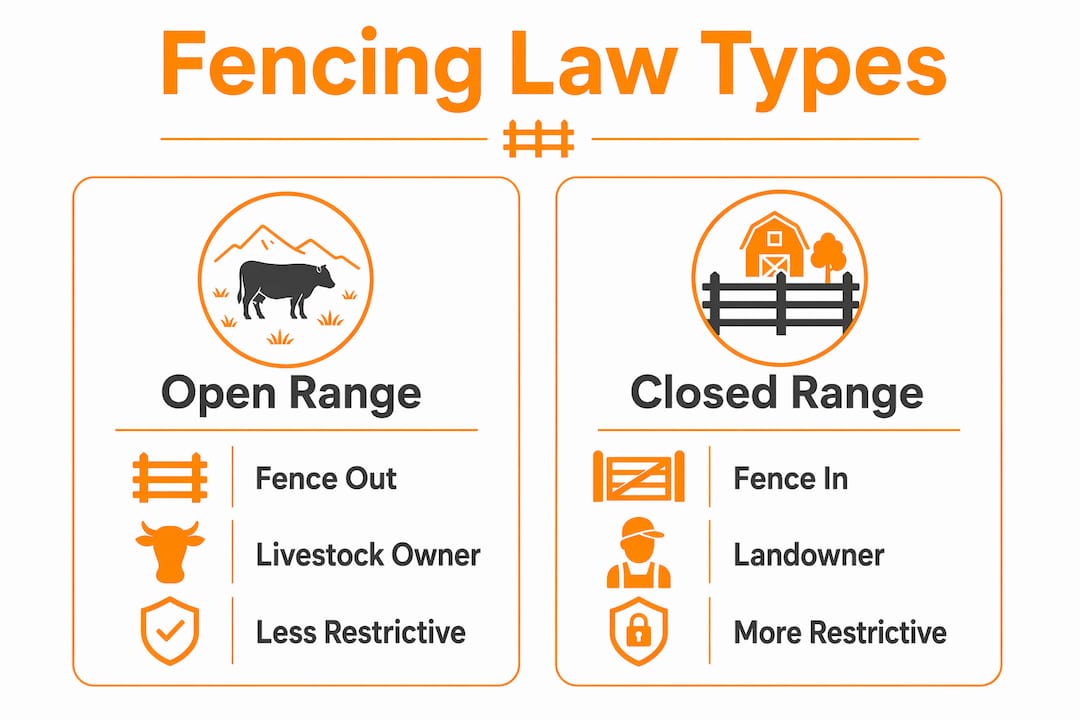
Open-range and closed-range doctrine is the single most important legal concept governing agricultural fencing rules for rural landowners. Under open-range law, livestock owners bear no automatic duty to fence their animals in. If a neighbor’s cattle wander onto your crop field, the burden falls on you to have fenced them out. Under closed-range law, the opposite applies: livestock owners must contain their animals, and they face liability if those animals trespass.
Fence laws favor livestock owners in open-range states while placing the full cost and legal responsibility of fencing on neighboring landowners. That means a cattle rancher in an open-range county can legally let his herd roam public roads and adjacent land without penalty, while you absorb the cost of a perimeter fence to protect your property.
Texas illustrates exactly how complicated this gets at the county level. Texas has no single statewide fence code; fencing responsibilities depend on county or city jurisdictions, local stock laws, and whether a county has voted to become closed range. Two neighboring Texas counties can operate under opposite systems, meaning a fence that protects your legal rights on one side of a county line offers no protection on the other. Texas counties may shift from open to closed range through a formal election process under Agriculture Code Chapter 142, and those recorded elections directly change your fencing obligations.
| Feature | Open range | Closed range |
|---|---|---|
| Livestock containment duty | Landowner must fence out animals | Livestock owner must fence animals in |
| Liability for trespass damage | Landowner bears risk without a fence | Livestock owner liable for damage |
| Fence cost responsibility | Neighboring landowner pays to exclude | Livestock owner pays to contain |
| Common jurisdictions | Rural western states, many Texas counties | Urban-adjacent counties, eastern states |
| Legal trigger | No fence required by livestock owner | Livestock owner must maintain perimeter |
Pro Tip: Before purchasing rural land in Texas or any western state, contact the county clerk’s office and request documentation of the county’s current open or closed range status. This single step can save you thousands in unexpected fencing costs.
What are the legal standards for a lawful fence in Colorado and New Mexico?
A “lawful fence” is the legal term used in statutes across multiple states to describe a fence that meets minimum construction standards required to support a legal claim for livestock trespass damages. If your fence does not qualify as lawful, courts may deny your damage claim entirely, regardless of how much crop loss or property damage occurred.
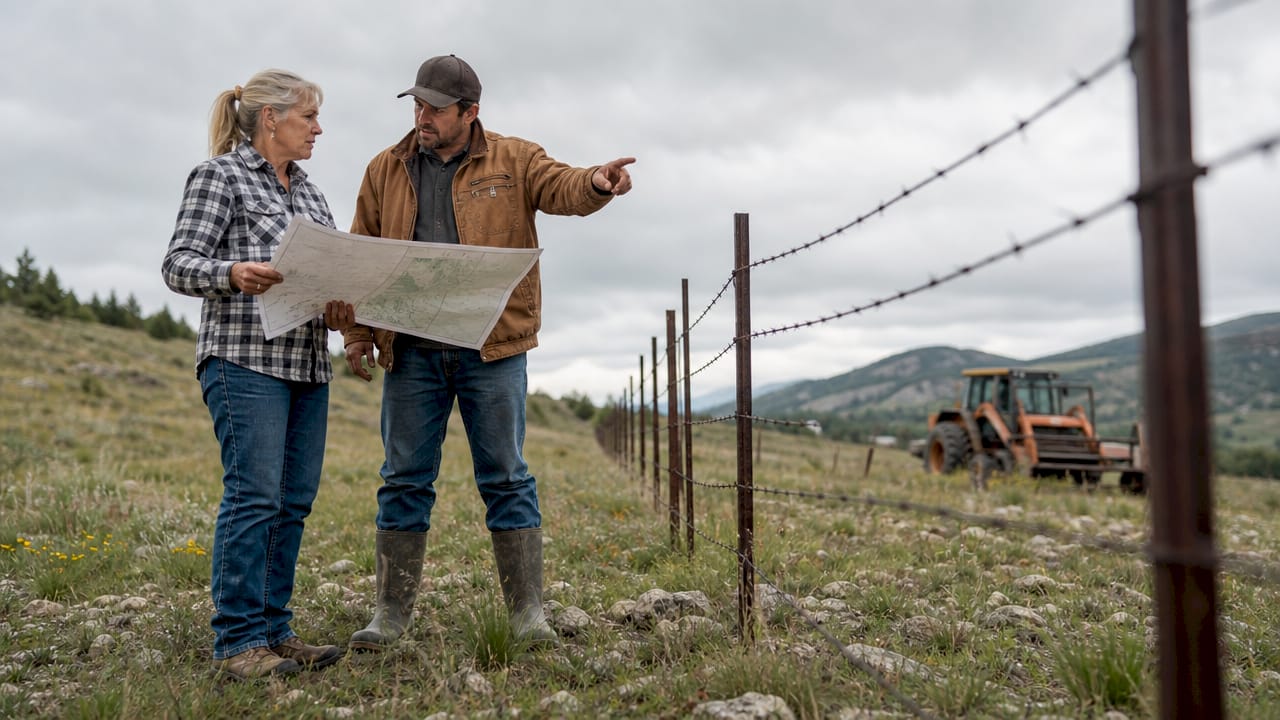
Colorado’s statutes provide one of the clearest definitions in North American agricultural law. Colorado law requires landowners to fence out livestock with a lawful fence to claim damages for trespass, and repairs must follow a 30-day written notice procedure. Under Colorado Statutes § 35-46-112 and 113, a lawful fence typically consists of three strands of barbed wire, posts set at specific intervals, and gates that meet equivalent strength standards. Damages for livestock trespass in Colorado require evidence that the fence meets the state’s lawful fence standard, including quality, materials, and maintenance, which directly affects the strength of any legal claim you bring.
New Mexico operates as a strict open-range state. New Mexico’s fence-out principle is codified under NMSA 1978 § 77-16-1, which specifies that a landowner who lacks a legal fence forfeits the right to recover damages for livestock trespass. This is not a technicality. Courts in New Mexico have dismissed trespass claims because a single fence section failed to meet adequacy standards.
Here is a practical compliance checklist for rural landowners in states with lawful fence statutes:
- Confirm your state’s statutory definition. Pull the actual statute, not a summary. Colorado, New Mexico, and most western states publish these through their state legislature websites or cooperative extension services like CSU Extension.
- Document your fence before livestock season. Photograph every section, note post spacing, wire tension, and gate hardware. Date-stamp every image.
- Send written notice for shared fence repairs. Colorado requires a 30-day written notice before you can pursue cost-sharing from a neighbor. Send it via certified mail and keep the receipt.
- Inspect after every severe weather event. A fence that meets lawful standards in spring may fail that threshold after a winter storm. Courts look at the fence’s condition at the time of the trespass incident.
- Consult your county’s cooperative extension office. CSU Extension and similar state programs publish jurisdiction-specific guidance that translates statutory language into construction specs you can actually use on the ground.
Pro Tip: Keep a physical fence log in a waterproof binder stored on your property. Record every inspection date, repair made, and material used. This log becomes your primary evidence if a trespass dispute reaches court.
How do boundary disputes involving fences arise and how should they be resolved?
Fence-related boundary disputes are among the most common and most expensive conflicts between rural neighbors. They typically start with a fence that was built years or decades ago without a professional survey, then passed through property sales with everyone assuming the fence line was the legal boundary.
Boundary disputes involving fences require a professional land survey to accurately establish property lines. A licensed land surveyor uses recorded deeds, government survey monuments, and GPS technology to establish the legal boundary. Their findings carry evidentiary weight in court that a neighbor’s verbal claim or an old aerial photo simply cannot match.
One legal doctrine that catches rural landowners off guard is adverse possession, sometimes called the “7-year fence law.” Adverse possession requires continuous, exclusive, and open possession without permission for a statutory period, which varies by state but is commonly seven years. If a neighbor has maintained a fence on your land for that period without your objection, they may have grounds to claim ownership of that strip of land. This is not theoretical. It happens regularly on rural properties where boundary lines were never formally confirmed.
A common misconception worth addressing directly: fence maintenance responsibility does not depend on which side the fence sits relative to a property line. Joint ownership agreements and written contracts define liability, not the physical position of the fence posts.
Practical steps to resolve a boundary dispute before it reaches litigation:
- Commission a licensed land survey as the first step, not the last resort.
- Document the existing fence line with photographs, measurements, and GPS coordinates.
- Send a written letter to your neighbor describing the discrepancy and proposing a meeting. Keep the tone factual, not accusatory.
- Negotiate a formal encroachment agreement if the fence cannot be moved immediately. This protects both parties and prevents adverse possession claims from accumulating.
- Consult a real estate attorney if the neighbor refuses to engage. Many boundary disputes settle quickly once legal counsel is involved.
“Regular communication and written agreements between neighbors can prevent costly disputes and improve fence maintenance cooperation.” — HS Legal PC
What local regulations and permits might rural property owners need?
Local fencing regulations rural areas impose often surprise landowners who assume agricultural land is exempt from zoning rules. The reality is that rural-adjacent properties, hobby farms, and acreages near municipal boundaries frequently fall under layered regulatory systems that include county zoning, state agricultural codes, and private HOA covenants simultaneously.
Key regulatory factors to check before you build:
- Fence height restrictions. Many counties cap fence heights at 6 to 8 feet along property lines, with lower limits near road rights-of-way. Rural fence height restrictions differ from residential limits, but they still exist.
- Material restrictions. Barbed wire and electrified fencing are typically banned or restricted in residential zones to prevent injury. If your rural parcel borders a residential subdivision, the residential zone’s rules may apply to your shared boundary.
- Setback requirements. Most jurisdictions require fences to sit a minimum distance from road centerlines, waterways, and neighboring structures. Setbacks on rural roads often differ from those on state highways.
- Permit requirements. Some counties require a fence permit for any structure over a certain height or length, even on agricultural land. Permit timelines range from 48 hours to several weeks depending on the jurisdiction.
- HOA covenants. Rural subdivisions and acreage developments frequently carry deed restrictions that specify approved fence styles, colors, and materials. These covenants are enforceable regardless of what county zoning allows.
- Penalties for non-compliance. Violations can result in fines, mandatory removal orders, and in some cases, liens against the property. Removing and rebuilding a non-compliant fence costs far more than the original permit fee.
The safest approach is to contact your county planning and zoning office before purchasing materials. Ask specifically about agricultural exemptions, since many rural counties exempt working farms from residential fence rules, but that exemption must be confirmed in writing.
What practical steps help rural landowners comply and prevent disputes?
Compliance with rural property fencing laws starts before the first post goes in the ground. The landowners who avoid disputes and legal costs are the ones who treat fencing as a legal and logistical project, not just a physical one.
Follow these best practices for rural fencing to protect your land and your livestock:
- Hire a licensed land surveyor to confirm your boundary lines before installation. Survey costs are a fraction of litigation costs.
- Select fence materials that meet your state’s lawful fence definition and your county’s material restrictions. Three-strand barbed wire meets Colorado’s standard but may violate a neighboring residential zone’s rules.
- Inspect your fence line at least twice per year and after any major weather event. Document every inspection in writing.
- Talk to your neighbors before you build along a shared boundary. A five-minute conversation prevents months of dispute.
- Put shared fence agreements in writing. Specify who maintains which sections, how costs are split, and what happens when repairs are needed. Have both parties sign and date the document.
- Know your county’s protocol for stray livestock. Most jurisdictions require you to notify the livestock owner and local animal control before moving or impounding animals that have entered your property.
Pro Tip: Review your county’s livestock fencing regulations annually. Local ordinances change, and a fence that was compliant when you built it may fall out of compliance after a zoning amendment.
Key takeaways
Rural property fencing laws require landowners to understand their jurisdiction’s open-range or closed-range status, meet statutory lawful fence standards, and resolve boundary disputes through professional surveys and written agreements before disputes escalate.
| Point | Details |
|---|---|
| Open vs. closed range status | Determines who bears fencing costs and livestock trespass liability in your county. |
| Lawful fence standards | States like Colorado and New Mexico require specific construction standards to support damage claims. |
| Boundary surveys | A licensed land surveyor’s findings are the only reliable evidence in fence boundary disputes. |
| Local permits and zoning | Rural properties near residential zones face material and height restrictions that require permit verification. |
| Written neighbor agreements | Documented cost-sharing and maintenance agreements prevent the most common rural fence disputes. |
What I’ve learned advising rural landowners on fencing
Most rural property owners I’ve worked with make the same mistake: they assume their county’s rules match what they’ve heard from a neighbor two properties over. Open-range status, lawful fence definitions, and permit requirements are hyper-local. A rancher in one Texas county can let cattle roam freely while his counterpart across the county line faces liability for the same behavior.
The other pattern I see constantly is landowners who skip the survey to save money upfront. That decision almost always costs more in the end. Adverse possession claims, encroachment disputes, and fence removal orders are all preventable with a survey that costs a few hundred to a few thousand dollars. Compare that to litigation, which routinely runs into five figures.
My honest recommendation: treat your local cooperative extension service as a free legal resource. Organizations like CSU Extension and Texas A&M AgriLife Extension publish jurisdiction-specific guides that translate complex statutes into plain language. Use them before you call a lawyer, and call a lawyer before you call a contractor. The sequence matters.
The landowners who manage fencing well are not the ones with the most expensive materials. They are the ones who did the legal homework first, communicated with their neighbors early, and kept records throughout.
— Juiced
How Fencefast supports rural landowners with compliant fencing

Fencefast carries the fencing components, electric fencing systems, and livestock management supplies that rural property owners across Canada need to meet agricultural fencing standards and protect their land. Whether you are installing a three-strand barbed wire perimeter to meet Colorado’s lawful fence definition or setting up a Gallagher eShepherd virtual fencing system to manage cattle movement without physical posts, Fencefast has the products and the expertise to support the project. The team also provides design consulting and guidance on government funding programs including OFCAF and BMP grants that can offset virtual fencing adoption costs. Visit Fencefast to browse the full product catalog or get in touch with a fencing specialist who understands the regulatory and practical demands of working agricultural land.
FAQ
What is the difference between open range and closed range fencing laws?
Open-range law places the burden on neighboring landowners to fence out livestock, while closed-range law requires livestock owners to contain their animals. Texas counties can shift between these systems through a formal election process, changing fencing liabilities entirely.
What qualifies as a lawful fence for livestock trespass claims?
A lawful fence meets the statutory construction standards set by your state, typically specifying wire type, post spacing, and maintenance condition. In Colorado, failure to maintain a lawful fence standard eliminates your right to recover damages for livestock trespass.
Do I need a permit to build a fence on rural agricultural land?
Permit requirements vary by county and zoning classification. Many rural agricultural parcels qualify for exemptions, but properties near residential zones or HOA developments often require permits and must comply with height and material restrictions.
How do I resolve a dispute if my neighbor’s fence crosses my property line?
Commission a licensed land survey first to establish the legal boundary with documented evidence. Then pursue a written encroachment agreement or formal legal remedy, since professional surveys are the foundational evidence courts rely on in boundary fence disputes.
Can a neighbor claim ownership of land where a fence has stood for years?
Yes. Adverse possession, sometimes called the 7-year fence law, allows someone who has openly and continuously maintained a fence on another’s land for a statutory period to claim ownership rights. Confirm your boundary lines and address encroachments promptly to prevent this.
Recommended
- Best practices for rural fencing: Secure your livestock and land – FenceFast Ltd.
- Livestock Fencing Regulations: What Owners Must Know – FenceFast Ltd.
- Fencing laws in Canada: a guide for livestock owners – FenceFast Ltd.
- How to Build a Fence: Step-by-Step Guide for Rural Properties 2025 – FenceFast Ltd.

