

Nearly half of Canadian livestock producers say rising energy costs are their biggest challenge. For farmers looking to keep animals secure without draining their budget or relying on traditional american electric grids, solar fencing systems offer a practical solution. This overview breaks down how solar-powered fencing works, why it matters for animal containment and energy savings, and what options are available for rural Canadian operations.
Table of Contents
- Defining Solar Fencing Systems For Farms
- Core Components And How Solar Fencing Works
- Types Of Solar Fencing Systems Available
- Main Factors Affecting Solar Fencing Price
- Comparing Solar And Traditional Electric Fencing
Key Takeaways
| Point | Details |
|---|---|
| Solar Fencing Systems Combine Functions | These systems integrate livestock containment with renewable energy, enhancing agricultural efficiency. |
| Customization for Diverse Needs | Farmers can tailor solar fencing configurations based on terrain, livestock types, and environmental conditions. |
| Cost Factors to Consider | Key pricing variables include solar panel quality, installation complexity, and geographic location, affecting the overall investment. |
| Energy Independence Advantage | Solar fencing operates autonomously, providing lower operational costs and greater reliability in remote areas compared to traditional electric fencing. |
Defining Solar Fencing Systems for Farms
Solar fencing systems represent an innovative agricultural technology that combines traditional livestock containment with renewable energy generation. These advanced systems integrate solar photovoltaic (PV) panels directly into farm fence infrastructure, creating a dual-purpose solution for energy production and animal management. Innovative solar fencing technologies are transforming how farmers approach perimeter security and sustainable power generation.
At their core, solar fencing systems consist of several key components: solar panels, energizers, batteries, grounding systems, and electrical wire. The solar panels capture sunlight and convert it into electrical energy, which charges a battery-powered fence controller that delivers periodic electrical pulses along the fence wire. This design ensures that the fence not only contains livestock but also provides a deterrent against potential predators or wildlife intrusion. Unlike traditional electric fences, these systems operate independently from the electrical grid, making them ideal for remote agricultural locations with limited infrastructure.
Farmers can configure solar fencing systems in various configurations depending on their specific needs. Some setups focus purely on animal containment, while others integrate advanced features like IoT-enabled security monitoring to track fence integrity and potential breaches. The flexibility of these systems allows ranchers to customize their approach based on terrain, livestock type, and specific environmental challenges.
Pro tip: When planning a solar fencing system, conduct a comprehensive site assessment to determine optimal panel placement and ensure maximum sunlight exposure throughout the day.
Core Components and How Solar Fencing Works
Solar fencing systems are sophisticated agricultural technologies designed to provide both security and power generation. Typical solar fencing configurations consist of five critical components that work together to create an effective and efficient perimeter management solution. These key elements include solar panels, batteries, charge controllers, energizers, and conductive fence wires, each playing a vital role in the system’s overall performance.
The operational mechanism of solar fencing is both elegant and straightforward. Solar panels capture sunlight and convert it into electrical energy, which is then stored in batteries through a charge controller that regulates power flow. The energizer transforms this stored energy into periodic electrical pulses that travel along the fence wire, creating a powerful deterrent for livestock containment and predator prevention. Solar fence power systems are uniquely designed to function independently from the electrical grid, making them ideal for remote agricultural locations with limited infrastructure access.
Farmers can customize their solar fencing systems based on specific requirements such as terrain, livestock type, and environmental conditions. The modular nature of these systems allows for scalability, enabling ranchers to expand or modify their fencing as their agricultural needs evolve. Advanced configurations can include additional features like IoT-enabled monitoring, voltage regulators, and specialized grounding systems that enhance overall performance and reliability.
Pro tip: Select solar panels with a slightly higher wattage rating than your immediate needs to account for potential future expansion and ensure consistent performance during periods of reduced sunlight.
Types of Solar Fencing Systems Available
Farmers have multiple solar fencing system options designed to meet diverse agricultural needs. Solar fencing configurations can be categorized based on structural design, installation requirements, and functional capabilities. The primary types include permanent installations with integrated solar panels, portable systems for temporary use, and modular designs that allow for flexible deployment across different farming environments.
Permanent solar fencing systems represent the most robust solution for long-term agricultural perimeter management. These installations typically feature built-in solar panels mounted directly on fence structures, providing continuous power generation and livestock containment. In contrast, portable solar electric fences offer farmers greater flexibility, enabling quick setup and relocation for rotational grazing, temporary paddock management, or seasonal crop protection. These mobile systems are particularly valuable for ranchers managing diverse terrain or frequently changing livestock configurations.
Advanced solar fencing technologies now incorporate additional features like IoT monitoring, voltage regulation, and specialized grounding systems. Farmers can choose between wire-based systems, mesh configurations, and post-supported designs depending on specific agricultural requirements. Some sophisticated models include multiple power input options, remote monitoring capabilities, and advanced battery storage technologies that ensure consistent performance even during periods of reduced sunlight or challenging weather conditions.
Here’s a summary of the main solar fencing system types and their unique strengths:
| System Type | Best Use Case | Key Benefit | Flexibility Level |
|---|---|---|---|
| Permanent | Long-term perimeter control | Reliable, low maintenance | Low—fixed installation |
| Portable | Rotational grazing, seasonal | Easy relocation, quick setup | High—move as needed |
| Modular | Expanding operations | Scalable, customizable design | Medium—reconfigurable |
Pro tip: Conduct a comprehensive site assessment of your farm’s terrain and livestock needs before selecting a solar fencing system to ensure optimal performance and cost-effectiveness.
Main Factors Affecting Solar Fencing Price
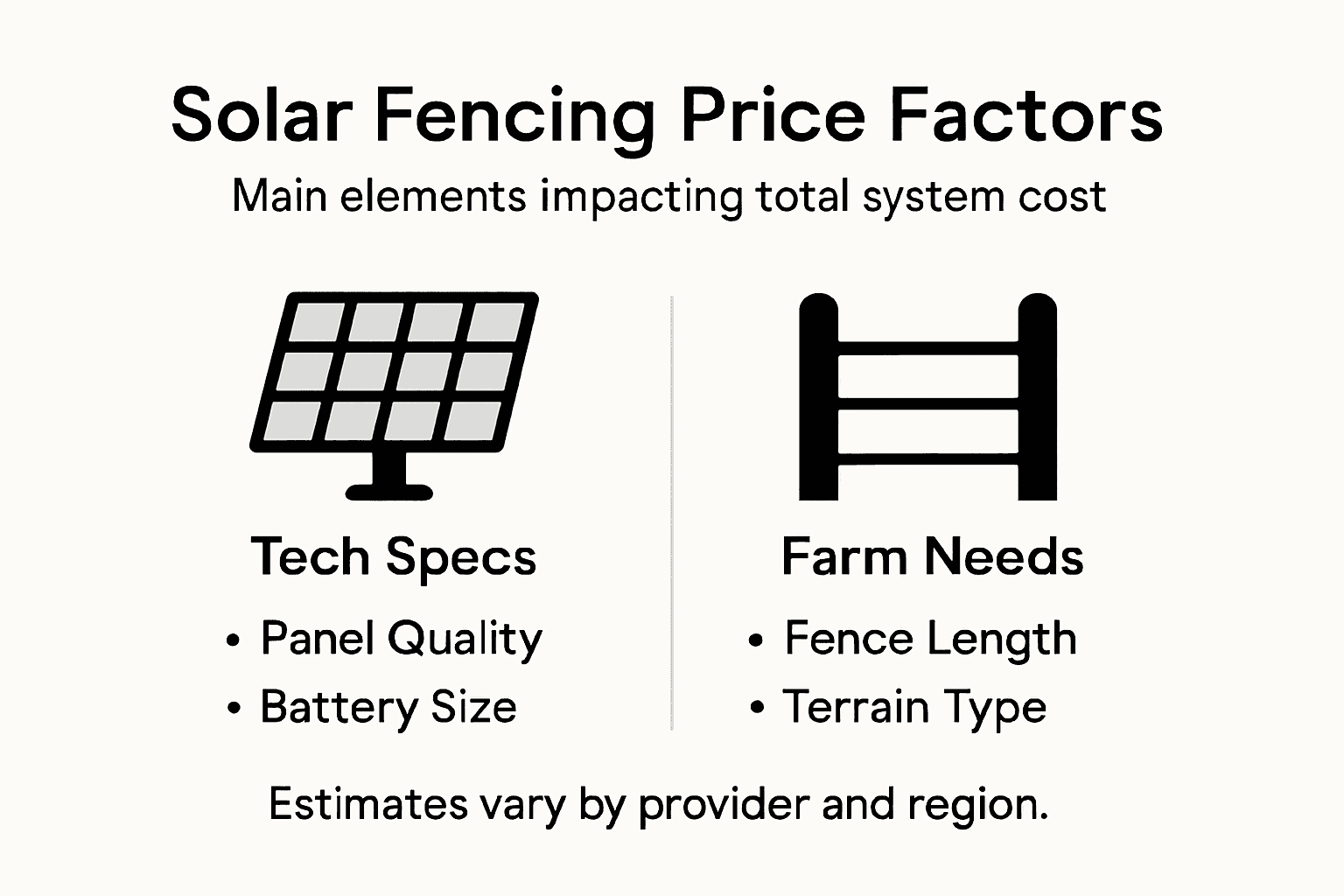
Solar fencing system costs involve multiple complex variables that farmers must carefully consider when budgeting for their agricultural infrastructure. The primary pricing factors include solar panel quality, battery capacity, fence material specifications, installation complexity, farm size, and geographic location. Each of these components contributes significantly to the overall investment required for an effective solar fencing solution.

The technological sophistication of solar components plays a crucial role in determining system pricing. Higher efficiency solar panels with advanced photovoltaic technologies typically command premium prices but offer better long-term performance and energy generation capabilities. Agrivoltaic solar fencing technologies require additional structural modifications, which can increase initial capital costs. Farmers must balance upfront expenses against potential energy savings and livestock management benefits when selecting their solar fencing system.
Geographic and environmental conditions substantially impact solar fencing pricing. Regions with challenging terrain, extreme weather patterns, or complex installation requirements will experience higher implementation costs. Factors such as wind load requirements, terrain complexity, soil conditions, and local climate variations directly influence the engineering and installation expenses. Advanced systems featuring IoT monitoring, remote management capabilities, and specialized grounding technologies will naturally represent a more significant investment compared to basic solar fencing configurations.
Pro tip: Request multiple quotes from solar fencing providers and compare not just initial costs, but projected long-term performance and maintenance expenses to ensure comprehensive financial planning.
Comparing Solar and Traditional Electric Fencing
Solar-powered electric fence systems represent a significant technological advancement over traditional grid-dependent electric fencing solutions. Unlike conventional electric fences that rely entirely on external power sources, solar fencing offers unprecedented energy independence and sustainability for agricultural operations. The fundamental difference lies in their power generation and distribution mechanisms, with solar systems generating electricity on-site through photovoltaic panels and storing energy in specialized batteries.
Traditional electric fencing requires consistent grid connectivity and ongoing electricity costs, making them less flexible and more expensive in remote or rural settings. Solar electric fences, by contrast, operate autonomously, drawing power directly from sunlight and storing excess energy for consistent performance during low-light conditions. This self-sufficiency translates to lower operational expenses, reduced carbon footprint, and greater reliability in areas with unreliable electrical infrastructure. Farmers can install solar fencing systems in locations where conventional electrical connections are impractical or cost-prohibitive.
The following table highlights how solar and traditional electric fencing differ in real-world farm scenarios:
| Aspect | Solar Fencing | Traditional Electric Fencing |
|---|---|---|
| Power Source | Sunlight via PV panels | Utility grid connection |
| Ideal Farm Location | Remote or off-grid areas | Farms with reliable grid access |
| Installation Costs | Higher upfront | Lower upfront, ongoing costs |
| Operation Costs | Minimal maintenance | Continuous electricity expenses |
| Expandability | Easily scalable | Wiring and infrastructure limits |
The comparative advantages of solar fencing extend beyond energy generation. These systems offer superior adaptability, allowing farmers to easily expand or reconfigure fence lines without complex electrical rewiring. Advanced solar fencing technologies incorporate smart monitoring features, enabling remote tracking of fence integrity, battery performance, and potential security breaches. While initial installation costs may be higher than traditional electric fencing, the long-term savings in energy expenses and maintenance make solar fencing an increasingly attractive investment for modern agricultural operations.
Pro tip: Calculate your potential energy savings by comparing the estimated annual electricity costs of traditional electric fencing against the one-time investment and minimal maintenance expenses of a solar fencing system.
Optimize Your Farm’s Solar Fencing Investment with FenceFast.ca
Choosing the right solar fencing system means balancing upfront costs with long-term reliability and efficiency. This article highlights crucial factors like panel quality, battery capacity, and installation complexity that directly impact your solar fencing system price. If you want to avoid costly mistakes and ensure your investment brings smart savings while offering dependable livestock management and energy independence FenceFast.ca provides the perfect place to start.

Explore our extensive range of electric fencing components and solar panels tailored specifically for Canadian farms. Benefit from expert design consulting and access helpful advice on maximizing solar fencing performance and cost-effectiveness. Don’t wait to make the energy-efficient, sustainable upgrade your farm deserves Visit FenceFast.ca today to secure the best products and turn your solar fencing vision into reality.
Frequently Asked Questions
What factors influence the price of a solar fencing system?
The price of a solar fencing system is influenced by variables such as solar panel quality, battery capacity, fence material specifications, installation complexity, farm size, and geographic location.
How does the cost of solar fencing compare to traditional electric fencing?
While solar fencing systems may have higher upfront installation costs, they generally offer lower operational expenses over time due to their energy independence and reduced maintenance needs compared to traditional electric fencing, which relies on constant electricity from the grid.
What are the main components of a solar fencing system?
A solar fencing system typically includes solar panels, batteries, charge controllers, energizers, and conductive fence wires, all of which work together to create an effective livestock containment and power generation solution.
Can farmers customize solar fencing systems to fit specific needs?
Yes, farmers can customize solar fencing systems based on their specific requirements, such as terrain, livestock type, and environmental conditions, allowing for scalability and flexibility in deployment.

