

An agricultural fence gate company is a supplier of farm gates, gate hardware, electric fencing components, and virtual fencing systems — not a residential installer. Before you call one, do three things: measure the widest piece of equipment that will pass through your gateway, photograph the existing post setup, and note your livestock type and daily traffic patterns. That information determines gate width, hardware grade, and whether electric or virtual fencing fits your operation.
Quick pre-order checklist:
- Measure your widest tractor, trailer, or implement (add at least 2 feet of clearance)
- Note livestock species and herd size
- Photograph existing posts, footing condition, and soil type
- Record whether you need electric fencing, virtual fencing, or both
Pro Tip: The University of Kentucky Cooperative Extension cites 14 feet as a common modern standard for agricultural gate openings — but that number is a starting point, not a rule. Measure your actual machinery first.
Key Takeaways
Invest in heavy-duty gate materials and adjustable through-bolt hardware from the start — it costs less over a gate’s full service life than replacing economy components every few years.
| Point | Details |
|---|---|
| Measure before ordering | Use your widest machinery width plus clearance; 14 ft is a common standard but not a guarantee. |
| Hardware grade matters most | Through-bolt hangers, shape plates, and bottom rests prevent sag and latch failure. |
| Economy gates cost more long-term | Extension guidance puts economy gate lifespan at 1–5 years under farm conditions. |
| Virtual fencing needs full planning | GPS neckbands, base stations, connectivity, and ongoing costs all factor into the budget. |
| Fencefast for farm-ready supply | Fencefast stocks gates, hardware, energizers, and Gallagher virtual fencing with setup support. |
Table of Contents
- What does a fence gate company supply to farms and ranches?
- How do you size a farm gate for equipment and livestock?
- Which gate materials hold up best for livestock use?
- What gate hardware prevents sagging and latch failures?
- How do electric and virtual fencing systems work for cattle?
- How should you prepare a gateway site before installation?
- What maintenance keeps gates and fencing working long-term?
- What do farm gates and fencing systems typically cost?
- How do you choose the right fence gate company for your farm?
- The case for hardware-first thinking on farm gates
- Fencefast: agricultural fencing and gate hardware, shipped to your farm
- Sources
What does a fence gate company supply to farms and ranches?
A full-service agricultural gate supplier covers far more than steel panels. Expect product lines across several categories, and ask directly whether a company stocks all of them or specializes in a subset.
Standard product categories:
- Heavy-duty tubular steel gates and panel systems
- Hinge and latch hardware (through-bolt hangers, shape plates, self-latching mechanisms)
- Electric fence energizers (AC, battery, and solar options), grounding rods, and fence testers
- Polywire, poly tape, poly rope, and insulators
- Gate handles, gate kits, and anchors for temporary and permanent electric fence setups
- Solar panels and battery backup systems for remote paddocks
- Virtual fencing neckbands, base stations, and herd management software
Service offerings vary. Some suppliers provide design consultation and custom gate fabrication; others ship standard sizes only. Ask whether the company offers installation guidance or only components, and confirm rural delivery capability before placing a large order.
Pro Tip: Ask about lead times and warranty in the same conversation as pricing. A supplier who can’t give you a written lead time estimate is a risk for time-sensitive spring fencing projects.
How do you size a farm gate for equipment and livestock?
Measure first, order second. The correct gate width is the measured width of your widest current or anticipated machinery plus enough clearance for safe passage — not a catalog default.
The University of Kentucky Cooperative Extension identifies 14 feet as a modern standard agricultural gate opening, but explicitly advises producers to evaluate their own machinery dimensions because undersized gates are a primary operational barrier on working farms.
Measurement checklist:
- Measure your widest tractor or combine at the widest point (mirrors, headers, attachments)
- Measure trailer width, including any overhang
- Estimate turning radius needed at the gateway
- Confirm vertical clearance for any cab or loader height
- Determine whether livestock handling equipment must also pass through
For heights, cattle gates typically run 48–54 inches; sheep and goat gates can be shorter but need tighter spacing to prevent escape. Perimeter gates prioritize vehicle clearance; handling alley gates prioritize animal control. A guide to farm gate system types can help you match gate design to each location on your property.
Which gate materials hold up best for livestock use?
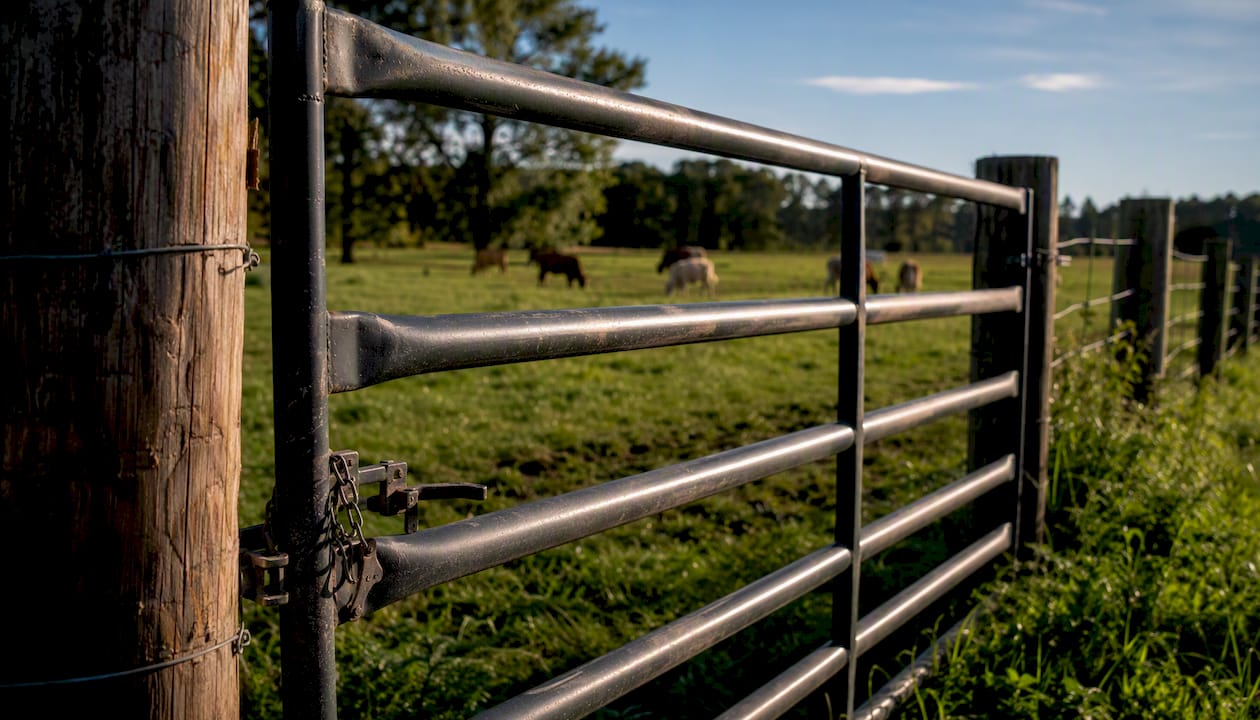
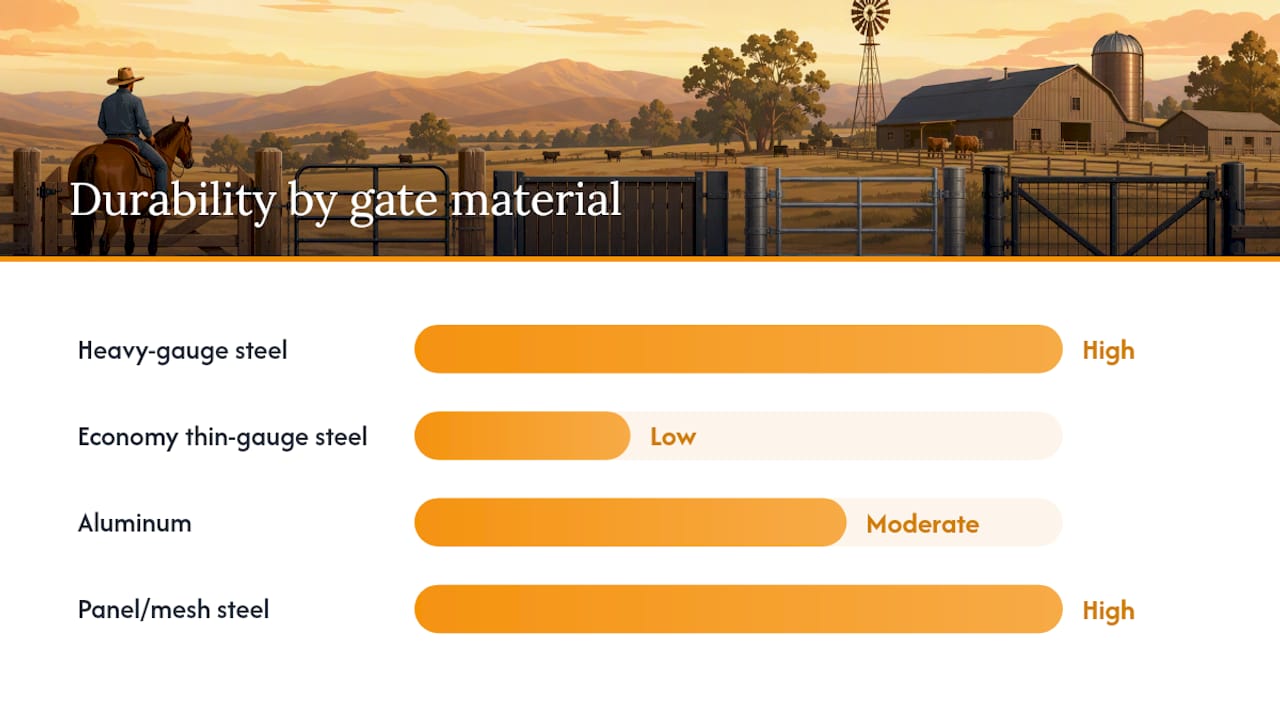
Heavy-gauge tubular steel is the long-term choice for cattle and high-traffic farm gates. Economy thin-gauge gates cost less upfront, but extension guidance is direct: economy gates wear quickly and typically last only 1–5 years under farm conditions. Heavy-duty gates with proper hardware commonly last significantly longer.
| Material | Durability | Weight | Corrosion Resistance | Best For |
|---|---|---|---|---|
| Heavy-gauge tubular steel | High | Heavy | Moderate (needs coating) | Cattle, high-traffic farm gates |
| Economy thin-gauge steel | Low | Light | Low | Temporary or low-use areas only |
| Aluminum | Moderate | Light | High | Horses, lighter livestock, coastal sites |
| Panel/mesh steel | High | Heavy | Moderate | Handling yards, small stock |
Vendor guidance from Edge Line Products reinforces this split: steel for heavy livestock and high-pressure use, aluminum where weight and corrosion resistance matter more than raw strength.
Common gate styles include tubular single-swing gates, multi-panel gates, sliding gates for tight spaces, and temporary electric netting gates for rotational paddocks. Solid panel designs reduce visual stimulation for flighty animals; mesh or bar designs allow animals to see through, which can reduce fence-charging.
Pro Tip: Spend on heavier material and better hardware. A $400 gate that lasts 15 years costs less per year than a $150 gate replaced every three.
What gate hardware prevents sagging and latch failures?
Adjustable, through-bolt hangers are the single most important hardware choice after gate material. Misalignment and sag are the leading causes of gates that won’t latch or drag on the ground within a few seasons.
Agricultural engineers consistently rank correct hinge alignment and adjustable hardware as the most practical investments to avoid rework and extend gate life. A misaligned hanger discovered after installation often requires re-setting or replacing the post entirely — a far more expensive fix than specifying the right hardware upfront. (Farm Gates: Design Considerations, AEN-137)
Hardware to specify when ordering:
- Through-bolt hangers (not lag-screw types) for load transfer to the post
- Shape plates to distribute hinge load across post face
- Bottom gate rests to relieve structural tension and reduce sag
- Self-latching mechanisms rated for livestock pressure
- Heavy-duty hinge pins with corrosion-resistant coating
- Stainless or galvanized fasteners throughout
For farm gate security, self-latching mechanisms that require deliberate human action to open are worth the extra cost on any gate where animal escape is a risk.
Pro Tip: Use a plumb bob from the upper hanger before final tightening. Confirming alignment at installation takes five minutes; correcting it after the fact can take a full day and a new post.
How do electric and virtual fencing systems work for cattle?
Electric fencing uses energized wire or poly tape, powered by an energizer and grounded through rods, to contain livestock through a brief, safe shock. Virtual fencing replaces physical wire entirely: GPS-enabled, solar-powered neckbands deliver audio cues and low-level electric pulses to define digital boundaries, letting you move or adjust grazing zones from a phone app without stringing new wire.
Core components for electric fencing:
- Energizer (AC plug-in, 12V battery, or solar panel)
- Ground rods and grounding cable
- Insulators for posts and corners
- Polywire, poly tape, or high-tensile wire
- Fence tester/voltmeter
- Gate handle kits and gate anchors
For virtual fencing systems, add:
- GPS neckbands (one per animal)
- Solar-powered base station
- Herd management app or software subscription
- Reliable cellular or satellite connectivity at the site
Virtual fencing is well-suited to rotational grazing, exclusion zones around water sources, and remote paddocks where running physical wire is impractical. For a deeper look at how the technology works, this overview of virtual fencing for cattle covers collar tech and boundary setup in practical terms.
Pro Tip: Match energizer output to fence length and expected animal pressure. A solar energizer sized for a quarter-mile of polywire will underperform on a mile of high-tensile wire with heavy cattle pressure. Check the Zareba catalog for AC/battery/solar compatibility guidance.
How should you prepare a gateway site before installation?
Reinforce before you hang. A gate installed on a poorly braced post in soft soil will sag within one season regardless of hardware quality.
Site prep steps:
- Install compacted gravel pads or concrete footings at high-traffic gateways
- Use properly braced corner or end posts; brace assemblies transfer load away from the hinge post
- Set post depth to local frost line plus soil stability requirements
- Route vehicle traffic so it doesn’t stress the gate frame during opening
Installation sequence:
- Set and brace hinge post; confirm plumb before concrete sets
- Hang gate and check swing arc for ground clearance
- Fit bottom rest and confirm load relief
- Install latch post; adjust for self-latching engagement
- Add stile for pedestrian access if foot traffic is frequent
Extension guidance specifically warns against using vehicles to push or pull gates open — it stresses hinges and bends frames faster than almost any other single habit. Stiles reduce the number of times a gate needs to open for human passage, which meaningfully extends hardware life on busy farm lanes.
Pro Tip: For smart livestock fencing layouts, plan gateway locations before post-setting so you can orient swing direction away from prevailing wind and slope.
What maintenance keeps gates and fencing working long-term?
Regular inspections catch small problems before they become expensive ones. Schedule a quick visual check monthly and a full hardware inspection every six months.
Routine maintenance checklist:
- Lubricate hinge pins and latch mechanisms (grease or penetrating oil)
- Tighten through-bolts and check for post movement
- Inspect for corrosion at welds, cut edges, and fastener heads
- Check gate for sag; adjust hangers if needed
- Test energizer output and ground rod connections seasonally
- Replace worn pins, fasteners, or cracked insulators immediately
| Task | Frequency | Notes |
|---|---|---|
| Visual inspection | Monthly | Check for sag, latch engagement, obvious damage |
| Full hardware check | Every six months | Tighten bolts, lubricate, check alignment |
| Energizer/ground test | Seasonally | Confirm voltage output; check ground rod moisture |
| Corrosion treatment | Annually | Touch up paint or galvanizing at welds and cuts |
Economy gates typically last 1–5 years under working farm conditions. Heavy-duty gates with proper hardware and consistent maintenance commonly last well beyond that range.
What do farm gates and fencing systems typically cost?
Cost varies widely based on material grade, custom sizing, hardware level, and whether electric or virtual systems are included. These are ballpark ranges to frame your budget conversations with suppliers.
These are typical ballpark ranges only. Actual pricing depends on supplier, region, custom fabrication, and shipping to rural addresses.
Lead times range from same-week for stocked standard gates to 4–8 weeks for custom fabrication. Virtual fencing systems may require additional setup time for base station installation and herd training. Virtual fencing cost considerations are worth reviewing before budgeting for GPS collar systems, as ongoing device and subscription costs add to the initial hardware investment.
Pro Tip: *Get rural delivery costs in writing before finalizing your order.
How do you choose the right fence gate company for your farm?
Prioritize suppliers who can confirm heavy-duty hardware availability, meet your measured gate opening, and provide clear lead times and written warranty terms before you commit.
Buyer checklist:
- Confirm gate width and height match your measured equipment clearance
- Ask whether hardware includes through-bolt hangers and shape plates
- Request a drawing or photo approval for custom gates before fabrication
- Get rural delivery cost and estimated transit time in writing
- Confirm warranty terms and return policy for damaged shipments
Questions to ask every supplier:
- Do you fabricate to custom sizes, or stock sizes only?
- What gauge steel is used, and what is the hinge hardware grade?
- Is the energizer UL-listed and compatible with poly products?
- What are the ongoing subscription or device costs for virtual fencing?
- Do you provide setup guidance for virtual fencing base stations?
Red flags: vague lead times, inability to specify hardware detail, no written warranty, no confirmation of compatibility with your measured equipment, and no installation or setup guidance for electric or virtual systems.
For a broader checklist, 10 tips for choosing the best livestock fence covers supplier evaluation alongside fence type selection.
The case for hardware-first thinking on farm gates
Most gate failures trace back to one decision made at the point of purchase: choosing a gate by price per foot rather than by hardware grade. A gate that sags after two winters, drags on the ground, and won’t self-latch isn’t a maintenance problem — it’s a purchasing decision that compounded over time.
The conventional wisdom is to buy a heavier gate. The more useful version of that advice is to buy better hardware first, then match the gate to it. A heavy gate hung on lag-screw hangers in a soft post will fail just as fast as a light one. Through-bolt hangers, shape plates, and a bottom rest cost a fraction of a gate replacement and do most of the structural work.
Virtual fencing gets oversold as a replacement for physical infrastructure. It isn’t. It’s a complement — genuinely useful for rotational grazing and remote boundary adjustments, but it still requires solid perimeter fencing, reliable power, and a herd that’s been trained to the collar cues. Budget for both the hardware and the training time.
Fencefast: agricultural fencing and gate hardware, shipped to your farm
Fencefast carries the full range of agricultural gate hardware, electric fencing components, and Gallagher eShepherd virtual fencing systems that this article covers — from heavy-duty tubular gates and through-bolt hanger kits to solar energizers, GPS neckbands, and base stations. As an authorized Gallagher dealer with a 26-year partnership, Fencefast provides setup guidance for virtual fencing alongside the hardware, so you’re not sourcing components from one place and troubleshooting from another.
If you’re budgeting for a new gate setup, replacing worn hardware, or evaluating virtual fencing for rotational grazing, browse the full product catalog at Fencefast and contact the team for sizing and compatibility support before you order.
Sources
The recommendations in this article draw on the following authoritative sources:
- Farm Gates: Design Considerations (AEN-137)
- Zareba catalog (gate handles, kits, and electric fence components)
- How to choose the right farm gate for your livestock (Edge Line Products)

