

A permanent 5–7 strand high tensile electric fence, built with Class III galvanized or aluminized 12.5-gauge smooth wire, a properly sized energizer, and a solid grounding system, is the most durable and cost-effective way to contain goats on most farms. Set the bottom strand at 6 inches from the ground and the top wire at 42–54 inches depending on breed. Use an energizer larger than the minimum recommended and ensure proper bracing. Everything else follows from those decisions.
Here’s the short version of what that system requires:
- Wire: 12.5-gauge smooth high tensile, Class III hot-dip galvanized or aluminized, minimum ~170,000 psi breaking strength
- Strand count: 5–7 strands for permanent fences; 3–5 for temporary setups
- Bottom strand height: ~6 inches (critical for deterring kids)
- Top strand height: 42–54 inches depending on breed and predator risk
- Energizer: size by joules for your fence length, not by marketing volts; oversize for vegetated runs
- Grounding: minimum 3 ground rods for energizers up to 15 joules, 5 rods up to 25 joules, 7 rods up to 35 joules
- Bracing: brace assemblies spaced no more than a mile along straight fence sections
- Tensioning: inline strainers placed roughly every 800 to 1,000 feet per wire strand
Portable electric netting is a legitimate short-term alternative for rotational grazing or starter herds, but it won’t match the longevity or predator resistance of a well-built permanent system.
Key Takeaways
A permanent 5–7 strand high tensile electric fence, built to Class III galvanizing spec with a properly sized energizer and grounding system, is the most durable and cost-effective goat confinement solution for most farm operations.
| Point | Details |
|---|---|
| Wire spec matters | Use 12.5-gauge Class III galvanized or aluminized wire with ~170,000 psi breaking strength for a fence that lasts decades. |
| Bottom strand placement | Set the lowest wire at 6 inches from the ground to stop kids from crawling under. |
| Size energizers by joules | Choose a higher-joule energizer for long or vegetated runs; target minimum 4,000–5,000 V under load. |
| Ground rods by joule rating | Install at least 3 rods for up to 15 J, 5 rods for up to 25 J, and 7 rods for up to 35 J, each driven 6 feet deep. |
| Fencefast for complete supply | Fencefast stocks wire, energizers, insulators, and hardware for permanent HT goat fences, with design consulting available. |
Table of Contents
- What wire, insulators, and hardware does a high tensile electric fence for goats need?
- How many strands do you need, and where do you put them?
- How do you size an energizer and build a grounding system that actually works?
- What posts, braces, and tensioning methods make a high tensile system hold up?
- When does portable electric netting make more sense than permanent HT fencing?
- How do you train goats to respect an electric fence, and what safety checks matter?
- How do you troubleshoot low voltage and keep the fence performing long-term?
- Quick technical reference: standards and specs to use when ordering materials
- What Fencefast actually recommends, and where the conventional wisdom gets it wrong
- Fencefast has the supplies to build this fence right
- Sources
What wire, insulators, and hardware does a high tensile electric fence for goats need?
The wire choice determines how long your fence lasts. For a permanent high tensile fence for goats, smooth high tensile wire is the standard. Barbed wire is off the table entirely with goats — their curiosity and tendency to test fences with their faces makes lacerations a real risk.
According to USDA/EFOTG permanent electric fence specifications, the correct spec is 12.5-gauge Class III galvanized or aluminized wire with a minimum breaking strength of approximately 170,000 psi. Class III galvanizing provides significantly greater zinc coating than Class I, improving corrosion resistance and extending service life substantially. Aluminized wire performs similarly and holds up well in high-humidity or coastal environments.
Electro-galvanized wire is not the same thing. It costs less at the farm store, but it corrodes quickly when it contacts soil or moisture. For a permanent fence, hot-dip galvanizing or aluminized wire is the only sensible choice.
Insulators and fasteners
Offset insulators are the right choice for hot wires on wood posts. They hold the wire 2–4 inches away from the post, preventing grounding through wet wood and ensuring the first contact point for a goat is the wire, not the post. For steel T-posts, use snap-on or clip-type insulators rated for high tensile wire tension. Polyethylene insulators handle most conditions well; porcelain is more durable in UV-intense environments but costs more and is heavier to work with.
- Wood posts: offset bracket insulators for hot wires; screw-in or staple-type for grounded wires
- Steel T-posts: snap-on clip insulators rated for HT tension
- Self-insulating posts (Insultimber-type): wire clips directly to the post; no separate insulator needed
Strainers, crimp sleeves, and tension springs
Inline strainers allow you to tension each strand independently and re-tension seasonally without rebuilding end assemblies. Crimp sleeves (with a proper crimping tool) make clean, strong end terminations at corner and end posts. Tension springs absorb shock loads when animals hit the wire, reducing the chance of a broken strand or a pulled brace. Use them at end assemblies on long runs.
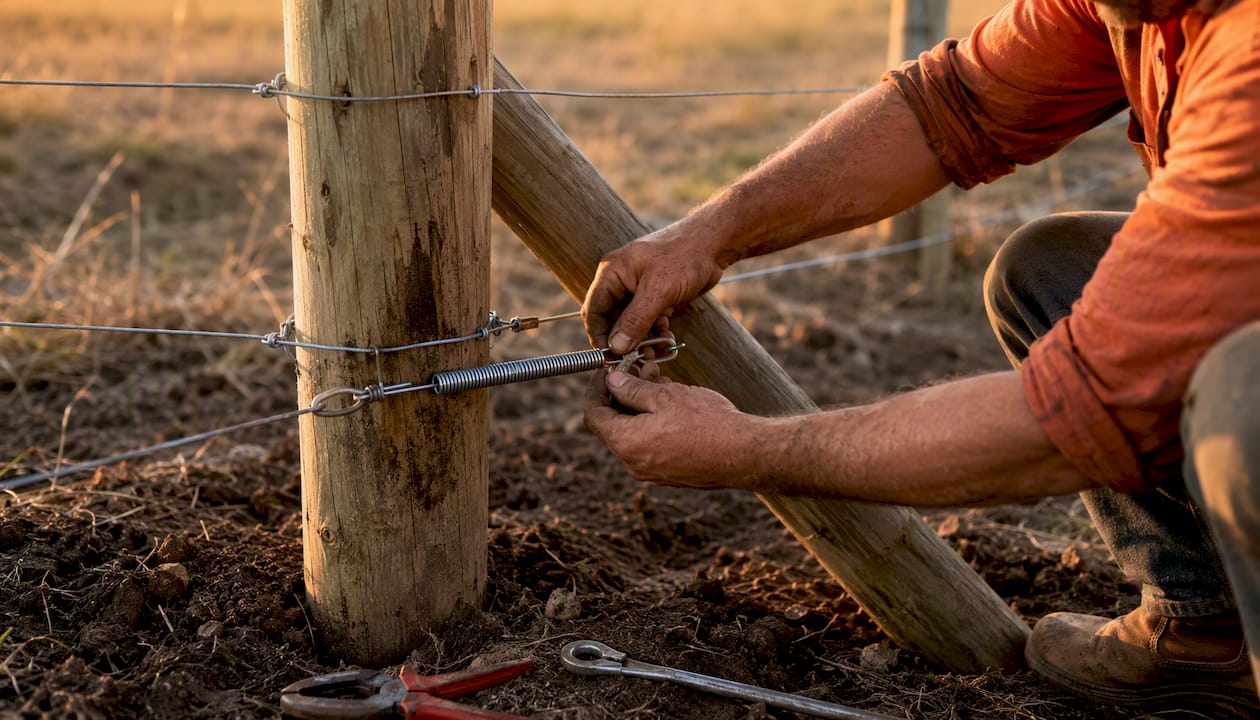
Pro Tip: In areas with ACQ-treated lumber or high soil moisture, use stainless steel clamps at every connection point. ACQ treatment is corrosive to standard galvanized hardware, and a corroded connection is a resistance point that quietly kills fence voltage.
How many strands do you need, and where do you put them?
Strand count and spacing are where most goat fences fail. Goats are persistent, flexible, and smart. A fence that would hold cattle will not hold goats. The bottom strand placement is the single most important dimension: set it at 6 inches from the ground to stop kids from crawling under, and the rest of the layout builds from there.
Practical homestead guidance recommends 5–7 strands for permanent systems, with the top wire between 42 and 54 inches depending on breed and whether predators are a concern. For Nigerian Dwarfs and other small breeds, tighter spacing in the lower half of the fence is more important than total height. For larger breeds like Boer or Nubian, the top wire should reach at least 48 inches.
Sample strand layouts
| Layout | Strand heights from ground (inches) | Best use |
|---|---|---|
| 5-strand | 6, 12, 20, 30, 42 | Standard adult goat herd, flat terrain |
| 6-strand | 6, 10, 22, 32, 42, 48 | Mixed herd with kids, moderate predator risk |
| 7-strand | 6, 10, 14, 22, 30, 40, 54 | Large breeds, high predator pressure, perimeter |
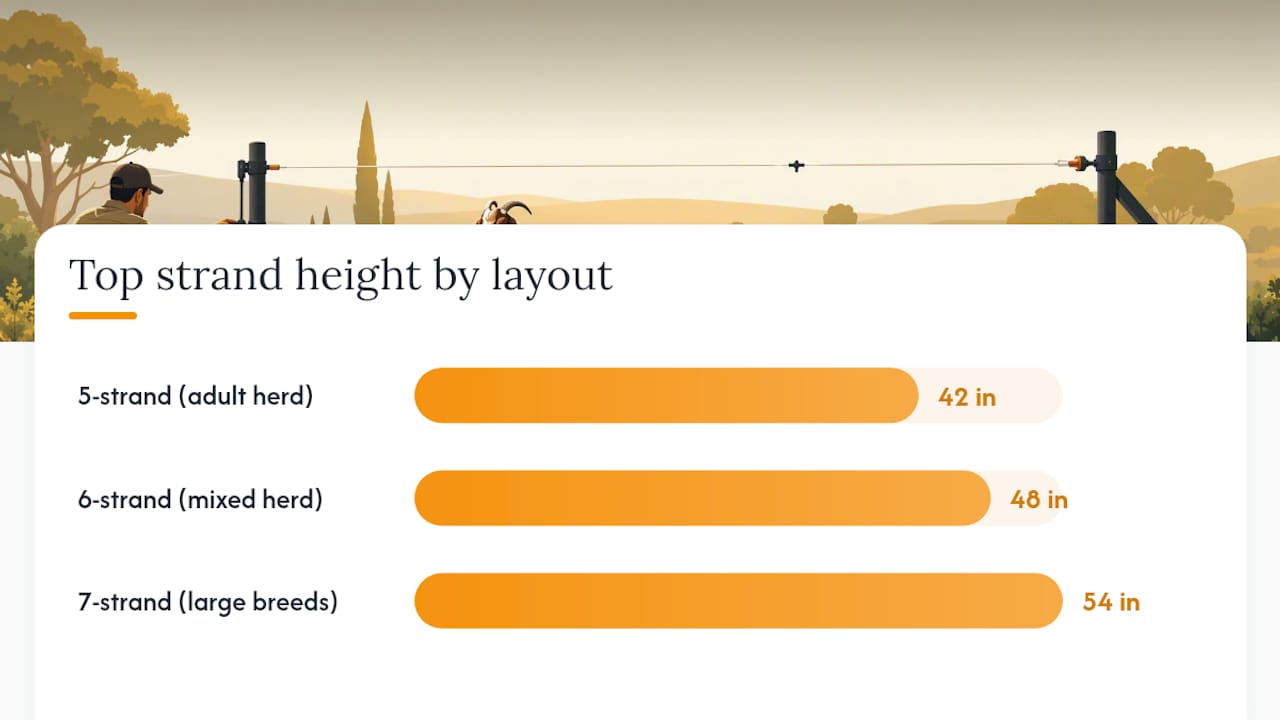
For small breeds like Nigerian Dwarfs, compress the lower spacings: 4, 8, 14, 22, 32, 42 inches works better than a standard layout because the critical deterrent zone is below knee height on a small goat.
Hot wires vs. alternating hot/ground configurations
In areas with reliable soil moisture, an all-hot configuration works fine. In dry or sandy soils, alternating hot and grounded wires gives the circuit a return path through the fence itself rather than relying entirely on soil conductivity. This matters most in summer on sandy ground or during drought. The Gallagher 5-wire Insultimber layout uses this principle, pairing hot wires with grounded return wires to maintain shock effectiveness regardless of soil conditions.
- All-hot: simpler wiring, works well in humid climates with good soil conductivity
- Alternating hot/ground: better for dry soils, sandy terrain, or regions with seasonal drought
When predators are a concern, push the top wire to 54 inches and consider adding a second wire at 60 inches. Visual markers — strips of flagging tape or colored insulators — help goats identify the fence boundary during the initial training period.
Pro Tip: Offset insulators placed at roughly two-thirds of shoulder height on existing fence posts are an effective way to electrify a woven wire fence without rebuilding it. The first contact hits the nose or chest, which is exactly where you want it.
How do you size an energizer and build a grounding system that actually works?
The energizer is the heart of the system, and the grounding system is what makes the energizer’s output useful. Both are routinely undersized, and both failures look the same from the outside: goats that walk through the fence.
Energizer sizing
Size by joules of stored energy, not by the voltage number on the box. Voltage tells you the open-circuit potential; joules tell you how much energy the energizer can deliver through a loaded fence. A fence with vegetation contact, multiple strands, and a long run needs joules to maintain a deterrent shock. Practical guidance recommends minimum fence-line voltages of 4,000–5,000 V for goats, and achieving that under load on a vegetated run requires a higher-joule energizer than the fence length alone would suggest.
A rough rule: plan for at least 1 joule of output per mile of fence wire (total wire, not fence line). For a 1-mile perimeter with 6 strands, that’s 6 miles of wire. When in doubt, go bigger. An oversized energizer running a clean fence is far better than an undersized one struggling against weeds.
For solar-powered options, check the solar energizer comparison to match panel capacity to your joule requirement before buying.
Grounding system design
According to Virginia Tech Extension grounding guidance, the minimum ground rod counts by energizer joule rating are:
These are minimums, not targets. In dry or sandy soils, add rods or treat the soil around them. A bentonite/salt slurry improves conductivity in very dry conditions, but it’s corrosive — use stainless steel rods and clamps if you go that route.
Connect ground rods with 12.5-gauge or heavier insulated wire. Never mix copper and galvanized steel in the same grounding circuit without stainless or bronze clamps; the galvanic reaction corrodes connections within a few seasons and raises resistance quietly.
- Use galvanized steel rods as the default
- Space rods at least 10 feet apart along the fence line
- Keep the ground system at least 50 feet from utility grounds and building foundations to reduce lightning risk
Pro Tip: Site your grounding system on the shaded, north-facing side of a fence run where soil stays moister longer into summer. A few feet of placement difference can meaningfully reduce ground resistance during dry months.
For a deeper walkthrough of grounding electric fences for livestock, Fencefast’s installation guide covers the step-by-step process with diagrams.
What posts, braces, and tensioning methods make a high tensile system hold up?
High tensile wire stores enormous tension, and that tension has to go somewhere. It goes into the corner and end brace assemblies. If those assemblies are underbuilt, the fence fails — not gradually, but suddenly, when a goat leans on it or a freeze-thaw cycle shifts the soil.
Post choices
- Treated wood line posts: 4-inch diameter minimum, set 3–4 feet deep, spaced 40–60 feet apart on flat ground
- Steel T-posts: lighter and faster to install; use between wood posts at 20–30 foot intervals in areas with terrain changes or animal pressure
- Self-insulating Insultimber-type posts: eliminate the need for separate insulators; good for permanent paddock divisions
Corner and end bracing
The USDA/EFOTG specification recommends brace assemblies no more than 1,320 feet apart on straight runs. Each corner and end post needs a full H-brace or diagonal brace assembly. The brace post should be at least 8 feet long, set 3.5 feet deep, with a horizontal brace rail and a diagonal brace wire tensioned to push the corner post outward against the wire pull.
For long straight runs, add a line brace every 1,320 feet. On hilly terrain, add them at every significant grade change.
Tensioning sequence
Here’s the order that works:
- Set all corner, end, and brace posts first. Let concrete cure if used.
- Set line posts at planned intervals.
- Attach wire at one end post using a crimp sleeve termination.
- Unroll wire to the far end, keeping it off the ground.
- Attach the inline strainer at the far end, leaving slack.
- Thread wire through all line post insulators.
- Tension each strand with the inline strainer to a firm, resonant tension (the wire should hum when plucked, not sag or vibrate loosely).
- Attach tension springs at end assemblies on runs longer than 500 feet.
- Connect energizer and ground system last, before testing voltage.
Inline strainers are used to tension roughly 800 to 1,000 feet of wire each. On longer runs, stagger strainer positions between strands so they’re not all at the same point, which distributes the load on the brace assembly.
Pro Tip: Check tension in early spring and late fall. Wire contracts in cold weather and can pull brace assemblies if it was tensioned too tight in summer. A tension spring at each end assembly absorbs that seasonal movement and saves you from re-tensioning every year.
When does portable electric netting make more sense than permanent HT fencing?
The honest answer: portable netting is the right tool for a specific set of situations, and permanent high tensile is the right tool for everything else. Mixing them up costs money and frustration.
Woven wire and HT comparison data shows that high tensile electric wins on long-term cost per foot for large perimeters, while portable options offer flexibility that permanent systems simply can’t match for rotational grazing.
Portable electric netting
Portable netting (typically 164-foot rolls, 35–42 inches tall) sets up in minutes and moves with the herd. It’s the right choice for:
- Rotational grazing paddocks where the layout changes seasonally
- Starter herds where you’re still figuring out your permanent layout
- Temporary predator protection during kidding season
- Small acreage where a permanent multi-strand system is overkill
The limits are real, though. Netting has a shorter service life than permanent HT wire, typically 5–10 years with careful handling. It’s less effective against determined predators than a properly tensioned permanent fence. And it requires more frequent attention: netting that sags or contacts vegetation loses voltage fast.
For more on electric net fencing for goats, Fencefast’s guide covers setup and rotation strategies.
Permanent high tensile multi-strand
Permanent HT fencing is the right investment when:
- You have more than 2–3 acres to fence
- The herd is established and the layout is fixed
- You need predator resistance as well as goat containment
- You want a fence that lasts decades without rebuilding
The installation precision required is higher than for netting. Weak bracing or poor tensioning leads to early failure. But a well-built permanent system, with proper maintenance, outlasts every other option.
Hybrid approach
Many farms run both: permanent HT wire on the perimeter and portable netting for internal paddock rotation. The perimeter handles predators and keeps the herd on the property; the netting manages grazing rotation without the cost of permanent interior fencing. This is the approach Livestock Fencing Hub recommends for mixed-species farms with predator risk and intensive handling areas.
Checklist to choose your system:
- More than 3 acres to fence? Permanent HT.
- Rotational grazing with changing paddock layouts? Portable netting for interior.
- Predator pressure (coyotes, dogs)? Permanent HT perimeter, minimum 7 strands.
- Starter herd, uncertain layout? Netting first, permanent later.
- Budget for full installation now? Permanent HT wins on 10-year cost.
How do you train goats to respect an electric fence, and what safety checks matter?
Training is not optional. A goat that has never been shocked by a fence will test it. A goat that has been shocked once, correctly, will respect it for years. The training process takes a few days and pays off for the life of the fence.
Training steps
- Set up a small training pen with a hot wire at nose height (roughly 8–12 inches for adults, 6 inches for kids) inside a safe enclosure.
- Let goats discover the wire on their own. Don’t push them toward it.
- After 2–3 days of exposure, move them to the permanent fence.
- Use flagging tape or colored markers on the wire for the first week so goats can see the fence boundary clearly.
Homestead guidance recommends internal hot wires for training, placed at chest height to ensure the first contact is nose-to-wire rather than body contact, which delivers a more memorable deterrent.
A goat that learns the fence boundary early rarely tests it again. The training investment of a few days prevents years of escape incidents and fence repairs.
Routine safety checks
- Test fence voltage weekly during the first month, then monthly. A fence voltage minimum sufficient to deliver an effective deterrent shock to goats.
- Walk the fence line after every significant storm. Fallen branches are the most common cause of sudden voltage drops.
- Inspect insulators quarterly for cracking, UV degradation, or displacement.
- Clear vegetation from the bottom two strands monthly during the growing season. Grass contact is the most common cause of chronic low voltage.
Human and pet safety
- Post “Electric Fence” signs at all entry points and gates.
- Use lockable gate latches on all paddock entries.
- Disconnect the energizer before any maintenance work on the fence.
- Keep children and pets away from the fence during the initial energizing period.
For a full post-installation safety checklist, Fencefast’s electric fencing tips for goats covers the most common mistakes owners make in the first 30 days.
How do you troubleshoot low voltage and keep the fence performing long-term?
Low voltage is the most common complaint with electric goat fences, and it almost always has one of five causes. Work through them in order before replacing the energizer.
Most fence failures trace back to the grounding system or vegetation contact, not the energizer. Check those two first before spending money on new equipment.
Troubleshooting flow
- Check energizer output. Disconnect the fence from the energizer and test output directly. If it reads below spec, the energizer needs service or replacement.
- Test voltage at intervals along the fence. A significant drop between the energizer and a mid-fence point indicates a short or high-resistance connection in that span.
- Inspect the grounding system. Check all rod connections for corrosion. Re-drive any rods that have heaved. In dry conditions, water the ground around the rods.
- Remove vegetation contact. Walk the fence and clear any grass, weeds, or brush touching the bottom two strands.
- Isolate problem spans. Disconnect sections one at a time to find the span causing the voltage drop, then inspect that section for broken wires, damaged insulators, or loose connections.
Maintenance checklist
- Annual: check all strand tensions, re-tension as needed; inspect brace assemblies for movement; test all connections for corrosion
- Every 3–5 years: re-treat or replace wood posts showing rot at the soil line; inspect crimp sleeve terminations
- Before grazing season: replace energizer batteries or service solar panels; test full fence voltage under load
- After winter: check for wire breaks from ice or fallen branches; re-tension strands that contracted during cold weather
Winterizing and quick repairs
In cold climates, disconnect solar panels from energizers during extended periods of non-use to preserve battery life. For broken strands, carry a small repair kit: crimp sleeves, a crimping tool, and a short length of matching wire. A broken strand left unrepaired is an escape waiting to happen.
For dry or sandy soils where grounding remains a chronic problem, Virginia Tech Extension describes a bentonite/salt slurry treatment that improves soil conductivity around ground rods. Use stainless steel rods and clamps when applying this treatment, as the mixture is corrosive to standard galvanized hardware.
Quick technical reference: standards and specs to use when ordering materials
When you’re ordering wire, insulators, and hardware, these are the specs to confirm with your supplier before purchasing.
Wire specifications
- Gauge: 12.5-gauge smooth high tensile
- Galvanizing: Class III hot-dip galvanized or aluminized (not electro-galvanized)
- Breaking strength: minimum ~170,000 psi per USDA/EFOTG guidance
- Strand count: 4 or more strands for goats and sheep per the same specification
Bracing and tensioning reference
- Maximum 1,320 feet between brace assemblies on straight runs
- Inline strainers: one per strand per 800–1,000 feet of wire
- Stagger strainer positions between strands to distribute load on brace assemblies
- Tension springs at end assemblies on runs longer than 500 feet
Grounding quick reference
- Ground rod depth: 6 feet into moist soil
- Rod spacing: minimum 10 feet apart
- Rod counts: 3 rods (up to 15 J), 5 rods (up to 25 J), 7 rods (up to 35 J) per Virginia Tech Extension
What to insist on from suppliers
- Hot-dip galvanized wire, not electro-galvanized
- Stainless steel clamps when mixing metals in grounding systems
- Insulators rated for high tensile wire tension (not standard barbed wire clips)
- Crimp sleeves and a proper crimping tool for end terminations (never tie wire)
One purchasing shortcut that costs farms money: buying “high tensile” wire without confirming the galvanizing class. Class I wire at the same gauge looks identical on the shelf but corrodes in 5–8 years in most climates. Ask specifically for Class III or aluminized.
What Fencefast actually recommends, and where the conventional wisdom gets it wrong
Most fencing guides treat strand count as the primary variable. It’s not. The two things that determine whether a high tensile electric fence holds goats are the grounding system and the brace assemblies. Get those right and a 5-strand fence will outperform a 7-strand fence with weak corners and a marginal energizer.
The other thing guides consistently understate: goats are not cattle. A fence designed for cattle containment, even a good one, will fail with goats. The geometry is different (lower, tighter spacing), the energizer needs to be bigger relative to fence length, and the training process matters in a way it doesn’t with larger animals. Goats remember a fence that shocked them. They also remember one that didn’t.
Permanent HT fencing makes sense when the herd is established, the acreage justifies the installation cost, and you need a system that works for 20+ years without rebuilding. For farms still figuring out their layout, or running rotational grazing with changing paddock configurations, portable netting is the pragmatic first step. The two systems aren’t competing; they’re complementary.
The one recommendation that applies universally: oversize the energizer. The cost difference between an adequately sized energizer and an oversized one is small. The cost of goat escapes, fence repairs, and predator losses from an underpowered fence is not.
Fencefast has the supplies to build this fence right
Fencefast stocks the complete range of high tensile electric fencing components for goat operations: 12.5-gauge Class III galvanized and aluminized wire, offset insulators, inline strainers, crimp sleeves, tension springs, and Gallagher energizers sized from small paddock units to high-joule perimeter chargers. Every product is selected for farm-scale permanent installations, not backyard hobbyist setups.

If you’re building a new perimeter fence or upgrading an existing system, Fencefast’s design consulting service helps you spec the right energizer, ground rod count, and strand layout for your acreage and herd size before you order. No guesswork on joule ratings or brace spacing. Visit Fencefast to browse the full product catalog or get in touch with the team for a system recommendation tailored to your operation.
Sources
The following references were used throughout this guide. Each covers a specific aspect of high tensile electric fence design and installation.
- Permanent Electric High Tensile Fence (USDA/EFOTG)
- SPES-691: Grounding Electric Fences (Virginia Tech Extension)
- Goat fencing guide: build an escape-proof pen (Plan Your Homestead)
- Woven wire / field fence guide (Livestock Fencing Hub)
Where to start: if you’re building from scratch, read the USDA/EFOTG spec for materials and the Virginia Tech grounding guide before you order anything. Those two documents answer most of the questions that cause expensive mistakes.

