

TL;DR:
- Virtual fencing uses GPS collars to contain livestock with over 99.5% accuracy.
- Costs include collars, subscriptions, and optional base stations, but savings in labor are significant.
- It serves as a management tool for internal grazing but doesn’t replace perimeter fences.
Virtual fencing has crossed a major threshold. Canadian field trials now show over 99.5% containment with GPS collar systems, a number that rivals or beats many traditional electric fence setups. Yet most farmers still assume this technology is either too expensive or too experimental to justify. That assumption is costing some operations real money, because the funding programs, labor savings, and grazing flexibility that come with virtual fencing are already available right now. This guide breaks down actual collar costs, subscription fees, funding opportunities, and the practical limitations you need to understand before making a decision for your Canadian ranch or farm.
Table of Contents
- What is virtual fencing and how does it work?
- Breaking down the real costs: Collars, subscriptions, and more
- How virtual fencing compares to traditional fencing in Canada
- Key considerations and common pitfalls in Canadian conditions
- The real opportunity: Virtual fencing as a management tool, not a silver bullet
- Get started with trusted virtual fencing solutions
- Frequently asked questions
Key Takeaways
| Point | Details |
|---|---|
| Upfront collar cost | Most virtual fencing collars for Canadian farms cost $350–$550 CAD each before subscriptions. |
| Long-term savings | Virtual fencing reduces labor and repair costs over time compared to traditional systems. |
| Funding support | Canadian farmers may receive substantial grants, offsetting 85% of system costs in some provinces. |
| Needs physical backup | Physical fences remain crucial for boundaries despite the flexibility of digital systems. |
What is virtual fencing and how does it work?
Virtual fencing replaces physical wire and posts with GPS-equipped collars worn by individual animals. You draw boundaries on a smartphone app, and the collar enforces those boundaries using sound and a mild electric pulse. There are no posts to drive, no wire to string, and no physical barrier to maintain.
The learning process is straightforward. When an animal approaches a virtual boundary, the collar emits an audio warning tone. If the animal keeps moving toward the line, it receives a mild pulse. That pulse is roughly one-fifth the strength of a standard electric fence shock. Most cattle learn to respect the audio cue within a few days, meaning the pulse rarely triggers after the initial training period.
The collars are solar-powered, which matters a lot for Canadian operations where running power to remote pastures is expensive or impossible. Boundaries can be redrawn remotely from any device with internet access, so you can shift a grazing zone in minutes without driving out to the field. Real-time GPS tracking lets you monitor herd location, check for animals that have strayed, and receive alerts if a collar goes offline.
Research backs up the practical results. GPS collars using audio cues and mild pulses have achieved containment rates above 99.5% in Canadian trials, which is a strong performance benchmark. For more background on the mechanics, virtual fencing explained covers the full technology picture in detail.
The biggest operational advantage is flexibility. You can create rotational grazing paddocks on the fly, protect riparian areas without installing permanent exclusion fencing, and adjust grazing pressure based on forage conditions. GPS technology studies confirm that adaptive grazing managed through virtual systems can improve pasture utilization significantly.
There are real limitations, though. Virtual fencing requires either cellular coverage or a LoRa base station to function. It is not designed to replace perimeter fencing for property boundaries or predator exclusion. Think of it as a powerful internal management tool, not a complete substitute for all physical infrastructure.
“Virtual fencing gives you the ability to manage grazing with precision that physical fences simply cannot match, but it works best as part of a layered system rather than a standalone solution.”
Breaking down the real costs: Collars, subscriptions, and more
Now that you know how virtual fencing works, let’s break down what you’ll actually pay to use it on your farm.
Collar prices range from CAD $350 to $550, depending on the brand and included features. Subscription fees vary widely. Some platforms like Ag Proud and Monil charge as little as $2.50 per month per collar, while annual plans can run around $81 per year per animal when converted from euro-based pricing. Check Nofence and Monil pricing for current comparisons across platforms available in Canada.

If your pastures are in remote areas without cell coverage, you will also need a base station. These units extend coverage using LoRa radio technology and add to your upfront hardware cost, though a single station can cover a large area.
Sample cost estimate for a 50-head herd:
| Cost item | Low estimate | High estimate |
|---|---|---|
| Collars (50 units) | $17,500 CAD | $27,500 CAD |
| Annual subscription (per collar) | $30/year | $97/year |
| Base station (if needed) | $1,500 | $3,000 |
| Total year one | $19,000 | $30,600 |
| Annual ongoing cost | $1,500 | $4,850 |
Compare that to portable fencing costs for a similar operation. Traditional temporary electric fencing for rotational grazing across 50 head can easily run $8,000 to $15,000 in materials alone, plus ongoing labor for moves, repairs, and resets. Over five years, the labor cost gap often closes the difference in hardware investment.
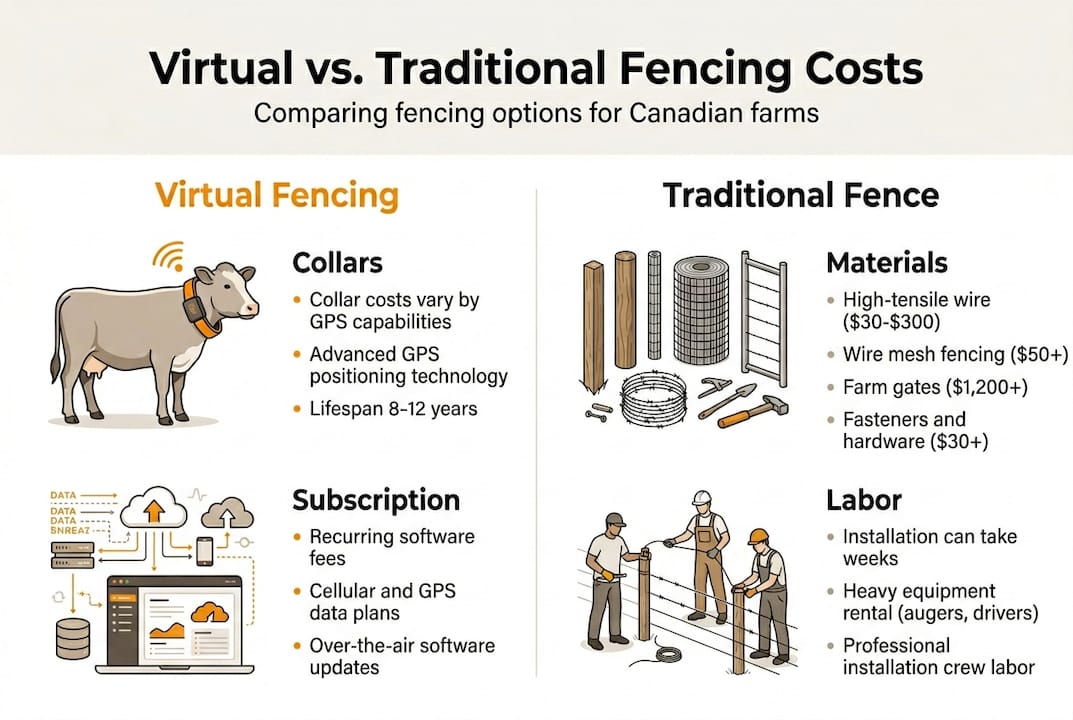
For operations considering durable fencing alternatives, permanent post-and-wire systems involve high installation costs and zero flexibility once built.
Pro Tip: Funding programs can cover up to $75,000 with a 15% producer share through Alberta’s RDAR OFCAF program. Ontario’s BMP program and other provincial initiatives offer similar support. Applying early in the season improves your chances of approval before funds are allocated.
How virtual fencing compares to traditional fencing in Canada
Cost is only one piece of the decision. Here’s how the virtual option really stacks up against traditional fencing.
Upfront costs for virtual fencing are higher, but labor requirements and long-term costs are often lower. That trade-off is the core of the comparison.
Virtual fencing vs. traditional fencing comparison:
| Factor | Virtual fencing | Traditional fencing |
|---|---|---|
| Upfront hardware cost | High (collars + base station) | Moderate to high (posts, wire, labor) |
| Boundary flexibility | Instant, app-based | Fixed, requires physical change |
| Labor for moves | Near zero | Significant |
| Repair and maintenance | Collar battery, software updates | Post replacement, wire repair, stapling |
| Riparian protection | Easy to set and adjust | Expensive to install and maintain |
| Predator exclusion | Not suitable | Effective with proper materials |
| Perimeter security | Not a replacement | Essential |
Here are the specific tasks that virtual fencing eliminates or simplifies:
- Moving temporary electric fence reels and posts between paddocks
- Repairing wire breaks after weather events or wildlife contact
- Driving fence lines to check for shorts or damage
- Installing and removing seasonal exclusion zones around riparian areas
- Manually tracking herd location across large or rugged terrain
For ranchers using rotational grazing fencing strategies, the labor savings from virtual systems are often the most compelling argument. Moving 50 head between paddocks with a physical fence can take hours. Redrawing a virtual boundary takes minutes.
“The real value of virtual fencing isn’t just what it costs less to build. It’s what you get back in time, flexibility, and grazing precision that physical fences can never give you.”
The virtual vs. traditional fencing debate ultimately comes down to your operation’s goals. If you need flexible internal management and adaptive grazing, virtual wins. If you need hard perimeter security, physical fencing is still essential.
Key considerations and common pitfalls in Canadian conditions
Before you commit, it’s critical to know where virtual fencing excels and where traditional options are still essential.
Here are the key requirements and limitations specific to Canadian farms and ranches:
- Connectivity: Virtual fencing requires cellular coverage or a LoRa base station. Dead zones on remote pastures will prevent the system from functioning reliably.
- Winter performance: Winter battery effectiveness remains above 96% in Canadian field tests, which is reassuring for year-round operations. Solar charging is reduced in winter months, so collar battery management becomes more important.
- Animal size: Collars are not suitable for calves under 500 lbs. If your operation runs cow-calf pairs, you will need physical fencing or supplemental management for young animals.
- Perimeter fencing: Virtual fencing does not replace property boundary fences. You still need physical barriers for liability, predator exclusion, and legal boundary compliance.
- Long-term durability: The technology is relatively new in Canada. Long-term collar durability and system reliability over 8 to 10 years is still being established through field experience.
- Learning curve: Staff and operators need to be comfortable with app-based management. This is not a barrier for most, but it is worth factoring into your adoption timeline.
Understanding virtual fencing limitations before investing protects you from costly surprises. The rotational grazing benefits are real, but only when the system is matched to terrain and connectivity conditions that support it.
Pro Tip: Before purchasing collars, run a connectivity check across your entire grazing area. A single dead zone in a key pasture can undermine the whole system. Your supplier should be able to help you map coverage before you commit.
The real opportunity: Virtual fencing as a management tool, not a silver bullet
Here is what many experienced advisors wish more Canadian farmers understood before adopting virtual fencing: it is a management tool, not a replacement for a fencing strategy.
The operations getting the most value from virtual systems are using them for internal paddock management, adaptive grazing rotation, and riparian protection. They are not tearing out their perimeter fences. They are layering virtual technology on top of a solid physical foundation. That combination is where the real efficiency gains live.
The early adopters who struggled were often the ones who expected virtual fencing to solve every containment problem. It doesn’t. But when you use it for advanced grazing management within a well-designed system, the labor savings and grazing flexibility are genuinely transformative.
There is also a timing argument. Funding programs like RDAR OFCAF are available now, and early applicants have better access to cost-share dollars before annual budgets are exhausted. Waiting for the technology to mature further means leaving money on the table and falling behind on the grazing efficiency curve.
The honest bottom line: virtual fencing is not cheap upfront, but for the right operation with the right terrain and connectivity, it pays back in labor, flexibility, and forage utilization within a few seasons.
Get started with trusted virtual fencing solutions
If you’re ready to take the next step, here’s how to find expert support tailored to Canadian farms.
FenceFast has spent 26 years working with Canadian farmers and ranchers on fencing solutions that actually perform in real field conditions. We carry Gallagher eShepherd GPS collar systems, base stations, and everything you need to build a layered fencing strategy that works year-round.

Visit FenceFast virtual fencing options to browse our full product catalog, request a personalized quote, or connect with our team for guidance on matching the right system to your operation. We can also help you identify and apply for available funding programs to reduce your upfront investment. Whether you’re starting with 20 head or scaling up a large ranch, we have the products and expertise to help you move forward with confidence.
Frequently asked questions
How much does a virtual fencing collar cost in Canada?
Collar prices typically range from $350 to $550 CAD each, with additional monthly or annual subscription fees depending on the platform you choose.
Are there grants or funding programs for virtual fencing?
Yes, programs like Alberta’s RDAR OFCAF offer up to $75,000 in funding with a 15% producer share for approved virtual fencing systems, and similar programs exist in other provinces.
Does virtual fencing work in winter or remote areas?
Winter battery effectiveness stays above 96% in Canadian tests, but remote locations without cell coverage will need a LoRa base station to maintain reliable system operation.
Can virtual fencing replace perimeter fencing?
No. Virtual fencing is not a replacement for perimeter or property boundary fences, which are still required for legal compliance, predator exclusion, and liability protection.

