

For perimeter security, multi-strand barbed wire, woven wire, or braced high-tensile systems are your workhorses. Interior paddocks and rotational grazing call for electrified smooth wire or portable polywire. Handling areas and corrals need welded panels or pipe. Calf areas demand woven wire with small mesh openings. Bull pens require the heaviest-duty option you can build: reinforced pipe, heavy panels, or braced high-tensile with extra strands.
The single most important decision rule: match fence strength to stocking density and herd temperament. A calm, low-density cow-calf herd on open pasture has completely different requirements than a pen of breeding bulls. Bekaert Fencing and USDA extension services both make this point clearly, and Fencefast carries the full range of materials to match any scenario.
Quick use-case summary:
- Perimeter: Multi-strand barbed, woven wire, or braced high-tensile. Physical barrier that holds under pressure.
- Interior paddocks: Electrified smooth wire (2–4 strands). Psychological barrier; cheap per foot, easy to reconfigure.
- Rotational grazing: Portable polywire or polytape on step-in posts. Fast to set, fast to move.
- Calves and mixed stock: Woven wire (hinged-joint/field fence) with small mesh. Prevents leg entanglement.
- Bulls: Heavy welded panels, pipe fencing, or reinforced high-tensile with extra height and bracing.
- Handling/corrals: Welded steel panels or pipe. Rigid, safe, built for repeated pressure.
Table of Contents
- What are your cattle fencing options, and how do they compare?
- What posts, braces, and gates actually hold a fence together
- What does it actually cost, and how long will it last?
- How stocking density and herd temperament should drive your fence choice
- Maintenance, safety, and when to replace what you have
- Key Takeaways
- What experienced fence-builders actually do differently
- Authoritative resources for further reading
- Fencefast has what you need to build it right
What are your cattle fencing options, and how do they compare?
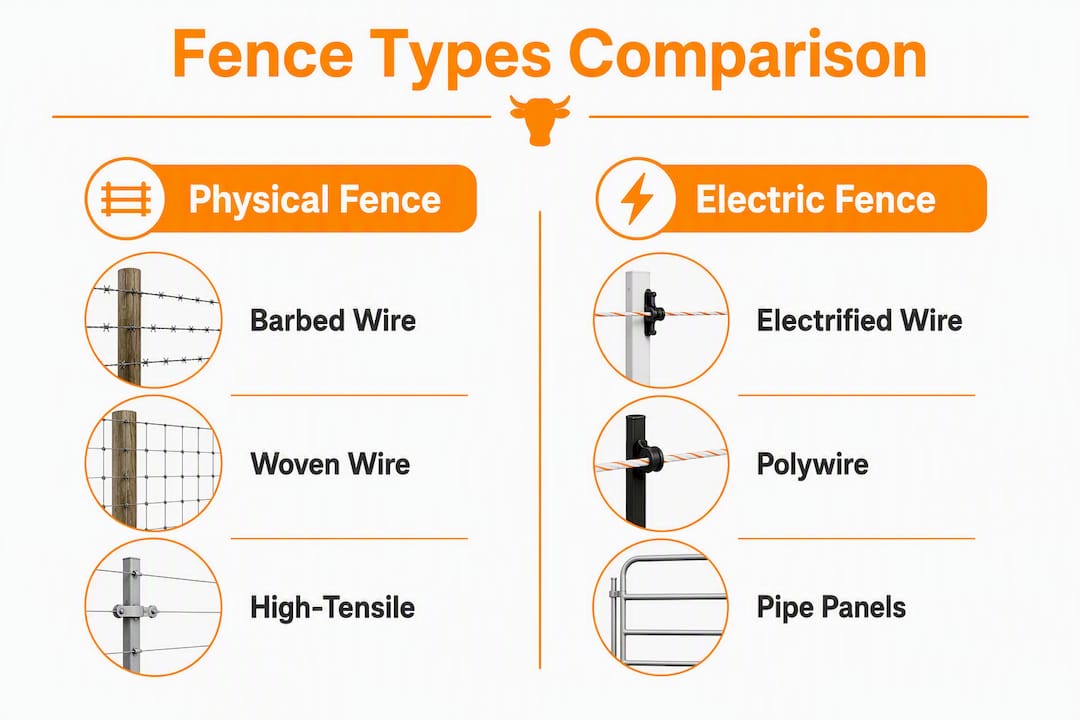
Every fence type has a job it does well and a job it fails at. Here is a plain breakdown of the six main systems, followed by a side-by-side comparison.
Barbed wire
Three to five strands of suitable gauge twisted wire with closely spaced barbs. Posts typically sit close enough to provide ample support. It is the most widely used cattle fence in the U.S. for good reason: low material cost, widely available, and proven over generations. Multiple-strand builds are commonly used for cattle perimeters.
The real trade-off is injury risk. Barbs that deter movement are the same barbs that cut an animal that panics or gets crowded. One rule is non-negotiable: never electrify barbed wire. An animal or person entangled in barbs cannot pull away from the shock, which turns a deterrent into a serious hazard. Keep barbed wire as a plain physical fence.
High-tensile smooth wire (fixed-knot and plain)
High-tensile wire runs at 12.5 gauge and holds tension far better than standard wire, allowing for wider post spacing on flat ground. Fewer posts over a long run is where the cost savings come from. Multiple strands are typical for cattle fencing.
The system lives or dies on its end assemblies. Corners and ends need proper H-brace construction with 8-foot posts set at least 4 feet deep. In-line strainers are required to maintain tension on long runs, and without them the wire sags and the fence loses effectiveness. Fixed-knot high-tensile can last up to 30 years with proper installation, giving it a low annualized cost compared to some other fences.
Woven wire (hinged-joint/field fence)
A continuous mesh of horizontal and vertical wires, typically 32–48 inches tall with graduated spacing (tighter at the bottom for calves). Woven wire offers better protection for calves and smaller livestock because of smaller mesh openings, but it can deform over time and may require closer post spacing in wet climates. Posts typically sit close enough together to support the mesh appropriately. Often topped with one or two strands of barbed wire to bring total height to 54 inches or more.
Cost runs higher per foot than some other wire types, so most operations reserve it for high-pressure boundaries: near roads, handling areas, or mixed-species pastures.
Welded wire panels and pipe fencing
Rigid welded-wire panels and pipe fencing are common choices for corrals, loading areas, and bull pens. No tension required, no training required. They hold up to repeated pressure and direct contact better than any wire system. The trade-off is cost: panels and pipe run significantly higher per linear foot than wire, so they are rarely used for large perimeters.
Electrified smooth wire
Several strands of smooth high-tensile wire connected to an energizer. The fence works as a psychological barrier, not a physical one, which means success depends entirely on consistent voltage and proper animal training. Line posts can be spaced widely when the wire is kept taut, making this one of the more cost-effective options for interior subdivisions.
Energizer sizing matters. A common guideline is roughly one joule of output per mile of energized fence, and cattle need a minimum of around 2,000 volts on the line to respect it reliably. Grounding is the single most common failure point.
Portable polywire and polytape
Lightweight polywire or polytape on step-in fiberglass or plastic posts. Sets up in minutes, moves in minutes. This is the backbone of rotational grazing systems. Temporary electric polywire requires visibility aids (flags or bright tape) and routine weed control to avoid shorting and wire damage. Not suitable as a standalone perimeter fence.
Side-by-side comparison
| Fence type | Best for | Cost shape | Durability / lifespan | Maintenance effort | Installation difficulty | Animal control (calves / adults / bulls) | Post spacing |
|---|---|---|---|---|---|---|---|
| Barbed wire | Perimeter, large pastures | Low | 30+ years | Low–medium | Easy | Poor / Good / Fair | 10–12 ft |
| High-tensile smooth | Long perimeter runs | Low–medium | Up to 30 years | Low (if tensioned) | Moderate | Fair / Good / Fair | 30+ ft |
| Woven wire (field fence) | Calves, mixed stock, roads | Medium–high | 15–25 years | Medium–high | Moderate | Good / Good / Fair | 8–12 ft |
| Welded panels / pipe | Corrals, bull pens, handling | High | 30+ years | Low | Hard (heavy) | Good / Excellent / Excellent | N/A (rigid) |
| Electrified smooth wire | Interior paddocks, semi-perm perimeter | Low–medium | several years | Medium | Moderate | Fair (trained) / Good / Poor | 40–60 ft |
| Portable polywire/tape | Rotational grazing, temporary | Very low | 3–7 years (components) | High | Very easy | Poor / Fair / Poor | step-in posts |
What posts, braces, and gates actually hold a fence together
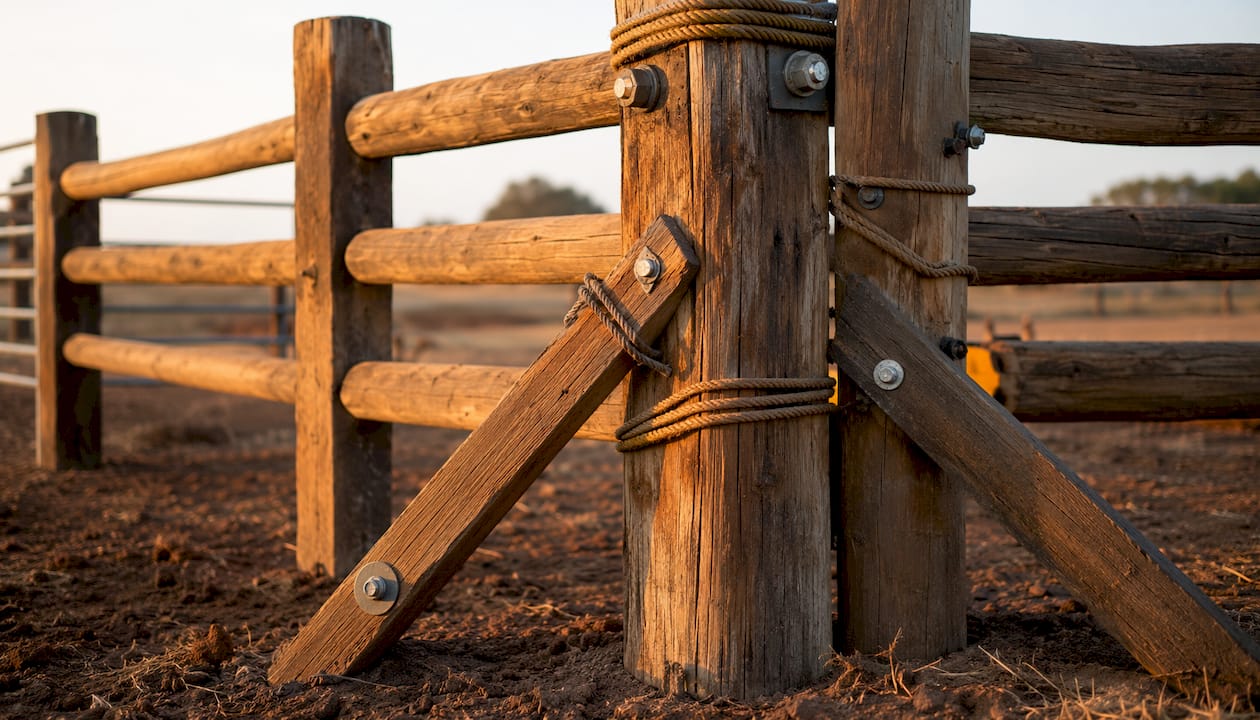
Wire is only as strong as what it is attached to. Corners and end assemblies are where most fences fail first, and getting them right is the single highest-return investment in any fencing project.
Corner and strainer assemblies
A proper H-brace uses two vertical posts connected by a horizontal brace rail, with a diagonal wire brace running from the base of the anchor post to the top of the line post. For high-tensile systems, the tension in the wire pulls constantly on the corner, so the brace must be sized to match. Typical specs: 8-foot treated wood posts, 5–6 inches in diameter at the top, set 3.5–4 feet deep in concrete or packed gravel. Undersized corners are the number-one cause of fence failure on long runs.
Post selection
- Treated wood posts: Best for permanent perimeter fences and corner assemblies. Pressure-treated pine or cedar rated for ground contact (UC4B or UC4C treatment). Typical diameter: 4–6 inches for line posts, 6–8 inches for corners.
- Steel T-posts: Fast to drive, no digging required. Good for interior paddocks and supplemental line posts on barbed or high-tensile runs. Not suitable for corners or high-tension applications.
- Fiberglass posts: Lightweight, non-conductive, ideal for electric fence line posts. Poor choice for corners or any application requiring structural strength.
- Pipe/heavy steel: Required for bull pens, corrals, and any high-pressure handling area.
Post spacing by fence type
Spacing is not one-size-fits-all. High-tensile wire holds tension between posts, so wider spacing works. Woven wire needs closer spacing to prevent sagging and mesh deformation. Panels are rigid and self-supporting.
| Post type | Recommended spacing | Best use |
|---|---|---|
| Treated wood (line post) | 10–12 ft | Barbed wire perimeter, woven wire |
| Treated wood (line post) | 30+ ft | High-tensile smooth wire (flat terrain) |
| Steel T-post | 8–12 ft | Interior barbed, supplemental high-tensile |
| Fiberglass step-in | typical spacing | Portable electric, rotational grazing |
| Pipe / heavy steel | Per panel width | Corrals, bull pens, handling |
Gate placement
Plan gate locations during the initial fence project. Adding gates to established wire later is considerably more labor-intensive and costly than building them in from the start. Gates should be placed at natural traffic flow points: where cattle move between pastures, near water sources, and at every corner of a handling facility. Minimum gate width for cattle is 12 feet for general use; 16 feet for equipment access. Handling facilities need at least one 16-foot gate for tractor entry. Every pasture should have a secondary emergency exit gate.
Pro Tip: Install a gate at every corner of a new paddock, even if you think you will not need it. Cattle management changes, and a gate you did not build costs three times as much to add later.
What does it actually cost, and how long will it last?
Costs vary by region, terrain, and whether you hire labor or DIY. The ranges below reflect typical installed costs in the U.S. and are meant as planning benchmarks, not quotes.
| Fence type | Typical installed cost (per linear foot) | Expected lifespan | Major cost drivers |
|---|---|---|---|
| Barbed wire (4-strand) | $1.50–$3.00 | 30+ years | Posts, labor, staples |
| High-tensile smooth (5-strand) | $1.50–$3.00 | Up to 30 years | Corner assemblies, tensioners |
| Woven wire + 1 barbed top | $2.00–$5.00 | 15–25 years | Wire cost, closer post spacing |
| Welded panels (16 ft) | $5.00–$10.00 | 30+ years | Panel cost, post setting |
| Electrified smooth wire | $0.75–$2.00 | several years | Energizer, grounding rods |
| Portable polywire/tape | $0.10–$0.40 | 3–7 years (components) | Replacement reels, step-in posts |
A few things to know before you budget. Materials typically represent 40–60% of total installed cost on a wire fence; labor and post setting make up the rest. On a long perimeter run, high-tensile smooth wire often beats barbed wire on total cost because fewer posts offset the slightly higher wire price. Welded panels look expensive per foot, but their 30-plus-year lifespan and near-zero maintenance make them the right call for corrals and bull pens.
Installation sequence for any wire fence: survey and mark the line, set corners and braces first, drive line posts, string wire from one end, tension and staple, then add gates. For electrified systems, install the energizer and grounding rods last and test voltage before introducing cattle.
For electric systems specifically, energizer sizing is a budget item many ranchers underestimate. Buy more joule capacity than you think you need. Vegetation load, fence length, and future expansion all eat into output, and an undersized energizer is the most common reason an electric fence stops working.
How stocking density and herd temperament should drive your fence choice
Stocking density is the primary factor in selecting fence type. High stocking density areas require stronger physical barriers like 4–6 strands of barbed wire, woven wire, or electrified smooth wire. Lower-density operations can often get by with fewer strands or a lighter system.
Herd temperament changes the math further. A calm cow-calf herd on 500 acres behaves very differently from a pen of Brahman-cross yearlings or a group of breeding bulls. The most common oversight in fence planning is failing to account for this. Even a physically robust fence fails if the design ignores bull behavior or herd pressure points.
Practical selection matrix
| Stocking density | Herd temperament | Recommended fence |
|---|---|---|
| Low | Calm | 3-strand barbed or 3-strand electrified smooth wire |
| Medium | Calm to moderate | 4-strand barbed, high-tensile, or electrified smooth wire |
| High | Moderate to flighty | Woven wire or 5-strand barbed; add electric offset wire |
| Any | Aggressive / bulls | Heavy panels, pipe, or reinforced high-tensile with extra height |
Electric fence training checklist
An electric fence is only effective if cattle respect it. Untrained animals that hit a hot wire on open pasture may bolt straight through it.
- Size the energizer for total fence length plus a 25–30% buffer for vegetation load.
- Install a minimum of 3 feet of ground rod per joule of energizer output, with rods spaced at least 10 feet apart. Moist soil improves grounding performance.
- Confirm at least 2,000 volts on the line before introducing cattle.
- Introduce stock to the hot wire in a small training paddock first. It typically takes one to two days for them to learn.
- Add visibility aids (white polytape, flags) so animals can see the wire before they contact it.
- Check and clear vegetation from the fence line weekly during the growing season to prevent shorting.
For a detailed electric fence setup guide, Fencefast has step-by-step instructions covering energizers, grounding, and livestock training.
Bull-proofing your fence
Bulls require special fencing. Standard cattle wire is often insufficient for heavy or aggressive bulls. Heavier-duty panels, reinforced high-tensile, or pipe fencing are the right call for bull pens. Minimum recommended height for bull pens is 60 inches. During breeding season, bulls will test every weak point in a fence, so inspect and reinforce corners and braces before turnout.
Pro Tip: For high-tensile runs longer than 650 feet, install an in-line strainer at least every quarter mile. Without them, wire loses tension as it settles and expands seasonally, and a sagging high-tensile fence loses its psychological and physical effectiveness fast.
Three quick scenario rules
- Cow-calf operation on large pasture: Permanent 4-strand barbed or 5-strand high-tensile perimeter, portable polywire for interior rotational grazing cells.
- Stocker operation with high stocking density: Woven wire perimeter with electric offset wire on the inside; electrified smooth wire for interior paddocks.
- Bull pen or breeding pasture: Pipe or heavy welded panels for the pen itself; reinforced high-tensile with 6 strands and extra bracing for the adjacent pasture.
Experts recommend a hybrid approach: permanent perimeter fencing for security and portable electrified polywire for interior rotational grazing to balance durability and management flexibility. That combination handles most U.S. cattle operations without over-building or over-spending.
Maintenance, safety, and when to replace what you have
A fence that looked solid at installation can fail quietly over years. Routine checks catch problems before they become escapes or injuries.
Routine maintenance checklist
- Vegetation control: Mow or spray under wire fences twice a year minimum. Vegetation shorting an electric fence is the leading cause of voltage drop.
- Tension checks: Walk high-tensile and barbed wire runs each spring and fall. Tighten any wire that has sagged more than 2–3 inches below its original height.
- Post integrity: Check for leaning, rotting, or frost-heaved posts. Replace any post that moves more than an inch under hand pressure.
- Gate hardware: Lubricate hinges and latches annually. Check that gate posts have not shifted, which causes gates to drag and latch poorly.
- Energizer testing: Use a digital fence tester monthly on electric systems. Voltage below 2,000 volts on the line means something needs attention.
Safety dos and don’ts
Keep exposed barbed wire away from lanes, gates, and any area where cattle or people move quickly. Livestock fence safety around handling facilities means smooth wire or panels, not barbed. Add white flags or polytape to electric wires near gates so animals and people see the wire before contact. Never work on an energized fence; always disconnect the energizer before handling wire.
Red flags that mean major work is needed
A fence that requires more than two repairs per season on the same stretch is telling you something. Repeated sagging, rust-through mesh, loosened corner braces, or recurring escapes after storms are not maintenance issues. They are replacement signals. The cost of a new fence run is almost always less than the cumulative cost of repeated repairs plus the liability of escaped livestock on a road.
Fixed-knot high-tensile fencing can last up to 30 years, which means a fence installed in the 1990s may be at or past its service life. Woven wire in wet climates tends to rust and deform faster than the same wire in dry conditions, often showing failure at 15–18 years.
Common troubleshooting
- Poor voltage on electric fence: Check grounding first. Add ground rods if needed. Then check for vegetation contact along the line.
- Sagging high-tensile wire: Tighten in-line strainers. If strainers are maxed out, the wire may have stretched past its elastic limit and needs replacement.
- Panel deformation in bull pen: Replace the deformed panel and reinforce the post behind it. A bent panel is a structural failure, not a cosmetic one.
Key Takeaways
Matching fence type to stocking density and herd temperament is the single decision that determines whether a cattle fence holds or fails.
| Point | Details |
|---|---|
| Perimeter vs. interior logic | Build permanent, heavy perimeters; use portable electric for interior rotational grazing cells. |
| Stocking density drives choice | High-density areas need woven wire or 4–6 strand barbed; low-density can use lighter electrified systems. |
| Fixed-knot high-tensile lifespan | Properly installed fixed-knot high-tensile can last up to 30 years, giving it the lowest annualized cost. |
| Bull pens need a different standard | Use pipe, heavy welded panels, or reinforced high-tensile at 60 inches minimum height for bull containment. |
| Fencefast as your supplier | Fencefast carries the full range of wire, panels, energizers, and accessories for every cattle fencing system. |
Action checklist:
- Inspect perimeter corners and braces before each breeding season.
- Choose fence type by stocking density and herd temperament, not by what the neighbor used.
- Plan and install all gate locations during the initial build.
- Train cattle on electric fences in a small paddock before relying on them for perimeter control.
- For long perimeter runs, bull pens, or when you lack the equipment to set corners properly, contact a fencing supplier or installer. Fencefast offers design consulting and a full product catalog at fencefast.ca.
What experienced fence-builders actually do differently
The gap between a fence that lasts 30 years and one that needs constant attention usually comes down to a few decisions made in the first week of a project, not the wire itself.
Site prep is where most ranchers underinvest. Walking the entire fence line before driving a single post reveals low spots that will hold water and rot wood faster, rocky ground that makes post-setting difficult, and natural cattle pressure points like water sources and shade trees where the fence will take more abuse. Knowing those spots in advance lets you use heavier posts and closer spacing exactly where they are needed.
Staging materials along the fence line before you start saves more time than most people expect. On a half-mile run, carrying posts and wire spools back and forth adds hours. Set up a staging area at the midpoint and work outward in both directions.
Gate placement is the decision most ranchers regret. The instinct is to put gates where they are convenient to build, not where cattle actually move. Watch your herd for a few days before you finalize gate locations. Cattle create their own trails, and a gate that aligns with a natural trail gets used without pressure. One that fights the herd’s movement becomes a daily battle.
One practical lesson that shows up repeatedly in fence-building: switching a long perimeter from aging barbed wire to fixed-knot high-tensile with proper H-bracing typically cuts annual maintenance time significantly. The upfront cost is higher, but the fence holds tension through freeze-thaw cycles and requires far fewer post replacements over a decade. For operations where labor is the real constraint, that trade-off pays for itself.
For ranchers planning a new build or a major upgrade, Fencefast’s cattle fencing best practices guide covers current recommendations for materials, energizer selection, and installation sequencing.
Authoritative resources for further reading
These are the sources worth bookmarking when you are planning a build, specifying materials, or troubleshooting an existing system.
- Mississippi State Extension: Livestock Fencing Systems for Pasture Management — One of the most practical U.S. extension publications on matching fence type to livestock and management system. Covers electric fence training in detail.
- Mississippi State Extension: Electric Fencing Technical Bulletin (P2538) — The go-to reference for energizer sizing, grounding specifications, and voltage requirements for cattle. Use this before you buy an energizer.
- University of Tennessee Extension: Planning and Building Fences on the Farm (PB1541) — Detailed construction specs for corners, bracing, post setting, and high-tensile installation. Includes diagrams for H-brace assembly.
- Bekaert Fencing: Choosing the Right Fence for Your Animal Application — Industry-level guidance on matching fence type to stocking density and animal behavior. Useful for operations with mixed species or variable pressure zones.
- Fencefast: Temporary Livestock Fencing Guide — Practical supplier-backed guidance on portable fencing materials, energizer selection, and rotational grazing setup for U.S. and Canadian ranchers.
- Fencefast: Electric Fencing for Cattle — Comprehensive guide to electric fencing components, energizer selection, and accessory choices for cattle operations.
- Your state’s land-grant extension service — State-specific guidance on recommended fence heights, local regulations, and visibility requirements varies. Search “[your state] extension cattle fencing” for the most relevant local publication.
Fencefast has what you need to build it right
Choosing the right fence type is half the job. Getting the right materials, in the right quantities, without hunting across three suppliers is the other half.
Fencefast stocks the full range of cattle fencing materials: high-tensile and barbed wire, woven wire, welded panels, electric fence components, energizers, grounding systems, polywire, polytape, and all the hardware in between. As an authorized Gallagher dealer with over 26 years of experience, Fencefast also offers design consulting for ranchers planning new perimeter builds or rotational grazing systems. Whether you are bull-proofing a pen, setting up a rotational grazing cell with temporary cow fencing, or replacing an aging perimeter, the catalog and the expertise are in one place. Browse the full selection and get your project started at fencefast.ca.

