

TL;DR:
- Farm gate systems vary by movement, material, and purpose, so selecting the right type depends on site conditions and function. Proper installation and livestock-safe construction are crucial for long-term durability, safety, and minimal maintenance. Automation needs farm-rated hardware with proper sizing, backup power, and offline fallback to ensure reliable operation.
The core types of farm gate systems break down into eight categories, and the right pick depends almost entirely on what the gate needs to do.
- Swing (hinged) gates: Best for level sites, light-to-medium spans, and low-traffic driveways where there’s room to arc open.
- Sliding gates: Right for tight openings or sites where a swing arc would block a road or building.
- Cantilever gates: The go-to on sloped, muddy, or snowy ground where a ground track would clog or fail.
- Tubular/pipe (stock) gates: Built for livestock yards, cattle runs, and any high-contact, high-cycle situation.
- Panel/palette gates: Portable, reconfigurable, and ideal for temporary yards or rotational grazing setups.
- Wooden entrance gates: Suited to farmhouse driveways and aesthetic entrances where appearance matters more than heavy livestock duty.
- Automatic/electric gates: Worth the investment on high-frequency vehicle access points or any site where security and remote control are priorities.
- Cattle grids: Vehicle-only throughput where stopping to open a gate every trip is impractical and animals are managed elsewhere.
The single rule: match the gate to its primary job — contain, secure, or automate — before you think about budget or looks.
Table of Contents
- What are the main types of farm gate systems and how do they differ?
- Swing vs sliding vs cantilever: which one fits your site?
- Material and construction details that actually matter for livestock safety
- How do automatic gate systems work, and what do you need to install one?
- Livestock-specific gates and handling systems: what’s different about stock gates
- Installation considerations, common failure modes, and realistic cost ranges
- How to choose the right gate system: a decision checklist
- Maintenance schedule and expected lifespan by gate type
- What modern access-control options are available for farm gates?
- Key Takeaways
- The part most farmers get wrong about gate systems
- Useful sources and further reading
- Fencefast has the gate hardware and expertise your farm actually needs
What are the main types of farm gate systems and how do they differ?
Farm gate types split first by how they move, then by what they’re made of. Understanding both axes keeps you from buying a gate that works fine in a showroom and fails in a muddy cattle yard.
By movement:
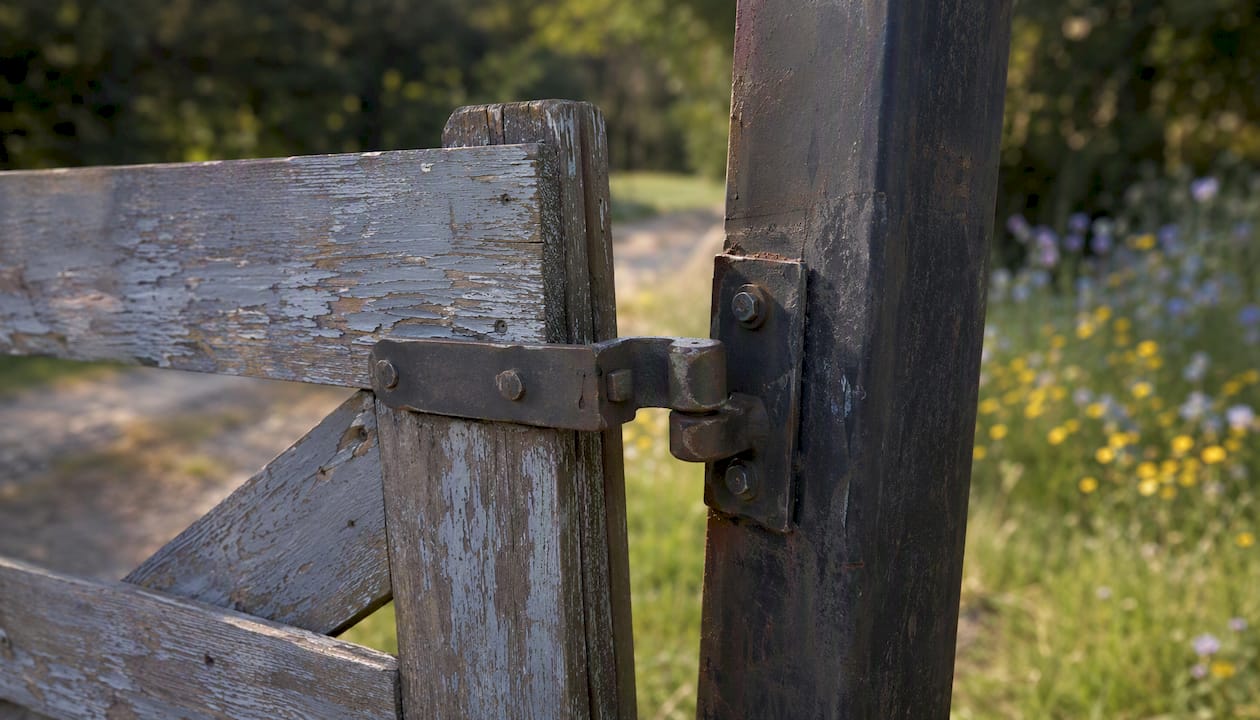
Swing gates pivot on hinges fixed to a post. They’re the simplest build, cheapest to install, and easy to repair. The catch is that they need a clear arc — typically equal to the gate’s full width — and that arc must be level and unobstructed. On a flat driveway with light use, they’re hard to beat. In a busy yard with tractors, they’re a liability.
Sliding gates roll laterally along a bottom track. They work well where swing clearance is impossible, but the track collects mud, manure, and debris. A clogged track is the most common reason sliding gates fail in farm settings.
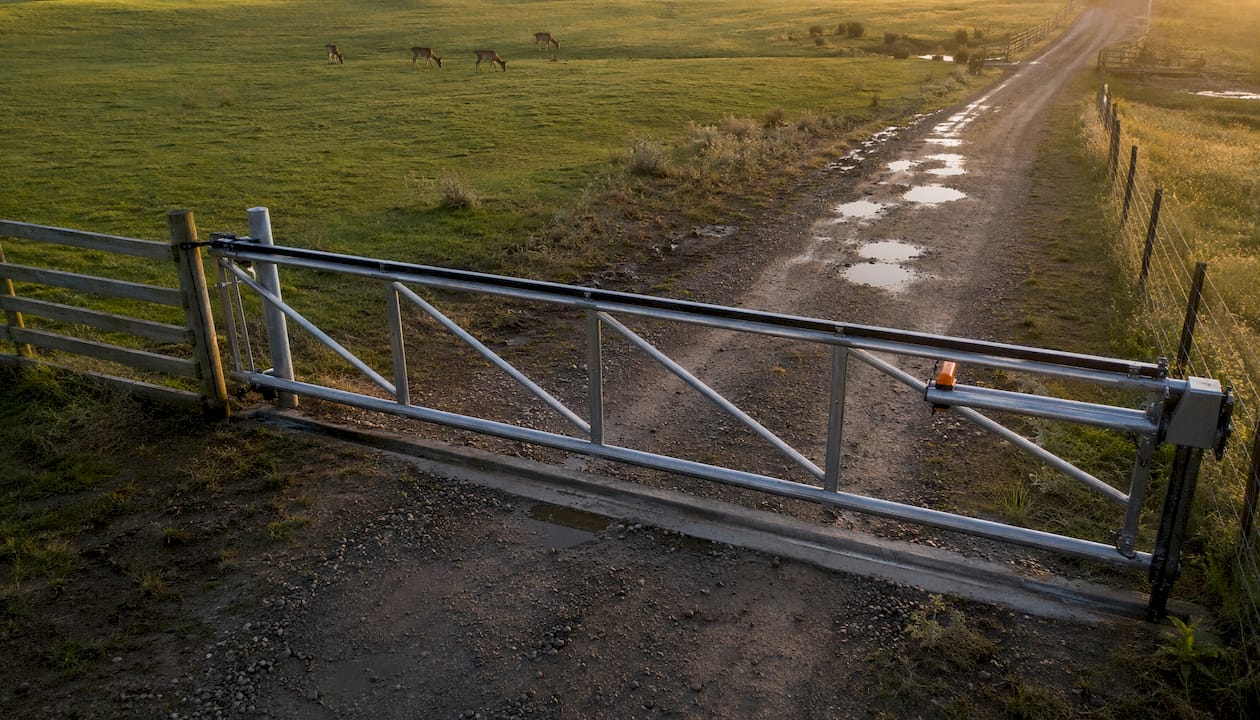
Cantilever gates solve the track problem by suspending the gate above the ground on a counterbalanced carriage. They’re mechanically more complex and cost more upfront, but on sloped or debris-prone approaches, cantilever gates avoid ground contact and sidestep the track-blocking problems that plague standard sliding systems.
Tubular/pipe/stock gates are a construction type as much as a movement type — usually hinged, built from round or oval steel tube, and rated for the repeated impact of cattle pushing against them. “Tubular,” “pipe,” and “stock” gates all describe the same basic build.
Panel gates are freestanding, pinned-together sections. They’re not fixed to a post in the traditional sense, which makes them portable and reconfigurable for temporary yards and sorting lanes.
By material:
Galvanized steel is the industry standard for heavy-duty farm applications. It handles impact, weather, and the chemical aggression of manure without corroding quickly. Aluminum is lighter and naturally rust-resistant, which makes it a solid option for gates that need to be moved frequently or where weight matters. Timber suits entrance gates where aesthetics drive the decision, though it demands more maintenance than steel. Powder-coated finishes add a corrosion barrier on top of galvanized or mild steel, extending service life in coastal or high-moisture environments.
Swing vs sliding vs cantilever: which one fits your site?
The mechanical choice comes down to three site variables: available swing path, ground conditions, and how much you’re willing to spend upfront versus over time.
| Feature | Swing gate | Sliding gate | Cantilever gate |
|---|---|---|---|
| Clear swing path needed | Full gate width | None | None |
| Ground-level requirement | Level, firm | Level, debris-free track | Tolerates slope and debris |
| Span suitability | Up to 12 ft easily | Wide spans possible | Wide spans, heavier builds |
| Installation complexity | Low | Medium | High |
| Debris/snow vulnerability | Low (no track) | High (track clogs) | Low (no ground contact) |
| Typical cost bracket | Lowest | Mid | Highest |
| Best farm use | Driveway, paddock entry | Urban-style entrance, tight lot | Sloped approach, snowy/muddy sites |
For a high-traffic cattle yard, a swing gate that opens into the flow of animals is a real problem. A cantilever or sliding system keeps the opening clear. For a simple paddock entry on flat ground, a swing gate is faster to install and easier to fix when something goes wrong.
Pro Tip: If you’re debating between a sliding and a cantilever on a muddy or snowy approach, pay the premium for the cantilever. The track on a sliding gate will clog at the worst possible time — usually during calving season or a winter storm — and the repair cost will exceed the price difference within a few years.
One common misapplication: swing gates on sloped driveways where the gate drags the ground on one side. The hinge takes the strain, the post leans, and within a season the gate won’t close properly. If the approach drops more than a few inches across the gate’s width, go cantilever or sliding from the start.
Material and construction details that actually matter for livestock safety
A gate that looks solid can still injure an animal if the rail spacing is wrong or the profile catches a hoof. The construction details are where livestock welfare and gate longevity intersect.
Rail profile and spacing: Oval-profile rails are the standard recommendation for livestock gates. The rounded surface reduces the chance of a hoof or leg catching and twisting under pressure. Flat bar rails have edges that can trap a hoof, particularly when an animal panics and pushes against the gate. Vertical rail spacing should be tight enough that a young animal’s head can’t pass through and get stuck — typically no more than 6 inches for cattle gates, tighter for sheep and goats.
Post anchoring and hinge reinforcement: A gate is only as strong as its post. For a standard farm gate, the hinge post should be set at least 3.5 feet deep in concrete, with a diameter appropriate to the gate’s weight and span. Undersized posts are the single most common cause of gate sag and early failure. Hinge hardware should be galvanized or stainless steel — mild steel hinges rust and seize faster than the gate itself wears out.
Gate heights: Cattle gates are usually designed to be tall enough to prevent animals from escaping, with horse gates typically even taller due to their jumping ability. Sheep and goat gates tend to be shorter, emphasizing tighter rail spacing over height to ensure containment.
Livestock safety rule: Minimize gaps, use oval or round rails, and size the gate height to the animal’s shoulder, not its body length. A gate that an animal can push through, get a leg caught in, or jump over is a welfare liability and a containment failure waiting to happen.
Finish recommendations: Galvanized steel holds up best in manure-heavy or high-moisture environments. Powder-coat adds a second layer of protection and slows corrosion in coastal areas where salt accelerates rust. For corrosion resistance in harsh environments, aluminum is worth considering for lighter gates, though it dents more easily than steel under animal impact.
How do automatic gate systems work, and what do you need to install one?
Automation turns a gate from a passive barrier into a managed access point. The operator type, power source, and access-control method each carry trade-offs worth understanding before you buy.
Operator types:
- Swing gate operators use a linear actuator or articulated arm to push or pull the gate through its arc. They work on single and dual-leaf gates and are the most common choice for farm driveways.
- Sliding gate motors drive a rack-and-pinion or chain mechanism along the gate’s bottom rail. They require a clean, level track to function reliably.
- Cantilever drives attach to the carriage assembly and are typically more powerful to handle the gate’s counterbalanced weight.
- Barrier-arm actuators suit vehicle-only checkpoints where a full gate isn’t needed — think grain elevator entrances or equipment yards.
Power sources:
- AC power with battery backup is the most reliable option where grid power is available. The backup keeps the gate operational during outages, which matters on a working farm.
- Solar with battery bank works well for remote gates. Solar-powered systems can run multiple cycles daily when sized correctly, but battery capacity needs to account for winter sun angles and high-cycle periods like calving or harvest.
- Battery-only is a short-term solution for temporary setups, not a permanent installation.
Access-control options:
- Keypads: low cost, easy to change codes, but codes get shared.
- RFID tags: vehicle-mounted or key-fob style; faster than keypads and auditable.
- Long-range UHF readers: read a tag from 15–30 feet, which means the gate starts opening before the vehicle stops.
- Bluetooth/app control: convenient for operators with smartphones, but requires cellular or Wi-Fi coverage at the gate.
- Remote transmitters: simple and reliable for single-operator sites.
Installation checklist for automation:
- Confirm the actuator is rated for the gate’s weight and cycle frequency — farm duty cycles are far higher than residential.
- Install weatherproof housing on all electrical components.
- Add safety edges and photocells to prevent the gate from closing on a vehicle or animal.
- Include a manual release so the gate can be opened during a power failure or actuator fault.
- Verify that electrical components carry UL listings or equivalent certification.
- Test the full open/close cycle under load before commissioning.
For electric gate advantages on rural properties, the convenience payoff is real — but only when the hardware is sized for farm conditions, not residential use.
Livestock-specific gates and handling systems: what’s different about stock gates
A stock gate isn’t just a heavy gate. It’s engineered for the specific stresses of animal handling: repeated lateral pressure from bunching cattle, the impact of a 1,400-pound animal pushing through a sorting lane, and the need to latch and unlatch quickly with one hand while managing animals with the other.
Yard and pen gates are typically built from heavy-gauge oval-tube steel with reinforced frame corners. The oval profile matters here too — in a sorting lane where animals are moving fast, a flat-bar rail edge is a cut waiting to happen. Pen gates for sheep and goats use closer rail spacing and are often shorter, but the latch mechanism needs to be animal-proof. Goats in particular will work a standard gate latch open given enough time.
Crush integration: Gates that connect to a cattle crush or squeeze chute need to align precisely with the crush opening and swing clear without creating a gap an animal can wedge into. A poorly aligned gate at a crush entry point is a common source of leg injuries during pregnancy testing or vaccination runs.
Cattle grids serve a specific and limited purpose: vehicle throughput at a boundary where stopping to open a gate every trip is impractical. They work by creating a gap that vehicles cross easily but cattle won’t step over. The practical limits are real — cattle grids don’t stop dogs, sheep, or pigs, and they require a bypass gate for foot traffic and for moving animals across the boundary. They also need regular cleaning to prevent fill-up with debris, which defeats their purpose.
For livestock fencing and gate placement ideas, the gate’s position in the yard layout matters as much as the gate itself. A well-placed gate reduces animal stress and speeds up handling.
Installation considerations, common failure modes, and realistic cost ranges
Most gate failures trace back to the installation, not the gate itself. The hardware is usually fine; the post, the footing, or the hinge spec is what gives out first.
Typical installation timeline:
- Site prep and layout (half a day to a full day depending on clearing needed).
- Post setting and concrete curing — allow at least 48–72 hours before hanging the gate.
- Gate hanging and hardware adjustment (a few hours for a standard swing gate; a full day for a sliding or cantilever system).
- Automation wiring and component installation (add a full day for a basic system; two or more for complex multi-gate setups).
- Safety testing and commissioning.
Typical cost brackets vary widely by gate type, span, and automation level. A basic tubular steel swing gate with posts runs a few hundred dollars in materials for a DIY install. A wide cantilever gate with an automated operator, solar power, and RFID access control can reach several thousand dollars installed. Automation roughly doubles the cost of any gate system.
Common failure modes:
- Undersized hinge posts that lean under the gate’s weight over time.
- Shallow or poorly mixed concrete footings that heave in freeze-thaw cycles.
- Mild steel hinge hardware that rusts and seizes before the gate wears out.
- Actuators rated for residential use running farm-duty cycles and burning out within a season.
Professional installation is recommended for sliding systems, long spans, and any automated gate. A basic lightweight hinged gate on a paddock is a reasonable DIY project. Anything heavier, wider, or motorized benefits from a pro who knows post-embed depths and actuator specs.
Questions to ask an installer:
- What is the post embed depth and diameter for this gate’s weight and span?
- What concrete mix and curing time do you specify?
- What actuator brand and duty-cycle rating are you using?
- Is the electrical installation covered by a warranty, and does it meet local code?
- What’s the service interval for the operator, and who handles it?
- Does the gate include a manual release, and where is it?
For more on post and foundation specs, the post material choice affects both longevity and the depth required for a stable installation.
How to choose the right gate system: a decision checklist
Work through these in order. The answer to each one narrows the field.
Decision checklist:
- Primary job: Is the gate’s main function to contain animals, secure a driveway, or automate vehicle access? Each answer points to a different gate family.
- Traffic type and frequency: Pedestrian only, vehicle only, mixed, or livestock? High-cycle vehicle traffic justifies automation. Livestock-only traffic demands stock-rated construction.
- Site constraints: Is the approach level or sloped? Is there room for a swing arc? Is the ground muddy or snow-prone? Sloped or debris-prone sites push you toward cantilever.
- Animal type and welfare needs: Cattle, horses, sheep, goats, or pigs each have different height, spacing, and rail-profile requirements.
- Power availability: Is grid power at the gate location? If not, is solar viable? No power means manual or battery-only, which limits automation options.
- Budget and maintenance tolerance: A cantilever automated gate costs more upfront and more to maintain. A simple hinged gate costs less but requires manual operation.
Red flags when evaluating a quote or product:
- No specification of post embed depth or concrete volume.
- A residential-grade actuator quoted for a farm gate.
- No manual release included in an automated system.
- No mention of safety edges or photocells on a motorized gate.
- No warranty on electrical components or hardware.
- A timber gate quoted for a high-traffic cattle yard.
The gate security options that make sense for a farmhouse driveway are different from what a working cattle operation needs. Don’t let a supplier blur that line.
Maintenance schedule and expected lifespan by gate type
A galvanized tubular steel gate under heavy livestock use will outlast a powder-coated decorative timber gate by a decade or more — but only if the steel gate gets basic maintenance. Neglect accelerates failure on any material.
Maintenance cadence:
- Hinges and latches: Inspect and grease every 3–6 months. A seized hinge puts stress on the post and the gate frame. Replace any hinge showing surface rust before it fails.
- Welds and frame: Annual visual inspection for cracks at weld points, especially on gates that take regular animal impact. A cracked weld at a corner joint will propagate quickly under load.
- Actuators: Follow the manufacturer’s service interval — typically annually or after a set number of cycles. Battery replacement on solar systems is usually needed every 3–5 years depending on cycle frequency and climate.
- Finishes: Powder-coat chips should be touched up as soon as they appear. Bare steel under a chip will rust faster than ungalvanized steel because the surrounding coating traps moisture against the exposed metal.
Expected lifespan:
Galvanized steel stock gates in heavy cattle-yard use typically last 15–25 years with basic maintenance. Powder-coated steel on a lower-traffic driveway gate can match that range if the finish is maintained. Timber entrance gates in good conditions last 10–20 years, but in wet climates or where the gate contacts soil, rot shortens that significantly. Automated operators typically have a service life of 7–15 years depending on duty cycle and whether they’re farm-rated or residential-grade.
Matching finish to environment — galvanized for manure-heavy yards, powder-coat for drier decorative applications — is the single biggest lever on total cost of ownership outside of post quality.
What modern access-control options are available for farm gates?
The gap between a padlock and a full IoT access system has narrowed considerably. The practical options for farms now range from simple RFID fobs to AI-driven multi-site access matrices.
Main modern options:
- Rugged RFID/UHF vehicle tags: Mounted to a tractor or truck, read from 15–30 feet by a long-range reader at the gate. The gate starts opening before the vehicle arrives. No fumbling with a keypad in the rain.
- Long-range readers with audit logs: Every entry and exit is timestamped and logged. For multi-site operations or equipment yards, this is the difference between knowing who accessed a site and guessing.
- BLE/Bluetooth app control: Works well where cellular coverage is reliable. Less useful at remote gates where connectivity is intermittent.
- AI-driven access matrices: Modern access systems allow role-based, time-limited, and auditable entry control across multiple farm entry points — useful for operations with contractors, seasonal workers, and multiple access points that need different permission levels.
- Virtual fencing and GPS-based containment: Technologies like Gallagher eShepherd use GPS-enabled neckbands to define animal boundaries without physical gates. This is a genuine adjunct to physical perimeter gates for rotational grazing management, but it doesn’t replace a physical gate for driveway security or vehicle access control.
Practical limits to plan for:
Advanced access-control systems require ruggedized actuators, reliable power, and local edge controllers that can operate offline. A system that depends on cloud connectivity to open a gate will fail the moment the internet goes down — which happens on farms more often than in suburban offices. Consumer-grade smart-home automation is not a substitute for farm-rated hardware. The corrosive environment, the cycle frequency, and the power variability will kill a residential-grade system within a season.
Pro Tip: Before investing in app-based or IoT gate control, confirm the system has an offline fallback mode. A gate that won’t open without a cloud connection is a liability, not a convenience.
Key Takeaways
Matching gate type to primary job — contain, secure, or automate — is the single decision that determines whether a gate system works long-term or fails early.
| Point | Details |
|---|---|
| Match gate to primary job | Contain animals, secure a driveway, or automate vehicle access each require a different gate family. |
| Invest in proper foundations | Undersized posts and poor concrete footings are the leading cause of premature gate failure. |
| Size automation for farm duty | Consumer-grade actuators fail in high-cycle, corrosive farm environments; specify farm-rated hardware. |
| Livestock-safe construction | Oval rails and tight vertical spacing prevent hoof entrapment and reduce injury risk in handling areas. |
| Fencefast for products and guidance | Fencefast supplies farm-rated gate hardware, electric fencing components, and design consulting for agricultural operations. |
The part most farmers get wrong about gate systems
The conventional wisdom says to buy the heaviest gate you can afford and you’ll be fine. That’s half right. A heavy, well-built gate hung on an undersized post with a shallow footing will sag within two years. The gate itself is rarely the weak link. The post, the concrete, and the hinge hardware are where most installations fail — and they’re also the parts that get cut when a contractor is trying to hit a price point.
The other thing that gets underestimated is the difference between a gate that works and a gate that works for your operation. A beautiful timber entrance gate on a cattle yard is a maintenance headache and a welfare risk. A heavy-duty cantilever system on a flat, low-traffic paddock entry is money spent solving a problem you don’t have. The selection checklist in this guide isn’t bureaucratic box-ticking — it’s the fastest way to avoid buying the wrong thing.
On automation specifically: the technology has genuinely improved. Solar-powered systems with RFID access and audit logs are practical and reliable when they’re specified correctly. The failure mode isn’t the technology; it’s specifying residential-grade hardware for a farm environment and then being surprised when it fails in year two. Buy farm-rated, size the battery bank for winter, and include a manual release. Those three decisions account for the majority of automation failures on working farms.
Useful sources and further reading
- The Ultimate Guide to Farm Gates: Security, Automation, and Custom Solutions — Covers material selection, finish recommendations, and automation basics for farm gate buyers.
- How to choose the right farm gate for your property — Practical use-case guidance on matching gate type to farm function, including cantilever vs sliding trade-offs.
- 5 Types of Farm Gates and How to Install Them — Installation guidance with a focus on post foundations and when to hire a professional.
- AgriAccess AI: Smart Farm Access Control Systems — Overview of RFID, IoT, and AI-driven access control for multi-site farm operations.
- What are the different types of farm gates? — Fence Depot — A broad overview of gate categories from wooden and metal to electric and wire-filled.
- Fencefast — Gate hardware, electric fencing components, and design consulting for agricultural operations across Canada; a practical starting point for sourcing and specification help.
Fencefast has the gate hardware and expertise your farm actually needs
If you’ve worked through this guide and know what you need, Fencefast is where to source it. The product range covers electric fencing systems, gate components, solar power supplies, and Gallagher virtual fencing technology — all specified for agricultural use, not residential. That distinction matters when you’re running a high-cycle gate on a cattle operation or setting up a solar-powered access point at a remote pasture.
Fencefast has operated as an authorized Gallagher dealer for 26 years, which means the advice you get on automation, virtual fencing, and animal management hardware comes from real agricultural experience, not a general fencing catalog. Whether you’re replacing a worn-out yard gate, adding automation to a driveway entrance, or exploring GPS-based animal containment as a complement to your physical perimeter, the team can help you spec the right system for your operation. Browse the full product range or reach out for design consulting — no guesswork, just the right hardware for the job.

