

TL;DR:
- Effective pig fencing combines woven wire barriers with ground-level electrified strands to prevent rooting and pushing behaviors. Proper installation, ground-level containment, and consistent voltage maintenance are essential for long-term reliability, with hybrid systems outperforming single-type fences. Training pigs to respect electric fences and reinforcing gate points ensure minimal escapes and lasting containment.
Effective fencing solutions for pigs combine woven wire physical barriers with electrified offset wire positioned close to the ground, targeting the rooting and pushing behaviors that defeat conventional livestock fencing. Pigs are not like cattle or horses. They test fences from the bottom up, using their snouts as levers and their body weight as a battering ram. The right pig containment solution addresses this reality with a layered approach: a sturdy woven wire mesh backed by a low-running electric strand, proper post bracing, and a maintenance routine that keeps voltage consistent. Materials like 6x6-inch woven wire mesh, low-impedance energizers, and step-in posts each play a defined role in a system that actually holds.
What are the best fencing solutions for pigs?
The single most effective pig containment solution is a permanent woven wire fence combined with an electrified offset wire running 6 to 8 inches inside the fence line near the ground. This design works because it addresses both the physical force pigs apply and the behavioral learning that electric shock triggers. Physical wire alone can be pushed, lifted, or rooted under. Electric wire alone fails if pigs are untrained or if vegetation shorts the line. Together, they create a barrier that is greater than the sum of its parts.
Ground-level containment is the most critical design factor in pig fencing, more so than fence height. A six-foot fence with a weak bottom edge will fail before a four-foot fence with a buried apron and an electric offset strand. This is the foundational principle that separates pig-specific livestock fencing from general farm fencing, and it is the starting point for every decision you make about materials, layout, and maintenance.
Why ground-level containment determines success or failure
Pigs root by nature. They use their snouts to push into and under objects, and a fence bottom that sits flush with soft or loose soil is an open invitation. A pig that finds a gap of even a few inches at ground level will exploit it, and once one pig escapes, others follow quickly.
The primary failure modes for pig fences occur at ground level due to soil conditions, root foraging behavior, and the physical force pigs generate. Two proven methods address this directly:
- Electrified offset wire: A single strand of electric wire mounted 6 to 8 inches inside the fence line and 6 to 8 inches above the ground trains pigs to stay back from the base of the fence. This prevents rooting contact before it starts.
- Buried wire apron: Burying woven wire 6 to 8 inches underground along the fence perimeter stops pigs that do reach the base from digging under. This method increases installation labor and cost but delivers long-term rooting prevention that requires no electricity.
Post stability matters just as much as the wire itself. Posts set in soft ground or spaced too far apart allow the fence to flex under pressure, creating gaps at the base. Wooden corner posts should be set at least 3 feet deep with diagonal bracing. Line posts can be spaced 8 to 12 feet apart for woven wire, but tighter spacing at 6 to 8 feet is worth the extra cost in high-pressure areas like feeding zones and water points.
Pro Tip: Place your electric offset strand at the height where your pigs’ snouts naturally contact the fence. For piglets, that means 4 to 6 inches. For mature sows and boars, 8 to 10 inches is more effective. Adjust as your herd grows.
Gates and corners are the most common failure points in any pig fence. Corners receive concentrated lateral force when pigs push along the fence line, and gates are often the weakest link in terms of gap control at the bottom. Reinforce both with extra bracing and check them first during every inspection.
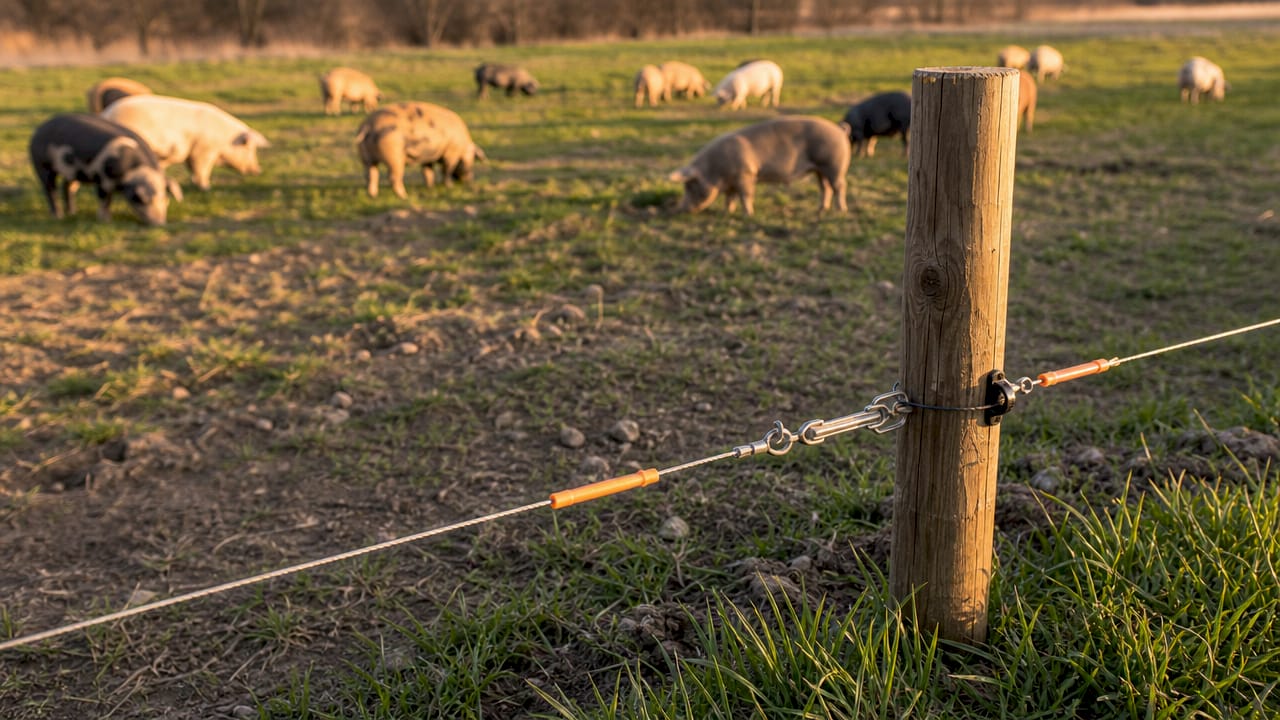
Comparing pig fencing options: woven wire, electric, hog panels, and hybrid systems
No single fence type is right for every operation. Your choice depends on herd size, whether you are building permanent or rotational enclosures, your budget, and the terrain you are working with.
| Fence type | Upfront cost | Durability | Maintenance | Best use case |
|---|---|---|---|---|
| Woven wire | Medium to high | High | Low to medium | Permanent perimeter fencing |
| Electric only | Low | Medium | High | Rotational grazing, trained pigs |
| Hog panels | High | Very high | Low | Small pens, confinement areas |
| Hybrid (woven + electric) | Medium to high | Very high | Medium | Permanent pasture and farm perimeter |
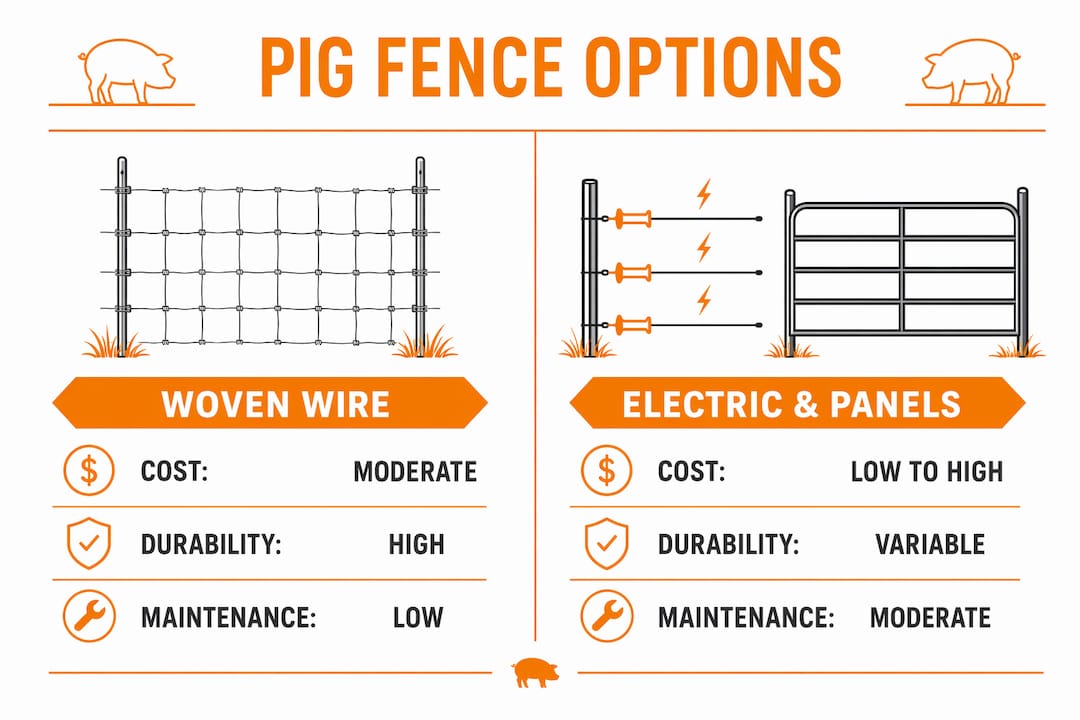
Woven wire fencing uses a grid of horizontal and vertical wires, typically with 6x6-inch spacing for pigs. It provides a strong physical barrier that does not depend on electricity, making it reliable in all weather conditions. Installation requires post setting, wire stretching, and stapling, which takes time and skill to do correctly.
Electric fencing for pigs uses strands at 6 and 14 inches above the ground as a minimum two-strand configuration for trained adult pigs. A third strand at 22 inches is recommended for boars and gestating sows, which are stronger and more motivated to push through barriers. Electric fencing is the most affordable pig fencing option for rotational systems. Portable 3-strand electric fencing with step-in posts can be set up and relocated in under an hour, making it ideal for pasture-raised pigs on a rotation schedule.
Hog panels are constructed from thick, rigid galvanized wire welded into a grid. They are strong physical barriers suited for confinement pens and small paddocks but are heavier, less portable, and more expensive per linear foot than woven wire or electric options. They work best as a permanent pen solution rather than a large-scale perimeter fence.
Hybrid systems combine woven wire or hog panels with an electric offset strand. This approach delivers the highest containment reliability because it addresses both physical force and pig behavior simultaneously. Hybrid fences require maintaining both physical integrity and consistent electric voltage. One without the other creates a gap that pigs will eventually find.
How to install and maintain pig fencing step by step
A well-installed fence that is poorly maintained will fail. A poorly installed fence that is well-maintained will also fail. Both elements are non-negotiable.
Installation steps for a woven wire and electric offset system:
- Mark your fence line and identify corner post locations. Set corner posts first, at least 3 feet deep with diagonal bracing.
- Stretch woven wire mesh along the fence line, stapling to posts every 12 inches vertically. Keep the bottom edge tight to the ground or slightly below grade.
- Install line posts at 8 to 10-foot intervals. Use 6-foot spacing near gates and corners.
- Mount electric offset brackets on the inside of the fence posts, 6 to 8 inches above ground and 6 to 8 inches inside the fence line.
- Run a single strand of electric wire through the offset brackets and connect to your energizer.
- Select an energizer that delivers a minimum of 4,000 volts under load. Low-impedance energizers maintain voltage even when vegetation contacts the wire.
- Ground the energizer with at least three ground rods, spaced 10 feet apart, driven 6 feet into moist soil.
- Test voltage at multiple points along the fence using a digital fence tester before introducing pigs.
Maintenance routine:
- Test fence voltage weekly during the growing season and after any storm. Voltage below 4,000 volts signals a problem.
- Mow or spray vegetation under and around the fence line monthly. Grass and weeds shorting against the electric wire are the most common cause of voltage loss.
- Inspect posts, wire connections, and insulators after heavy rain or freeze-thaw cycles.
- Check gates and corners every two weeks for loosening hardware or ground-level gaps.
Pro Tip: Keep a fence tester and a spool of replacement wire in your truck at all times during the grazing season. Catching a short or a broken strand the same day it happens prevents escapes and reduces the time pigs spend testing weak points.
Consistent energization is the single most important maintenance factor for electric pig fencing. Pigs that experience an inconsistent shock will probe the fence repeatedly until they find a pattern, and a fence that shocks sometimes is worse than one that shocks reliably every time.
How do you train pigs to respect an electric fence?
Electric-only fencing requires pig training. Untrained pigs placed directly into an electric-fenced pasture may breach the fence before they learn to avoid it, especially if they are startled or motivated by food or other animals outside the boundary.
The training process works by giving pigs a controlled, supervised introduction to the electric fence in a small pen where escape is not possible even if they push through the wire. Here is how to do it correctly:
- Set up a small temporary electric fence inside a secure physical enclosure, such as a hog panel pen.
- Energize the wire and allow pigs to make contact naturally. Do not force contact.
- Most pigs will touch the wire once or twice, receive a shock, and back away. This initial learning typically happens within the first 30 minutes.
- Leave pigs in the training pen for 24 to 48 hours, allowing repeated low-stakes contact with the energized wire.
- Once pigs consistently avoid the wire, move them to the main electric-fenced area.
Pigs that have been trained in this way generally avoid electric fences reliably, making electric fencing highly effective as a behavioral deterrent. The key is that the shock must be consistent. A fence that delivers 4,000 volts every time a pig touches it teaches avoidance. A fence that delivers 1,500 volts sometimes teaches pigs to test it.
Common training pitfalls include starting with too large an area, using an underpowered energizer during training, and failing to maintain voltage after training is complete. Pigs have good memories for pain, but they also test boundaries regularly. Ongoing voltage maintenance is what keeps trained pigs contained long-term. For more detail on energizer selection and setup, the Fencefast pig fencing guide covers component choices specific to swine operations.
Key takeaways
Effective pig containment requires ground-level physical barriers combined with consistent electric deterrents, proper installation, and regular voltage maintenance to prevent rooting and pushing escapes.
| Point | Details |
|---|---|
| Ground-level containment is primary | Focus fence design on the bottom 12 inches, not fence height, to stop rooting and pushing. |
| Hybrid systems outperform single-type fences | Combining woven wire with an electric offset strand delivers the highest long-term reliability. |
| Energizer voltage must stay above 4,000 volts | Low-impedance energizers and weekly voltage checks keep behavioral deterrence consistent. |
| Training pigs before electric-only use is required | Supervised initial contact in a secure pen prevents breaches when pigs first encounter electric wire. |
| Gates and corners fail first | Reinforce and inspect these points more frequently than the main fence line. |
What I’ve learned from watching pig fences fail
Most pig fence failures I have seen come down to one of two things: a farmer who built a great fence and then stopped maintaining it, or a farmer who spent money on height and materials while ignoring the bottom six inches. Pigs do not jump. They dig, push, and root. Every dollar you spend above three feet of fence height is largely wasted if the base is not secure.
The hybrid system is the right answer for permanent installations, but it only works if you treat both components as equally important. I have watched operations where the woven wire was solid but the electric offset strand had been shorted by grass for three weeks. The pigs found it within days. The physical fence slowed them down, but it did not stop them. The electric strand was the behavioral layer that made the system work, and without it, the fence was just a suggestion.
Gates deserve more attention than they get. Farmers spend hours getting the fence line right and then hang a gate that leaves a four-inch gap at the bottom. Pigs notice that gap immediately. Use drop rods, ground-level boards, or a short section of hog panel across the gate base to close it off.
The upfront cost of a properly installed hybrid fence is higher than electric-only or woven wire alone. Over five years, it is almost always cheaper. Escaped pigs cause crop damage, road hazards, and stress that no fence repair bill can fully account for. Build it right the first time.
— Juiced
Fencefast has the pig fencing supplies you need
Whether you are building a permanent perimeter fence or setting up a rotational grazing system, Fencefast carries the electric fencing components, woven wire, and hog panels that pig farmers across Canada rely on.

From low-impedance energizers that hold voltage above 4,000 volts to step-in posts for portable electric setups, Fencefast stocks the full range of pig containment supplies you need to build and maintain a fence that actually holds. The team at Fencefast also provides design guidance for farmers setting up new systems or upgrading existing ones. If you are managing a rotational grazing operation, the portable energizer options available through Fencefast are worth a close look for their flexibility and ease of setup. Shop online with nationwide shipping across Canada.
FAQ
What is the most effective fencing for pigs?
A hybrid system combining woven wire mesh with an electrified offset wire at 6 to 8 inches above ground is the most effective pig containment solution. This design addresses both the physical force pigs apply and the behavioral deterrence that electric shock provides.
How many strands of electric wire do pigs need?
A minimum of two strands at 6 and 14 inches above ground is recommended for trained adult pigs. A third strand at 22 inches is needed for boars and gestating sows, which are stronger and more likely to push through a two-strand setup.
What voltage should an electric fence for pigs deliver?
Electric fence energizers for pigs should deliver at least 4,000 volts under load. Low-impedance energizers are preferred because they maintain voltage even when vegetation contacts the wire.
Do pigs need to be trained before using electric fencing?
Yes. Untrained pigs placed directly into an electric-fenced area may breach the fence before learning to avoid it. A 24 to 48-hour supervised introduction in a secure training pen is the standard protocol before moving pigs to an electric-fenced pasture.
How often should pig fence voltage be tested?
Test voltage weekly during the growing season and after any storm or freeze-thaw event. Voltage below 4,000 volts indicates a short, grounding failure, or broken connection that needs immediate repair.
Recommended
- Animal fencing basics: Essential solutions for Canadian farms – FenceFast Ltd.
- 7 Best Fencing for Small Farms: Essential Tips for Success – FenceFast Ltd.
- Fencing Safety Precautions for Farmers and Livestock – FenceFast Ltd.
- How to Repair Fences: Practical Steps for Farmers and Landowners 2025 – FenceFast Ltd.

