

TL;DR:
- Rotational grazing, which involves moving livestock between paddocks to promote forage recovery, improves pasture health and productivity. Planning a grazing system requires mapping land, documenting herd details, and using forage height as the primary trigger for livestock movement. Flexible infrastructure with electric fencing and well-placed water points enables adaptation to seasonal conditions and enhances pasture resilience.
Rotational grazing, the practice of systematically moving livestock between paddocks to allow forage recovery, is the most effective tool for improving pasture health and livestock productivity on any farm or ranch. Knowing how to plan grazing rotation means building a site-specific roadmap that aligns livestock moves with forage growth stages, stocking rates, and seasonal conditions. The Noble Research Institute frames this as balancing land, livestock, and time with built-in decision points for adaptive management. Done right, a solid grazing rotation strategy reduces overgrazing, cuts feed costs, and keeps your herd performing through dry spells and wet years alike.
What do you need before planning a grazing rotation?
Every effective grazing management plan starts with a clear picture of what you have. Before you schedule a single move, you need accurate data on your land and your herd.
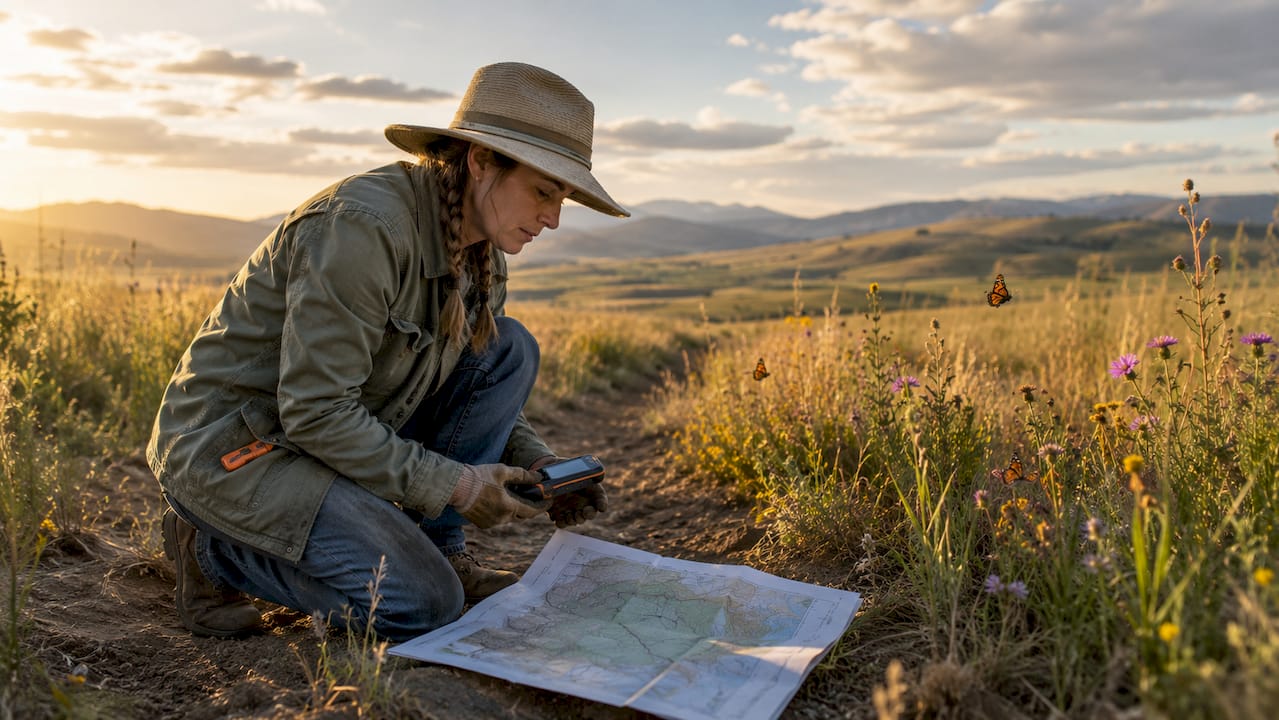
Map your pastures first. Walk every paddock and calculate grazeable acres, excluding areas like ponds, brush, and steep slopes that livestock won’t use productively. Sketch a rough layout showing permanent fencing, water points, and access lanes. This map becomes your working document throughout the season.
Document your herd in detail. Record total animal numbers, animal unit equivalents, and key dates like calving, weaning, and breeding. These dates affect how many animals are grazing at any given time and how much forage demand shifts across the year.
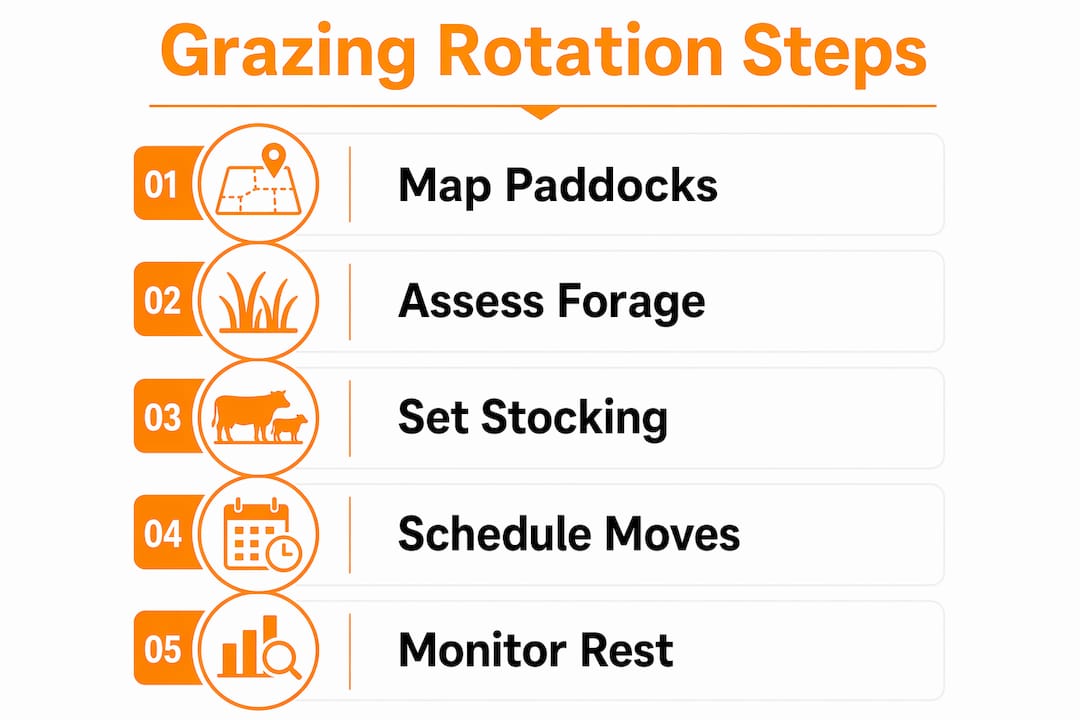
Here is a quick checklist of what to gather before you build your rotation:
- Total grazeable acres per paddock
- Herd size in animal units (AU)
- Current fencing layout (permanent and temporary)
- Water access points and their coverage radius
- Soil type and dominant forage species per paddock
- Historical rainfall averages by month
Pro Tip: A grazing stick is one of the cheapest and most useful tools you can own. It measures forage height in seconds and removes the guesswork from move timing.
Water access is a non-negotiable infrastructure requirement. Uneven water distribution causes localized overgrazing near water sources while distant paddock areas go underutilized. Plan water points so animals walk no more than 600–800 feet to drink. Short walking distances mean more uniform grazing across every paddock.
| Prerequisite | Why It Matters |
|---|---|
| Grazeable acre map | Sets realistic carrying capacity per paddock |
| Herd documentation | Matches forage supply to actual animal demand |
| Water point layout | Prevents overgrazing near water and underuse elsewhere |
| Fencing inventory | Identifies where temporary subdivisions are needed |
How do you build a grazing schedule around forage growth?
The core of any livestock grazing rotation is matching animal moves to forage condition, not to a fixed calendar. Illinois Extension recommends using forage height as the primary trigger for moving cattle. Grass below 4 inches is too short. Grazing it stunts root development and slows recovery. The optimal grazing window is 6–12 inches. Forage above 12 inches becomes over-mature, loses nutritional quality, and gets wasted as trampled residue.
Here is how to build your rotation schedule step by step:
- Measure forage height in every paddock before the season starts. Note which paddocks are ready and which need more rest.
- Estimate your rest period. Cool-season grasses like orchardgrass and tall fescue typically need 21–35 days to recover in spring and 45–60 days in summer. Warm-season grasses like bermudagrass may need 30–45 days.
- Calculate how many paddocks you need. Divide your target rest period by your planned grazing period per paddock. If you graze each paddock for 3 days and need 30 days of rest, you need at least 11 paddocks.
- Sequence paddocks logically. Move animals in a consistent direction so you always know which paddock is next and which is recovering.
- Build in flexibility. Flag two or three paddocks as overflow areas for drought or slow regrowth periods.
A flexible rotational system typically uses 6–8 permanent paddocks per livestock group as a baseline. Virginia Tech Extension notes that temporary electric fencing lets you raise grazing intensity when forage is abundant and reduce pressure when growth slows. That flexibility is what separates a good rotation from a rigid one that fails in a dry August.
Pro Tip: Never set your rotation schedule in stone at the start of the season. Forage growth rates can double in spring and drop by 70% in midsummer drought. Build your schedule in two-week blocks and reassess.
| Schedule Type | Paddocks Needed | Grazing Period | Rest Period |
|---|---|---|---|
| Low intensity | 4–6 | 5–7 days | 25–35 days |
| Medium intensity | 6–8 | 3–5 days | 30–45 days |
| High intensity | 10+ | 1–3 days | 45–60 days |
Stocking rate is the single most critical variable in this calculation. Texas A&M AgriLife Extension identifies it as the key grazing management decision. Overstocking even one paddock by 20% for a single grazing cycle can set back recovery by weeks.
How do you manage grazing intensity and monitor pasture health?
Grazing intensity is defined by three variables: the percentage of forage removed, the time animals spend in a paddock, and the regrowth time required before the next grazing. Ohio State University Extension notes that two farms with identical paddock counts can have completely different outcomes based on how these variables interact. More paddocks alone do not guarantee better results.
Target a utilization rate of 40–60% of available forage per grazing cycle. Removing less than 40% wastes forage and slows plant cycling. Removing more than 60% stresses root systems and reduces next-cycle yield. Balancing utilization with post-grazing residual is the discipline that separates productive rotations from ones that degrade pastures over time.
Watch for these warning signs that your rotation needs adjustment:
- Residual height consistently below 3 inches after grazing
- Animals losing body condition despite adequate paddock time
- Bare patches expanding between grazing cycles
- Forage species composition shifting toward weeds or low-quality grasses
“The goal is not to graze every blade of grass. Leave enough residual that the plant can photosynthesize and recover quickly. That residual is your investment in the next grazing cycle.” — Noble Research Institute
Pro Tip: Take a photo of each paddock at entry and exit every rotation. After two seasons, you will have a visual record of pasture trends that no spreadsheet can match.
Adjust your plan actively. If a paddock is not recovering to 6 inches before your scheduled return, extend the rest period by moving animals to an overflow paddock or supplementing with hay. Increasing paddock number increases rest days during the growing season, which is the most reliable way to improve recovery without reducing herd size.
What fencing and water infrastructure does a rotation require?
Infrastructure is where grazing rotation strategy meets real-world cost and labor. The right setup makes daily moves quick and low-stress. The wrong setup turns a good plan into a chore you abandon by July.
Permanent perimeter fencing defines your outer boundary and provides the backbone of your system. Inside that perimeter, temporary electric fencing creates the paddock subdivisions that give you flexibility. Temporary electric fencing lets you resize paddocks based on forage availability without committing to a fixed layout. A paddock that works well in May may need to be split in half during a dry stretch in August.
| Infrastructure Type | Function | Flexibility Level |
|---|---|---|
| Permanent perimeter fence | Outer boundary and lane structure | Low, fixed |
| Permanent interior cross-fence | Divides major paddock blocks | Medium |
| Temporary electric subdivision | Creates grazing cells within paddocks | High, adjustable |
| Water hydrants with valves | Delivers water to each paddock | Medium to high |
Water distribution geometry matters as much as fencing. Strategic water placement combined with fencing layout reduces overgrazing near water and encourages animals to graze the full paddock area. A central lane with water hydrants spaced along it is the most efficient design for most rectangular farm layouts. Animals move through the lane to each paddock, and water is never more than a short walk away.
Pro Tip: Install a central water line with quick-connect hydrants along your main lane before you build interior fencing. Retrofitting water access after fences are in place costs three times as much and disrupts your rotation.
Labor efficiency depends on how well your infrastructure supports animal movement. Gates positioned at paddock corners, not centers, allow animals to flow naturally from one paddock to the next. Gathering points at the end of lanes reduce the time you spend moving the herd. Every minute saved on daily moves is time you can spend monitoring forage and making better decisions.
For a deeper look at how rotational grazing fencing affects pasture outcomes, the design principles around paddock count and fence placement are worth reviewing before you break ground.
Key takeaways
Effective grazing rotation planning requires matching livestock moves to forage growth signals, not fixed dates, while maintaining the infrastructure flexibility to adjust as conditions change.
| Point | Details |
|---|---|
| Map before you schedule | Document grazeable acres, herd size, and water access before building any rotation plan. |
| Use forage height as your trigger | Move livestock when grass reaches 6–12 inches; never graze below 4 inches. |
| Design for 6 or more paddocks | More paddocks extend rest periods and improve pasture recovery without reducing herd size. |
| Target 40–60% utilization | Removing the right percentage of forage each cycle protects root systems and next-cycle yield. |
| Build flexible infrastructure | Temporary electric fencing and well-placed water points let you adapt your rotation to seasonal conditions. |
Why fixed schedules are the biggest mistake i see
Most ranchers who struggle with rotational grazing are not failing because of bad land or bad cattle. They are failing because they built a calendar-based rotation and refused to deviate from it. I have seen producers move cattle every seven days regardless of what the grass looked like, and by August their pastures were bare and their cows were losing weight.
The shift that changes everything is treating your rotation as a recovery plan, not a schedule. Your job is to protect the plant’s ability to regrow. Some weeks that means moving in four days. Some weeks it means waiting twelve. The forage tells you when to move. Your job is to listen.
Start small if you are new to this. Two or three paddocks with a simple temporary electric setup will teach you more in one season than any textbook. Once you understand how your specific soils, grasses, and rainfall patterns interact, scaling up to eight or ten paddocks becomes straightforward. The farmers who try to build a ten-paddock system in year one often abandon it because the complexity overwhelms them before the benefits show up.
Infrastructure investment pays back faster than most people expect, but only if you design it for flexibility from the start. A central water lane with temporary fencing capability is worth more than a perfectly engineered fixed system that cannot adapt to a drought year. Embrace the seasons. Learn from what goes wrong. Your rotation will get sharper every year.
— Juiced
Build your rotation with the right fencing from Fencefast
A well-designed grazing rotation lives or dies on the quality of your fencing infrastructure. Fencefast carries the permanent and temporary electric fencing solutions that Canadian farmers and ranchers rely on to build flexible, efficient paddock systems.
From electric fencing components like Gallagher-powered energizers and solar panels to temporary poly wire and step-in posts for fast paddock subdivisions, Fencefast has the products to match your rotation plan. Whether you are setting up your first two-paddock system or expanding to a high-intensity ten-paddock rotation, the team at Fencefast can help you choose the right gear. Explore the full catalog at Fencefast and get your infrastructure working as hard as your herd does.
FAQ
What is the first step in planning a grazing rotation?
The first step is mapping all your pastures, calculating grazeable acres, and documenting herd size in animal units. This baseline data lets you match forage supply to animal demand before scheduling any moves.
How many paddocks do i need for rotational grazing?
A minimum of 6–8 paddocks per livestock group is recommended for a medium-intensity system. High-intensity, short-duration grazing requires 10 or more paddocks to allow adequate rest periods between grazings.
How do i know when to move cattle to the next paddock?
Move cattle when forage reaches 6–12 inches in the next paddock and residual height in the current paddock drops to around 3–4 inches. Forage height is a more reliable trigger than any fixed number of days.
What utilization rate should i target per grazing cycle?
Target removing 40–60% of available forage per grazing cycle. Removing less wastes forage; removing more stresses plant root systems and reduces recovery speed for the next rotation.
Can temporary electric fencing replace permanent paddock fencing?
Temporary electric fencing works well for subdividing existing paddocks and adjusting paddock size seasonally, but permanent perimeter fencing provides the structural backbone every rotation system needs. The two work best together.
Recommended
- Rotational Grazing Strategies: Maximize Pasture and Livestock Gains – FenceFast Ltd.
- 6 Best Grazing Rotation Schedules for Cattle Ranchers – FenceFast Ltd.
- Rotational Grazing Explained: Boost Pastures and Livestock Health – FenceFast Ltd.
- Rotational Grazing Fence: Boosting Pasture Health and Herd Control – FenceFast Ltd.

