

Livestock monitoring technologies are sensor and software systems that give you earlier, actionable alerts on animal health, reproduction, location, and production metrics. Farmers running these systems catch sick animals days before visible symptoms appear, time breeding more accurately, know exactly where the herd is at any moment, and get production data without a single manual weigh-in.
TL;DR:
- Continuous sensor data analysis, such as individualized baselines, is crucial to reduce false alarms and ensure accurate health and behavior alerts.
- Hardware choices depend heavily on species, herd size, and profit per animal, with wearables fitting larger, high-value animals and vision or environmental sensors suited for smaller or flock species.
- Effective connectivity options like LoRaWAN or cellular are essential to reliably transmit data across expansive or rugged terrains, with edge processing reducing battery drain.
- Early detection of illness through subtle behavioral shifts can decrease antibiotic use and improve animal welfare, while accurate location tracking enhances biosecurity and theft prevention.
- Proper pilot testing over a full breeding cycle and clear vendor transparency on data ownership and accuracy are vital steps before expanding livestock monitoring systems.
Table of Contents
- What Are Livestock Monitoring Technologies?
- Core Technology Categories: What Each One Measures
- What Can You Actually Do With This Data?
- Getting Monitoring Onto Your Farm: Connectivity and Hardware Realities
- How Sensor Data Becomes a Farm Decision
- RFID, Traceability, and Staying Audit-Ready
- Choosing the Right System for Your Operation
- Where FenceFast Fits Into Your Monitoring Plan
- The Adoption Curve Nobody Talks About
- Start Building Your Monitoring Foundation With FenceFast
- Sources
What Are Livestock Monitoring Technologies?
The field goes by a more formal name in research circles: precision livestock farming, or precision ranching when applied to range operations. That’s the term you’ll see in academic reviews and extension bulletins, and it matters because it signals a shift from periodic manual checks to continuous, individualized data collection on every animal in the herd.
The core idea is simple even if the hardware isn’t. Instead of walking pens twice a day and hoping you spot a limping calf or a cow off her feed, sensors and cameras watch constantly, flag deviations from that specific animal’s normal behavior, and push an alert to your phone. Extension programs studying dairy technologies at Penn State note that validated systems already track reproductive status, health alerts, and milk yield in commercial operations, not just research pens.
What makes this different from a basic ear tag or a fence charger is the layer of analysis sitting behind the hardware. A GPS collar alone tells you where an animal is. A collar paired with software that learns that animal’s typical grazing pattern tells you something is wrong when she stops moving for six hours in the middle of the day. That distinction, sensor plus individualized analysis, is what separates modern monitoring from the identification tags farms have used for decades.
Core Technology Categories: What Each One Measures
Four hardware categories cover most of what’s deployed on farms today, and each one answers a different question about your herd.
- Wearable sensors attach to collars, ear tags, or boluses (intra-ruminal sensors swallowed by the animal) and typically measure accelerometer data, body temperature, and GPS location. These are the workhorses for cattle operations because they generate continuous, animal-specific data streams.
- Computer vision systems use fixed cameras, infrared imaging, or 3D depth cameras positioned over pens or feed lines to score body condition and flag behavior changes without touching the animal at all.
- Environmental sensors monitor barn climate, ammonia and other gas levels, and humidity, which matters as much for welfare compliance as for production efficiency in confined systems.
- Drones cover ground fixed cameras can’t. Research on drone-based livestock monitoring shows aerial platforms handling counting, movement tracking, and even herding tasks across pastures too large for a practical camera grid.
- Electronic and virtual fencing systems, like GPS-enabled neckbands paired with base stations, do double duty: they contain animals within a boundary you set from an app, and every location ping is also a health and behavior data point.
Wearable sensors and computer vision remain the two most widespread approaches for collecting animal-level data, according to a review of livestock monitoring devices and machine learning applications. Which one fits your operation depends heavily on species and how much profit sits on each individual animal, a point worth returning to when you get to budgeting.
What Can You Actually Do With This Data?
Farmers ask a version of the same question before buying anything: what does this change day to day? Here’s where the technology categories above translate into decisions you actually make on the ground.
- Catch sickness before it’s obvious. Computer vision and behavioral sensors detect subtle shifts, reduced feeding time, an animal isolating itself, a droop in ear posture, that precede visible clinical signs. Research summarized in the GAP bulletin on livestock health monitoring points to this early window as the reason some operations report reduced antibiotic use: intervening sooner often means a milder treatment does the job.
- Time breeding without guesswork. Activity spikes and rumination changes are reliable estrus signals. Wearables that track both let you schedule insemination within hours of peak fertility instead of relying on visual heat checks that miss quiet or nighttime cycles.
- Know where every animal is, all the time. GPS tracking and geofencing cut the labor of physically checking pasture boundaries and shrink the window for theft or predation to go unnoticed.
- Replace guesswork on production with real numbers. Automated weighing tied to RFID identification gives you weight trends per animal instead of the handful of manual weigh events most operations manage in a season.
- Strengthen biosecurity. Individual tracking makes it far easier to isolate exposure risk when illness does show up, since you know exactly which animals were near an infected one and when.
Getting Monitoring Onto Your Farm: Connectivity and Hardware Realities
Buying sensors is the easy part. Getting them to talk to each other reliably across a few hundred acres, in weather, for years, is where projects succeed or stall.
Connectivity is the first decision. LoRaWAN networks offer long range and very low power draw, making them a practical fit for rural properties where cellular coverage is patchy. A livestock intelligence platform built around LoRaWAN processes data at the gateway level before it ever reaches the cloud, which means critical alerts still fire even when your internet connection drops. Cellular-connected devices work well where coverage is solid and per-device data volume is higher, such as video from fixed cameras. Either way, edge processing, filtering and scoring data locally before sending a summary, matters more as herd size and gateway distance grow.
Battery life and durability vary widely by device type. Ear tag sensors with simple accelerometers can run one to two years on a coin cell. GPS collars with more frequent location pings need larger batteries and, in virtual fencing systems, solar panels to sustain them indefinitely. Look for an IP67 or IP68 rating on anything living outdoors year-round; anything less won’t survive a wet spring.
Placement decisions follow herd geography. Base stations and gateways need line of sight or minimal obstruction to reach collars across your terrain, so a single hilltop mount often outperforms three units buried in a valley.
- Cattle and other high per-head-value species usually justify per-animal wearables.
- Poultry, sheep, and other lower per-head-value species are usually better served by flock-level vision or environmental sensors, per the review of monitoring devices and unit economics.
- A phased rollout, pilot on one paddock or pen, expand once baselines stabilize, then integrate with farm records, beats a full-herd purchase on day one.
Pro Tip: Run your pilot through at least one full breeding or calving cycle before expanding. Baselines built on 30 days of data miss the seasonal behavior swings that cause the most false alarms later.
How Sensor Data Becomes a Farm Decision
Raw sensor readings aren’t useful on their own. The value shows up in how the system turns thousands of data points into a single, trustworthy alert.
Individualized baseline modeling is the piece that separates a useful system from a noisy one. Rather than flagging every animal against a herd average, the software learns what’s normal for that specific animal, her typical rumination rhythm, her usual step count, and only alerts when she deviates from her own pattern. The review of machine learning applications in livestock production identifies this per-animal baseline approach as the key factor in cutting false positives, which is the single biggest reason farmers abandon monitoring systems in year one.
A typical data pipeline runs in three stages: edge filtering at the collar or gateway, cloud-based machine learning inference that scores wellness against the animal’s baseline, and a final health score or alert delivered to your dashboard. Published architecture models describe aggregating readings in short intervals with energy-aware uplinks, which keeps battery drain low while still supporting close to hourly wellness scoring.
What you should expect from a well-built system:
- Alerts that come with a confidence level, not just a binary flag.
- Recommended next steps, whether that’s a visual check or a call to your veterinarian.
- Export options that feed your existing herd management or accounting software rather than trapping data in a separate app.
- Dashboards and scheduled reports summarizing herd-wide trends, not just individual alerts.
RFID, Traceability, and Staying Audit-Ready
RFID and electronic identification (EID) have moved from optional to required in a growing number of jurisdictions, and traceability rules are often the reason farms build identification infrastructure in the first place. Regulatory pressure tied to disease control programs is a major driver behind RFID adoption globally, and once that tagging infrastructure exists, it becomes the backbone for everything else: automated weighing, individual production records, and audit trails all depend on reliable animal identification.
Before buying tags or readers, ask about:
- Tag standard compatibility (ISO 11784/11785 is the common baseline) and whether readers support it.
- Realistic read range for your handling setup, panel readers versus handheld wands behave very differently in a working chute.
- How the system logs and timestamps reads for audit purposes.
Our guide to RFID in animal management covers the setup details that matter most for compliance recordkeeping.
Choosing the Right System for Your Operation
Matching technology to your operation starts with two variables: herd size and species value per head. A 40 cow operation and a 4,000 head feedlot have almost nothing in common when it comes to sensor economics.
- Match hardware to herd economics. Per-animal wearables make sense when the value or risk per head justifies the cost, typically cattle, dairy, and horses. Flock-level cameras and environmental sensors tend to pencil out better for poultry and small ruminants.
- Budget in three layers. Hardware is the upfront cost, network infrastructure (gateways, base stations) is the middle layer, and ongoing subscription or analytics fees are the recurring cost most first-time buyers underestimate.
- Interrogate vendor claims before you sign. Ask specifically about data ownership and export rights, warranty terms on outdoor hardware, whether battery replacement is a field job or a factory return, and whether the system has an open API for your existing farm software.
- Watch for vague accuracy claims. A vendor who won’t specify false-positive rates, or who can’t explain how baselines are calculated per animal, is a red flag worth pressing on.
Pro Tip: Ask any vendor what happens to your data if you cancel the subscription. Some platforms lock historical records behind an active plan, which is a serious problem if you’re trying to build multi-year breeding or health trends.
Where FenceFast Fits Into Your Monitoring Plan
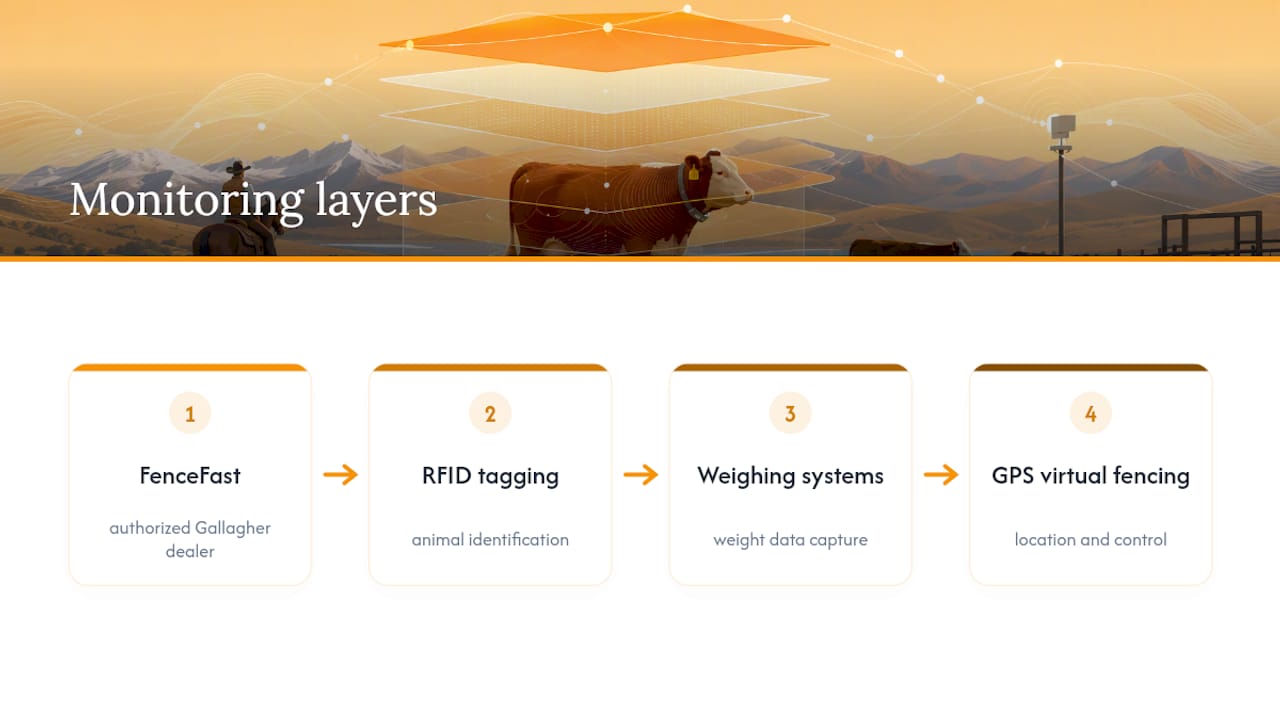
FenceFast works as an authorized Gallagher dealer, providing access to virtual fencing and RFID integration products that support farm monitoring needs. RFID tagging, weighing systems, and GPS-based virtual fencing aren’t separate purchases; they’re layers of the same monitoring foundation, and our RFID livestock tracking setup guide and weighing and reading resources walk through how they connect on real operations.
The Adoption Curve Nobody Talks About
Early adopters overbuy hardware before validating one pilot herd, then abandon the project when false alerts pile up. The fix is boring: start small, trust the baseline period, and expect edge computing and tighter tagging standards to make the next generation of tools far less forgiving of that mistake.
— Juiced
Start Building Your Monitoring Foundation With FenceFast
FenceFast offers hardware for livestock monitoring, providing solutions from a single source. We stock the fence equipment, GPS-enabled virtual fencing collars, RFID tags, and weighing systems that form the backbone of any monitoring buildout, plus the tools and fasteners needed to actually install them correctly the first time.
If you’re not sure where to start, our design consulting walks through your paddock layout, herd size, and connectivity constraints before you spend a dollar on hardware. Browse our fence equipment collection to see what a phased rollout looks like in practice, or check the fence tools and fasteners you’ll need for installation day. Reach out through our homepage to get a design consultation started this week.
Sources
- Applications of livestock monitoring devices and machine learning algorithms in animal production and reproduction: an overview
- Integrated Model for Intelligent Monitoring and Diagnostics of Animal Health Based on IoT Technology for the Digital Farm
- Livestock Intelligence Platform — IoT Hardware, AI Analytics & LoRaWAN Network | Herdwize

