

Rotational grazing cattle means moving your herd through a series of fenced paddocks on a planned rest cycle instead of letting them roam one pasture all season. Producers who switch see a notable increase in forage per acre compared to continuous grazing, which usually translates into more cattle per acre and lower feed bills. The trade-off is real: you need fencing, water access to each paddock, and more hands-on management than a set-it-and-forget-it pasture.
TL;DR:
- Rotational grazing increases forage production by about 30%, allowing higher stocking rates and lowering feed costs for dairy and beef operations.
- Proper paddock sizing depends on forage availability, with cover crops supporting one day of grazing per animal unit and irrigated pastures supporting longer rotations.
- Infrastructure such as flexible fencing and water access within 800 feet of each paddock is critical to system success and animal distribution.
- Grazing management should be flexible, emphasizing forage height monitoring and adjusting move timing based on plant regrowth rather than a fixed schedule.
- Overestimating paddock capacity or neglecting water access risks overgrazing, bunching cattle, and undermining forage gains, making initial planning and phased implementation essential.
Table of Contents
- What Is Rotational Grazing and Why Does It Work?
- How Do You Choose a Grazing Intensity System?
- How Do You Calculate Stocking Rate and Paddock Size?
- What Fencing and Water Setup Does Rotational Grazing Need?
- When Should You Move Cattle Between Paddocks?
- What Are the Downsides of Rotational Grazing?
- Who’s Behind This Guide and Where to Go Next
- Why the Textbook Version of Rotational Grazing Sets Producers Up to Fail
- Get Your Rotational Grazing System Set Up Right
- Sources
What Is Rotational Grazing and Why Does It Work?
Rotational grazing goes by several names in the field. You’ll hear “cell grazing,” “management-intensive grazing” (MiG), and “mob grazing” used depending on how aggressive the rotation is, but they all share the same backbone: cattle graze a paddock hard, then move on while that ground rests and regrows.
The numbers behind the method are hard to argue with. Ohio State’s extension research found rotational systems increase forage production by an average of 30% over continuous grazing, largely because rested grass regrows from a stronger root reserve instead of getting nibbled down to the crown daily. That extra forage means more stocking capacity from the same acreage.
Pro Tip: Dairy operations running well-managed pasture programs cut feed costs by $0.50 to $1.00 per cow per day during the grazing season. On a 100 cow herd over a 180 day season, that’s not pocket change.
Beef producers see similar gains. University modeling comparing three to twenty four paddock systems found consistent increases in both pounds of gain per acre and dollar returns per acre as paddock count went up, according to University of Kentucky.
Beyond the yield numbers, producers report:
- More even manure and urine distribution, which reduces the need for purchased fertilizer over time
- Longer usable grazing seasons because rested paddocks recover faster after drought or heavy rain
- Better forage quality at each grazing pass, since cattle are eating leafy regrowth instead of stemmy, overgrazed residue
How Do You Choose a Grazing Intensity System?
Every rotational system runs on three levers: frequency (how often you move cattle), intensity (how much forage you let them remove before moving), and opportunity (how long the paddock rests afterward). Extension agronomists call this the FIO principle, and it’s the mental model worth keeping in your back pocket when you’re staring at a pasture map.
From there, systems split into rough categories:
- Low intensity, high frequency (LIHF): Smaller bites of forage removed, frequent moves, gentler on the sward. Good for building pasture quality on recovering ground.
- High intensity, low frequency (HILF): Cattle stay longer, take more forage per visit, move less often. Works when labor is tight.
- Management-intensive grazing (MiG): Balances animal nutrient demand against forage supply day to day, with moves typically every one to four days, per Colorado State University Extension.
- Mob grazing: Very high stocking density for very short periods, mimicking bison herd impact, mainly used for rapid pasture renovation.
Pro Tip: Most successful operations don’t pick one system and stick with it year round. Run tighter, more frequent moves in spring when grass grows fast, then stretch rest periods during the summer slump when regrowth slows.
How Do You Calculate Stocking Rate and Paddock Size?
Paddock math starts with the Animal Unit, or AU, a standard reference point equal to one 1,000 pound cow with calf consuming about 26 pounds of dry forage a day. A 1,200 pound cow counts as roughly 1.2 AU; a herd of 50 cows averaging 1,300 pounds works out to about 65 AU total.
From there, sizing a paddock takes four steps:
- Estimate available forage. Extension worksheets, including tables from Penn State Extension, convert pasture height into pounds of dry matter per acre for common forage types.
- Apply a utilization target. Most guides recommend leaving cattle take no more than 50% of standing forage, leaving the rest for root reserves and regrowth.
- Divide by daily AU demand. If a paddock offers 2,000 pounds of usable forage per acre and your herd needs 1,700 pounds a day, that acre supports roughly one day of grazing per AU equivalent.
- Multiply out paddock count. A 100 acre farm split into 20 paddocks of 5 acres each gives you a rotation that can run 20 to 40 days depending on regrowth speed.
Productive irrigated pasture might run 0.5 to 1 acre per AU for a full season, while dry rangeland can require 5 acres or more per AU. Square or near square paddocks graze more evenly than long, narrow strips, and keeping every paddock within about 800 feet of a water source keeps cattle from bunching near the trough and overgrazing the rest.
What Fencing and Water Setup Does Rotational Grazing Need?
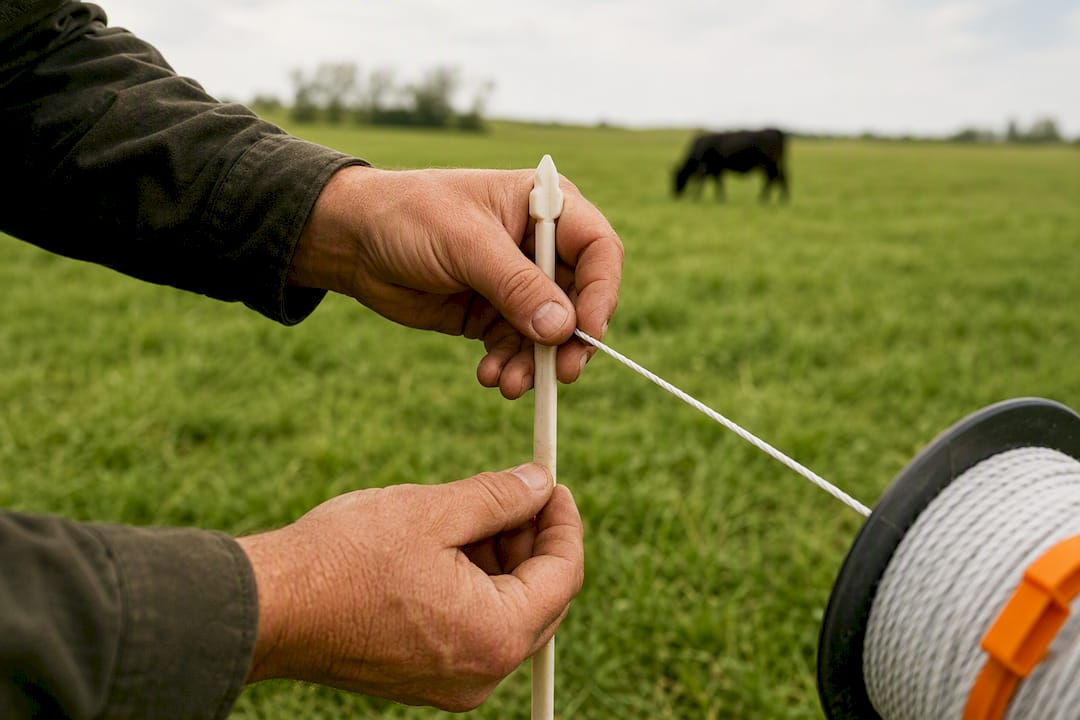
Infrastructure is where most rotational plans succeed or stall. Permanent perimeter fence anchors the whole system, but the paddock divisions inside it don’t have to be permanent, and for most operations, they shouldn’t be. Temporary polywire or polynet lets you resize paddocks as forage conditions change, and it’s a fraction of the cost of permanent cross fencing. A temporary cow fence setup built around reel systems and step in posts can be moved by one person in under an hour once you’ve got the layout down.
Water is the harder constraint. Cattle generally won’t walk much farther than 800 feet to drink, and performance drops off once that walk exceeds a quarter mile. That usually means running a water lane through the center of your paddock block so every division has access, rather than building a trough for every single cell.
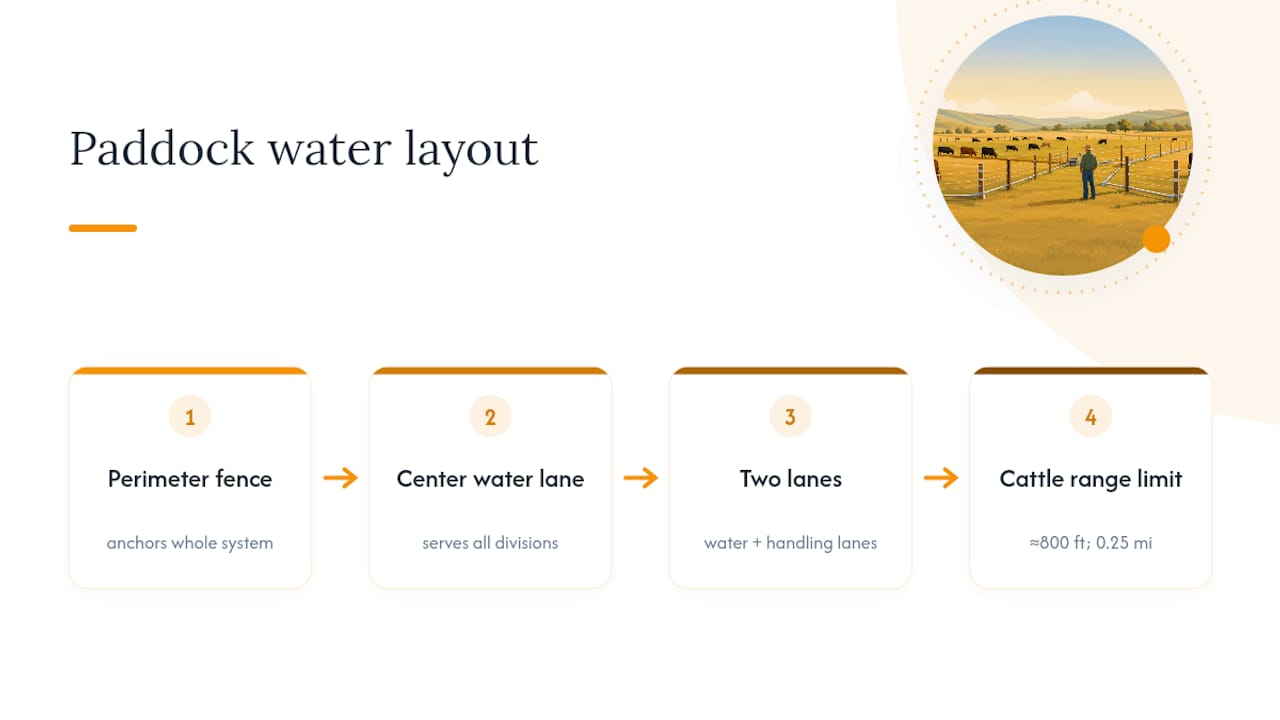
Pro Tip: A two lane layout, one lane for water and handling access, one for cattle movement, cuts erosion at gates dramatically compared to funneling every animal through a single corridor twice a day.
Choosing between electric fencing, fixed cross fence, and newer options like GPS-based virtual fencing comes down to how often your paddock lines need to move and how much labor you have to move them.
When Should You Move Cattle Between Paddocks?
Residency time, meaning how long cattle stay in one paddock, depends heavily on your system and forage type. Dairy operations often move cows after every milking. Beef producers typically run three to four day residencies, with six to seven days as a practical upper limit before regrowth starts getting grazed twice. MiG systems built around tight moves usually cycle every one to four days.
Rather than sticking to a rigid calendar, watch the grass:
- Measure grazing height with a pasture stick before turning cattle in and again before moving them out.
- Target removal of no more than half the standing forage. Once you see stems getting grazed hard, it’s time to move.
- Extend rest periods when regrowth slows, typically during summer heat or after a dry spell.
- Stockpile fall growth for late season or early winter grazing instead of mowing it down.
- Mow ahead of cattle if seed heads have gotten away from you, so they’re grazing leafy regrowth instead of stemmy waste.
As CSU Extension notes, the whole point of MiG is matching moves to actual forage supply and animal demand rather than following a fixed schedule, which is exactly why a grazing rotation schedule works better as a flexible template than a locked calendar.
What Are the Downsides of Rotational Grazing?
No system is free of trade-offs, and rotational grazing has three real ones: upfront fencing cost, added labor for moving cattle and checking water, and the temptation to overdo stocking density before you’ve built the muscle memory to manage it well.
Mob grazing in particular carries compaction risk. Pushing 50,000 or more pounds of livestock per acre onto wet soil can cause damage that takes a full season to recover from, according to Ohio State Extension, compared with moderate densities of 10,000 to 30,000 pounds per acre that most operations run day to day.
Practical mitigations:
- Phase in fencing gradually, starting with a few cross fences rather than building out the whole grid at once
- Lean on temporary polywire for early paddocks before committing to permanent cross fencing
- Hold off on high density pulses when soil is saturated; save them for dry stretches with stockpiled forage
- Shorten residency time to break parasite life cycles, since most internal parasites need several days on pasture to complete a cycle back into cattle
Even with those added costs, the university modeling on per-acre returns still comes out ahead of continuous grazing once a system is running smoothly.
Who’s Behind This Guide and Where to Go Next
The fencing and water guidance above is based on real experience from a dealer authorized to supply Gallagher products. It’s built from watching what actually holds up on working cattle operations.
If you’re mapping your own transition, here’s where the pieces above connect to real next steps:
- Building your first cross fences: start with temporary cattle fencing options sized for phased rollout
- Wiring up a new paddock grid: review electric fencing basics before buying components
- Setting your rotation calendar: use a grazing rotation schedule template as a starting point, then adjust to your own forage readings
| What you need | Where it fits | Section to revisit |
|---|---|---|
| Paddock division fencing | Early rollout, phased budget | Fencing and water setup |
| Water lane planning | Any paddock count | Fencing and water setup |
| Rotation calendar | Weekly management | Move timing |
| Stocking rate math | Initial paddock design | Sizing and stocking |
Why the Textbook Version of Rotational Grazing Sets Producers Up to Fail
Most guides on rotational grazing cattle read like a checklist: divide the pasture, move every few days, watch the numbers climb. The research backs the payoff. What it glosses over is that the producers who actually stick with rotational grazing past year one are the ones who built flexibility into the system from day one, not the ones who tried to nail the “perfect” paddock count on a spreadsheet before ever moving a cow.
The conventional advice oversells rigid schedules and undersells water logistics. You can get paddock sizing wrong for a season and still come out ahead of continuous grazing. Get water access wrong, and cattle will bunch, overgraze the near ground, and undo half your forage gains before you notice. That’s the detail extension bulletins mention once and producers learn the hard way.
Start with water and perimeter fence solid, then treat cross fencing as a living draft you’ll redraw for two or three seasons.
— Juiced
Get Your Rotational Grazing System Set Up Right
Extension research proves the forage and return gains. Turning that into a working system on your own ground comes down to fencing that flexes with your rotation and water access that doesn’t force compromises. Fencefast built its business around exactly that gap, supplying the fence equipment and tools and fasteners that let you phase in paddocks without overcommitting to a layout before you’ve tested it on your own pasture.
With product supply paired with actual design input, you are not just guessing at paddock counts or water lane placement from a generic worksheet. Whether you’re wiring your first cross fence or rebuilding a water lane system that’s been fighting you for years, browse the fence equipment collection and start pricing out what your first phase actually needs.
Sources
- Determining the Grazing Intensity and Move Frequency for Your Rotational Grazing System | Ohioline
- Four steps to rotational grazing | Penn State Extension
- Management-Intensive Grazing | CSU Extension
- Rotational grazing guidance (UC ANR)

