

TL;DR:
- Livestock safety features include handling equipment, facility design, and operational protocols that prevent injuries and stress. Properly designed squeeze chutes, loading ramps, and fencing are critical for animal and handler safety, while protocols like hazard assessments and PPE training ensure compliance and reduce accidents. Building a safe farm requires implementing these features as everyday habits based on thorough safety evaluations.
Livestock safety features are specialized equipment and protocols designed to protect animals from injury and stress during handling, housing, and transport. The industry term for this discipline is “livestock welfare management,” and it covers everything from squeeze chute design to roll-stability technology in transport trailers. Farmers who invest in the right animal protection measures reduce veterinary costs, meet Canadian agricultural compliance standards, and keep both animals and handlers out of harm’s way. This guide breaks down the top features worth knowing in 2026.
1. What are the core livestock safety features every farm needs?
The most effective livestock safety features fall into three categories: handling equipment, facility design, and operational protocols. Each category addresses a different point of risk, from the moment an animal enters a chute to the daily routines of farm workers. Skipping any one category creates gaps that equipment alone cannot fix. The strongest farms treat all three as equally non-negotiable.
2. Adjustable squeeze chutes for safe cattle restraint
Adjustable squeeze chutes are the single most important piece of handling equipment on a cattle operation. Squeeze chutes with widths from 190 to 750 mm accommodate varied cattle sizes and reduce handling injuries during veterinary procedures and pregnancy checks. That range matters because a chute set too wide allows dangerous movement, and one set too narrow causes panic and bruising. Look for models with smooth interior surfaces, a self-catching headgate, and a side-exit option that lets animals leave calmly without backing out.
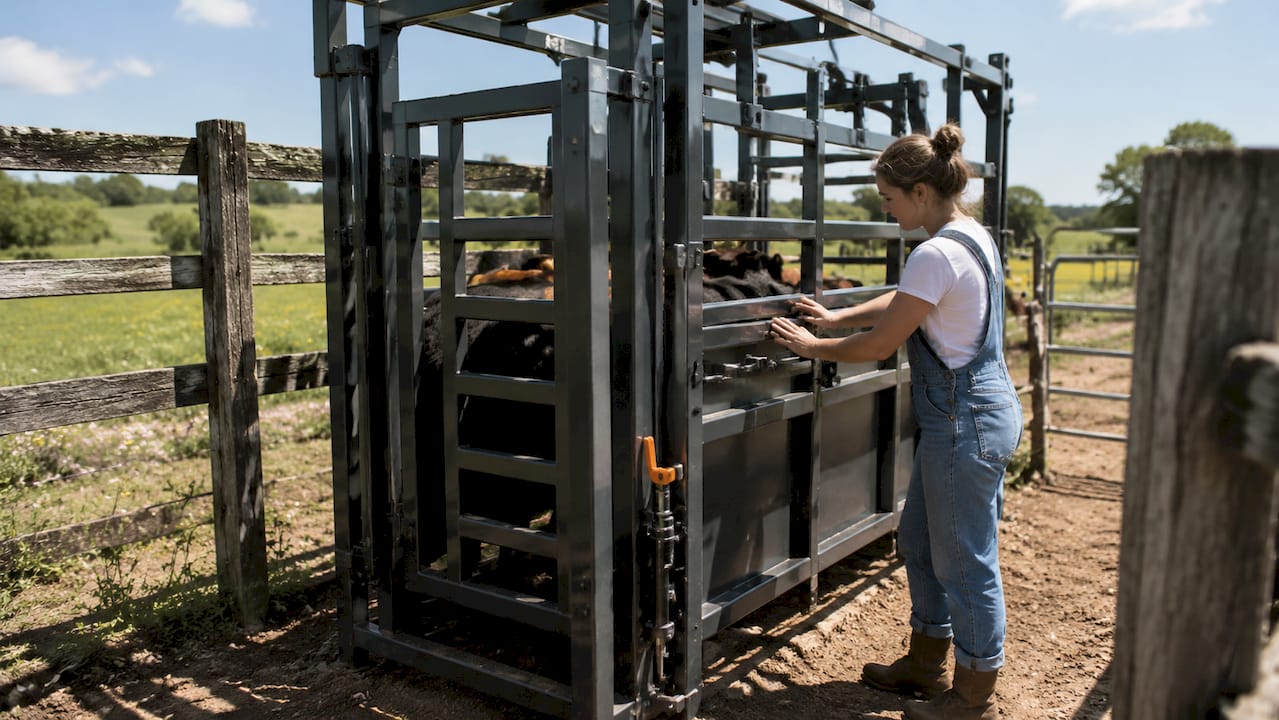
Pro Tip: Choose a chute with a built-in weighing platform. You get restraint and weight data in one step, which cuts handling time and reduces repeated stress on the animal.
3. Loading ramps designed to prevent slips and balking
A poorly designed loading ramp causes more livestock injuries than almost any other single piece of equipment. Ramp inclines must stay at or below 10 degrees, with solid sidewalls or curtains that block visual distractions and stop animals from balking mid-load. Cleated, non-slip surfaces are non-negotiable. Cattle move forward confidently when they cannot see gaps below their feet or activity to the side.
Good livestock handling guidelines also call for ramps that match the trailer floor height exactly. A gap or a step at the top of the ramp is a common cause of leg injuries during loading.
Pro Tip: Paint ramp cleats a contrasting color. Cattle have limited depth perception, and a visual cue at each step encourages forward movement without prodding.
4. Man gates and handler escape routes
Man gates are low-cost features with a high safety return. These narrow gates, typically 12–16 inches wide, let handlers slip out of a pen quickly while blocking cattle from following. Every working alley and crowding tub should have at least two man gates positioned so a handler is never more than a few steps from an exit. Escape routes are a core element of farm safety protocols and are required under most provincial occupational health and safety codes.
5. Ventilation systems in livestock transport vehicles
Transport is one of the highest-risk periods for livestock injury and stress. Modern livestock transport ventilation must achieve 60–80 complete air changes per hour to manage ammonia buildup and heat. Failure to meet that threshold leads to respiratory distress, heat stroke, and weight loss that directly cuts into your returns. Adjustable vents positioned along the trailer’s length, combined with roof hatches, give drivers real-time control over airflow regardless of outside temperature.
6. Acoustic lining and noise reduction in trailers
Most handlers overlook noise as a safety factor, but it is a direct cause of livestock fatigue and bruising. Closed-cell foam acoustic lining in transport compartments reduces the metal-on-metal noise that spikes during acceleration and braking. Quieter trailers produce calmer animals. Calmer animals move less during transit, which means fewer impact injuries and less bruising at the processing end. This is one of the most cost-effective upgrades available for existing trailers.
7. Electronic roll-stability and braking systems
Active vehicle safety technology protects both animals and drivers. Electronic roll-stability programs and electronic braking systems prevent trailer rollovers and reduce stopping distances significantly. A trailer rollover is catastrophic for livestock, and the physics of a loaded livestock trailer make it far more top-heavy than a standard freight trailer. Roll-stability programs detect lateral forces and apply individual wheel brakes before a driver can react. Pair this with 360-degree camera systems and drowsiness alerts for the driver, and you have a transport setup that protects the load from both mechanical and human failure.
8. Secure and species-specific fencing
Fencing is the first line of defense in any animal protection plan. A fence that fails to contain cattle or horses does not just risk animal injury. It creates road hazards, neighbor disputes, and legal liability. Livestock fence safety tips consistently point to post depth, wire tension, and species-specific height as the three variables that determine whether a fence holds under pressure. Electric fencing adds a behavioral deterrent that physical fencing alone cannot provide. Properly set up, it teaches animals to respect the boundary without causing injury.
Pro Tip: Walk your fence line after every major storm. Fallen branches and frost heave are the two most common causes of fence failure between scheduled inspections.
9. Sanitary housing and well-ventilated animal areas
Clean, well-ventilated housing prevents respiratory disease, hoof problems, and the stress-related injuries that come from overcrowding. Ammonia from urine accumulates quickly in poorly ventilated barns and causes eye and lung damage in cattle, pigs, and poultry. Concrete flooring with proper drainage slopes, rubber matting in high-traffic areas, and regular bedding changes are the minimum standard for livestock care standards in Canada. Overcrowding is a welfare violation in most provinces and a direct cause of injury from trampling and fighting.
10. Personal Protective Equipment for handlers
Handler safety is inseparable from animal safety. An injured handler cannot respond to an animal emergency, and panic from a handler transfers directly to the animals nearby. Task-specific PPE and proper training on its use reduce handler injuries and keep operations running. Steel-toed boots, cut-resistant gloves, and helmets are standard for cattle work. Hearing protection matters in high-noise environments like poultry barns. PPE only works when workers wear it consistently, which is a training and culture issue as much as an equipment issue.
11. Hazard assessments and documented safety protocols
Hazard assessments are the legal foundation of farm safety in Canada. Safety experts require that each farm task be broken into steps to identify specific risks and build exact training documentation. A hazard assessment for loading cattle, for example, would identify the ramp angle, the handler position, the lighting conditions, and the animal’s prior handling history as separate risk factors. That level of detail produces training that actually prevents injuries rather than just satisfying a checkbox.
Documented walk-around inspections before each use of equipment are equally non-negotiable. They provide legal proof of due diligence and catch mechanical failures before they become animal welfare incidents.
12. Compliance with OSHA and agricultural machinery standards
Machinery safety is a direct component of preventing livestock injuries. OSHA standards require tractors manufactured after 1985 to have Rollover Protective Structures and prohibit their use on slopes steeper than 15 degrees. A tractor rollover near a livestock pen creates a chain of hazards: the machine, the handler, and the panicked animals all become threats to each other simultaneously. Keeping machinery compliant is not just a legal requirement. It is a direct risk management tool for the entire operation.
13. Safety culture: posted commitments and hazard zone maps
Equipment and protocols only work when the people using them take safety seriously every day. A signed, prominently displayed farm safety commitment and clearly labeled hazard zones build awareness among workers and visitors alike. Hazard zone maps posted at barn entrances tell new workers and contractors exactly where the high-risk areas are before they step inside. This is not a bureaucratic exercise. Operations with a visible safety culture have fewer incidents because workers make better decisions when expectations are clear and posted in plain sight.
Key takeaways
Effective livestock welfare management combines the right equipment, facility design, and documented protocols to prevent injuries and meet compliance standards.
| Point | Details |
|---|---|
| Handling equipment specs matter | Squeeze chutes with 190–750 mm width and ramps at or below 10 degrees reduce injuries during restraint and loading. |
| Transport safety is multi-layered | Ventilation, acoustic lining, and roll-stability systems each address a different risk during transit. |
| Fencing is the first line of defense | Species-specific fencing with correct post depth, wire tension, and height prevents escapes and injuries. |
| Protocols are as important as equipment | Hazard assessments, documented inspections, and PPE training are legally required and operationally critical. |
| Safety culture prevents incidents | Posted commitments and hazard zone maps reduce accidents by setting clear expectations for every worker on the farm. |
What I’ve learned after years of watching farms get safety wrong
The farms that struggle most with animal injuries are rarely the ones with bad equipment. They are the ones where safety is treated as a one-time purchase rather than a daily habit. A $10,000 squeeze chute does nothing if the handler using it has never been trained on the headgate release. A perfectly designed loading ramp fails when someone props a board across it because the real ramp is “too far to walk.”
The most effective animal welfare features I have seen in practice are the ones that make the safe choice the easy choice. A man gate positioned at arm’s reach. A ramp that is always in place, not stored in a shed. A fence line that gets walked after every storm, not just when an animal goes missing. These are not expensive interventions. They are habits built on a foundation of knowing what the risks actually are.
My honest advice: do the hazard assessment first. Walk every task your operation involves and write down every point where an animal or a handler could get hurt. That document will tell you exactly which equipment gaps to fill and which protocols to write. Buying equipment before doing that assessment is guessing. Doing the assessment first is farming with intention.
— Juiced
Where to find quality livestock safety equipment
Fencefast carries the fencing, handling equipment, and animal management supplies Canadian farmers need to build a safer operation from the ground up. From electric fencing systems and Gallagher eShepherd virtual fencing technology to livestock handling tools and RFID management systems, Fencefast stocks products built for real farm conditions. The team also provides design consulting and setup guidance, so you get equipment that fits your specific operation rather than a generic solution. Visit Fencefast to browse the full catalog or get expert advice on building a safer, more compliant farm.
FAQ
What are the most important livestock safety features for cattle?
Adjustable squeeze chutes, properly inclined loading ramps, and secure fencing are the three most critical features for cattle operations. Combine these with documented hazard assessments and handler PPE training for full compliance.
How do I prevent livestock injuries during transport?
Use trailers with ventilation achieving 60–80 air changes per hour, acoustic lining to reduce noise stress, and electronic roll-stability systems to prevent rollovers. Match ramp inclines to 10 degrees or less at loading and unloading.
What farm safety protocols are legally required in Canada?
Canadian farms must conduct hazard assessments, maintain documented equipment inspections, and comply with provincial occupational health and safety codes. OSHA standards also require Rollover Protective Structures on tractors manufactured after 1985.
How does fencing contribute to livestock safety?
Proper fencing prevents escapes, reduces road hazards, and stops inter-animal injuries from mixing incompatible groups. Species-specific height, post depth, and wire tension are the key variables that determine whether a fence holds under pressure.
What PPE do livestock handlers need?
Steel-toed boots, cut-resistant gloves, and helmets are standard for cattle and large animal work. Hearing protection is required in high-noise environments like poultry barns. Training on correct PPE use is as important as the equipment itself.

