

TL;DR:
- Canadian ranchers face unique security challenges across vast, unpredictable terrain and changing provincial regulations.
- A hybrid system combining physical and virtual fencing offers the most adaptable, cost-effective solution for modern livestock management.
Canadian ranchers face a pressure that most industries never deal with: keeping animals safe across hundreds of acres of unpredictable terrain, through brutal winters, and under strict provincial rules that change by region. The gap between a well-secured operation and a costly breach often comes down to how well you match your security tools to your specific land, livestock, and budget. Whether you run a small cow-calf operation in Ontario or manage a large grazing herd across Alberta’s open range, understanding both proven and emerging options gives you a real edge in 2026.
Table of Contents
- How to evaluate farm security options
- Physical fencing: Traditional and modern improvements
- Virtual fencing: Technology transforming livestock management
- The hybrid approach: Best of both security worlds
- Comparing your options: Which farm security solution is right for you?
- Our perspective: Why farm security is about more than fences
- Find the right fencing solution for your farm
- Frequently asked questions
Key Takeaways
| Point | Details |
|---|---|
| Integrate security methods | Use both physical and virtual fencing for optimal livestock protection and flexibility. |
| Virtual fencing is reliable | Modern systems deliver 98-99.5% containment and work well even in Canadian winters. |
| Compliance is essential | Physical perimeter fencing remains a legal requirement for Canadian farms. |
| Match solution to needs | Consider your livestock, climate, and terrain before choosing a security upgrade. |
| Regular inspections matter | Checking and maintaining fences yearly can prevent the majority of avoidable failures. |
How to evaluate farm security options
Before spending a dollar on wire, posts, or GPS collars, you need an honest look at what your operation actually requires. The best fencing strategy for a 200-acre mixed farm in British Columbia looks nothing like the right choice for a remote pasture lease in Saskatchewan. Getting that match right from the start saves significant money and headaches over time.
Start with these core evaluation factors:
- Terrain and species behavior: Forested land, steep slopes, and marshy ground all change what physical infrastructure you can install and maintain. Predator pressure also varies sharply by region.
- Regulatory requirements: Provincial codes set minimum standards that you cannot ignore. Fencing code compliance matters for insurance coverage and liability, not just inspections. Ontario, for example, requires a minimum 4-foot fence height for most livestock species.
- Budget structure: Upfront capital versus long-term labor and maintenance costs play out differently on every farm. Virtual fencing has higher startup costs but significantly lower ongoing labor demands than traditional wire.
- Integration potential: The strongest operations often run hybrid systems. Thinking about integration early prevents you from locking yourself into a single approach that won’t scale.
- Inspection schedules: Canadian fencing laws require maintained, functional fences, but beyond legal compliance, annual security checks can prevent up to 80% of system failures before they cause a breach.
Pro Tip: Zone your farm intentionally. Calving areas, water access points, and property perimeters have different security demands. Mapping those zones before you choose a product prevents costly retrofitting later.
A full evaluation takes time but saves far more than it costs. Write down your top three priorities before comparing any product or system.
Physical fencing: Traditional and modern improvements
Physical fencing has anchored livestock security for generations because it works. It stops animals without batteries, networks, or software. When the power goes out and the cell towers are down, a solid woven wire fence is still doing its job. That reliability is worth a lot on remote operations where outside help is hours away.
The main types available to Canadian producers include:
- Woven wire: Best for sheep, goats, and pigs due to its tight spacing. Durable and low maintenance once installed, though expensive per foot.
- Barbed wire: Common for cattle perimeters. Lower cost per foot but requires regular tension checks and is not suitable for horses due to injury risk.
- Wood board or rail: Strong visual deterrent and ideal for horses, but high material and labor costs, especially at scale.
- Electric fencing: Highly effective as a deterrent, relatively affordable, and works well in rotational grazing setups. Requires a reliable power source and regular testing.
- Portable and modular systems: Temporary electric reels and step-in posts have transformed how producers manage portable fencing systems for seasonal rotation, allowing you to move boundaries without driving posts every time.
One critical point that too many producers overlook: physical fences must meet livestock fencing regulations regardless of what other technology you layer on top. No virtual collar or GPS system currently replaces your legal obligation to maintain a physical perimeter fence.
“Virtual fencing excels for internal rotational grazing and riparian exclusion, saving 4-5 hours of labor per day, but it requires physical perimeter fences for security, predator control, and regulatory compliance.” Source
That quote captures something important. Physical fences and virtual systems are not competitors. They are partners. Understanding that early changes how you think about every investment decision going forward.
Regular inspections are the part most producers skip until there is a problem. Walk fence lines every spring after frost heave and every fall before winter. Check tension, post integrity, staple holding, and ground contact. Small repairs done early cost a fraction of what emergency fixes run after a breach.
Virtual fencing: Technology transforming livestock management
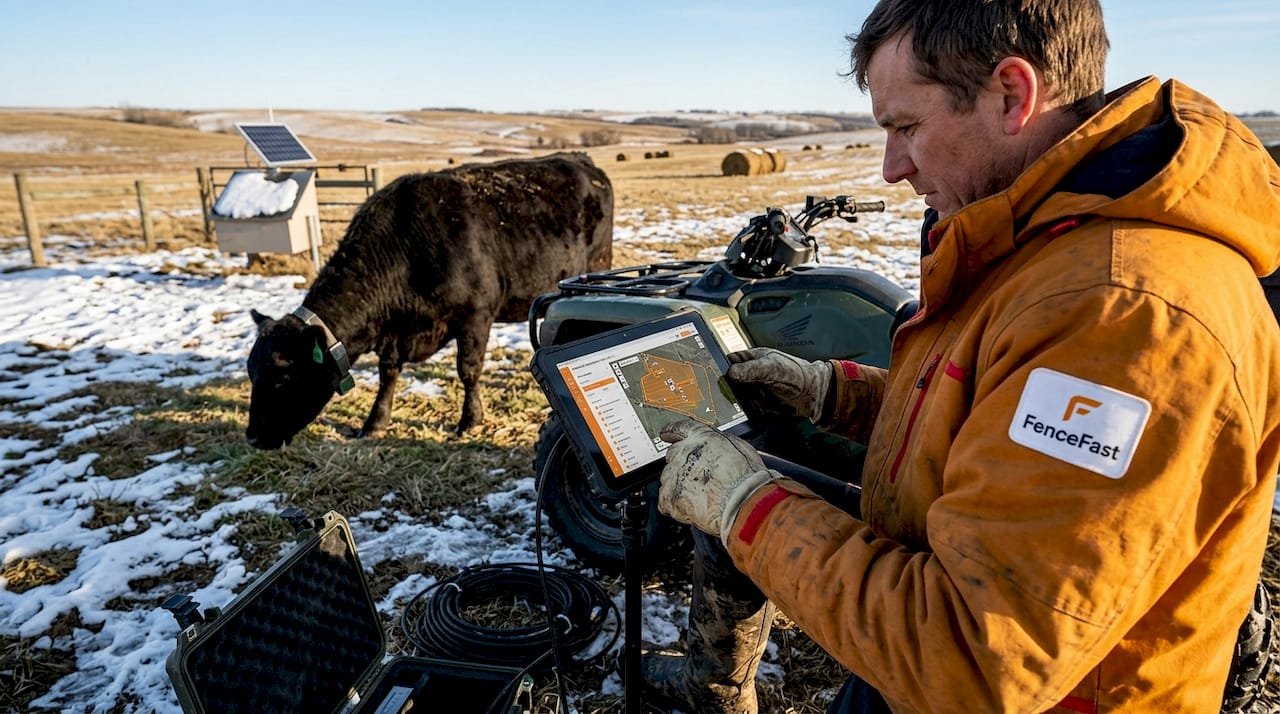
Virtual fencing sounds like science fiction until you see the numbers. GPS-enabled collars deliver audio cues to cattle approaching a digital boundary. If the animal ignores the audio, a mild electric pulse, roughly one-fifth the strength of a standard electric fence, reinforces the boundary. The animal learns the system quickly. Most herds adapt within 3 to 10 days, and containment rates hold at 98 to 99.5 percent across Canadian trials.
Here is what makes virtual fencing genuinely useful in the Canadian context:
- Winter performance: Research in Alberta showed battery retention above 96% even in extreme cold, with collars functioning reliably at temperatures reaching -38°C.
- Network reliability: The same Alberta trial showed network connectivity intervals averaging 8 to 9 minutes with less than 1% poor connections across most test areas.
- Remote area considerations: Very remote or densely forested zones may need base stations for coverage. Collar loss is rare, and recovery is typically straightforward with GPS tracking built in.
- Animal welfare: Multiple studies confirm no welfare impact from collar use, with no measurable effect on weight gain or conception rates.
- Labor savings: Producers consistently report saving 4 to 5 hours of daily labor when replacing manually moved temporary fences with virtual boundaries managed through an app.
Key statistic: Virtual fencing systems deployed in Canadian environments achieve containment rates of 98 to 99.5 percent, comparable to or exceeding traditional electric fencing, with the added advantage of boundary adjustments that take minutes instead of hours.
Pro Tip: If you are managing pastures across varied terrain, read up on virtual fencing for BC ranches to understand how slope and forest cover affect collar performance before you purchase. It will help you right-size your base station investment.
Understanding virtual fencing costs is also critical. The upfront investment in collars and base stations is real, but Canadian government programs including OFCAF and BMP grants can significantly reduce that barrier for qualifying operations. Ask your equipment supplier about current funding availability before writing off the technology on price alone.
The Gallagher eShepherd system, available through authorized Canadian dealers, is a strong example of how this technology is being packaged for practical farm use. Solar-powered GPS neckbands, cloud-based herd management, and app-controlled boundaries give you the kind of flexibility that was impossible to achieve with wire alone just a few years ago. You can learn more about how virtual fencing works before committing to any specific platform.
The hybrid approach: Best of both security worlds
The most effective farm security setups in Canada right now are not purely physical and not purely virtual. They are hybrid systems designed to use each technology where it performs best.
Here is the basic structure that works across a wide range of Canadian operations:
- Physical perimeter: Meet legal requirements, deter predators, and provide a hard boundary that does not depend on power or connectivity.
- Virtual internal zones: Manage rotational grazing paddocks, exclude cattle from riparian areas, and create temporary calving zones without installing or removing wire.
- Scheduled inspections: Physical fences get walked seasonally; virtual system health is monitored through the app dashboard daily.
- Funding integration: Government programs often support the virtual component specifically, making the hybrid approach financially viable for operations that could not afford either system alone.
The evidence is clear. Empirical trials in Canada confirm that virtual fencing enables better forage use and rest periods for more resilient pastures, while fixed traditional fences limit the adaptability needed for modern grazing management.
Understanding rotational grazing fencing benefits helps you see why this matters practically. Cattle moved through well-timed rotations produce better weight gains, leave behind healthier pasture, and reduce parasite exposure. Virtual fencing makes running eight or ten paddock rotations feasible for a two-person operation that previously could only manage two or three.
| Security layer | Physical fence | Virtual fence | Hybrid system |
|---|---|---|---|
| Legal perimeter compliance | Yes | No | Yes |
| Predator deterrence | Strong | Weak | Strong |
| Internal zone flexibility | Low | High | High |
| Labor demand | High (installation/maintenance) | Low (app-managed) | Medium |
| Initial cost | Medium to High | High | High |
| Long-term cost | Medium | Low | Low to Medium |
| Winter performance | Strong | Strong (96%+ battery) | Strong |
For practical setup guidance, rotational grazing fence setup walks through the specific steps for laying out paddocks, and fencing for rotational grazing covers equipment selection for Canadian conditions. These resources are worth reading before you finalize any hybrid plan.
Comparing your options: Which farm security solution is right for you?
Choosing between physical, virtual, or hybrid security comes down to four variables: your land size, your livestock species, your labor availability, and your regulatory environment. Here is a practical decision process:
- Check your provincial code first. Identify the minimum fence specifications required for your livestock species and location. This is non-negotiable and defines your baseline requirement.
- Assess your terrain. If you run cattle on open range with strong cellular coverage, virtual fencing becomes highly practical. If you manage horses or hogs in tight paddocks, physical fencing remains the core tool.
- Calculate your labor cost. If you are spending more than two hours a day managing fence moves or repairs, virtual fencing’s labor savings will likely pay off within one to two grazing seasons.
- Research available funding. Canadian programs have been actively supporting virtual fencing adoption. A subsidized virtual system changes the cost comparison significantly.
- Plan for the perimeter first. No matter how you manage internal zones, invest in a strong, code-compliant perimeter fence before adding any other layer.
Canadian trial data consistently shows 99-plus percent containment rates for virtual systems, which makes them a legitimate operational tool rather than a novelty. But they work best as part of a planned system, not as a standalone replacement for physical infrastructure.
Farms under 100 acres with intensive livestock management typically get the most value from a strong physical setup with selective portable electric additions. Operations over 500 acres with cattle on pasture are the strongest candidates for hybrid systems with virtual interior management. Mid-sized operations in between benefit most from a careful cost-labor analysis before committing.
Our perspective: Why farm security is about more than fences
Here is what 26 years of working with Canadian producers has taught us: the farms that struggle most with security are not the ones with the wrong fences. They are the ones that treated their security system as a finished project instead of an ongoing practice.
A fence installed in 2015 and never re-evaluated is not the same fence in 2026. Climate shifts have changed frost heave patterns. New predator pressures have moved into regions that did not have them before. Provincial codes have been updated. New technologies have arrived that could save 20 hours a week for the same investment that older methods required.
The guide to virtual fencing we reference throughout this article is not just about one technology. It is about the mindset of staying current. Producers who regularly review their systems, compare what is available, and stay connected to regulatory updates consistently outperform those who do not, both in livestock safety outcomes and in operational profitability.
Real farm security is adaptive. It is not about having the newest technology or the most expensive setup. It is about matching the right tools to current conditions, knowing when those conditions change, and being willing to adjust. That approach is what separates operations that stay ahead of problems from those that only react to them.
Find the right fencing solution for your farm
Choosing the right security setup should feel manageable, not overwhelming. Whether you are pricing out a new perimeter fence, exploring virtual fencing for the first time, or trying to figure out if a hybrid system makes financial sense for your operation, you do not have to work through it alone.
At FenceFast.ca, we carry everything from traditional fencing components and electric systems to the full Gallagher eShepherd virtual fencing lineup, with nationwide shipping across Canada. Our team has worked with ranchers on terrain from coastal BC to the Prairies and understands what the Canadian climate actually demands from a security system. We can help you identify funding programs, plan a hybrid setup, or simply find the right posts and wire for your next project. Browse our full catalog or reach out for personalized advice tailored to your land and livestock.
Frequently asked questions
How well does virtual fencing work in Canadian winters?
Virtual fencing trials in Canada show over 96% battery capacity and effective cattle containment even at -38°C, making it a genuinely viable year-round option in northern climates.
Is virtual fencing approved for perimeter security under Canadian laws?
No, current codes require a physical perimeter fence for regulatory compliance and predator control. Virtual fencing is best deployed for internal grazing zone management within a compliant perimeter.
How quickly do cattle adapt to virtual fencing?
Most cattle learn to respond to the audio cue system within 3 to 10 days, with the mild pulse acting as a secondary reinforcement that most animals rarely need after initial training.
Are there network connectivity issues with virtual fencing on large or remote farms?
Connectivity is strong across most tested Canadian regions, but very remote or forested areas may require additional base stations. Most connectivity gaps are solvable with proper site assessment before installation.
Can virtual fencing save labor compared to traditional fencing?
Yes, producers using virtual fencing for rotational grazing consistently report saving 4 to 5 hours of daily labor previously spent moving temporary fences and checking physical boundaries across large pasture areas.

