

TL;DR:
- Portable fencing reduces setup time by over 50 percent, increasing efficiency and land flexibility for Canadian farmers. It offers significant cost savings, easy reconfiguration, and better livestock containment compared to traditional fencing. Advances like solar and virtual fencing technology make portable systems reliable in remote and harsh Canadian conditions.
Portable fencing is quietly reshaping how Canadian livestock operations run, and the numbers back it up. Installation time drops by over 50% compared to traditional fixed systems, meaning you spend less time driving posts and more time managing your herd. For farmers juggling rotational grazing, seasonal moves, and tight labor budgets, that kind of efficiency isn’t a luxury. It’s a necessity. This article walks through the real advantages of portable fencing, from cost savings and containment reliability to the latest solar and virtual fencing technology, so you can make smarter decisions for your operation.
Table of Contents
- Why portable fencing is transforming Canadian livestock operations
- Comparing portable and permanent fencing: Cost, labor, and containment
- How portable fencing supports grazing, flexibility, and land management
- Tech advances: Electric, solar, and virtual fencing solutions
- Rethinking farm fencing: Our perspective on smarter, flexible solutions
- Ready to make fencing faster and easier?
- Frequently asked questions
Key Takeaways
| Point | Details |
|---|---|
| Setup speed | Portable fencing can be installed by one person in hours, offering major time savings for Canadian farms. |
| Cost savings | Lower upfront costs and labor make portable fencing much more affordable than permanent alternatives. |
| Containment effectiveness | Modern portable and virtual fencing cuts livestock escapes dramatically, improving herd management and safety. |
| Weather durability | UV-resistant and solar-powered designs ensure portable fences perform even in Canada’s harshest climates. |
| Operational flexibility | Portable fencing enables rapid responses to changing farm needs, from grazing rotations to land reclamation. |
Why portable fencing is transforming Canadian livestock operations
Traditional fixed fencing has its place, but it locks you in. Once those posts are set and that wire is strung, your pasture layout is essentially frozen. Portable fencing breaks that constraint entirely, letting you reconfigure your land as your herd and seasons demand.
The adoption numbers are telling. 68% of Canadian mixed livestock farmers use polywire to cut setup time by over 50%, and that shift isn’t happening by accident. Farmers are choosing portable systems because they deliver real, measurable results on the ground.
Here’s a quick look at how portable fencing stacks up across key performance areas:
| Factor | Portable fencing | Traditional fencing |
|---|---|---|
| Setup time | 2 to 4 hours | 1 to 3 days |
| Labor required | 1 person | 2 to 4 people |
| Reconfiguration | Easy, same day | Difficult or impossible |
| Cost per linear foot | Under $1.25 | $2.00 to $4.50 |
| Seasonal adaptability | High | Low |
The core advantages that drive this adoption include:
- Fast installation: Enclosures that used to take a full crew several days can now go up in a single morning.
- Emergency response: If a section of pasture floods or a drought forces a herd move, you can respond the same day.
- Rotational grazing support: Moving paddock boundaries every few days is practical with portable systems, not theoretical.
- Semi-permanent flexibility: You can leave sections up for months without committing to a permanent structure.
For a deeper breakdown of what works across different farm types, the fencing guide for Canadian farmers covers species-specific setups and terrain considerations. If you’re managing multiple livestock types, the options in systems for livestock control show how to layer portable solutions for maximum coverage.
The bottom line is that portable fencing isn’t a compromise. For most Canadian operations, it’s a genuine upgrade.
Comparing portable and permanent fencing: Cost, labor, and containment
Now that you see the broad benefits, let’s directly compare portable to permanent fencing on the things that matter most.
The cost difference alone is significant. Portable electric fencing runs under $1.25 per linear foot, while permanent fencing typically costs between $2.00 and $4.50 per foot once you factor in materials and installation labor. On a 1,000-foot project, that’s a potential savings of $750 to $3,250 right out of the gate.
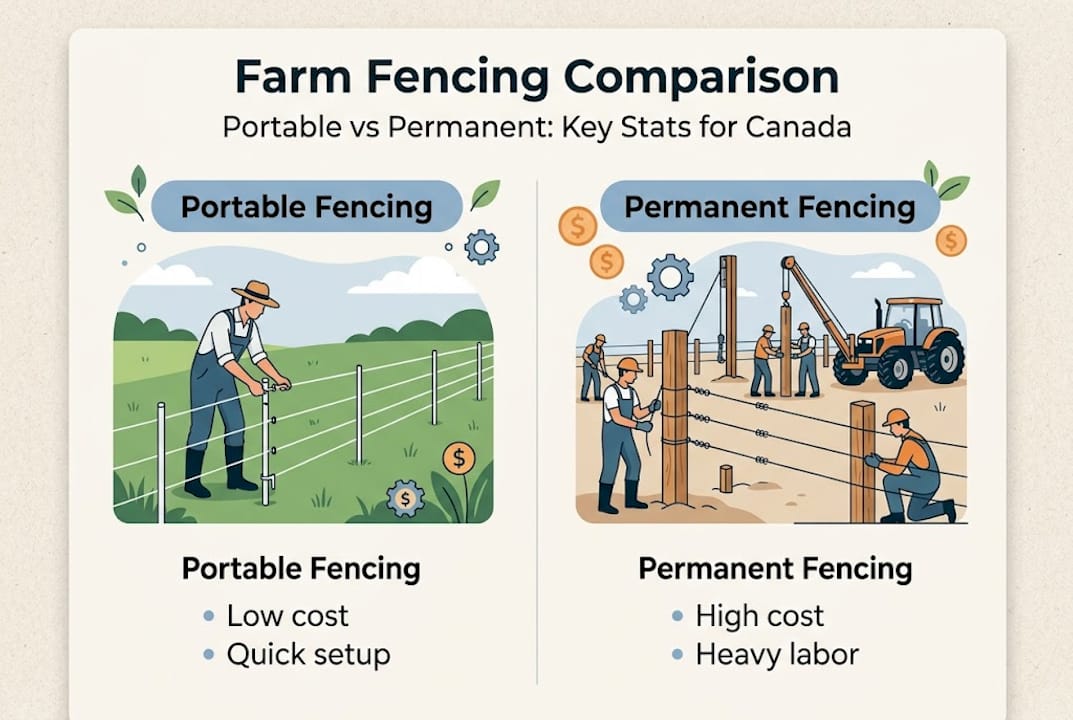
But upfront cost is only part of the story. Here’s a side-by-side comparison across the factors Canadian farmers care about most:
| Category | Portable electric | Permanent fixed |
|---|---|---|
| Upfront cost | Low | High |
| Ongoing labor | Minimal | Moderate |
| Escape rate reduction | Up to 70% | Varies |
| Reconfiguration ability | High | None |
| Lifespan | 5 to 10 years (components) | 20 to 30 years |
| Best use case | Rotational, seasonal, temporary | Perimeter, permanent boundary |
Portable electric fencing reduces livestock escape rates by up to 70%, which surprises a lot of farmers who assume a physical barrier is always more reliable. The psychological deterrent of an electric fence is often more effective than a physical one because animals learn quickly to respect the boundary.
Here’s how to approach a cost-smart fencing strategy for your operation:
- Assess your perimeter needs first. Permanent fencing still makes sense for outer boundaries that never change.
- Map your rotational grazing zones. These are ideal candidates for portable electric systems.
- Calculate your labor budget. One person can handle most portable setups, which cuts your labor costs significantly.
- Factor in flexibility value. If your herd size or land use changes seasonally, portable systems pay for themselves fast.
Pro Tip: When reviewing temporary fencing costs, don’t forget to include the labor hours saved over a full season. On large operations, that can exceed the hardware cost itself.
For operations looking to scale up or try new grazing patterns, a flexible livestock fence approach lets you test configurations before committing to anything permanent.
How portable fencing supports grazing, flexibility, and land management
Beyond cost and simplicity, what truly sets portable fencing apart is its ability to unlock smarter land and herd management.
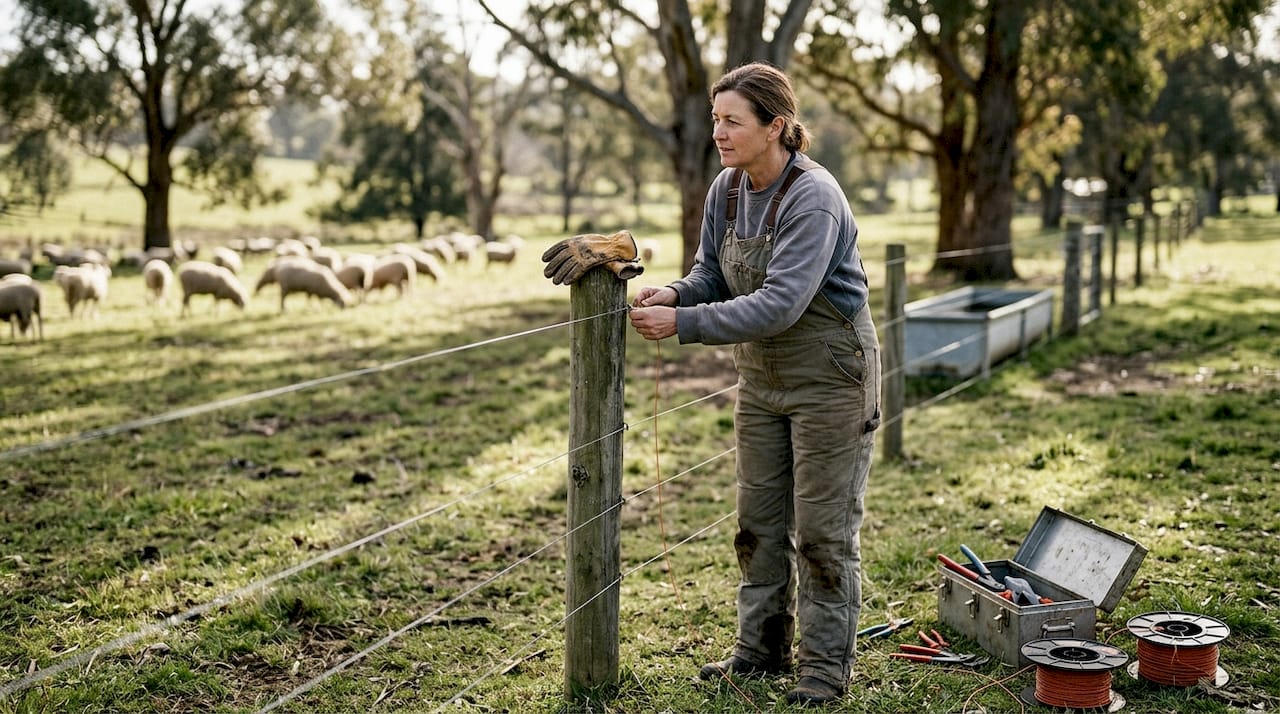
Rotational grazing is one of the most effective tools a Canadian rancher has for improving pasture health and livestock condition. But it only works if you can actually move your boundaries. Portable fencing makes that practical, not just possible.
Key ways portable fencing improves land and herd management:
- Controlled grazing pressure: Move animals off a paddock before they overgraze, then let it recover fully before returning.
- Land reclamation: Fence off degraded sections to give them rest while directing livestock to healthier pasture.
- New livestock arrivals: Quickly set up a quarantine or introduction paddock without disrupting your main herd layout.
- Drought response: Redirect grazing away from stressed areas within hours, not days.
- Seasonal protection: Fence off riparian areas or sensitive land during critical growth periods.
As the fencing guide for Canadian farmers notes, the strongest operations combine permanent perimeter fences with portable internal divisions for optimal flexibility and cost savings. That hybrid model gives you the security of fixed outer boundaries with the adaptability of moveable internals.
“The farms that get the most from their land aren’t always the ones with the most fencing. They’re the ones with the right fencing in the right places at the right time.”
For operations focused on boosting farm flexibility, portable systems let you respond to real conditions rather than planning months in advance and hoping nothing changes. Sheep producers in particular benefit from this approach, and the options outlined in fencing for sheep show how netting and polywire work together for effective containment.
Pro Tip: If you’re new to rotational grazing, start with two or three paddocks and a simple polywire setup. You’ll see pasture improvement within one season, which makes it easy to justify expanding the system. More moveable fence ideas can help you scale at your own pace.
Tech advances: Electric, solar, and virtual fencing solutions
Having explored the core benefits, let’s look at the next-generation options making portable fencing more powerful than ever.
Modern portable fencing has moved well beyond basic polywire and step-in posts. Today’s systems are engineered specifically for Canadian conditions, and the technology gap between portable and permanent fencing is closing fast.
Here’s how the main technology categories compare:
| Technology | Best for | Key advantage | Limitation |
|---|---|---|---|
| Polywire/polytape | Cattle, sheep, horses | Low cost, fast setup | Requires regular checking |
| Solar electric | Remote pastures | No grid power needed | Higher upfront cost |
| High-tensile electric | Large perimeters | Long-lasting, strong | Less portable |
| Virtual fencing | Large range cattle | GPS-based, no wire | High initial investment |
On the durability side, UV-resistant, high-tensile materials and solar power allow portable systems to operate reliably in remote areas up to 60 km from grid power. That’s a game-changer for ranchers in northern Alberta, Saskatchewan, or the BC interior where running power lines isn’t practical.
Electric fencing works as a psychological barrier. Cattle and sheep learn the boundary fast and respect it consistently. For electric fencing in Canada, the key is proper grounding and regular voltage checks, especially after heavy rain or dry spells. Horses respond well too, and horse fence solutions designed for visibility and safety make portable setups practical for equine operations.
Virtual fencing is the most exciting development in the space. Using GPS collars and audio or vibration cues, these systems train animals to stay within defined zones with no physical wire at all. Alberta winter trials showed over 99% containment using virtual fencing, and real-world results on Canadian ranches are reinforcing those numbers. For more on the practical and financial side, this overview of virtual fencing on Canadian ranches is worth reading.
The numbered steps for adopting new fencing technology:
- Start with a solar-powered energizer if you’re working in remote pastures.
- Test polywire or polytape for internal divisions before investing in high-tensile systems.
- Evaluate virtual fencing only after you’ve established reliable rotational grazing habits.
- Always test voltage weekly and after major weather events.
Rethinking farm fencing: Our perspective on smarter, flexible solutions
With all the pros laid out, it’s worth sharing some field-tested perspective on maximizing the advantages while sidestepping common pitfalls.
The farms that get the most from portable fencing aren’t the ones who replace everything at once. They’re the ones who treat it as a system. A solid permanent perimeter combined with portable internal divisions gives you the best of both worlds: security where you need it and adaptability everywhere else. That hybrid approach is what choosing durable fencing for Canadian conditions is really about.
Portable fencing is not one-size-fits-all, though. Goats are the classic example. They’re notorious for crawling under low-set netting, and young kids can tangle in certain mesh designs. Goats and young livestock need special handling or alternate setups to stay safe and contained. Vegetation control matters more than most guides admit too. Tall grass or brush shorting out your fence line is one of the most common reasons portable systems underperform.
Maintenance habits are what separate operations that love portable fencing from those that give up on it. Check for shorts regularly. Move your fence lines before the ground gets compacted. Treat it as a living part of your operation, not a set-and-forget solution.
Ready to make fencing faster and easier?
If you’ve been managing livestock with fixed fencing and wondering why your setup feels inflexible or expensive, portable systems are worth a serious look. The efficiency gains are real, the cost savings are measurable, and the technology has never been more reliable for Canadian conditions.
At FenceFast.ca, we carry everything you need to get started or scale up. The Patriot electric fence kit is a great entry point for smaller operations, and the positive/negative fence netting works exceptionally well for sheep and poultry setups. Browse our full range of portable fencing solutions or reach out to our team for advice tailored to your specific operation, herd size, and terrain.
Frequently asked questions
How long does it take to set up portable fencing for livestock?
Most portable fencing systems can be installed in 2 to 4 hours by a single person, which is far quicker than the one to three days needed for traditional fixed fencing.
Does portable fencing work in extreme Canadian weather?
Yes. Modern portable fencing uses UV-resistant, high-tensile materials and solar-powered energizers that perform reliably from minus 40C through summer highs, including in remote areas far from grid power.
Can portable electric or virtual fencing reduce livestock escapes?
Electric fencing can reduce escapes by up to 70%, while virtual fencing trials in Alberta have demonstrated over 99% containment rates even through winter conditions.
What types of livestock are best-suited for portable fencing?
Cattle and sheep respond best to portable electric systems. Goats and very young livestock may need alternate setups or closer monitoring due to their tendency to crawl under or tangle in certain fence designs.
Is portable fencing cost-effective compared to permanent fencing?
Portable electric fencing typically costs under $1.25 per linear foot, compared to $2.00 to $4.50 per foot for permanent fencing, making it significantly more affordable for most Canadian operations.
Recommended
- Agricultural fencing in Canada: choosing durable solutions – FenceFast Ltd.
- Portable outdoor fencing guide for Canadian farmers 2026 – FenceFast Ltd.
- 7 Practical Moveable Fence Ideas for Small Canadian Farms – FenceFast Ltd.
- Portable fence systems for livestock control in Canada 2026 – FenceFast Ltd.

