

The right scale depends entirely on how you work: weigh bars retrofit an existing chute, single-animal platforms give you precision for health and breeding records, portable trailer units cover multiple sites, and group scales move whole pens through fast. Pick by application first, capacity second, and confirm NTEP legal-for-trade certification if money changes hands based on the reading.
TL;DR:
- Choose a scale type based on your throughput needs, such as weigh bars for high accuracy or group scales for fast, large-volume weighing.
- Confirm if your existing infrastructure supports retrofit options like load bars or requires dedicated platforms, influencing upfront costs and setup complexity.
- Ensure capacity margins are at least 20% above your heaviest animal to accommodate growth, mud weight, and unexpected weight increases.
- Purchase only NTEP-certified scales if weight measurements directly impact sale prices, otherwise uncertified digital scales suit herd management.
- Match your mobility and site needs with trailer-mounted or portable scales for dispersed locations or seasonal weighing requirements.
Table of Contents
- How to Choose the Right Type of Livestock Scale
- Weigh Bars: Turning Your Existing Chute Into a Scale
- Single-Animal Platform Scales for Precision Weighing
- Portable and Trailer-Mounted Scales for Multi-Site Work
- Group Scales for Fast, High-Volume Weighing
- Vet, Small-Animal, and Farm-Scale Options Worth Knowing
- The Technical Checklist Before You Buy
- Your Buying Checklist Before You Order
- What a Working Weigh System Looks Like in the Field
- Why Application Should Drive Every Scale Decision
- Get the Right Scale Setup Without Guessing at Specs
- Sources
- FAQ
How to Choose the Right Type of Livestock Scale
Every scale decision starts with a tradeoff between throughput and precision. A scale built to weigh 40 head in an hour will never match the per-animal accuracy of a squeeze chute scale, and that’s fine, because they solve different problems. Feedlots processing large groups need speed. Cow-calf operations tracking individual gain need repeatable, tight readings.
NTEP (National Type Evaluation Program) certification only matters when a reading determines a sale price or a contract term. If you’re weighing for herd management, an uncertified digital scale works fine. If you’re selling by the pound at a scale house or auction, legal-for-trade certification isn’t optional.
Your existing handling infrastructure also narrows the field. A working chute or squeeze already in place often makes weigh bars the cheapest path to accurate individual weights, according to Rice Lake’s livestock weighing guide. Before comparing brands, check:
- Daily or seasonal throughput (head per hour)
- Whether transactions require certified accuracy
- Compatibility with your current chute, squeeze, or alley
- Indicator features: power source, data logging, connectivity
Weigh Bars: Turning Your Existing Chute Into a Scale
Weigh bars, also called load bars, sit under an existing crush or chute and turn handling equipment you already own into a weighing station. Two to four bars go under the frame, connect to a digital indicator, and you’re weighing without buying a dedicated platform, a setup Scale Blog describes as one of the most versatile conversions available to producers with working infrastructure.
- Lower upfront cost than a standalone platform
- Preserves your existing workflow and chute footprint
- Requires careful leveling and protected cabling to avoid drift
- Best suited to individual weighing without a new deck
Fencefast’s load bar sets built for heavy-duty squeeze chutes rate to 11,000 pounds, enough margin for most mature cattle without upgrading the whole handling system.
Single-Animal Platform Scales for Precision Weighing
When you need individual weights for breeding decisions, dosing, or health monitoring, a dedicated platform or squeeze-integrated scale beats a retrofit. These come as open platforms, caged pens, or full squeezes with the scale built into the frame.
- Open platforms suit calm, halter-trained stock
- Cages and squeeze integrations handle flighty or unfamiliar animals
- Motion-filtering indicators average multiple readings while the animal shifts weight
- Standard capacities run 2,000 to 5,000 pounds; buy above your heaviest animal’s expected weight, not at it
These setups shine in feedlot and breeding-program record keeping, where every pound recorded feeds a management decision.
Pro Tip: Buy at least 20% more capacity than your heaviest animal. A scale rated exactly to your biggest bull leaves zero margin once feed, mud, or a growth spurt adds weight.
Portable and Trailer-Mounted Scales for Multi-Site Work
Portable scales come in two forms: wheeled platforms you push or tow short distances, and trailer-mounted units built to travel between pastures, sale barns, or leased ground. Power comes from onboard batteries, a 12-volt hookup, or solar panels for extended remote use, a configuration Cardinal Scale builds into its mobile units for exactly this reason.
- Wheeled units suit single-property use across a few pens
- Trailer-mounted units suit operations weighing across leased pastures or multiple sites
- Leveling matters most here; most NTEP-certified units have strict tilt tolerances
- Ideal for seasonal weigh days, remote paddocks, and sale-yard use
Producers managing scattered or portable fencing setups often find a trailer scale fits the same logistics pattern already built into their operation.
Group Scales for Fast, High-Volume Weighing
Group scales, sometimes called mob or mobile group scales, weigh several animals at once on a large platform, typically ranging from 8 feet by 10 feet up to 8 feet by 20 feet, according to Central City Scale. Swing gates funnel animals on and off quickly, and capture-mode indicators lock in a stable average reading even while the group shifts and jostles on the deck.
- Handles a full pen in minutes instead of one animal at a time
- Trades per-head precision for speed and reduced handling stress
- Best for pen averages, load-out weights, and pricing groups of feeder cattle
- Cuts labor because fewer animals pass through a chute individually
The tradeoff is real: you get an average weight per head, not an individual record, so pair group scales with occasional individual weighing if you need both.
Vet, Small-Animal, and Farm-Scale Options Worth Knowing
Not every operation weighs cattle exclusively. Veterinary scales for sheep, goats, and pigs use low step-up platforms and small cages, since a scale built for a 1,500-pound steer is overkill and awkward for a 150-pound ewe.
- Vet/small-stock scales: low deck height, compact cages, capacities usually under 1,000 pounds
- Farm platform floor scales: general-purpose weighing for feed, supplies, and equipment, not livestock-specific
- Axle and truck scales: used for transport weight compliance, with rules that vary by jurisdiction, per Scale Blog’s farm scale overview
- Installation needs scale up fast: a truck scale requires a permanent concrete pad, while a vet scale can sit in a barn aisle
These categories rarely overlap with cattle scales in daily use but show up often enough in mixed operations to know before you shop.
The Technical Checklist Before You Buy
Specs matter more than brand names. Walk through this list before signing off on any scale, digital or mechanical.
- Capacity: buy above your heaviest expected animal, with margin for growth and mud weight
- Accuracy and motion handling: look for capture-mode or motion-filtering indicators; Central City Scale notes this matters more than raw resolution once animals start moving on the deck
- Load cell type: shear-beam cells suit weigh bars and multi-cell platforms for stability; compression or canister cells handle high-impact, high-capacity environments better
- IP rating: confirm weather protection on load cells and cabling if the scale lives outdoors year-round
- Flooring: X-lug composite decking sheds manure and debris better than corrugated metal with a rubber mat, extending deck life
- Indicator features: data logging, EID/RFID tie-in, and Bluetooth or USB export let weight records sync directly to herd software, a setup AgriEID’s integrated systems are built around
- Power: battery, 12-volt, or solar depending on how far you are from an outlet
- Certification: require NTEP legal-for-trade only when a sale or contract depends on the number
Pro Tip: Ask any supplier for the exact load cell type and IP rating in writing. “Weatherproof” without a number behind it is a marketing word, not a spec.
Your Buying Checklist Before You Order
- Confirm your primary use case. Individual health records, group load-out weights, or legal sales each point to a different scale family.
- Set your capacity floor. Add margin above your heaviest animal, not right at it.
- Decide on certification. If a sale price hinges on the number, require NTEP legal-for-trade.
- Match mobility to your sites. Stationary chute setups differ entirely from multi-pasture trailer needs.
- Ask the supplier three questions: How often does calibration need checking? Is on-site setup included? Are spare load cells and indicators stocked locally?
Red flags worth walking away from: vague accuracy claims with no resolution figure, no capture-mode feature on a group scale, and load cells with no stated weather rating.
What a Working Weigh System Looks Like in the Field
A cattle producer working with Fencefast used an integrated weigh setup to sharpen culling and breeding decisions instead of estimating by eye. Such setups can be supported with load bars, indicators, RFID/EID compatibility, and setup consulting, plus guidance on funding programs where they apply.
Why Application Should Drive Every Scale Decision
Most buying guides lead with features. That’s backwards. The scale that fits your neighbor’s 400-head feedlot is often the wrong purchase for a 60-cow operation running one chute, and the reverse is just as true.
The mistake we see most often is producers shopping for the most accurate scale available instead of the right scale for how they actually handle cattle. A group scale with slightly looser per-head precision beats a hyper-accurate single-animal platform if your real bottleneck is moving 80 head through a sale in an afternoon. Conversely, buying a big mobile platform when you only ever weigh one bull at a time for breeding soundness is money spent on capacity you’ll never use.
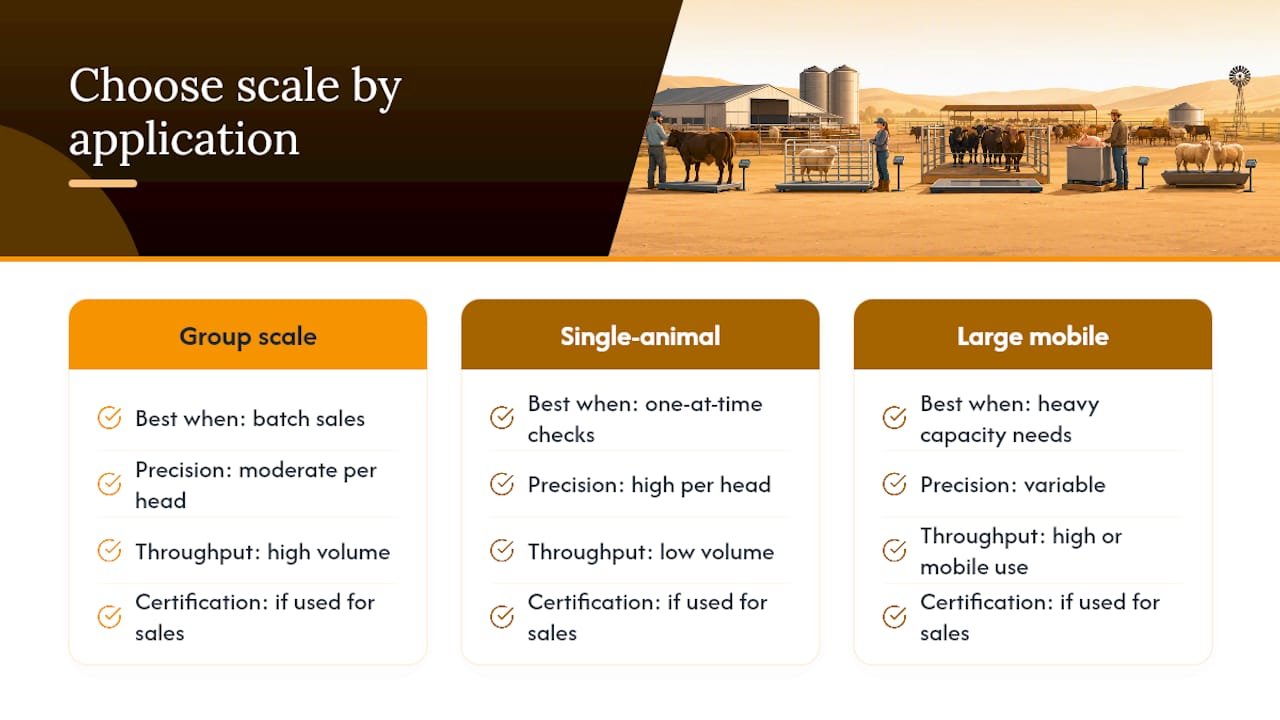
Certification gets treated as a box to check, but it’s really a legal question first. If a number you produce sets a price someone else pays, get it NTEP certified. If it only informs your own management decisions, don’t pay for certification you don’t need.
Start with your chute, your throughput, and your transactions. The scale follows from those answers, not the other way around.
— Juiced
Get the Right Scale Setup Without Guessing at Specs
The components that make up most of the scale types covered here include weigh bars and load bar sets, digital indicators, and mobile scale accessories designed to work with existing handling systems rather than requiring purchase of a whole new setup.
If you already run a squeeze chute or crush, a load bar conversion is usually the fastest path to individual weights without replacing equipment you paid for once already. If you’re planning a new setup from scratch, capacity, flooring, and certification needs all shape what you actually order. Browse the fence equipment collection to see current load bar and handling-compatible options, or reach out through Fencefast for a site-specific recommendation before you commit to a configuration that doesn’t match your chute, your herd size, or your certification needs.
Sources
Rice Lake, ScaleTec, Scale Blog, Cardinal Scale, and Central City Scale cover the technical detail behind these categories in more depth.
- Livestock weighing buyers guide | Rice Lake
- The Complete Guide to Farm and Livestock Scales | Scale Blog
- Group Livestock Scales | Central City Scale
FAQ
What are the main types of livestock scales?
The main types are weigh bars for existing chutes, single-animal platform scales, portable trailer-mounted scales, group or mob scales, and specialty vet or farm platform scales for smaller stock and non-livestock loads.
What are the different types of animal scales beyond cattle?
Veterinary scales handle sheep, goats, pigs, and poultry with low step-up platforms and small cages, while farm platform scales weigh feed, supplies, and general farm loads rather than animals specifically.
What are the four basic categories of weight scales used on farms?
Most operations end up choosing among mechanical beam scales, digital platform scales, load-bar conversion systems, and mobile group scales, each suited to a different combination of throughput and precision.
What’s the best livestock scale for weighing cattle?
There’s no single best option: weigh bars work well for individual weights on existing chutes, while group scales like those from Central City Scale suit high-volume pen weighing, so the right choice depends on your handling setup and whether you need NTEP certification.
Do I need NTEP certification for a livestock scale?
You need NTEP legal-for-trade certification only when a weight reading directly determines a sale price or contract terms; scales used purely for internal herd management don’t require it.

