

Modular fencing pays off fastest for anyone moving stock regularly: expect faster paddock setup, real labor savings, and tighter grazing control, plus conservation upside from excluding sensitive ground. The catch is that none of it runs on its own. Rotational grazing systems, virtual fencing platforms, and portable electric setups from suppliers like Fencefast still demand correct energizer sizing, grounding, and (for virtual collars) a subscription and a training period before the herd behaves.
TL;DR:
- Modular fencing is most cost-effective for operators frequently moving stock or practicing tight rotational grazing, with setup often taking less than an hour.
- Virtual fencing achieves containment rates of 90% or higher and allows herd movement control via phone, but requires upfront hardware investment and ongoing subscription fees.
- Proper energizer sizing and good grounding are essential for fence effectiveness; weekly voltage checks and vegetation management are critical maintenance steps.
- The choice of portable electric system depends on the species, with polywire for cattle, netting for sheep and goats, and polytape for horses.
- Funding options like grants can lower initial costs, and small-scale trials are recommended for operations new to modular fencing or virtual systems.
Table of Contents
- What Are the Core Advantages of Modular Fencing?
- Which Portable Electric Fencing System Fits Your Herd?
- How Well Does Virtual Fencing Actually Perform?
- Which Modular Approach Fits Your Grazing Goals?
- What Does Modular Fencing Really Cost, and What’s the Payback?
- How Do You Keep a Modular Fence System Working Right?
- Who Should Trial Modular Fencing First?
- Get the Right Fencing Setup From Fencefast
- Sources
What Are the Core Advantages of Modular Fencing?
Modular fencing wins on flexibility first. A rancher running strip grazing or mob grazing can reconfigure a paddock in an afternoon instead of pulling wire staples for a week, and that speed changes how often rotation actually happens in practice, not just on paper.
Extension research backs the payoff. NDSU Extension reports that virtual and portable fence systems used for rotational grazing improve forage utilization and support tighter conservation exclusion zones, because managers can shrink or shift a paddock boundary the moment pasture conditions call for it.
The labor math is where most operators get convinced. Setting up a quarter mile of polywire with step-in posts takes a fraction of the time of digging or repairing permanent line, and relocating it the next week costs almost nothing beyond a few minutes with a reel.
Environmentally, modular systems let you fence out what matters instead of fencing in everything else:
- Riparian buffers and wetland edges get excluded without a permanent structure blocking wildlife corridors.
- Reduced fragmentation means deer, elk, and other wildlife keep natural movement patterns across the property.
- Temporary exclusion zones can flex with seasonal habitat needs rather than locking in one boundary forever.
By the Numbers: Reviews of virtual fencing performance report containment effectiveness at 90% or higher in many studies, a rate researchers tie directly to precision grazing management and reduced reliance on fixed interior fence lines.
Which Portable Electric Fencing System Fits Your Herd?
Portable electric fencing is the entry point for most operations, and the right hardware depends heavily on species. Cattle tolerate polywire and a single or double strand reasonably well. Sheep and goats need electric netting because a strand-only system gives them too many gaps to slip through. Horses need high-visibility polytape, since a thin wire is nearly invisible to a spooked animal moving at speed. Poultry netting is its own category entirely, built with tighter mesh to hold birds and exclude ground predators.
- Polywire and step-in posts — the fastest, cheapest option for cattle on rotational grazing, typically running $150 to $300 for a basic starter kit.
- Electric netting — essential for sheep and goats, plus a solid option for temporary poultry runs.
- Polytape — the right conductor for horse paddocks, chosen for visibility over pure conductivity.
- Reel systems — worth the extra cost once you’re moving fence lines several times a week rather than a few times a season.
Setup on a straightforward starter kit runs under an hour once you’ve done it twice. What trips people up isn’t the hardware. It’s skipping the daily voltage check and letting weeds creep against the wire, both of which quietly drain a fence’s effectiveness long before an animal tests it.
How Well Does Virtual Fencing Actually Perform?
Virtual fencing adds something no wire fence can: a boundary you can redraw from your phone. Collars communicate with base stations to define inclusion zones, exclusion zones, and even movement corridors that shift the herd across a pasture on a schedule you set, without a human walking a single step of new line.

Performance data is genuinely strong. Field studies cited by MDPI report containment rates comparable to physical fencing, and cattle typically need only a short training period before shock frequency drops off sharply as they learn the audio cue that precedes the boundary signal.
The limits are real, though, and worth naming plainly:
- Base stations and collars carry meaningful upfront cost before you save a dollar in labor.
- Ongoing subscription fees apply for most virtual platforms, on top of the hardware.
- GPS accuracy and cellular or radio connectivity both degrade in heavy terrain or dense tree cover.
- Collar batteries, solar charging, and device durability need monitoring just like any other piece of farm equipment.
- Individual animals vary in how fast they learn the boundary, and a handful of stragglers can slow the whole herd’s transition.
The Noble Research Institute frames this well: virtual fencing is low-labor, not no-labor. Someone still has to manage boundaries, check collar status, and watch for animals that aren’t adapting.
Pro Tip: Run your first virtual fencing trial on a small paddock with a handful of animals before committing the whole herd. You’ll spot collar fit issues and learning-rate stragglers early, when fixing them costs you an afternoon instead of a season.
Which Modular Approach Fits Your Grazing Goals?
Match the tool to the actual problem you’re solving, not the newest technology on the market.
- Mob grazing to boost forage utilization — portable polywire and step-in posts, moved daily or every few days across small cells.
- Strip grazing for dairy or high-value pasture — reel-based polywire systems that let one person shift the front line in minutes.
- Temporary paddocks for weaning — electric netting, since it holds a mixed group tightly in a confined space.
- Riparian or habitat exclusion — either portable electric or virtual fencing, depending on whether the zone is permanent or seasonal.
Three questions usually settle it: how often you’re moving animals, how much labor you have on hand, and whether the terrain has reliable connectivity. Frequent moves on open ground with tight labor favor virtual fencing. Rough terrain, dense cover, or a tight budget usually points back to portable electric paired with a solid perimeter fence.
What Does Modular Fencing Really Cost, and What’s the Payback?
Cost comparisons only mean something when you count the right things on both sides of the ledger.
A basic portable starter kit runs $150 to $300, energizers add another line item scaled to your acreage, and electric netting for smaller livestock costs more per foot than plain polywire. Virtual fencing flips the cost structure: collars, a base station, and a recurring subscription replace most of your wire and post spending, but the money moves from a one time purchase to an ongoing bill.
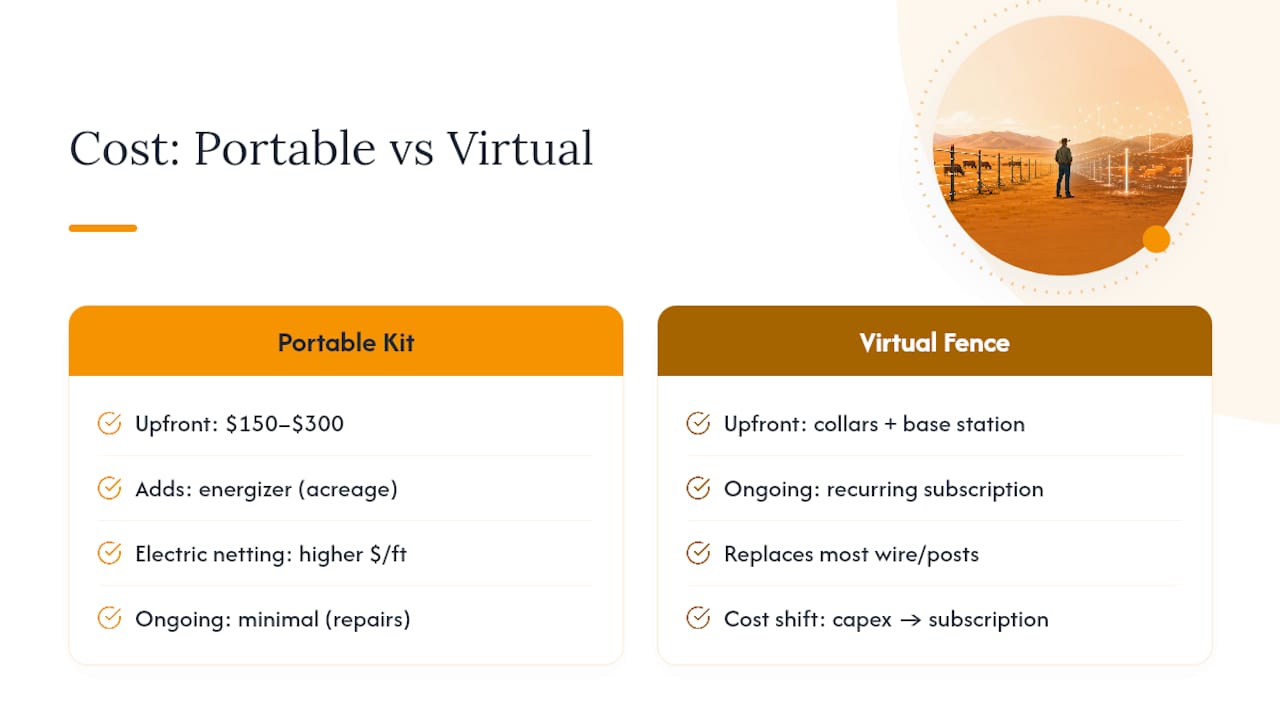
On the payback side, count labor hours saved on fence moves, extra forage captured through tighter rotation, and reduced repair costs versus permanent fence that needs annual upkeep. Those three usually determine whether a system pays for itself in one grazing season or three.
Funding can shorten that timeline. Programs like OFCAF and various BMP grants specifically support virtual fencing adoption in some regions, and Fencefast offers grant guidance to help producers figure out what they qualify for before they buy.
How Do You Keep a Modular Fence System Working Right?
Most fence failures trace back to two things: undersized energizers and bad grounding. Iowa State Extension recommends matching energizer output in joules to your total fence mileage and vegetation load, and MSU Extension notes that poor grounding is one of the fastest ways to lose voltage across the whole line.
- Test voltage at the far end of the fence weekly, not just at the energizer.
- Walk the line for vegetation contact after any heavy rain or growth spurt.
- Check posts and reels for wear before each major move.
- Monitor collar battery and solar charge status if you’re running virtual fencing.
- Store reels and posts out of UV exposure between seasons to extend their working life.
Match strand count and spacing to species: cattle generally need fewer strands than sheep or goats, and horses need visibility over voltage. Label your reels so you’re not guessing which line goes where at 6 a.m., and lock up energizers when fencing near roads or public land, since theft is common enough to plan for.
Pro Tip: Upsize your energizer for heavy vegetation loads before you think you need to. A fence that grounds out during a wet week teaches cattle they can push through it, and that’s a lesson you don’t get to unteach easily.
Who Should Trial Modular Fencing First?
The clearest winners are operations moving stock often, short on labor, or managing land with conservation strings attached. If you’re rotating weekly or more, modular fencing earns its cost fast. If you’re moving cattle twice a season, the case is weaker.
Before you buy anything, run through this: move frequency, animal class, terrain and connectivity, budget, and trial size. Start small regardless of which system you pick. Consulting support for system design and guidance on grants that can offset the cost of a first trial are available to help producers.
— Juiced
Get the Right Fencing Setup From Fencefast
Fencefast puts real hardware behind every advantage covered here, from starter-friendly portable fencing kits to full Gallagher eShepherd virtual fencing systems with collars, base stations, and app-based herd management.

That range matters because most producers don’t need one solution. They need the right one for this paddock, this herd, this season. The product lineup includes portable electric kits, energizers sized for acreage, and virtual collar hardware side by side. Design consulting is available for those unsure where to start, along with guidance on funding programs like OFCAF and BMP grants that help offset the cost of adopting virtual fencing.
If you’re ready to move past the planning stage, browse the fence equipment collection to price out a starter kit or a full virtual fencing setup for your operation.
Sources
- Virtual fencing: where it makes sense — Noble Research Institute
- Grazing and virtual fence — NDSU Extension
- Influence of virtual fencing technology in cattle management and animal welfare — MDPI (2025)
- Temporary & portable electric fencing guide — Livestock Fencing Hub
- Electric fencing & rotational grazing — Iowa State Extension

