

TL;DR:
- Fence height requirements depend on species, with cattle needing 48-54 inches and horses requiring 60 inches or more for containment. Behavior and predator threats influence fence design, such as dig-proof fencing for pigs and electric outriggers for goats and sheep. Proper post depth, bracing, and material choice are critical to prevent fence failure and ensure livestock safety.
A livestock fence height guide defines the minimum fence height required to contain each species based on shoulder height, jumping ability, and behavioral tendencies. The general rule across livestock fencing standards is that fence height should be at least 1.5 times the animal’s shoulder height. Get this wrong and you face escapes, injuries, and predator access. This guide covers proper fence height for livestock species from cattle and horses to pigs and poultry, plus the construction and maintenance details that determine whether your fence actually holds.
What is the recommended fence height for common livestock species?
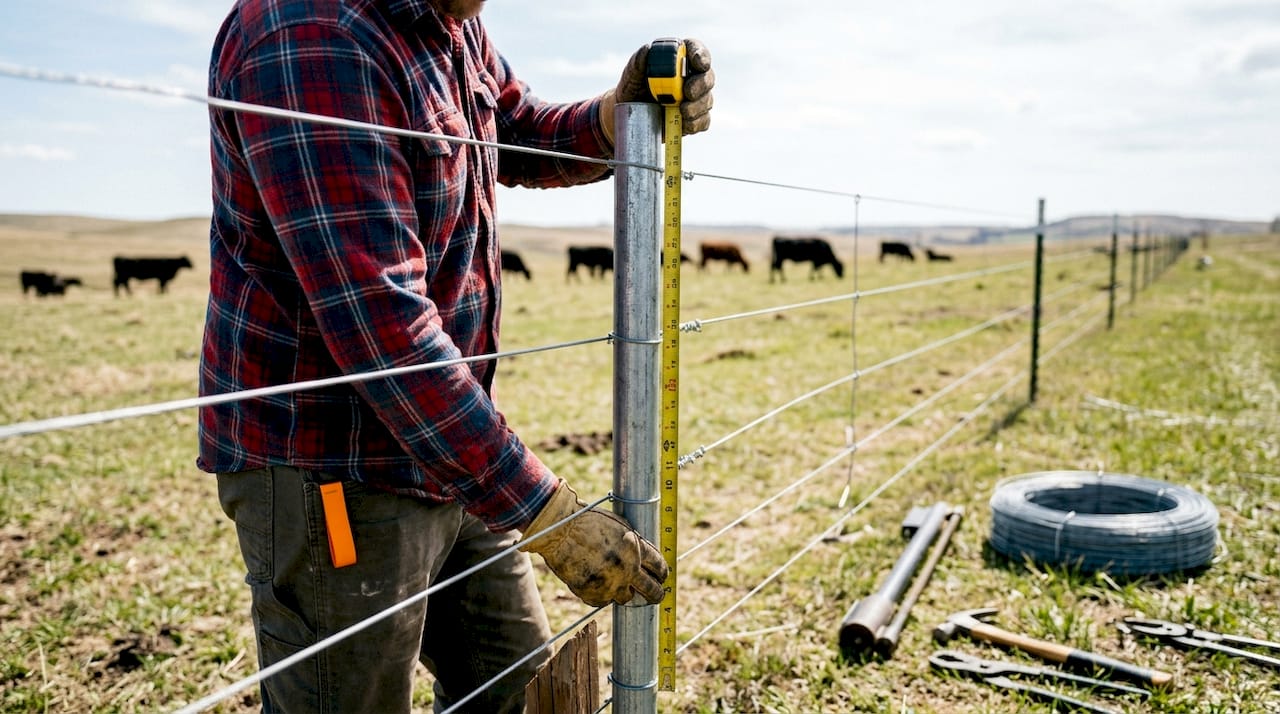
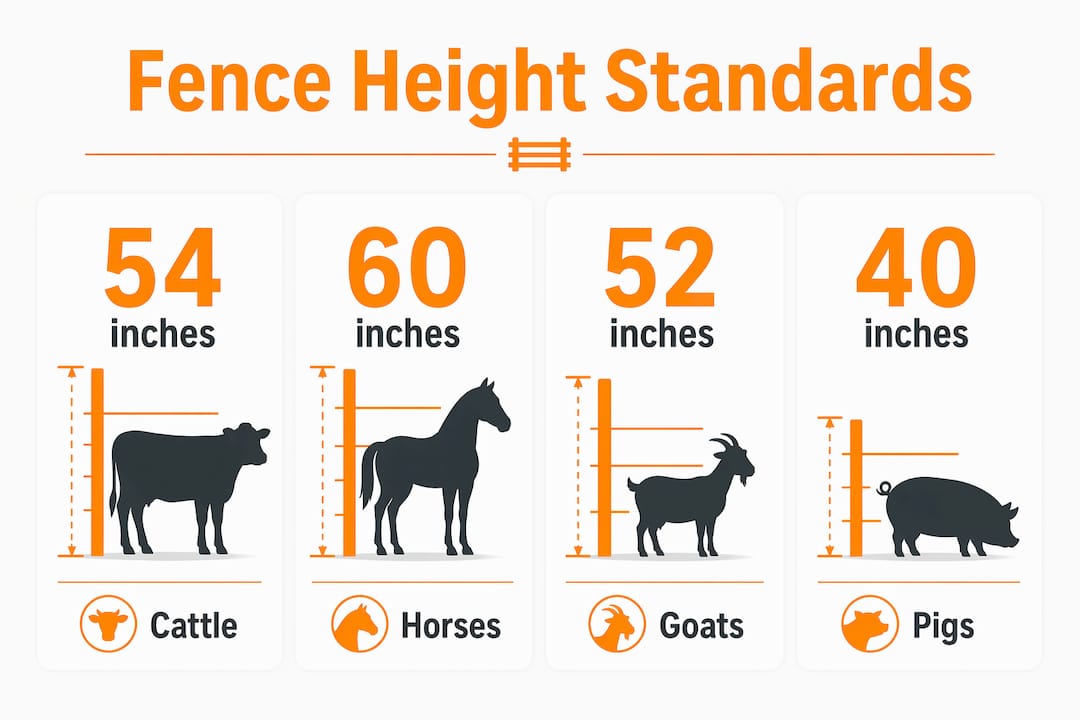
Fence height requirements vary significantly by species. A fence that works for beef cattle will fail completely for goats. The table below gives you the working minimums used by ranchers and supported by agricultural extension guidelines.
| Species | Minimum fence height | Notes |
|---|---|---|
| Cattle (cows) | 48–54 inches | 4–6 wire strands recommended |
| Bulls | 54–60 inches | Heavier gauge wire, stronger posts |
| Horses | 60 inches or more | Smooth surfaces to prevent injury |
| Sheep | 48 inches | Mesh openings 6 inches or less |
| Goats | 48–52 inches | Tighter mesh, electric outrigger advised |
| Pigs | 34–40 inches | Buried 12–18 inches below ground |
| Poultry | Full enclosure | Overhead netting required |
Cattle fences should stand 49–54 inches tall with 4–6 wire strands. Bulls require sturdier construction at the higher end of that range. A bull that tests a fence will find its weak points quickly, so heavier gauge wire and closer post spacing are non-negotiable.
Horses need at least 60 inches of fence height, and the surface material matters as much as the height. Rough wire edges cause serious leg injuries. Smooth rail fencing or coated wire is the standard for equine enclosures.
Sheep and goats need fences at least 48 inches tall with mesh openings no larger than 6 inches. Goats are the escape artists of the livestock world. They will test every gap, climb any horizontal surface, and squeeze through openings that look impossibly small. Electric outriggers placed at nose height add a critical deterrent layer.
Pigs require fences 34–40 inches tall, but the above-ground height is only half the equation. Fence material must extend 12–18 inches below ground to stop rooting escapes. Pigs are powerful diggers, and a fence that is not buried will fail.
Pro Tip: For poultry, height alone is not enough. Chickens and ducks need fully enclosed runs with overhead netting to prevent both escapes and predator entry from above.
How do animal behavior and containment needs influence fence design?
Animal behavior determines fence design more than any single measurement. Knowing how your livestock moves, tests boundaries, and responds to pressure is the starting point for every fencing decision.
The 1.5x shoulder height rule gives you a working minimum, but behavior adds the real-world adjustment. Goats and some sheep breeds jump readily. A Boer goat with a 28-inch shoulder height needs a fence well above 42 inches because it will use any nearby object as a launch point. Dairy goats are even more persistent. The fence height for goats should account for the specific breed, not just the species average.
Rooting behavior in pigs makes buried fencing non-negotiable. A pig can undermine a standard fence post in a matter of days if the bottom of the fence is not secured below ground. Electric wire placed 6–8 inches above ground level on the inside of the enclosure discourages rooting before it starts.
Predator deterrence is a design factor that directly affects fence height and mesh spacing. For sheep, woven wire mesh with openings of 6 inches or less blocks coyote entry. An electric outrigger wire placed 8 inches outside the fence at ground level stops predators from digging under. These additions change the effective height and depth of the fence system without changing the post height.
Electric fencing wire placement follows species-specific logic:
- Cattle: First wire at 18–24 inches, second at 36–42 inches, third at 48–54 inches
- Horses: Wires at 24, 42, and 60 inches; never use barbed wire for horses
- Sheep and goats: Wires at 10, 20, 30, and 48 inches; tighter spacing discourages ducking under
- Pigs: First wire at 6–8 inches above ground to target the nose; second wire at 18–20 inches
Pro Tip: Animals learn electric fences fast. One solid shock at nose height is more effective than three wires placed randomly. Position the lowest wire where the animal’s nose naturally drops when grazing or rooting.
What construction standards and material specifications matter most?
Fence height means nothing if the structure fails. Corner and gate bracing integrity is more critical to fence lifespan than wire gauge or fence height. Most livestock fence failures trace back to inadequate post installation, not the wire itself.
Straining posts, the corner and end posts that anchor the entire fence run, must be set 750mm to 1m deep and properly braced. In Canadian conditions, frost heave adds pressure on posts every winter. Posts set at the shallow end of that range will shift. A shifted corner post loses tension across the entire fence line.
Post spacing runs 10–16 feet for most fence types. Mesh fences for smaller animals like sheep and goats need spacing at the tighter end of that range. Wider spacing allows the mesh to bow outward under pressure, creating gaps that animals exploit.
Material choice determines how long the fence performs without major repairs. Galvanized wire and treated posts meet Canadian agricultural standards and resist weathering through freeze-thaw cycles. Untreated wood posts rot within a few years in wet conditions. Galvanized wire holds tension longer than ungalvanized alternatives and resists rust that weakens wire at the contact points.
| Construction element | Recommended standard | Why it matters |
|---|---|---|
| Corner post depth | 750mm–1m | Prevents frost heave and tension loss |
| Line post spacing | 10–16 feet | Controls sag and mesh bowing |
| Wire type | Galvanized, high-tensile | Resists rust and holds tension |
| Post material | Treated timber or steel | Withstands Canadian weather cycles |
| Brace system | Double-span H-brace | Distributes tension load at corners |
Pro Tip: Install a double-span H-brace at every corner and gate post. A single diagonal brace handles light loads, but livestock pressure and wire tension demand the added stability of a full H-brace configuration.
How do fencing needs differ for rotational grazing versus permanent enclosures?
Rotational grazing and permanent enclosures have fundamentally different fencing priorities. Getting the right system for your operation saves significant labor and cost over time.
Rotational grazing fencing prioritizes portability and speed of setup. Electric fences dominate rotational systems because they move quickly and cost less per foot than woven wire. The height requirements stay the same by species, but the construction approach is lighter. Step-in posts and polywire replace treated timber and high-tensile wire. The tradeoff is maintenance intensity.
Electric fences in rotational systems must maintain 3,000–5,000 volts to contain livestock reliably. Voltage drops below 3,000V and animals stop respecting the fence. Vegetation contact is the leading cause of voltage loss. A single grass stem touching the wire can drain enough power to make the fence ineffective.
Key differences between rotational and permanent fencing systems:
- Rotational: Polywire or polytape, step-in posts, energizer sized for the paddock rotation, daily or weekly moves
- Permanent: High-tensile galvanized wire, treated timber or steel posts, H-brace corners, designed for 20-plus years of service
- Height: Identical minimums by species, but permanent fences often add 6 inches of height as a buffer for animal pressure over time
- Maintenance: Rotational systems need daily voltage checks; permanent fences need seasonal inspections and vegetation clearing
Vegetation management is the single most important maintenance task for electric fences. Grass and brush touching the wire bleeds voltage constantly. Mow or spray a 12-inch strip under every electric fence line before the growing season starts. For temporary fencing options used in rotational systems, moving the fence line itself often solves the vegetation problem without additional labor.
What are common mistakes owners make with livestock fence height?
The most expensive fencing mistakes are the ones that look fine until an animal gets out. Most failures are predictable and preventable.
- Underestimating animal size. A calf that fits under a 36-inch fence today will be a 1,200-pound cow in 18 months. Build for the adult animal, not the current one.
- Skipping corner post bracing. Inadequate corner bracing is the leading cause of fence failure. Wire tension pulls constantly on corner posts. Without a proper H-brace, the post leans, tension drops, and the fence sags within a season.
- Wrong wire spacing for the species. A fence with wires spaced 12 inches apart works for cattle. The same fence lets a lamb walk through. Match wire spacing to the smallest animal in the enclosure.
- Ignoring vegetation on electric fences. Vegetation shorting is the leading cause of electric fence failure. Check voltage weekly during the growing season.
- Skipping periodic inspections. Walk every fence line at least twice per year. Look for leaning posts, broken wires, corroded connections, and areas where animals have been testing the fence.
Pro Tip: Carry a digital voltmeter on every fence inspection. A reading below 3,000V on an electric fence means the fence is not containing animals reliably, even if it looks intact.
Key takeaways
Fence height must match the species, behavior, and containment demands of your specific livestock. Corner post installation and bracing determine fence lifespan more than any other single factor.
| Point | Details |
|---|---|
| Species-specific height | Use 1.5x shoulder height as the minimum; cattle need 48–54 inches, horses 60 inches or more. |
| Behavior drives design | Pigs need buried fencing; goats need tight mesh and electric outriggers; horses need smooth surfaces. |
| Corner bracing is critical | Set straining posts 750mm–1m deep with H-braces to prevent tension loss and sagging. |
| Electric fence voltage | Maintain 3,000–5,000V in rotational systems; check voltage weekly during the growing season. |
| Material durability | Galvanized wire and treated posts extend fence lifespan through Canadian freeze-thaw conditions. |
What I’ve learned after years of watching fences fail
The ranchers who call about escaped livestock almost never have a fence height problem. They have a corner post problem. The wire is the right height. The posts are the right spacing. But the corner post was set 18 inches deep instead of 36, and by the second winter, the whole fence line had gone slack. The animal did not jump the fence. It walked through a gap that opened up because the tension was gone.
Height guidelines matter, and you should follow them by species. But I would tell any farmer building a new fence to spend 80% of their attention on the corners and gates, and let the line posts take care of themselves. A fence with perfect line posts and weak corners will fail. A fence with strong corners and average line posts will hold for decades.
The other thing I see consistently underestimated is the behavioral intelligence of goats and pigs. Goats will map every weakness in a fence within 24 hours of introduction. Pigs will find the one spot where the bottom wire is 2 inches higher than everywhere else and work it until they are through. These animals are not randomly escaping. They are solving a problem. Your fence needs to be a harder problem than they are motivated to solve.
For operations running rotational grazing, electric fencing gives you flexibility that permanent wire cannot match. But that flexibility comes with a daily maintenance commitment. A rotational system with inconsistent voltage monitoring is not a fencing system. It is a suggestion.
— Juiced
Fencefast has the fencing solutions your operation needs
Canadian livestock operations face specific challenges: freeze-thaw cycles, wide open pastures, and species mixes that demand different containment approaches in the same operation. Fencefast carries the full range of fencing components, electric fencing systems, and livestock fencing supplies built for exactly those conditions.
Fencefast stocks galvanized wire, treated post hardware, Gallagher electric fencing energizers, and everything needed for both permanent and rotational grazing setups. As an authorized Gallagher dealer with a 26-year partnership, Fencefast also offers expert guidance on system design, whether you are building a new permanent fence or setting up a rotational paddock system. Nationwide shipping across Canada means the right materials reach your operation without delay.
FAQ
How tall should a livestock fence be?
The minimum fence height for livestock is 1.5 times the shoulder height of the animal. In practice, cattle need 48–54 inches, horses need 60 inches or more, and sheep and goats need at least 48 inches.
What is the fence height for goats?
Goats require a minimum fence height of 48–52 inches with mesh openings no larger than 6 inches. Electric outriggers at nose height add a critical deterrent for persistent escape attempts.
How deep should fence posts be set for livestock fencing?
Straining and corner posts should be set 750mm to 1m deep and braced with an H-brace system. Shallow post installation is the most common cause of fence failure.
What voltage does an electric livestock fence need?
Electric fences for livestock containment should maintain 3,000–5,000 volts. Voltage below 3,000V is often insufficient to deter animals, especially in rotational grazing systems.
Do pigs need a different fence than cattle?
Yes. Pigs need fences 34–40 inches tall with the bottom of the fence buried 12–18 inches underground to prevent rooting escapes. Cattle fences do not require burial and focus on height and wire tension instead.

