

TL;DR:
- Whether you need to fence livestock depends on your state’s law, which varies between fence-in, fence-out, and open-range doctrines.
- Farmers should consult their state’s statutes, extension resources, and local ordinances to understand their fencing obligations and standards.
Whether you must fence your livestock depends entirely on your state’s law. Some states put the burden on the livestock owner to keep animals in; others follow open-range rules that require neighbors to fence animals out. Before you build, repair, or dispute a single post, pull your state’s fence statute and confirm which doctrine applies to your county. The National Agricultural Law Center maintains a state-by-state compilation of fence statutes — that is your first stop. For a concrete statutory example, Florida Statutes includes construction minimums and owner duties in detail, and the University of Florida IFAS Handbook of Florida Fence and Property Law translates that statute into plain-language guidance farmers can actually use.
Immediate risk-control steps:
- Secure all perimeter fences that border public roads and rights-of-way — these carry the highest liability exposure if an animal escapes.
- Photograph your fence line today with date-stamped images; this documentation is your first line of defense in any dispute or insurance claim.
- Check your state code for terms like “livestock running at large,” “line fence,” and “partition fence” to find the relevant sections fast.
- Contact your county extension office or land-grant university for state-specific construction guidance and any local ordinance overlays.
Table of Contents
- What “duty to fence” means: fence-in, fence-out, and open range
- How state laws differ: representative examples and statutory language to check
- Typical statutory standards: heights, wire strands, and construction language
- Liability when animals escape: damages, collisions, and negligence
- Resolving fence disputes: cost-sharing, enforcement, and first steps
- Practical compliance checklist and species-specific fencing tips
- How to find and read your state’s fence statute
- Key Takeaways
- The fence law lesson most farmers learn too late
- Authoritative sources and further reading
What “duty to fence” means: fence-in, fence-out, and open range
The phrase “duty to fence” sounds simple, but it carries a specific legal weight that varies dramatically depending on where your land sits.
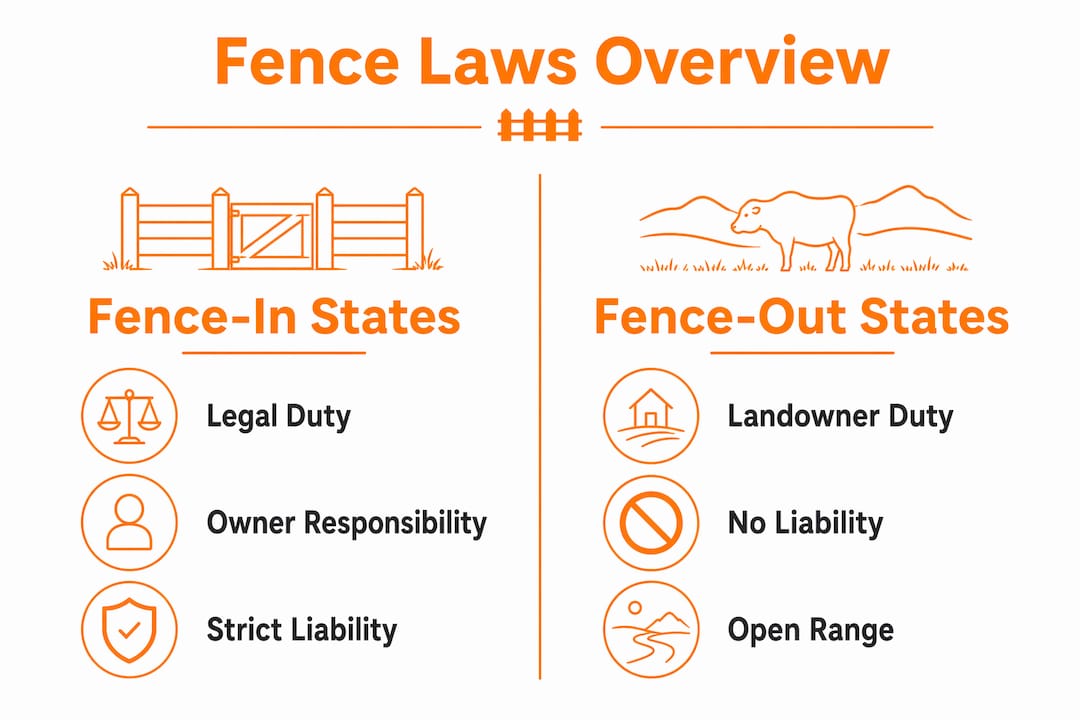
Fence-in states place the legal obligation on the livestock owner. If your cattle escape and damage a neighbor’s crops, you are liable — period. The burden of containment is yours, and failing to maintain an adequate fence is treated as negligence or, in some jurisdictions, strict liability.
Fence-out states flip that obligation. Under this doctrine, a landowner who wants to keep animals off their property must build and maintain their own barrier. If they do not, and a neighbor’s livestock wanders in, the livestock owner may face little or no liability. This model traces back to open-range traditions in the American West, where vast unfenced land made universal fencing impractical.
Open-range rules are a subset of the fence-out approach, often applied county-by-county or in designated agricultural districts. In open-range counties, livestock legally roam public roads and unfenced land. A motorist who hits a cow in an open-range area may have no civil claim against the rancher — a fact that surprises most people unfamiliar with western range law.
Common statutory terms to watch for:
- “Livestock running at large” — defines when an animal is legally considered uncontrolled.
- “Line fence” or “partition fence” — the shared boundary fence between two properties; often triggers cost-sharing obligations.
- “Legal fence” — a defined construction standard; fences that do not meet it may not protect the owner from liability even if they exist.
- “Agricultural district” — a designation that can modify or exempt a landowner from certain local fencing ordinances.
How state laws differ: representative examples and statutory language to check
All 50 U.S. states have statutes addressing fence law, but the duty and construction standards vary enough that a rule from one state can be the exact opposite of the rule next door.
A quick comparative snapshot
| State / Region | General Doctrine | Notes |
|---|---|---|
| Florida | Modified fence-in (§588) | Owner must fence livestock; specific construction minimums in statute |
| Indiana | Fence-in with line-fence cost-sharing | Township trustee resolves disputes; Purdue Extension details apportionment |
| Western open-range counties (AZ, NV, NM, WY, etc.) | Fence-out / open range | County elections determine which doctrine applies locally |
| Most Midwest states | Modified fence-in | Line-fence statutes with shared-cost provisions common |
Florida §588 as a concrete example
Florida Statutes §588 is one of the most frequently cited state fence statutes in extension literature because it is specific. It defines what constitutes a legal fence, sets out minimum construction references, and assigns owner liability for livestock running at large. The UF/IFAS handbook walks through the duty-to-fence provisions in plain language and is a model for how extension services translate statutory text into farm-level guidance. If your state has a similar handbook from its land-grant university, find it — it will save you hours of reading raw code.
What to check inside any state statute
- Who bears the primary duty to fence (owner or neighbor).
- Minimum construction language: height, wire count, post spacing, and materials.
- Penalties for livestock running at large and civil remedies available to damaged parties.
- Exceptions for railroads, highways, and designated agricultural districts.
- Whether county or township elections can modify the statewide default.
Pro Tip: Fence laws are intensely local. A statewide statute may allow county-level elections between fence-in and fence-out rules. Always verify county ordinances and township trustee roles before assuming the state default applies to your parcel.
Typical statutory standards: heights, wire strands, and construction language
Statutes rarely specify every bolt and staple, but they do set minimums — and courts use those minimums to decide whether a fence was “legally sufficient” when an escape leads to damages.
Common numeric standards
The USDA’s Conservation Practice Standard (Code 382) and regional extension guides give the most widely referenced construction benchmarks:
- Barbed wire for cattle: minimum four strands at 42 inches high, with wire spacing at 12, 22, 32, and 42 inches. Line posts spaced no more than 14 feet apart on level ground.
- Woven wire: minimum 32 inches high, typically paired with one or two barbed or high-tensile electric wires on top. Pull assemblies no more than 660 feet apart.
- Board fence: minimum 42 inches high with at least three boards spaced 12–14 inches apart. Corner posts set at 7.5 feet length.
- High-tensile non-electric: seven or more wires at 42 inches high (6, 12, 18, 24, 30, 36, and 42 inches), 12.5-gauge wire at 170,000 psi tensile strength.
- High-tensile electric: one or more wires at roughly two-thirds hip height (26–32 inches), with pull assemblies up to 2,000 feet apart for three or more wires.
Post spacing and corner braces
Extension guidance consistently points to corners and gates as the most common failure points. An H-brace assembly at every corner and end post is the standard — not optional. For runs longer than 200 feet, a double-span brace assembly is recommended because it is more than twice as strong as a single span. Posts driven into the ground are roughly 1.7 times stronger than tamped posts, so use a post driver where soil conditions allow.
Good corner bracing technique is not just a construction preference; it is what keeps a fence legally defensible when tension pulls corners out of alignment over time.
Permanent vs. temporary electric fences
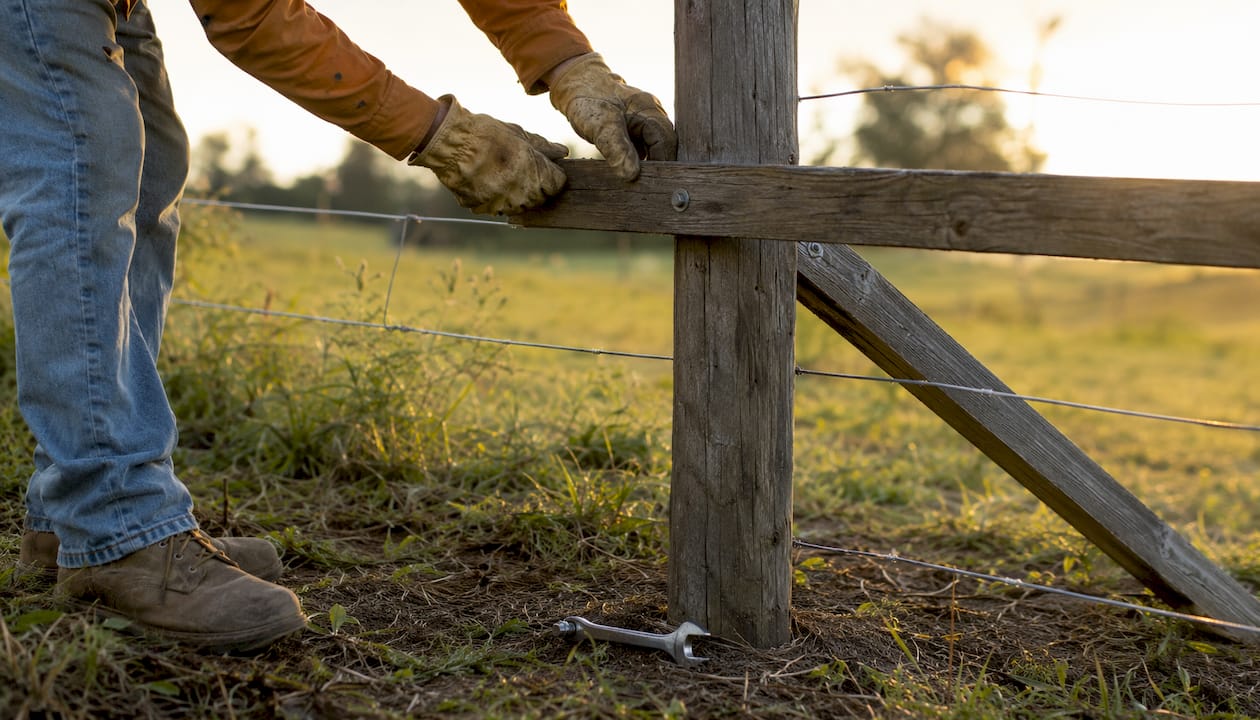
Temporary electric fencing is a valuable rotational grazing tool, but courts and statutes rarely treat it as a “legal fence” for boundary purposes. Extension literature warns that temporary electrified fences almost never satisfy legal fence definitions in boundary disputes. Use permanent, well-documented structures for any fence line that carries a legal duty. Reserve portable electric systems for internal pasture subdivision and grazing management.
Liability when animals escape: damages, collisions, and negligence
When livestock get out, the legal question is not just “whose fault is it?” — it is “what doctrine applies, and what evidence exists?”
Strict liability vs. negligence: In fence-in states, some courts impose strict liability for escaped livestock, meaning the owner is responsible for damages regardless of how well they maintained the fence. Others require proof of negligence — that the owner knew or should have known the fence was inadequate. The distinction matters enormously for insurance and litigation strategy.
Vehicle collisions: A car hitting a cow on a public road is one of the most serious liability scenarios a livestock owner faces. In fence-in states, the animal owner is typically liable for vehicle damage and personal injury. In open-range counties, the driver may bear more of the risk. Check your state’s specific rule on this — it is not uniform, and the financial exposure from a collision can far exceed the cost of a proper fence.
Evidence to collect after an escape:
- Date-stamped photographs of the breach point and surrounding fence condition.
- Repair invoices showing prior maintenance (demonstrates you were not negligent).
- Witness statements from anyone who observed the animal’s location or the fence condition.
- Veterinary records and vehicle damage estimates if animals or property were injured.
- A written incident report filed with local law enforcement or animal control.
Insurance and reporting: Notify your farm liability insurer immediately after any escape incident. Many policies require prompt reporting, and delayed notification can void coverage. Some states also require reporting escaped livestock to local authorities within a defined window.
Resolving fence disputes: cost-sharing, enforcement, and first steps
Most fence disputes between neighbors follow a predictable path — and the statutory workflow is usually faster and cheaper than going straight to court.
- Send written notice first. Most line-fence statutes require formal written notice to the adjoining landowner before any enforcement action. Document the date sent and keep a copy.
- Repair your half. If your state’s statute assigns each owner responsibility for a portion of the shared line fence, repair your section regardless of the dispute. Failing to do so weakens your legal position.
- Invoke the township trustee or county process. Indiana’s line-fence statute, detailed by Purdue Extension, is a good model: a trustee can be called to inspect, apportion costs, and order repairs. Many states have equivalent administrative remedies.
- Document all communications. Every conversation, letter, and email with your neighbor about the fence becomes evidence if the dispute escalates.
- File in small-claims court for minor damages. If the dispute involves a modest dollar amount, small-claims court is often faster and requires no attorney.
- Hire a licensed surveyor before building on or near the property line. Survey-backed fences are far more defensible in court, and recorded covenants about shared fence obligations prevent most future disputes entirely.
When to call an attorney: If the dispute involves significant damages, unclear property lines, or a neighbor who ignores statutory notice, consult a licensed agricultural attorney in your state. Bring your deed, any prior fence agreements, photographs, and your state’s fence statute to that meeting.
Agricultural-district status can also protect you from overly restrictive local ordinances. New York State guidance notes that fences used solely for agriculture in designated districts are often exempt from local building codes and permitting requirements — a protection worth confirming with your county office.
Practical compliance checklist and species-specific fencing tips
Step-by-step compliance checklist
- Confirm your state’s doctrine. Pull the statute from the National Agricultural Law Center compilation and note whether your county has elected a different rule.
- Check local zoning and agricultural district status. Confirm whether your parcel qualifies for agricultural exemptions from permitting or height restrictions.
- Inspect and photograph existing fence. Walk the entire perimeter, note every weak post, sagging wire, and gate latch issue, and date-stamp the photos.
- Repair or build to statutory minimums. Use the construction standards in your state’s statute or extension guide as the floor, not the ceiling.
- Record any shared fence agreements in writing. File them with your county recorder’s office so they bind future owners.
- Schedule annual inspections. Post-winter and post-storm checks catch failures before they become escapes.
Species-specific quick reference
Extension guidance from regional fencing publications gives the following general benchmarks (these are construction guidelines, not statutory law):
| Species | Recommended height | Key design notes |
|---|---|---|
| Cattle | 42 in minimum (perimeter) | 4-strand barbed wire or high-tensile; H-braces at all corners |
| Horses | 42 in | High-visibility rail or smooth wire; avoid barbed wire near horses |
| Sheep | 32–36 in | Woven wire with close spacing to prevent head entrapment |
| Swine | 32–36 in | Ground-level resistance critical; hogs root under loose bottom wires |
For more detail on species-specific height standards, the construction differences between cattle and horse fencing are significant enough to warrant separate planning.
Pro Tip: Permanent, surveyed, and well-documented line fences are far more defensible in a dispute than temporary electric-only installations. Use portable electric systems for rotational grazing inside your perimeter, but never rely on them as your legal boundary fence.
How to find and read your state’s fence statute
- Start with the National Agricultural Law Center. The NALC state fence law compilation links directly to each state’s statutes — it is the fastest way to find the right code section without guessing.
- Search your state legislature’s website. Use search terms like “fence,” “livestock running at large,” or “partition fence” in your state’s online code. Most state legislatures publish their statutes free online.
- Find your land-grant extension publication. Every state has a land-grant university with an extension service. Search “[your state] extension fence law” or “[your state] farm fence statute” — publications from Purdue, UF/IFAS, NC State, Mississippi State, and similar institutions translate statutory language into practical guidance.
- Call your county extension office. Extension agents know local ordinances, county elections on fence doctrine, and which township trustees handle fence disputes in your area.
- Check your county or township ordinances. Some states allow counties to elect between fence-in and fence-out rules. Your county clerk or township trustee office can confirm which applies.
Documents to have ready before any call or meeting:
- Your property deed and legal description.
- Any existing fence agreements or easements recorded against the property.
- Date-stamped photographs of the fence line in question.
- The relevant section of your state’s fence statute (print it out).
Zoning note: If your operation sits in a designated agricultural district, local zoning laws may not apply to your boundary or interior fences. Confirm this with your county agricultural office before pulling a building permit for a fence that may not require one.
Key Takeaways
Agricultural fencing rules in the U.S. are state-specific and often county-specific, so confirming your jurisdiction’s fence doctrine is the single most important compliance step you can take.
| Point | Details |
|---|---|
| Confirm your state’s doctrine first | Check the National Agricultural Law Center compilation to identify whether your state follows fence-in, fence-out, or open-range rules. |
| Secure road-facing fences immediately | Perimeter fences bordering public roads carry the highest liability exposure; repair and document them before anything else. |
| Build to statutory minimums | Use your state statute and extension guide as the construction floor: four-strand barbed wire at 42 in for cattle, woven wire at 32 in for sheep and swine. |
| Use surveyed, recorded line fences | Survey-backed fences with recorded agreements are far more defensible in disputes than undocumented or temporary installations. |
| Follow the statutory dispute workflow | Written notice, trustee involvement, and cost apportionment are usually faster and cheaper than immediate litigation. |
The fence law lesson most farmers learn too late
The most common mistake I see in fence-related disputes is not a bad fence — it is a fence with no paper trail. A landowner spends real money on posts and wire, the fence looks solid, and then a neighbor challenges the property line or refuses to share repair costs. Without a recorded agreement, a survey, and dated photographs, that farmer is arguing from memory against someone who may have their own memory of events.
Corners and gates fail more often than any other part of a fence system. Investing in proper H-braces and reinforced gate hardware is not just good construction practice; it is liability management. A fence that holds is a fence that never generates a claim.
The other thing worth saying plainly: temporary electric fencing is a fantastic grazing tool, and Fencefast carries the systems to run it well. But it is not a substitute for a permanent boundary fence when your state’s statute requires one. Use both, for different purposes, and document which is which.
If you need help designing a fencing system that meets your state’s construction standards and your operation’s grazing needs, Fencefast offers design consulting and a full range of fencing components, electric systems, and livestock management supplies.
Authoritative sources and further reading
The following primary sources and extension publications form the foundation of the guidance in this article. Save the links that apply to your state and return to them when building, repairing, or disputing a fence line.
- National Agricultural Law Center — States’ Fence Law Statutes: The definitive starting point for locating your state’s fence statute. Covers all 50 states with direct links to statutory text.
- Florida Statutes §588: A concrete example of a fence-in statute with specific construction minimums and owner liability provisions.
- UF/IFAS Handbook of Florida Fence and Property Law: Plain-language translation of Florida’s fence and property statutes; a model for how extension services make statutory law usable on the farm.
- Purdue Extension EC-657 — Indiana Farm Fence Laws: Detailed walkthrough of Indiana’s line-fence statute, trustee procedures, cost apportionment, and minimum construction standards.
- Mississippi State University Extension — Livestock Fencing Systems for Pasture Management: Practical guidance on combining permanent boundary fences with portable systems for rotational grazing.
- NC State/CES Robeson County Extension — Livestock Fencing: Species-specific design guidance and a clear warning about temporary electric fences in boundary disputes.
- New York State Ag — Guidelines for Review of Local Laws Affecting Animal Control and On-Farm Fencing: Explains agricultural-district protections and how they limit local zoning authority over farm fencing.
- USDA Conservation Practice Standard Fence (Code 382): Federal construction benchmarks for fence height, wire gauge, post spacing, and electric fence requirements across livestock types.
This article is general information, not legal advice. Fence law varies by state and county — confirm the current rules with your state’s statute, your county extension office, or a licensed agricultural attorney before making compliance decisions for your specific situation.
Recommended
- Agricultural Fencing Basics: A Practical Farm Guide – FenceFast Ltd.
- Animal species fencing requirements: The Canadian farmer’s guide – FenceFast Ltd.
- Canada fencing requirements: Stay compliant and protect livestock – FenceFast Ltd.
- Zoning Laws for Rural Fencing: What You Need to Know – FenceFast Ltd.

