

TL;DR:
- Canadian fencing regulations vary by province, animal type, and documentation practices.
- Proper planning, written notices, and adherence to provincial codes are essential for compliance.
- Funding programs like Manitoba’s can significantly offset costs if documentation and pre-approvals are managed properly.
Fencing regulations in Canada are not one-size-fits-all, and for livestock producers, that gap between what you assume and what the law actually requires can be costly. Disputes with neighbors, failed funding applications, and livestock escapes that result in damage claims are all real consequences of misunderstanding the rules. Whether you run cattle in Saskatchewan, horses in Ontario, or sheep in Manitoba, the rules that govern your fences depend heavily on your province, your animal type, and how well you’ve documented everything. This article cuts through the confusion and gives you a clear, actionable picture of what compliance actually looks like.
Table of Contents
- Understanding boundary fence regulations by province
- Livestock-specific fencing codes and safety standards
- Government programs and funding for compliant fencing
- Practical steps to ensure fencing compliance on your farm
- What most farmers miss about fencing regulations
- Find the right fencing solutions for your Canadian farm
- Frequently asked questions
Key Takeaways
| Point | Details |
|---|---|
| Provincial fence rules vary | Each province has its own regulations for boundary and livestock fencing you must follow. |
| Legal notice avoids disputes | Written notification and proper documentation are essential for boundary fence agreements. |
| Funding programs offer savings | Some provinces, like Manitoba, provide reimbursement for predator-resistant fencing. |
| Compliance steps are practical | Document boundaries, check codes, and apply for grants to stay safe and legal. |
| Expert help is available | Specialized fencing providers can guide you through compliance and durable solutions. |
Understanding boundary fence regulations by province
Let’s clarify how major provinces handle boundary fence obligations, because this is where most disputes start.
A boundary fence, sometimes called a line fence, sits on or near the property line between two landowners. Who pays for it, who maintains it, and how disputes get resolved all depends on where you farm. Getting this wrong doesn’t just strain relationships with neighbors; it can land you in front of a local fence viewer or in small claims court.
In Ontario, the Line Fences Act sets out clear rules: adjoining owners share costs equally or in proportion to the benefit each receives, and you must provide 30-day written notice before starting any boundary fence work. That notice requirement is not a formality. It gives your neighbor time to review the plan, raise concerns, or request a fence viewer inspection. Skip it, and any cost-sharing agreement you thought you had could fall apart.
In Alberta, boundary fence responsibilities are largely governed by the Stray Animals Act and local municipal bylaws, meaning your county or municipal district may have its own specific requirements layered on top of provincial rules. British Columbia relies heavily on the Partition Fence Act, which has similar cost-sharing principles but places more authority in local arbitration processes. In Quebec, the Civil Code establishes neighbor obligations, but the specific application varies significantly by region.
For a detailed breakdown of livestock fencing laws across provinces, understanding which legislation applies to your situation is the right first step before you drive a single post.
Important: Even in provinces where boundary fence rules are informal or customary rather than codified, documenting every agreement in writing is your best protection. A handshake deal is difficult to enforce if your neighbor sells the property or simply changes their mind.
When it comes to agricultural fencing choices, selecting materials and designs that meet provincial standards from the start saves you from expensive rework later. Barbed wire, woven wire, high-tensile, and electric fencing all have different use cases under provincial codes, and not every option is approved for every situation.
Pro Tip: Keep a paper trail of every written notice, every signed agreement, and every fence viewer decision. Store copies off-site or in the cloud. If a dispute arises years later, that documentation is your strongest asset.
Livestock-specific fencing codes and safety standards
Understanding boundary rules is only half the story; livestock-specific codes are just as vital for safety and compliance.
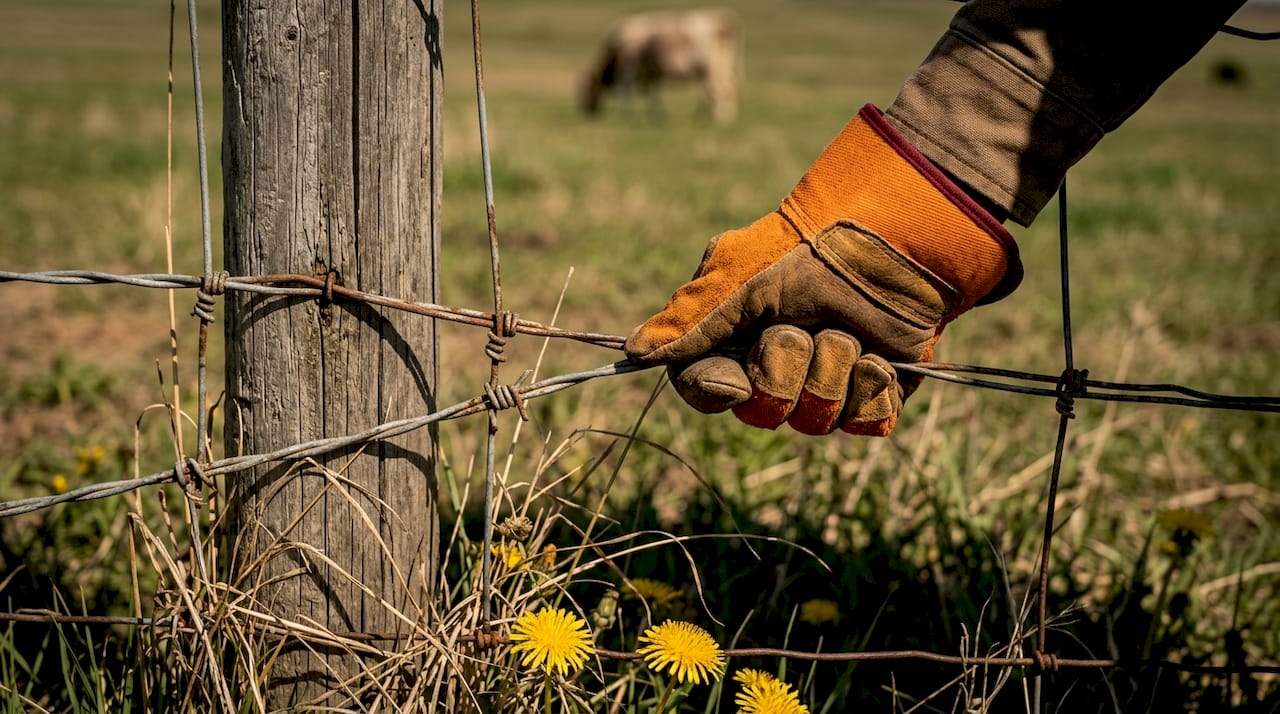
The type of animal you’re containing changes everything about fence design. A fence that legally and safely contains beef cattle will not necessarily meet the standards for horses, sheep, or poultry. Provincial codes recognize this, which is why requirements are written around animal type rather than a single universal standard.
In Saskatchewan, the Animal Production Act specifically mandates that fences must be appropriate to the animal type being contained, and it gives the minister authority to approve industry standards as official codes. That last point matters more than it might seem. It means the acceptable standard can change without a full legislative overhaul, so a fence design that was compliant three years ago might not meet current approved codes.
Here’s a general overview of how fence specifications tend to differ by species:
| Animal type | Minimum fence height | Common materials | Key considerations |
|---|---|---|---|
| Beef cattle | 1.2 m (4 ft) | Barbed wire, high-tensile, electric | Strand count and spacing matter |
| Horses | 1.4 m (4.5 ft) | Board rail, electric tape, woven wire | Safety from entanglement is critical |
| Sheep and goats | 1.0 to 1.2 m | Woven wire, electric netting | Predator resistance is a major factor |
| Pigs | 0.9 to 1.0 m | Welded wire, electric | Bottom strand must be close to ground |
| Poultry | 1.8 m or fully enclosed | Welded wire, hardware cloth | Overhead coverage often required |
These figures are general guides. Always verify with your provincial ministry before installing, because local codes can differ from the national norms listed here.
When reviewing fencing codes for livestock in your province, pay attention to both height requirements and strand or mesh spacing. A fence that’s tall enough but has gaps that allow a lamb to push through or a foal to catch a leg is still a liability.
For poultry specifically, requirements are often stricter because containment must also address aerial predators and disease biosecurity. Reviewing poultry fencing options early in your planning process can help you avoid under-building an enclosure that won’t pass a site inspection.
If you’re newer to livestock management, starting with animal fencing basics gives you a solid foundation before you work through the more specific provincial requirements.
Pro Tip: Before breaking ground on any new enclosure, call your provincial Ministry of Agriculture directly and ask for the current approved code for your specific animal type. This takes 20 minutes and can save you thousands in non-compliant rework.
The following items are worth confirming before installation for any species:
- Minimum and maximum strand or mesh spacing
- Approved energizer output if using electric fencing
- Required signage for electric fences near public areas
- Inspection or permit requirements in your municipality
- Any species-specific buffer zone requirements near water bodies
Government programs and funding for compliant fencing
Once you’ve nailed the livestock codes, it’s crucial to know how government grants and incentives can help you manage costs while staying compliant.
Building or upgrading fencing to meet provincial codes isn’t cheap. Depending on the scale of your operation, even a single perimeter fence project can run into tens of thousands of dollars. The good news is that Canadian farmers are not left to absorb all of that cost alone. Several provinces have structured programs that reimburse a significant portion of compliant fencing installations.
Manitoba stands out with one of the most direct reimbursement models available. Through the Sustainable Canadian Agricultural Partnership program, Manitoba offers up to 75% reimbursement for predator-resistant fencing installations. To qualify, you need to complete a livestock predation risk assessment and have a valid premises identification number registered with the province. These aren’t bureaucratic hurdles for their own sake; they help the program target funding to operations that genuinely face predator pressure, which makes the program more sustainable over time.
Key eligibility steps for Manitoba’s fencing reimbursement program:
- Register your premises and obtain a premises ID number
- Complete a predator risk assessment with a provincial wildlife officer or authorized assessor
- Submit a pre-approval application before beginning construction
- Use fencing materials and designs that meet program specifications
- Keep all receipts and contractor invoices for the reimbursement claim
- Submit your claim within the program’s specified deadline after completion
Other provinces offer their own versions of cost-sharing or rebate programs. Alberta, for example, has had programs through the Agricultural Sustainability Initiative that include riparian (riverbank and wetland) fencing. British Columbia has offered funding through the Beneficial Management Practices program for fencing that protects watercourses from livestock access.
For operations dealing with coyote or wolf predation, predator control fencing solutions like electrified netting or LGD-compatible perimeter systems may qualify for enhanced reimbursement rates in certain provinces. It’s worth asking specifically about predator-resistant configurations when you apply.
If your grazing operation uses rotational systems or moves livestock seasonally, portable fencing guidance can help you figure out what configurations are eligible under temporary versus permanent installation rules. Some programs only reimburse permanent fencing, so knowing the distinction before you buy is critical.
Pro Tip: Apply at the start of the fiscal year. Most provincial agricultural funding programs run on annual budgets, and popular programs like Manitoba’s predator fencing reimbursement can be fully subscribed before mid-year. Early applicants get first access to available funds.
Practical steps to ensure fencing compliance on your farm
With funding and regulations covered, let’s get practical about what you actually need to do to stay compliant.
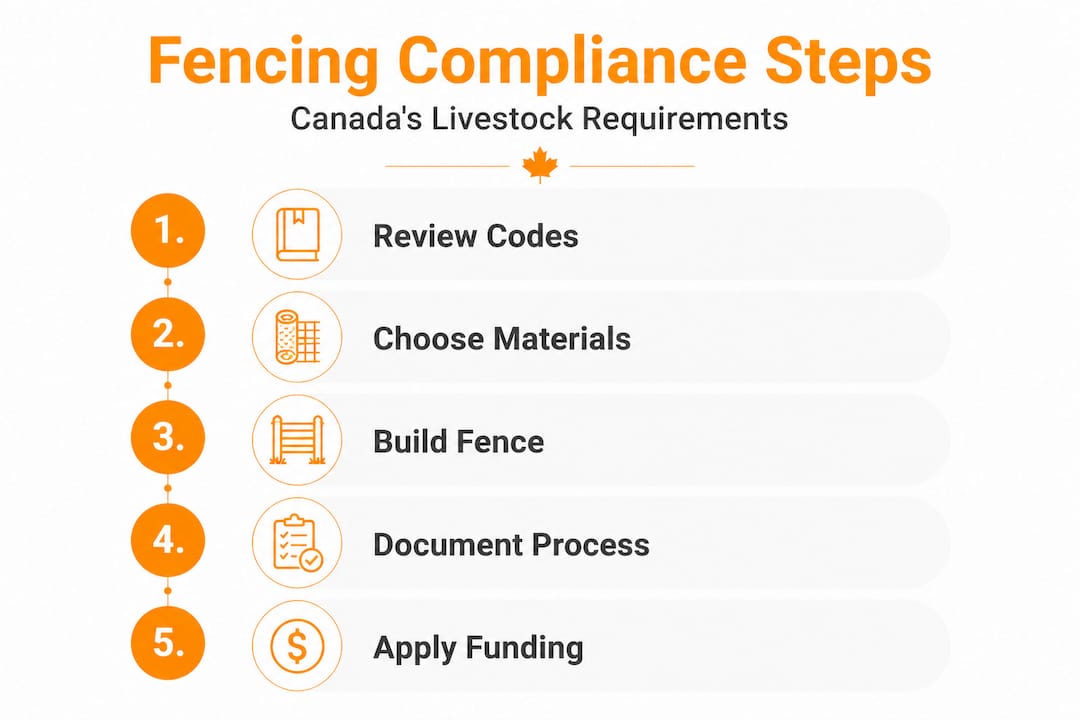
Knowing the rules is necessary, but it’s execution that protects you legally and financially. Here is a clear sequence of steps that will help you build or upgrade fencing the right way from start to finish.
-
Map your boundaries. Start with a current survey of your property lines. Do not assume old fence lines are in the right place. Boundary disputes that emerge after you’ve built a new fence are expensive to resolve, and courts generally favor documented surveys over historical assumptions.
-
Send written notice to neighbors. In Ontario, the Line Fences Act requires written notice at least 30 days before starting boundary fence work. Even in provinces without a strict statutory requirement, written notice protects you and keeps the relationship professional. Send it by registered mail and keep the receipt.
-
Verify provincial codes for your livestock type. Use the table in the previous section as a starting point, then confirm the current approved standard with your provincial ministry. Ask specifically about any code updates that have occurred in the last two years, since minister-approved standards can change without public fanfare.
-
Research applicable funding programs. Contact your provincial agricultural office, Agri-Service BC, or equivalent body and ask what cost-sharing programs apply to your installation type. Get the eligibility checklist in writing and confirm whether pre-approval is required before you begin.
-
Hire or consult a qualified contractor. Some programs require that installation be done by a certified or approved contractor. Even when it’s not required, a contractor who knows provincial codes can save you from specification errors that would void a funding claim.
-
Document everything during construction. Photograph each stage, keep material receipts, and note any deviations from the original plan along with how they were resolved. This is your evidence file if a funding auditor or neighbor dispute arises.
-
Schedule annual fence inspections. A fence that was compliant on installation day can deteriorate to a non-compliant state within a few seasons. Damaged posts, sagging wire, and failed insulators are all common findings. Build a spring and fall inspection into your farm calendar.
For step-by-step guidance specific to Canadian conditions, reviewing fence installation steps can help you plan your project with compliance built in from the beginning rather than patched on at the end.
What most farmers miss about fencing regulations
After working with producers across the country, a pattern emerges in where things go wrong, and it’s almost never about the fence itself.
The fence is usually fine. What trips farmers up is the paperwork, and more specifically, the assumption that the paperwork doesn’t matter until it suddenly does. A funding claim gets denied because a pre-approval form wasn’t submitted before construction started. A boundary dispute escalates because there’s no written record of the original cost-sharing agreement. A predator loss insurance claim gets complicated because the fence inspection records are incomplete. These are not rare edge cases. They happen every season.
The other major blind spot is treating provincial regulations as static. Farmers who installed fencing five or ten years ago and haven’t reviewed their provincial code since then are potentially operating non-compliant enclosures without knowing it. In Saskatchewan especially, where the Animal Production Act gives the minister broad authority to update approved standards, the code you built to may no longer be the code you need to meet. A quick annual review of your provincial ministry’s website costs nothing and takes less than an hour.
The third issue is simply not knowing what programs exist. Manitoba’s 75% reimbursement program is a strong example of a benefit that many eligible farmers in that province never access, purely because they didn’t know it was available or missed the application window. Provincial programs come and go, and the ones that stick around tend to be underpromoted. Staying connected with your local Ag office or commodity organization gives you early notice when new funding opens.
Reviewing the broader landscape of livestock fencing compliance across provinces once a year is a habit that pays off. Think of it like reviewing your input contracts. The details change, and staying current protects your margins.
Find the right fencing solutions for your Canadian farm
Navigating Canada’s fencing regulations takes more than just good intentions. It takes the right products installed correctly, documentation kept in order, and a supplier who understands what Canadian producers actually deal with.
At FenceFast, we’ve spent over 26 years helping Canadian farmers and ranchers source fencing that meets provincial codes, qualifies for funding programs, and holds up in real Canadian conditions. From high-tensile wire and electric energizers to Gallagher eShepherd virtual fencing systems that open new doors for rotational grazing and remote herd management, our product catalog is built around what works on working farms. Our team can help you match your fence design to your livestock type, confirm whether your setup qualifies for grants like Manitoba’s predator fencing reimbursement, and get your order shipped across Canada fast. When compliance and durability both matter, having a knowledgeable supplier in your corner makes a real difference.
Frequently asked questions
Do I need to notify my neighbor before building a boundary fence?
In Ontario, 30-day written notice is legally required before boundary fence work begins; other provinces may have similar notice requirements under their own legislation or municipal bylaws.
What types of livestock fencing are legally required in Saskatchewan?
Fences must be appropriate to animal type and must comply with codes or industry standards formally approved by the provincial minister, which can be updated without full legislative changes.
How can I get reimbursed for building predator-resistant fencing?
In Manitoba, you can receive up to 75% reimbursement by submitting a completed predator risk assessment and a valid premises ID number as part of your pre-approved application.
What documents should I keep to prove fencing compliance?
Keep written neighbor notices, signed cost-sharing agreements, funding pre-approval letters, material receipts, contractor invoices, inspection records, and photographs taken during each phase of construction.

