

TL;DR:
- A safe horse pasture depends on consistent management of fencing, grazing, footing, drainage, manure, and hazard inspections. Regular walk-throughs and timely repairs prevent injuries from hidden ground and fence hazards, supporting long-term horse health. Proper planning and routine oversight are essential to maintaining a hazard-free environment for horses.
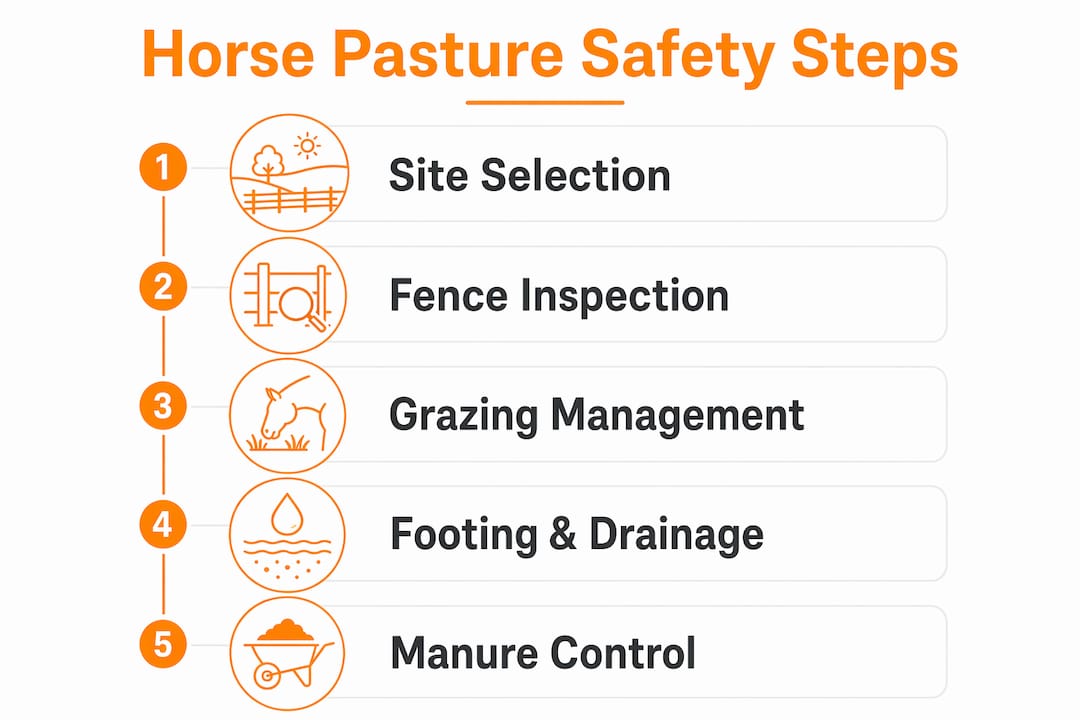
A safe horse pasture comes down to six things done consistently: choosing the right site and space, installing horse-appropriate fencing, managing grazing pressure, maintaining safe footing and drainage, controlling manure and parasites, and running a regular inspection routine with emergency prep in place.
Do this today:
- Walk your entire fenceline at horse eye and hoof level, looking for protruding bolts, sagging tape, and loose posts.
- Check every gate latch, water trough, and low spot for standing water or mud accumulation.
According to the Merck Veterinary Manual, ample turnout on quality pasture reduces boredom-related behaviors, lowers the risk of intestinal impactions, and helps prevent gastric ulcers. Getting the pasture right is not just about preventing injuries — it directly supports your horse’s long-term health.
Table of Contents
- 1. How to choose and plan your pasture site
- 2. Safe fencing types, gates, and what to inspect monthly
- 3. Stocking rates, rotational grazing, and the sacrifice paddock
- 4. Footing, drainage, and removing ground hazards
- 5. Manure management and parasite control basics
- 6. Toxic plants and tree hazards to remove now
- 7. Safe water sources and shelter placement
- 8. Your daily, weekly, and seasonal inspection schedule
- 9. Emergency preparedness: loose horses, first aid, and security
- Key Takeaways
- The pasture problems most owners overlook
- When your fencing setup needs an upgrade
- Authoritative resources and further reading
1. How to choose and plan your pasture site
The best pasture sites share a few non-negotiable traits: good natural drainage, gentle slope (2–5% is ideal for runoff without erosion), no proximity to busy roads without a solid buffer fence, and clear distance from chemical storage, old machinery, or dumped debris.
Acreage guidance: A commonly cited rule of thumb from university extension services is: an appropriate acre per horse depends on pasture quality and local conditions; poorer quality or stressed pastures require more space per horse. Overstocking is the single fastest way to turn a pasture into a mud lot, and OSU Extension notes that horse pastures tend to be overstocked more than any other livestock operation.
When your total acreage cannot support continuous grazing, a sacrifice paddock (dry lot) fills the gap. Keep horses there during wet weather, during pasture rest periods, and any time forage is too short or too lush for safe grazing. Size it for comfort but not so large that it becomes a second pasture. A gravel or wood-chip footing in the sacrifice area prevents mud buildup and reduces sand ingestion.
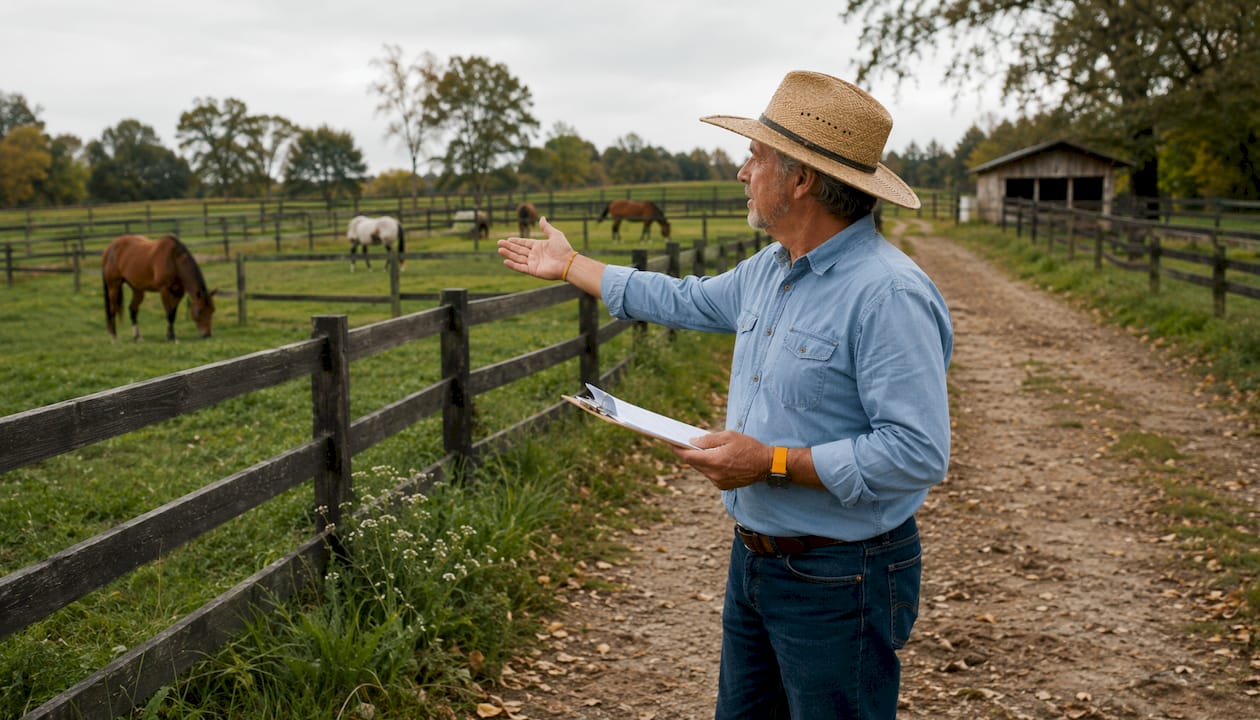
Pro Tip: Before you finalize a pasture layout, walk the entire perimeter crouching at horse shoulder height. You will spot sagging wire, low-hanging branches, and fence gaps that are invisible when you are standing upright.
| Pasture Condition | Recommended Acres per Horse |
|---|---|
| High-quality, well-managed pasture | 2 acres |
| Average pasture with moderate weed pressure | 2 acres |
| Poor or drought-stressed pasture | 3+ acres |
| Sacrifice paddock / dry lot (no grazing) | 0.1 acres |
2. Safe fencing types, gates, and what to inspect monthly
Barbed wire has no place in a horse enclosure. Horses move fast when spooked, and barbed wire causes deep lacerations that can end a horse’s career or life. The safe fencing options that consistently perform well for horses are post-and-rail (wood or synthetic), high-visibility coated wire or tape on electric systems, and small-mesh stock panels for high-risk zones like gate approaches.
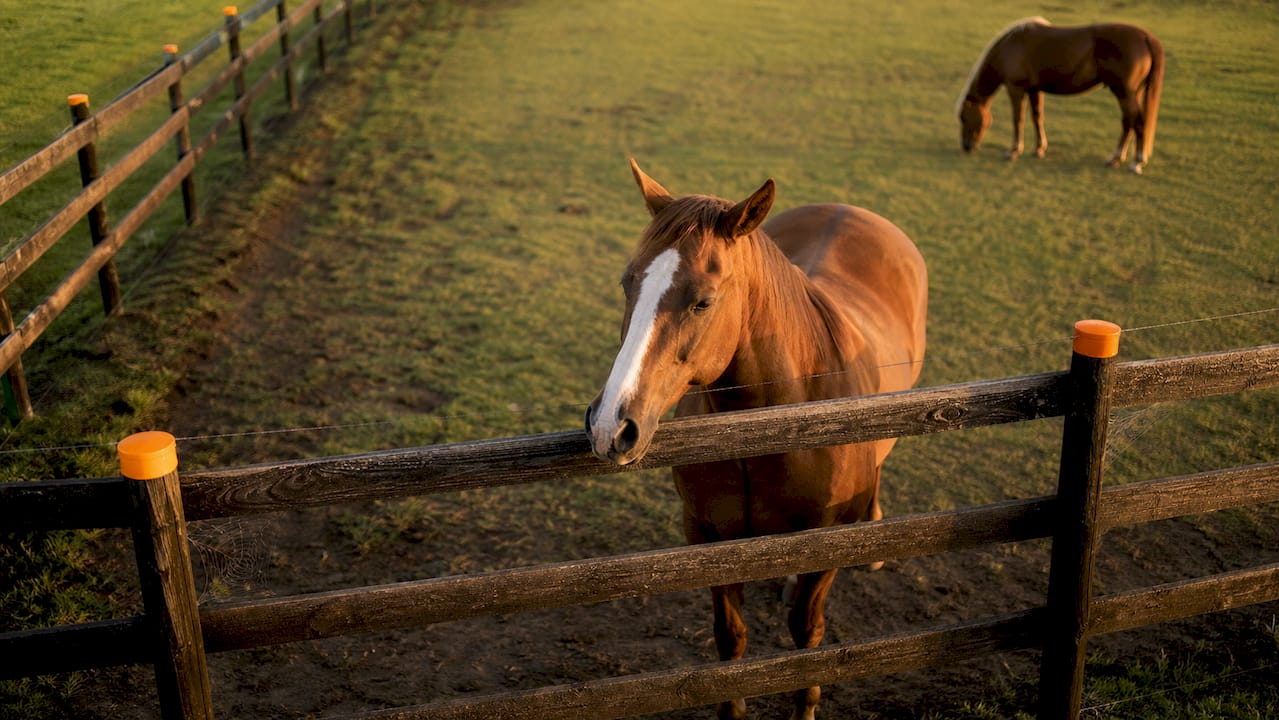
Fences for horses should be sufficiently tall to prevent escapes, with higher fences advisable for stallions and fence-testers.
Fence type comparison:
| Fence Type | Visibility | Entanglement Risk | Maintenance Level | Best Use |
|---|---|---|---|---|
| Post-and-rail (wood) | High | Low | Medium | Perimeter, paddock borders |
| High-visibility synthetic rail | High | Low | Low | Perimeter, high-traffic areas |
| Electric tape/rope combinations | Medium | Low (if tensioned) | Medium | Internal subdivisions, rotational cells |
| Small-mesh stock panel | Medium | Low | Low | Gate approaches, foal areas |
| Woven wire (no-climb) | Medium | Low | Medium | Perimeter with top rail |
| Barbed wire | Low | Very High | Low | Not appropriate for horses |
Fence visibility and entanglement prevention are the two factors that matter most for horse safety. T-post caps are not optional — an uncapped T-post at chest height is an impalement hazard if a horse falls or is pushed into it.
Gate hazards are underestimated. Gates are the most common injury site in horse enclosures. A hoof slipped between lower gate rungs can trap a horse and cause a catastrophic fracture. Adding small-mesh netting or a solid panel to the lower half of any gate is an inexpensive fix with a high safety payoff. Use hinges that cannot be lifted off their pins, and choose latches a horse cannot nudge open but a person can operate with one hand.
Monthly fence inspection checklist:
- Check all post bases for rot, heaving, or lean
- Test wire/tape tension along every run
- Confirm T-post caps are seated
- Inspect gate hinges and latches for wear or looseness
- Look for fallen branches on fence lines after storms
- Check electric fence voltage with a tester (minimum 3,000 volts for horses)
Pro Tip: Walk the fenceline at horse hoof level once a month. Protruding bolt ends, sagging bottom wires, and small gaps in mesh are invisible from standing height but obvious when you crouch down.
3. Stocking rates, rotational grazing, and the sacrifice paddock
Rotational grazing is the most cost-effective tool for maintaining pasture productivity and reducing equine pasture hazards from overgrazing. The concept is simple: divide your total pasture into two or more paddocks, graze one while the others rest, and rotate horses through on a schedule tied to forage regrowth.
UMN Extension recommends rest periods that allow paddocks to recover before horses return. For cool-season grasses, that typically means 21–30 days of rest between grazing events. Bermudagrass rotations should maintain a minimum of 2 inches of grass in each cell. The practical result is more total forage, less bare ground, and fewer weeds.
The USDA NRCS notes that rotational grazing systems allow livestock to utilize 50–70% of available pasture, compared to roughly 30–50% under continuous grazing. That difference directly affects how many horses a given acreage can support safely.
When to use the sacrifice paddock: Move horses to the dry lot when pasture forage is short, soil conditions are poor, or when lush new growth could risk laminitis in susceptible horses. UMN Extension identifies the sacrifice paddock as an active metabolic management tool, not just a muddy holding pen.
Pro Tip: For laminitis-prone horses, limit spring turnout to 30 minutes once or twice a day for the first few days, then gradually extend access over two weeks as you monitor their response.
| Scenario | Recommended Approach |
|---|---|
| 2 horses on 4 acres, good pasture | Two-paddock rotation, 21–30 day rest |
| 3 horses on 4 acres, average pasture | Three-paddock rotation, 21–30 day rest |
| 4+ horses on 4 acres | Sacrifice paddock required; limit turnout time |
| Laminitis-prone horse | Dry lot base; timed turnout on short grass only |
4. Footing, drainage, and removing ground hazards
Well-drained, even footing reduces slips, soft tissue injuries, and the respiratory dust exposure that comes with dry, cracked ground. The trouble spots are predictable: gate approaches, water trough surrounds, low-lying corners, and anywhere horses congregate and churn the ground.
Common fixes by problem area:
- Gate approaches: Install a 4–6 inch compacted gravel pad extending at least 10 feet into the paddock. This is the single highest-return drainage investment on most properties.
- Water trough surrounds: Same gravel treatment. Standing water around a trough breeds bacteria and creates a slip hazard.
- Low spots and seasonal wet areas: French drains (perforated pipe in a gravel trench) redirect subsurface water. For severe cases, a raised approach with compacted fill and geotextile fabric underneath prevents future sinking.
- Holes and buried debris: Walk every paddock on foot after the ground thaws in spring and after any significant erosion event. Probe soft spots with a fence post. Rocks that surface after frost heave need to be pulled before they cause a hoof bruise or a stumble.
For large-scale grading or drainage work, renting a skid steer or calling a contractor is faster and safer than trying to hand-shovel a problem that covers hundreds of square feet.
Pro Tip: Before winter sets in, grade and gravel any muddy high-traffic zone. Frozen mud is worse than wet mud — it sets into uneven ruts that horses have to navigate in the dark.
5. Manure management and parasite control basics
Regular manure removal lowers parasite pressure, reduces fly populations, and keeps horses grazing more of the available pasture. Horses are selective grazers and will avoid “roughs” (areas near manure piles) even when forage elsewhere is depleted, so manure buildup directly shrinks your effective grazing area.
Dragging pastures a few times per year breaks up manure piles, distributes nutrients more evenly, and exposes parasite eggs to drying and UV light, which reduces larval survival. Timing matters: drag during warm, dry weather (late spring and summer) for maximum parasite egg desiccation. Avoid dragging in cool, wet conditions — you will spread viable larvae across the pasture instead of killing them.
The Merck Veterinary Manual notes that manure removal frequency should be scaled to pasture size and use. In smaller or heavily used areas, remove manure frequently; in larger rotational pastures, pasture dragging a few times annually during warm, dry weather is recommended.
Pro Tip: In a sacrifice paddock or small dry lot, daily or every-other-day manure removal is worth the effort. Sand accumulation from manure-contaminated footing is a leading cause of sand colic in horses kept on sandy soils.
| Practice | Recommended Frequency | Notes |
|---|---|---|
| Manure removal (small paddock/sacrifice area) | 2–3 times per week | Reduces flies, sand ingestion, parasite load |
| Manure removal (multi-acre pasture) | As needed / after rotation | Focus on heavy-use areas |
| Pasture dragging | 2–4 times per year | Warm, dry weather only |
| Soil testing | Every 2–3 years | Guides fertilizer and pH management |
| Fecal egg count testing (horses) | 2 times per year minimum | Work with your veterinarian |
6. Toxic plants and tree hazards to remove now
Some of the most dangerous plants in U.S. pastures are trees and shrubs that owners walk past every day without recognizing the risk. The following are the highest-priority plants to fence out or remove:
- Red maple (Acer rubrum): Wilted or frost-damaged leaves cause severe hemolytic anemia. Even a small amount can be fatal. Fence horses away from any maple tree where leaves can fall into the paddock.
- Black walnut (Juglans nigra): Shavings are the most common exposure route, but ingestion of bark, leaves, or nuts causes laminitis. Remove trees from pasture perimeters or fence them out with a buffer zone.
- Wild cherry / chokecherry (Prunus spp.): Wilted leaves release cyanide. Fence out all Prunus species, especially after storms that break branches.
- Yew (Taxus spp.): Extremely toxic in tiny amounts. All parts, including clippings, are dangerous. Never plant yew near horse areas.
- Oleander (Nerium oleander): Common in the South and Southwest. Cardiac toxin; a few leaves can kill a horse.
- Bracken fern (Pteridium aquilinum): Causes thiamine deficiency with chronic ingestion. Common in the Pacific Northwest and Southeast.
- Johnsongrass / Sudan grass: Can produce prussic acid (cyanide) under stress conditions (drought, frost). Common in the South and Midwest.
UMN Extension specifically flags maple leaves after frost and certain Prunus species as acute toxicity risks that require fencing out, not just monitoring.
For tree hazards beyond toxicity, inspect mature trees along fencelines and shelter areas annually. Dead branches over 2 inches in diameter that hang over horse areas need to come down. Never site a run-in shed directly under a large tree — falling limbs during storms are a real risk.
Contact your county extension office for a region-specific toxic plant list. What grows in Florida is different from what threatens horses in Montana.
7. Safe water sources and shelter placement
Clean, reliable water is not negotiable. The direct recommendation: automatic waterers or regularly cleaned troughs are safer than unfenced ponds or open streams. Natural water sources carry risks that are easy to underestimate — bank erosion creates boggy footing, stagnant water can harbor cyanotoxins from algae blooms, and shared water points concentrate manure and disease vectors.
Fencing off natural water sources and providing a trough with controlled access is the standard recommendation from field practitioners. Clean troughs at least weekly in warm weather; algae growth accelerates dramatically above 70°F. Trough placement matters too: position it away from fence corners (where horses crowd and kick) and on a gravel pad to prevent mud.
Shelter guidance: A run-in shed should provide a minimum of 100–150 square feet per horse. Place it on the highest, driest ground in the paddock with the opening facing away from prevailing winds. Leave at least 12 feet of clearance between the shed opening and the nearest fence line — a horse trapped between a shed wall and a fence has no escape route if another horse crowds it.
Pro Tip: If you use electric tank heaters in winter, have an electrician check the grounding annually. Stray voltage in water troughs causes horses to stop drinking, which leads to impaction colic — a problem that is easy to miss until it is serious.
8. Your daily, weekly, and seasonal inspection schedule
A consistent inspection routine catches problems before they cause injuries. The framework below is adapted from field-practitioner guidance and university extension recommendations.
Daily checks (5 minutes):
- Confirm all horses are present and moving normally
- Check water supply and trough cleanliness
- Scan fence perimeter for obvious breaks or downed sections
- Look for loose boards, protruding hardware, or trapped limbs near shelters
Weekly checks (20–30 minutes):
- Walk the full fenceline at horse level; test electric fence voltage
- Remove manure from high-traffic areas and sacrifice paddock
- Check gate hinges, latches, and lower mesh for damage
- Inspect footing at gate approaches and water points for mud or ruts
- Look for new plant growth in toxic-species areas
Monthly and seasonal tasks:
- Test all fence post bases for rot or heave (monthly in spring/fall)
- Replace any missing T-post caps
- Drag pastures during warm, dry weather (2–4 times per year)
- Soil test every 2–3 years; fertilize according to results
- Mow pastures to 3–4 inches to prevent overgrazing and maintain forage quality
- Overseed bare patches in early fall or early spring depending on your grass species
- Inspect run-in shed roof and walls before winter
A fenceline walk at horse eye level reveals protruding bolts, sagging tape, and hidden protrusions that are common entanglement causes — and nearly invisible from standing height.
Maintenance log template (copy and use):
Pro Tip: Set a recurring phone reminder for your monthly fenceline walk. It takes 20 minutes and catches the slow-developing problems — a post that has been leaning a little more each week, a wire that has been losing tension since the last freeze — before they become emergencies.
9. Emergency preparedness: loose horses, first aid, and security
When a horse gets loose, the priority is safety for the horse and the people involved. Do not chase. Move calmly, use a familiar bucket of grain or a lead rope held loosely, and position helpers to guide the horse toward a gate rather than corner it. Panicked horses near roads are the highest-risk scenario — have a plan for blocking traffic before you need it.
First-aid checklist for common pasture injuries:
- Wire cuts and lacerations: Apply direct pressure, keep the wound clean, and call your veterinarian for any wound near a joint, tendon sheath, or hoof. These are emergencies, not wait-and-see situations.
- Wire entanglement: Stay calm, keep the horse as still as possible, and cut the wire away from the horse rather than trying to unwind it. Keep wire cutters in your barn kit.
- Suspected laminitis: Remove the horse from pasture immediately, provide deep bedding, and call your veterinarian. Do not wait for the classic “sawhorse stance” to develop.
Security measures: A perimeter alarm or camera system adds a meaningful layer of protection, especially for properties near roads or in areas with horse theft risk. The Gallagher i-Series Alarm is designed for electrified perimeters and alerts you to fence faults or breaches in real time. Redundant fencing near road frontage — a secondary electric line inside the perimeter fence — gives a horse a second barrier if the outer fence fails.
Pro Tip: Run a loose-horse drill with anyone who helps on your property. Walk through the steps: who blocks the gate, who calls the vet, who handles traffic. Doing it once in a calm moment means everyone knows their role when it counts.
Key Takeaways
A safe horse pasture requires consistent attention to six priorities: site and space, fencing, grazing management, footing and drainage, manure and parasite control, and a regular inspection routine with emergency prep.
| Point | Details |
|---|---|
| Space and site selection | Plan for 2 acres per horse on good pasture; use a sacrifice paddock when forage is short or lush. |
| Fencing fundamentals | Avoid barbed wire; use post-and-rail or high-visibility electric combinations; cap all T-posts and add small-mesh to gate lower halves. |
| Rotational grazing | Divide pasture into two or more paddocks and allow 21–30 days of rest between grazing events to maintain forage and reduce hazards. |
| Inspection routine | Walk the fenceline at horse level daily and weekly; drag pastures 2–4 times per year during warm, dry weather. |
| Fencefast fencing supplies | Fencefast carries electric energizers, perimeter alarms, and fencing tools suited to horse pasture setups across the U.S. |
The pasture problems most owners overlook
The conventional wisdom on horse pasture safety focuses heavily on fencing, and fencing matters. But in practice, the injuries that happen most often are not from fence failures — they are from the slow-developing hazards that owners stop seeing because they walk past them every day.
A gate approach that has been muddy since March. A maple tree that drops leaves into the paddock every fall. A water trough that has not been scrubbed since summer. A T-post that lost its cap six months ago. None of these look like emergencies. All of them cause injuries.
The inspection schedule in this guide is not bureaucratic box-checking. It is the mechanism that keeps familiar hazards visible. The owners who avoid serious pasture injuries are not the ones with the most expensive fencing — they are the ones who walk their property with fresh eyes on a schedule, fix small problems before they compound, and have a plan ready for the one time something goes wrong at 11 PM.
Fencefast’s pasture management resources are worth bookmarking for ongoing guidance on fencing, rotational grazing layouts, and equipment selection.
When your fencing setup needs an upgrade
If you have had repeated fence failures, a high-value horse near a road, or a property where horses share space with other livestock, the cost of a fence problem is higher than the cost of getting the setup right the first time.
Fencefast carries the fencing components, energizers, and tools that horse owners actually need for safe pasture setups. The Gallagher Live Lite energizer is a strong choice for smaller paddocks and rotational grazing subdivisions, delivering reliable voltage without overcomplicating the system. For perimeter security near roads or in high-risk areas, the Gallagher i-Series Alarm sends real-time alerts when fence voltage drops or a breach occurs. Fencefast also offers design consulting for owners who want a second set of eyes on their layout before they start installing posts. Browse the full range of horse fencing options or reach out directly for product recommendations tailored to your property.
Authoritative resources and further reading
- UMN Extension: Managing Established Horse Pastures — Practical guidance on rotational grazing, mowing heights, soil testing, and sacrifice paddock use. The most useful single extension resource for U.S. horse owners.
- Merck Veterinary Manual: Pasture for Horses — Veterinary-sourced guidance on turnout benefits, manure management frequency, and health risks from poor pasture conditions.
- Stable Management: Make Your Pasture Safer for Your Horse — Field-practitioner checklist covering gate hazards, fenceline inspection technique, and water source safety.
- OSU Extension: Managing Grazing of Horses (AFS-3981) — Detailed guidance on horse grazing behavior, stocking rates, and controlled grazing systems for small acreages.
- USDA NRCS: Managing Your Pasture — Concise comparison of continuous vs. rotational grazing with forage utilization data; includes contact information for free NRCS conservation planning assistance.
- Equus / My New Horse: How to Do a Horse Pasture Safety Check — Practical fenceline inspection walkthrough with specific attention to horse-level hazards.
- Your county extension office — For region-specific toxic plant lists, soil testing services, and local forage recommendations. Find your local office at extension.org.
- Your veterinarian — For fecal egg count testing schedules, laminitis risk assessment, and emergency preparedness planning specific to your horses.
This article is general information for educational purposes. Confirm current recommendations with your veterinarian, county extension agent, or a qualified equine professional for decisions specific to your horses and property.

