

TL;DR:
- A centrally located, safety-focused, modular corral with curved flow paths and galvanized steel panels offers the most effective livestock handling solution.
- Design decisions around site access, animal flow, and durable materials directly impact safety, efficiency, and long-term durability.
A safety-first, centrally sited, modular corral that funnels livestock through curved, solid-sided flow paths is the single most effective design you can build. Get that right, and everything else, from labor time to injury rates, improves downstream.
Three decisions drive every other corral design consideration:
- Site access and drainage: Place the corral where animals already move (near water, feed, or rotation lanes) and where an all-weather road reaches it year-round.
- Animal flow: Curved crowding tubs and single-file working chutes reduce balking and keep handlers out of harm’s way.
- Durable materials in high-traffic zones: Heavy-gauge, hot-dipped galvanized steel panels in working pens and alleys outlast everything else at a comparable price point.
Plan 35–45 sq ft per cow–calf pair in holding pens as your initial sizing baseline. Scale up for bulls or exotic breeds.
Pro Tip: Sketch your site before calling a contractor. A simple hand-drawn map showing the corral’s relationship to pasture gates, water, and road access will cut your first contractor meeting from two hours to thirty minutes.
Table of Contents
- What should your corral design checklist include?
- Where should you locate and orient a corral?
- How do you design for smooth animal flow?
- What gate types and latches work best?
- Which materials work best for corral panels and fencing?
- What are the right dimensions for pens, alleys, and chutes?
- How do you keep handlers and animals safe?
- What does a corral build cost and how long does it last?
- Permits, biosecurity, and where to find local help
- Key Takeaways
- The design mistake most ranchers make too late
- Fencefast has the panels, gates, and expertise to get you started
- Useful sources
What should your corral design checklist include?
Use this list to scope a build or request contractor quotes:
Site:
- Central to your pasture rotation, per Noble Research Institute guidance
- All-weather road access with trailer turnaround room
- Gentle slope (2–4%) for drainage away from working areas
- Proximity to water and feed delivery points
Core components to request:
- Circular or semicircular crowding tub with solid sides and a movable crowding gate
- Curved working chute, minimum 20 ft long
- Squeeze chute or headgate at the chute exit
- Loading chute with curved approach
- At least three holding pens (plan one more than you think you need)
- Solid-sided panels in the crowding pen and working chute
Materials and safety:
- Hot-dipped galvanized steel, G90 rating preferred
- Round tubing, no protruding bolts or sharp weld slag
- Heavy gates with slam latches and 270° swing capability
- Modular panel options for phased expansion
Pro Tip: Request a biosecurity isolation pen in your quote from the start. Adding it later costs significantly more than pouring one concrete pad during initial site prep.
Where should you locate and orient a corral?
Placement is the decision that pays dividends every single working day. The Noble Research Institute specifically recommends locating corrals where cattle must routinely walk through them to access water or supplemental feed. That one principle can eliminate most of your mustering labor.
For rotational grazing systems, a central position within the rotation means shorter drives from any paddock. Pair that with natural funnels formed by existing fencelines and you have a facility animals practically walk into on their own.
Practical layout tips:
- Keep high-value pens away from public road frontage to reduce theft exposure.
- Grade the loading and backing area so trailers approach at a shallow angle; steep grades make backing dangerous and slow.
- Run conduit for water, electricity, and future virtual-fencing controllers during initial construction. Retrofitting buried conduit later is expensive.
- Plan covered working areas if your operation runs cattle in extreme heat or cold; a simple roof over the squeeze chute pays for itself in handler comfort and animal compliance.
How do you design for smooth animal flow?
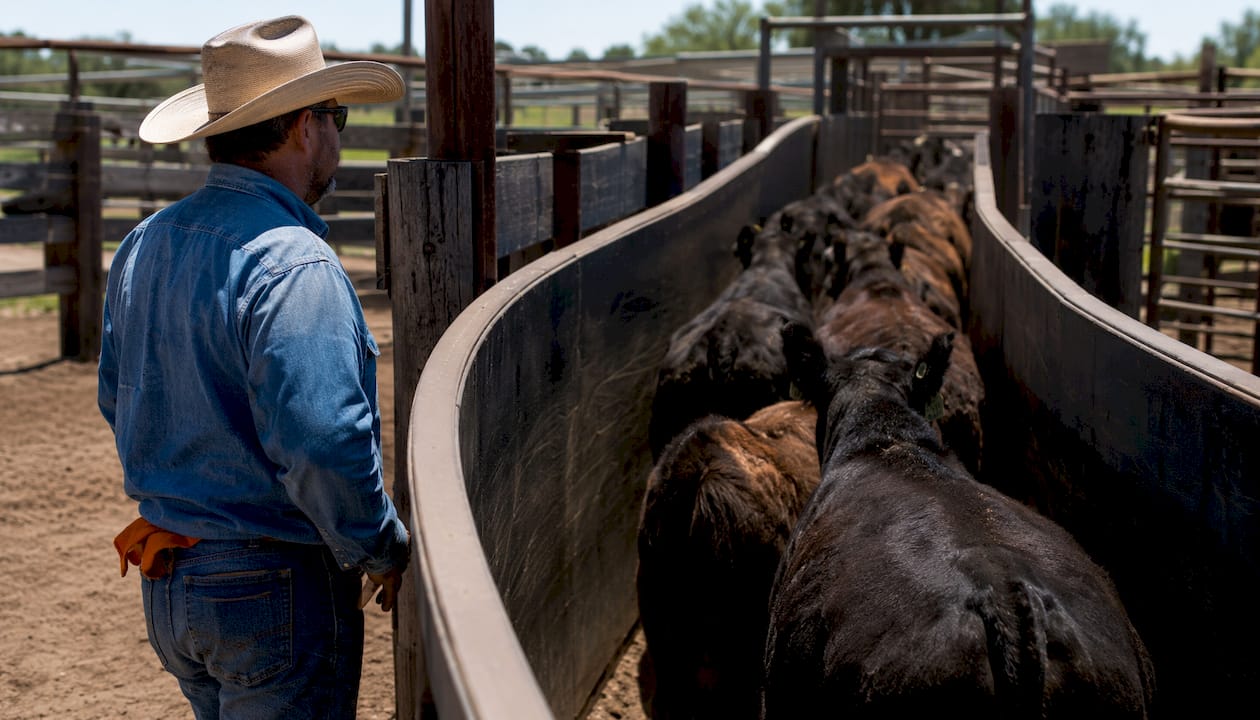
Animal behavior, not human convenience, should drive every dimension here. Curved, solid-sided working chutes restrict cattle vision so they cannot see the handler or the chute exit until the last moment, which dramatically reduces balking and backing.
| Component | Key dimension | Design note |
|---|---|---|
| Collection alley | 10–16 ft wide | Allows small groups to move without crowding |
| Crowding pen | 6–12 sq ft per head | Circular or funnel-shaped; solid sides; concrete floor |
| Working chute | Min. 20 ft long | Curved or 15° bend; sloped sides preferred for mixed sizes |
| Single-file lane | 18–26 in. wide | Adjust by animal size; wider for exotics |
| Loading chute | 26 in. wide | Curved approach; telescoping or adjustable sides |
Additional flow design points:
- A quarter-circle crowding pen with a 12-ft swinging gate handles up to 8 mature cows; scale up to half-circle or three-quarter circle for larger operations.
- Place a catwalk along the outside of the working chute, roughly 18 in. above ground, so handlers can vaccinate or treat without leaning over the rail.
- Include adjacent sorting pens directly off the crowding tub for quick separation after working. Two small sort pens beat one large one for flexibility.
- The loading chute approach should curve so animals cannot see the trailer until they are nearly inside it.
For a deeper look at cattle handling systems, the component relationships matter as much as any single dimension.
What gate types and latches work best?
Gates are the highest-wear point in any corral. A heavy gate that sags, sticks, or requires two hands to latch under pressure is a safety problem, not just an inconvenience.
- Use slam-style latches on all high-traffic gates so one hand closes and secures the gate in a single motion.
- Specify 270° gate swing capability wherever layout requires reversing traffic flow or sorting in multiple directions.
- Install man-gates (18-in. gap minimum for a person, too narrow for livestock) at strategic points so handlers can exit without opening a full panel gate.
- Avoid chains as primary latches on working gates; they slow you down when animals are moving and fail under repeated stress.
- Use headers on gate posts to prevent sag and maintain clearance for equipment to pass under when needed.
Pro Tip: Anchor gate posts with concrete collars even when using modular panels. A gate post that shifts even half an inch throws off latch alignment and turns a 10-second task into a wrestling match.
Which materials work best for corral panels and fencing?
Hot-dipped galvanized, heavy-gauge steel panels are the right call for working pens and high-traffic areas. Look for G90 galvanization, which seals welds and provides meaningful corrosion resistance in typical U.S. ranch conditions. Run a hand over the welds before purchasing; quality panels are ground smooth at the factory to prevent hide tears and infection risk.
- Prefer round tubing over square in animal contact zones; round profiles have no corners to catch legs or tack.
- Use 1-3/4 in. to 2 in. diameter rails in working pens; go to 5–6 rails for excitable animals or horses.
- Horse corrals require perimeter fencing 5–6 ft high and materials free of sharp edges or chewable surfaces.
- Modular portable panels with J-legs or chain connectors allow phased expansion without a full rebuild. Use concrete pads or packed base under panel anchors in muddy areas.
- Route conduit and reserve layout space for virtual-fencing controllers and temporary energizers now. Fencefast’s 26-year Gallagher partnership means practical advice on making a corral virtual-fencing ready is available before you pour a single footing.
Pro Tip: Buy one extra panel per run when ordering. Panel dimensions vary slightly between production batches, and a spare from the same batch saves a matching headache during future repairs.
What are the right dimensions for pens, alleys, and chutes?
| Space | Cattle (standard) | Horses | Sheep/small stock |
|---|---|---|---|
| Holding pen (sq ft/head) | 35–45 (cow–calf pair) | — | 8–12 per head |
| Single-file chute width | 18–26 in. | N/A | 12–16 in. |
| Collection alley width | 10–16 ft | 12 ft | 6–10 ft |
| Perimeter fence height | 5 ft minimum | 5–6 ft | 4–5 ft |
Sizing notes:
- Increase holding pen space for larger exotic breeds or bulls; the 35–45 sq ft baseline suits standard cow–calf pairs.
- A working chute must be at least 20 ft long to hold 3–4 cattle in sequence without crowding back into the crowding pen.
- Plan at least three holding pens and budget for one more than you think you need. The Noble Research Institute recommends a minimum of three: one large holding pen, one for calves, one for cows.
- Species-specific fence height standards matter; horses and cattle have meaningfully different containment requirements.
How do you keep handlers and animals safe?
Safety is the primary design driver, full stop. Oklahoma State University Extension identifies protruding hardware, inadequate latches, and poor escape routes as the leading causes of handler injury in cattle facilities.
- Grind all welds smooth; inspect panels for burrs before installation.
- Build handler escape routes into every working area: a man-gate or a rail gap wide enough to roll through but too narrow for cattle.
- Footing is the most overlooked element. Concrete with a rough finish in crowding pens and working chutes provides an all-weather surface and aids sanitation. Packed gravel or reject lime works in less critical zones.
- Provide adequate lighting for night work. Loading areas especially need non-slip surfaces and enough illumination to see latch positions clearly.
- For horses specifically, eliminate all blind corners and pad any sharp structural edges within reach.
A detailed livestock safety features guide covers hardware choices and man-gate placement in more depth.
Pro Tip: Walk the finished corral at animal eye level, literally crouch down, before your first working day. You will spot snag points and blind corners that are invisible from standing height.
What does a corral build cost and how long does it last?
Major cost drivers, in rough order of impact: site prep and drainage work, concrete or packed-footing areas, heavy galvanized panels and gates, and headgate/squeeze chute equipment.
Build timeline for a modular system:
- Site prep and drainage: 1–2 weeks depending on soil conditions and drainage complexity
- Panel and gate installation: 1–3 days for a modular system with experienced labor
- Finishing, punchlist, and utility connections: 1–3 additional days
Maintenance schedule:
- Annual: Inspect all gate hinges, latches, and slam mechanisms; check footing for erosion or mud buildup.
- Every 3–5 years: Targeted hardware replacement on heavily used components (hinges, latch pins, crowding gate hardware).
- As needed: Replace individual panels showing deep corrosion rather than attempting field re-galvanization, which is not practical on installed panels.
Properly installed steel panels with G90 galvanization typically last 15 or more years under normal U.S. ranch conditions. Wood elements, including posts and rails, generally need replacement sooner, particularly in wet climates.
Permits, biosecurity, and where to find local help
Check county and state permitting requirements before breaking ground. Permanent structures, road access improvements, and environmental setbacks near waterways often require permits that vary significantly by jurisdiction.
- Follow USDA and state livestock transport and handling guidelines for loading and working facilities.
- Design a hospital or isolation pen with shade and water access, positioned so traffic to it does not cross main holding pens.
- Include a footbath station or sanitation point at the isolation pen entry if disease risk is a concern in your area.
- Contact your county extension agent for localized corral plans, soil reports, and drainage guidance before committing to permanent concrete work. University extension fact sheets (Oklahoma State, University of Kentucky, and others) provide free, peer-reviewed design plans.
Key Takeaways
A safety-first, centrally placed, modular corral with curved flow paths and G90 galvanized steel panels is the most cost-effective and durable design for U.S. livestock operations.
| Point | Details |
|---|---|
| Site placement | Place corrals centrally in your rotation where animals already pass water or feed to cut mustering time. |
| Holding pen sizing | Plan 35–45 sq ft per cow–calf pair and at least three pens, plus one extra for sorting or isolation. |
| Flow design | Curved, solid-sided crowding tubs and a 20 ft minimum working chute reduce balking and handler risk. |
| Material standard | G90 hot-dipped galvanized steel panels with smooth welds last 15+ years and minimize injury risk. |
| Fencefast | Fencefast supplies heavy-gauge panels, gates, and virtual-fencing components with layout and material advice for phased builds. |
The design mistake most ranchers make too late
The conventional wisdom says “build what you need now and expand later.” That sounds practical. In reality, it usually means pouring concrete in the wrong place and spending twice as much to fix it three years down the road.
The corrals that work best long-term share one characteristic: the builder thought about the worst working day first, not the average one. What happens when you need to sort 200 head in the rain, alone, with a sick animal in the mix? If your facility cannot handle that scenario, it is not finished.
Footing and drainage get cut from budgets constantly because they are invisible once the panels go up. That is exactly backwards. A muddy crowding pen is a liability: animals slip, handlers fall, and hoof problems compound over months. Spend the money on the base before you spend it on the headgate.
Phased builds make sense, but phase them intelligently. Start with the crowding tub, working chute, and headgate on a proper concrete base. Add holding pens as budget allows. That sequence gives you a functional, safe working facility on day one instead of a collection of pens with nowhere to work cattle efficiently.
Fencefast has the panels, gates, and expertise to get you started
Ranchers planning a new corral or upgrading an existing one need a supplier who understands both the hardware and the layout. Fencefast stocks heavy-gauge galvanized panels, slam-latch gates, and virtual-fencing components, and the team can advise on material specs, footing anchors, and phased build sequencing before you commit to a single post hole.
Whether you need a starter kit for a modular crowding tub or a full parts list for a multi-pen facility, Fencefast’s 26-year Gallagher dealer partnership means virtual-fencing integration is part of the conversation from the start, not an afterthought. Get your parts list or request a quote at fencefast.ca.
Useful sources
- Corral and Working Facilities for Beef Cattle, Oklahoma State University Extension
- Top 12 Things to Consider Before Building a Cattle Handling Facility, Noble Research Institute
- BEEF CATTLE CORRALS AND HANDLING FACILITIES, University of Kentucky Extension (ID-13)
- Equestrian Design Guidebook for Trails, Trailheads, and Campgrounds, USDA Forest Service
- Corrals for Handling Beef Cattle (Agdex 420/723-1), Alberta Agriculture
- County extension offices and state livestock boards for localized plans, soil reports, and permitting guidance

