

TL;DR:
- Choosing the right fencing materials and installation techniques is essential for cost-effective cattle containment and land management.
- A hybrid approach combining permanent high-tensile or woven wire fencing with flexible electric fencing optimizes durability and operational adaptability.
Getting cattle fencing wrong is expensive in ways that aren’t always obvious upfront. A fence that fails under pressure, sags after the first hard winter, or penalizes your grazing rotation costs you far more than the materials ever would have. Cattle fencing best practices aren’t about picking the most expensive wire or the tallest post. They’re about matching your fence to your land, your cattle, and your operation. This guide covers what actually works: the right materials, sound installation methods, design strategies, and where modern technology fits in.
Table of Contents
- Key takeaways
- Cattle fencing best practices: choosing the right fence type
- Installation and maintenance that actually holds up
- Modern fencing strategies that improve grazing efficiency
- Practical design ideas for better farm operations
- My honest take on cattle fencing after years in the field
- Build a better fence with Fencefast
- FAQ
Key takeaways
| Point | Details |
|---|---|
| No single fence type works everywhere | Match fence type to function: perimeter, high-pressure zones, and rotational grazing each need different solutions. |
| Installation depth determines lifespan | Posts must be buried at least one-third of their total length to withstand livestock pressure and freeze-thaw cycles. |
| Hybrid fencing is the current standard | Combining permanent and temporary fencing balances long-term security with operational flexibility. |
| Virtual fencing changes grazing management | GPS-enabled collars let you move cattle with precision, reducing labor and physical fence repair time. |
| Monthly inspection prevents costly failures | Steel wire expands and contracts seasonally, so walking the fence once a month catches problems before they become escapes. |
Cattle fencing best practices: choosing the right fence type
The biggest mistake ranchers make isn’t a bad installation. It’s choosing the wrong fence for the job before a single post goes in the ground. No single material or design handles every situation on a working cattle operation, and understanding common cattle fence types is the first step toward making smarter choices.
Here’s a breakdown of the main options:
- Barbed wire: Low cost and widely available. Works well for perimeter fencing on large acreages where cattle have ample space. Not ideal for high-pressure zones or handling areas where injury risk increases.
- Woven wire (field fence): Stronger physical barrier than barbed wire. Better for mixed-use operations or areas where calves could slip through. Heavier installation and higher upfront cost.
- High-tensile wire: Long spans between posts, lower maintenance, and excellent durability. Requires proper tensioning tools and technique. A great choice for large perimeter sections.
- Electric fencing: Works as a psychological barrier once cattle learn to respect it. Proper voltage and maintenance keep cattle off the fence without constant physical contact. Excellent for rotational grazing divisions.
- Wood posts and cattle panels: Best for high-stress areas like loading chutes, corrals, and holding pens. Expensive per linear foot but built to handle repeated pressure.
| Fence type | Best use | Durability | Relative cost |
|---|---|---|---|
| Barbed wire | Large perimeter | Moderate | Low |
| Woven wire | Mixed livestock, calves | High | Medium |
| High-tensile wire | Long runs, perimeter | Very high | Medium |
| Electric | Rotational grazing | Moderate | Low to medium |
| Cattle panels | Corrals, handling areas | Very high | High |
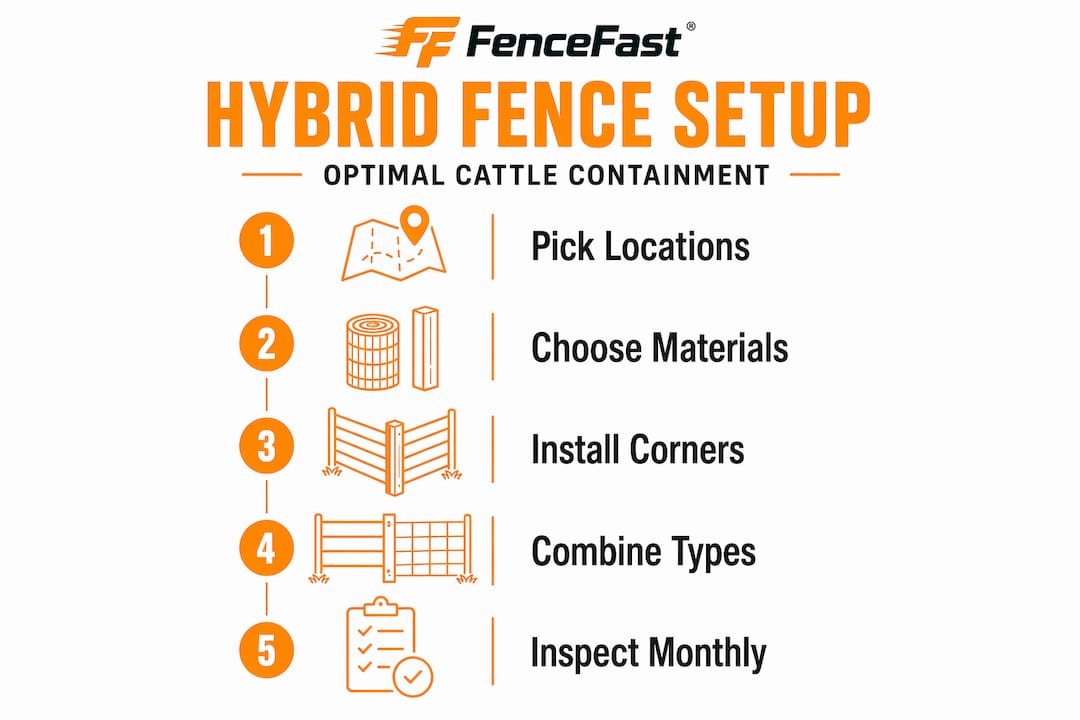
The most effective operations don’t pick one type and commit to it everywhere. A hybrid fencing approach uses permanent high-tensile or woven wire for perimeter security, then adds temporary electric fencing inside for flexible pasture management. That combination gives you the structural reliability you need on the boundary and the adaptability to manage rotational grazing without driving posts every season.
Pro Tip: When budgeting a new fencing project, spend your money on the corners and gates first. Those are the failure points. Mid-span wire is forgiving. A corner that shifts will pull your entire fence out of tension within a season.
Installation and maintenance that actually holds up
Even the right fence materials fail when the installation shortcuts pile up. The details below aren’t optional. They’re what separates a fence that lasts 20 years from one that needs constant attention after year three.
-
Set posts to the correct depth. Post depth requirements call for at least one-third of the post buried underground. For a 6-foot post, that means 24 to 30 inches in the ground. In areas with hard freeze cycles, go deeper. A post that isn’t seated correctly will heave with the ground movement.
-
Build your H-brace correctly. Proper brace construction converts horizontal wire tension into a downward force on the post, locking it against the soil. A weak corner is the number one cause of fence failure on cattle operations. Get this right before you stretch a single strand of wire.
-
Let concrete cure fully. If you’re setting posts in concrete, wait at least 48 to 72 hours before you start tensioning wire. Tensioning too early causes posts to shift under load, and once that happens, you lose your alignment for the entire run.
-
Handle high-tensile wire with respect. When tensioning, go slowly. Listen for the wire tone to rise as tension increases. Tensioning past the breaking point is a serious safety hazard. Wear gloves and eye protection every time. Snapped high-tensile wire recoils fast and with force.
-
Never nail wire directly to living trees. Trees grow. Growth causes bark to swallow staples and wire, which creates fence failure and a genuine hazard for livestock and equipment. Always use buffer blocks or insulators between tree bark and wire when natural anchors are unavoidable.
-
Ground your electric fencing system properly. For electric systems, use ground rods at least 3 feet long spaced 10 feet apart, and make sure they match the metal type used in your fence wire. Poor grounding is the hidden reason most electric fences underperform. Cattlemen will blame the energizer when the real problem is three inadequate ground rods.
-
Walk the fence monthly. Steel wire changes with the seasons. It expands in summer heat and contracts in winter cold. Wire that looked fine in October can be slack enough to push through by spring. One monthly walk catches tightening needs, broken insulators, and shorts before they become escapes.
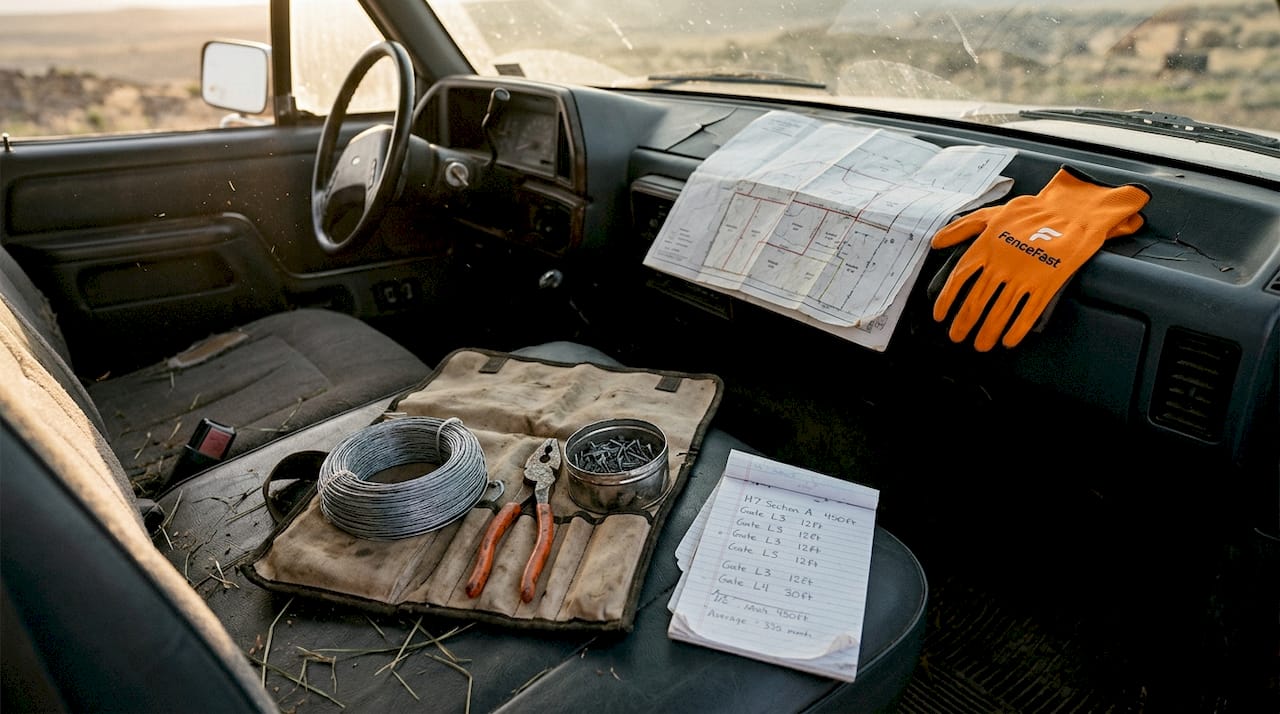
Pro Tip: Keep a fence repair kit in your truck or ATV at all times: extra staples, wire clips, a spool of wire, pliers, and a voltage tester. Catching a short on your Monday inspection means nothing if the repair has to wait until Friday.
Modern fencing strategies that improve grazing efficiency
Effective cattle containment practices have moved well beyond stringing wire and hoping cattle stay put. The best ranchers today use fencing as an active management tool, not just a boundary.
Rotational grazing is where smart fencing strategies for livestock deliver the most visible return. Subdividing a pasture into paddocks and rotating cattle through them gives each section time to recover before grazing pressure returns. This improves forage quality, reduces overgrazing, and increases the carrying capacity of your land over time. Temporary electric fencing makes this rotation practical. You can move a fence line in a morning rather than committing to a permanent division.
Virtual fencing takes that flexibility further. GPS-enabled collar technology lets you define and shift grazing boundaries digitally, moving cattle based on actual forage growth rather than a calendar schedule. Labor drops. Physical fence repair time drops. And your cattle spend more time on the right feed at the right stage of growth.
“Virtual fencing is enabling precise herd movement to optimize forage utilization in ways physical fence lines simply cannot replicate.” (AgProud, 2024)
Yard and alley design is another area where fencing decisions directly affect your bottom line. Curved alleys and bright, even lighting reduce animal stress during handling. Fewer abrupt corners mean cattle move more naturally, which reduces injury risk for both animals and handlers. If you’re designing or redesigning a working area, that research should inform every gate swing and alley bend.
For operations that want to explore virtual fencing for cattle without fully replacing traditional infrastructure, a hybrid approach works well. Permanent fencing holds the perimeter. Virtual fencing manages the interior rotation. You get the legal boundary security of physical wire combined with the operational agility of digital boundary management.
Practical design ideas for better farm operations
Good cattle fencing design ideas start before any wire goes up. The layout decisions you make on paper determine how efficiently your operation runs for the next decade.
- Separate perimeter from interior fencing by function. Your perimeter fence needs to be your most durable and permanent structure. Interior divisions can use lighter materials that are easier to move and modify.
- Put your strongest materials in high-stress zones. Gates, corners, loading areas, and water access points take the most abuse. Cattle panels or heavy-gauge woven wire belong here, not on open mid-pasture runs.
- Design with water and feed access in mind. Cattle will congregate at water and mineral sources. If a fence separates a herd from water, you will have a fence problem. Place water points so they serve multiple paddocks when possible, or factor access into your rotational schedule.
- Use visibility to your advantage. Cattle see and respond to fence visibility differently than humans do. Well-designed handling facilities account for where cattle naturally look and move. Bright-colored tape on temporary electric lines reduces accidental contact and teaches cattle faster.
- Plan for your operation five years out. A fence that works for 50 cows may not scale for 150. Leave room for additional paddocks, access lanes, and potential changes in enterprise mix. Installing a properly braced corner post now costs almost nothing extra compared to retrofitting later.
- Balance cost against durability honestly. Cheap wire installed poorly is not cheaper than quality wire installed right. Factor in the labor of repairs, the risk of livestock escaping, and the lifespan difference when you compare materials. You can compare fencing materials for Canadian conditions to get a realistic picture of long-term cost per foot.
My honest take on cattle fencing after years in the field
I’ve seen operations spend serious money on fencing that failed in the first year. And I’ve seen modest budgets stretch for decades because the planning was right. The single most underestimated factor in cattle fencing isn’t the wire or the post. It’s the time spent in the planning phase.
What I’ve learned is that most fence failures are designed in, not built in. A rancher who skips the soil assessment, ignores the freeze-thaw depth requirements, and posts too far apart on a long run has already failed before the first post goes in the ground. The physical work is the easy part. The thinking beforehand is where the real value is.
I’ve also changed my opinion on electric and virtual fencing over the years. I used to think of electric as a supplement, something you added when you couldn’t afford more wire. Now I see it as a core tool, especially for anyone managing rotational grazing at any meaningful scale. The grazing efficiency gains from being able to shift pasture boundaries quickly are not marginal. They’re significant.
The ranchers who adapt their fencing strategy as their operation grows consistently outperform those who commit early to one approach and stick with it regardless of what changes around them. Flexibility built into your fencing design is not a compromise. It’s a competitive advantage.
— Juiced
Build a better fence with Fencefast
If you’re ready to move from theory to the right materials and systems for your specific operation, Fencefast has you covered.

Fencefast carries everything from traditional woven wire and high-tensile components to electric fencing systems and Gallagher eShepherd virtual fencing technology. Whether you’re building a new perimeter from scratch, retrofitting a corral, or exploring digital boundary management for your rotational grazing, Fencefast has the products and the knowledge to match your operation’s needs. As an authorized Gallagher dealer with over 26 years of experience, Fencefast serves Canadian ranchers with professional-grade solutions, design consulting, and access to government funding programs like OFCAF and BMP grants for virtual fencing adoption. Start at FenceFast.ca to browse the full catalog or get in touch for personalized support.
FAQ
What is the best fence type for cattle perimeter security?
High-tensile wire or woven wire fencing are the most reliable choices for cattle perimeters. They offer long-term durability, resistance to livestock pressure, and lower maintenance compared to barbed wire over time.
How deep should fence posts be set for cattle fencing?
Posts should be buried at least one-third of their total length. A 6-foot post requires a minimum of 24 to 30 inches in the ground, with greater depth recommended in areas subject to freeze-thaw cycles.
How does virtual fencing work for cattle management?
Virtual fencing uses GPS-enabled collars to define and shift grazing boundaries digitally through an app, allowing ranchers to move cattle without physical fence lines and reducing both labor and fence repair demands.
How often should cattle fences be inspected?
Walking the fence line once a month is the recommended practice. Seasonal temperature changes cause wire to expand and contract, so regular inspection catches sagging, shorts, and broken insulators before they create escape situations.
Can electric fencing contain cattle on its own?
Yes, once cattle are properly trained to respect it. Electric fencing functions as a psychological barrier, and with proper voltage maintenance and good grounding, it reliably keeps cattle contained with far less infrastructure than physical wire.

