

TL;DR:
- The Canadian fencing market is projected to reach $38.43 billion by 2026, driven by the need for more efficient, durable, and sustainable solutions.
- Emerging trends include virtual fencing using GPS collars, sustainable materials like composite posts, and upgraded traditional fencing materials for longevity and environmental benefits.
- Farmers should match fencing innovations to their specific land, livestock, and operational needs, considering both return on investment and local challenges.
The global fencing market is on track to hit $38.43 billion in 2026, growing at a 5.4% annual rate, and Canadian agriculture is right in the middle of that expansion. If you’re still managing your operation with the same fencing setup you had five years ago, you’re likely leaving efficiency, animal welfare improvements, and real cost savings on the table. This year brings a genuine shift in what’s available, what’s affordable, and what’s actually worth your investment. Here’s a clear breakdown of the top fencing trends shaping Canadian farms in 2026 and how to decide which ones fit your operation.
Table of Contents
- What’s driving change: Key factors shaping farm fencing in 2026
- Trend 1: Smart and virtual fencing systems
- Trend 2: Focus on sustainability and wildlife-friendly design
- Trend 3: Upgrades in traditional fencing materials and installation
- How to decide: Matching fencing trends to your livestock and land
- Our perspective: What most Canadian farmers overlook about fencing innovation
- Enhance your fencing with expert solutions
- Frequently asked questions
Key Takeaways
| Point | Details |
|---|---|
| Smart fencing leads | Virtual and smart fencing options are transforming livestock management in 2026. |
| Eco-friendly gains | Sustainable materials and wildlife-safe designs are now viable for most Canadian farms. |
| Funding reduces costs | Government grants can significantly lower the barrier to adopting cutting-edge solutions. |
| New materials last longer | Advanced traditional fencing materials outperform older options for durability and maintenance. |
| Match trend to farm need | Choosing the best fencing combines a trend’s strengths with your specific goals and livestock requirements. |
What’s driving change: Key factors shaping farm fencing in 2026
To understand which fencing trends matter most, start with what’s causing rapid evolution on Canadian farms.
The fencing market growth at a 5.4% compound annual growth rate is not just a headline number. It reflects real pressure on producers to manage more land with less labor, contain costs, and meet new environmental standards. Canadian ranchers are dealing with rising input costs, tighter margins, and increasingly complex grazing management needs. Those pressures are pushing investment in smarter, more durable, and more flexible fencing systems.
Several forces are converging at once:
- Labor shortages are making manual fence checking and repair a serious operational burden
- Rotational grazing is expanding as producers recognize its soil health and productivity benefits, but it demands flexible, easy-to-move fencing
- Wildlife interaction is increasing in many regions, requiring designs that protect livestock without harming native species
- Government funding programs like OFCAF (On-Farm Climate Action Fund) are actively subsidizing specific fencing upgrades, making 2026 a financially smart time to act
- Climate variability across the Prairies, BC, and Ontario is demanding materials that hold up under freeze-thaw cycles, UV exposure, and wet conditions
Understanding these drivers helps you see that the trends below are not just novelties. They’re responses to real challenges you’re already facing. Investing in durable fencing solutions has never been more strategically important than it is right now.
Trend 1: Smart and virtual fencing systems
Alongside market shifts, innovation in smart fencing is transforming how livestock are managed.
Virtual fencing uses GPS-enabled collars worn by cattle to define grazing boundaries without a single physical post or wire. The system delivers an audio cue first, followed by a mild electrical pulse if the animal approaches a programmed boundary. The boundaries are set and adjusted through a smartphone app or computer, meaning you can move your entire herd to a new paddock from your truck cab in minutes.
Here’s a quick comparison of virtual versus traditional fencing to put the costs and benefits in perspective:
| Factor | Virtual fencing | Traditional fencing |
|---|---|---|
| Upfront cost per head | ~$350 CAD collar | Varies by material and acreage |
| Ongoing cost | ~$2.50/month data per collar | Maintenance, repair labor |
| Flexibility | Instant boundary changes | Physical relocation required |
| Labor for moves | Minutes via app | Hours of manual work |
| Wildlife interaction | No physical barrier | Barrier present |
| Funding available | Up to 70% via OFCAF | Limited programs |
Virtual fencing collars cost approximately $350 CAD each plus $2.50 per month in data fees, and OFCAF funding can cover up to 70% of project costs for rotational grazing applications. That changes the math significantly. A herd of 100 cows would cost roughly $35,000 CAD to equip before funding, and as low as $10,500 after a 70% offset. Compared to the cost of fencing large acreages with physical materials, the economics are compelling for many operations.
One of the biggest questions producers ask is how long it takes cattle to figure out the system. Research shows that cattle adapt to virtual fences in 4 to 7 days, with no measurable negative impact on conception rates, weight gain, or overall welfare. That’s a short learning curve with a big operational payoff.
Key benefits of virtual fencing for Canadian operations:
- Enables precise rotational grazing without physical infrastructure
- Reduces time spent moving fences, especially across large or remote acreage
- Provides real-time herd location data through the app
- Integrates with health monitoring features on some platforms
- Scales easily as your herd grows
To understand the full technology picture, read our guide to virtual fencing explained, and if you’re budgeting a project, the detailed breakdown of virtual fencing costs in the Canadian context will help you plan accurately.
Pro Tip: Before committing to a full rollout, apply for OFCAF or BMP (Beneficial Management Practices) funding first. These programs can dramatically reduce your upfront investment, and FenceFast can help you navigate the application process.
Trend 2: Focus on sustainability and wildlife-friendly design
While digital solutions are in the spotlight, hardware innovations focused on sustainability are rapidly gaining ground.
Canadian producers are under increasing pressure from both regulators and consumers to reduce their environmental footprint. At the same time, many ranchers have personal reasons to protect the wildlife on and around their land. The good news is that sustainable fencing approaches are no longer a compromise. They’re often a better long-term choice on both cost and performance.
Here’s a quick comparison of the leading sustainable material options:
| Material | Durability | Cost | Eco benefit | Best use case |
|---|---|---|---|---|
| Composite posts | Very high | Medium-high | Recycled content, no rot | Permanent perimeter fencing |
| Recycled plastic rail | High | Medium | Diverts plastic waste | Horse and livestock paddocks |
| High-tensile wire | Very high | Low-medium | Less steel per linear foot | Large acreage cattle fencing |
| Treated wood | Medium | Low | Locally sourced options | Traditional farm aesthetics |
Composite posts made from recycled plastics and wood fiber are gaining serious traction. They don’t rot, they don’t splinter, and they don’t require chemical treatment. Over a 20-year lifespan, they often outperform traditional wood on total cost when you factor in replacement and labor. Recycled plastic rail fencing is especially popular for horse operations where visibility and safety are priorities.
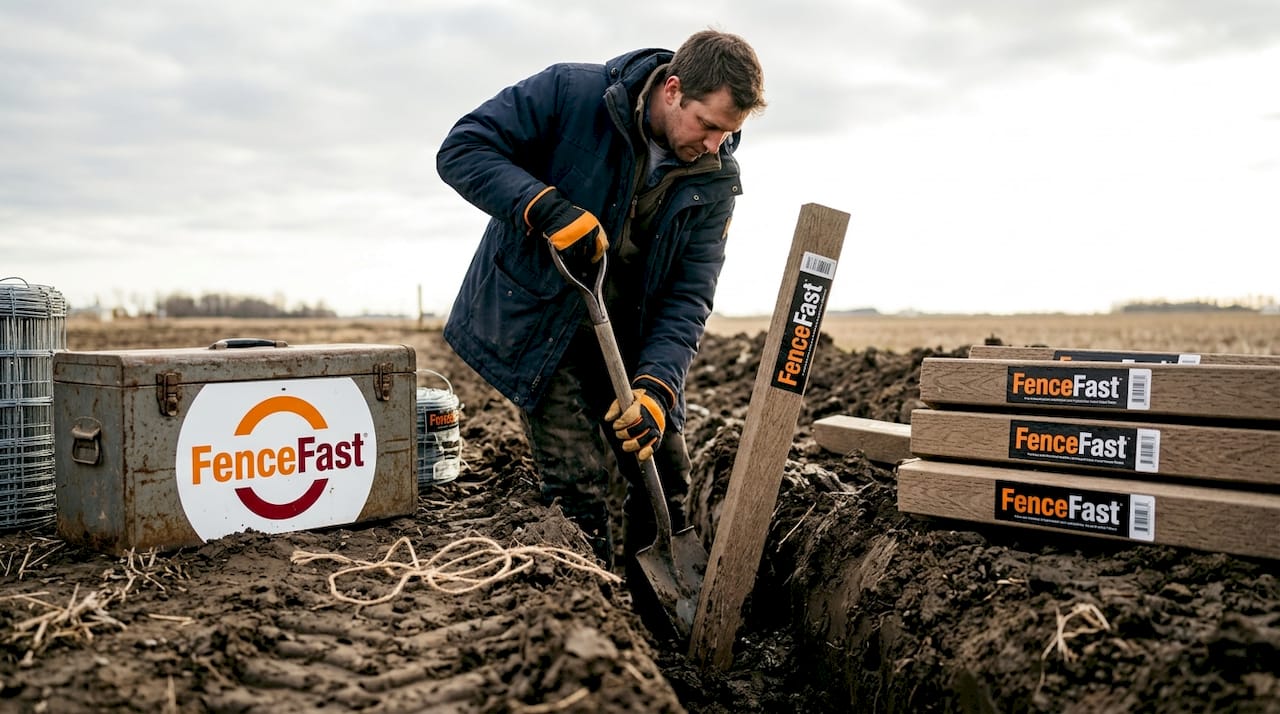
High-tensile wire remains one of the most sustainable choices for large-scale cattle operations. It uses less steel per foot than conventional wire, installs faster, and lasts significantly longer with minimal maintenance. When combined with eco-friendly fencing materials, you get a system that’s both practical and environmentally responsible.
Wildlife-friendly design is the other major piece of this trend. Smooth bottom wires, appropriate spacing, and lay-down sections allow deer and other wildlife to pass through or under fences without injury. These designs also reduce fence damage from wildlife pressure, which cuts your repair costs over time. For a detailed guide to wildlife friendly designs, the principles are straightforward and applicable across most Canadian regions.
Pro Tip: Combining high-tensile wire with composite or recycled plastic posts gives you the best of both worlds. You get long-lasting, low-maintenance performance with a significantly reduced environmental footprint, and it often qualifies for sustainability-focused funding programs.
Trend 3: Upgrades in traditional fencing materials and installation
Smart and sustainable options are rising, but next-gen traditional materials and easier installation are also worth a closer look.
Not every operation is ready for virtual fencing, and not every parcel of land suits a fully sustainable material approach. For many Canadian producers, the biggest gains in 2026 will come from upgrading the conventional fencing they already rely on. The good news is that durability and low-maintenance features are driving serious improvements in traditional fencing materials.
Here are the top upgrades worth considering this year:
-
Galvanized high-tensile steel wire has improved significantly in coating quality and tensile strength ratings. Modern Class 3 galvanized wire lasts two to three times longer than older Class 1 wire in Canadian conditions, especially in areas with heavy moisture or salt exposure near roads.
-
Polymer-coated wire and posts offer a weather-resistant barrier that prevents rust and UV degradation. These products are especially valuable in coastal BC or areas with harsh freeze-thaw cycles that accelerate corrosion.
-
Pressure-treated wood alternatives using newer borate-based treatments are safer for livestock and the environment than older arsenic-based options, while still delivering excellent rot resistance in wet soils.
-
Mechanical post drivers and hydraulic post pounders have become more accessible for mid-size operations. Renting or owning one of these tools cuts installation time dramatically and ensures consistent post depth, which directly affects fence longevity.
-
Modular fence panel systems allow faster installation and easier reconfiguration for handling areas, laneways, and temporary containment without specialized tools or skills.
When you’re evaluating your options, it helps to compare top fencing materials side by side before committing. The right choice depends heavily on your soil type, livestock species, and how permanent the installation needs to be. Understanding your fence post options is equally important, since posts account for a large share of both upfront cost and long-term performance. For producers tackling a new installation or major retrofit, following proven fence installation steps from the start prevents costly mistakes.
Pro Tip: When retrofitting older fences, prioritize replacing corner and brace assemblies first. These are the structural anchors of your entire fence line, and worn or undersized bracing is the most common cause of fence failure across the whole run.
How to decide: Matching fencing trends to your livestock and land
Once you know what’s possible in 2026, deciding comes down to your unique farm needs.
No single trend is the right answer for every operation. The best fencing strategy combines the right tools for your specific livestock, land, goals, and budget. Before you commit to any upgrade, work through these questions:
- What species are you containing, and what are their specific escape and pressure behaviors?
- How large is the area you need to fence, and how permanent does it need to be?
- Are you managing rotational grazing, or do your animals stay in fixed paddocks?
- What is your available labor for installation and ongoing maintenance?
- What is your realistic budget for upfront investment versus long-term operating cost?
- Are there wildlife species in your area that need to be considered in the design?
Use the answers to guide your decision with this framework:
| Situation | Recommended approach |
|---|---|
| Large acreage, rotational grazing, cattle | Virtual fencing with OFCAF funding |
| Horse operation, paddock fencing | Recycled plastic rail or composite posts |
| Mixed livestock, permanent perimeter | High-tensile wire with composite posts |
| Handling areas and laneways | Modular steel panels |
| Remote pasture, minimal labor | Solar electric with high-tensile wire |
| Budget-constrained upgrade | Retrofit corners, replace worn wire |
Understanding animal fencing basics for your specific species is the foundation of any good fencing decision. Cattle, horses, pigs, and poultry all have very different containment requirements, and a system designed for one species can fail badly with another.
Long-term maintenance cost is often underestimated. A fence that costs 20% more upfront but requires half the maintenance over 15 years is almost always the better investment. Run the numbers over a realistic lifespan, not just the purchase price.
Our perspective: What most Canadian farmers overlook about fencing innovation
Here’s something we’ve seen consistently over 26 years of working with Canadian producers: the farmers who get the most value from fencing innovation are not the ones who chase the newest technology. They’re the ones who match the right tool to a clearly defined problem on their specific operation.
Virtual fencing is genuinely transformative for rotational grazing on large acreage. But if your operation runs 50 cow-calf pairs on 200 acres with fixed paddocks, the ROI calculation looks very different than it does for a 500-head stocker operation on 5,000 acres of native range. The technology is excellent. The question is whether it solves your problem better than the alternatives.
The farms we see struggle with fencing upgrades are usually the ones that adopted a trend because it was exciting, not because it addressed a real bottleneck in their operation. They end up with expensive collars sitting in a shed, or composite posts in a soil type where they didn’t need them.
The most successful approach we’ve seen combines new technology where it delivers clear, measurable ROI with proven traditional methods everywhere else. That hybrid thinking, grounded in honest assessment of your own operation, consistently outperforms going all-in on any single trend. We also believe strongly in community feedback. Talk to other producers in your region who have tried these systems. Their real-world experience in your climate and with your livestock types is worth more than any product brochure.
For operations managing wildlife interaction alongside livestock, the resources on fencing for livestock management offer practical guidance on designing systems that handle both challenges without compromise.
Enhance your fencing with expert solutions
Knowing what’s available is only half the job. Putting the right system in place for your operation takes expertise, the right products, and access to funding that makes the investment work financially.
At FenceFast, we’ve spent 26 years helping Canadian farmers and ranchers build fencing systems that actually perform in real conditions. Whether you’re exploring Gallagher eShepherd virtual fencing for your cattle operation, sourcing high-tensile wire and composite posts for a perimeter upgrade, or looking for help navigating OFCAF and BMP funding applications, we have the products, knowledge, and hands-on experience to guide you from planning through installation. Our team can help you compare options, run cost projections, and build a fencing strategy that fits your land, your livestock, and your budget in 2026.
Frequently asked questions
How much does virtual fencing cost per head in Canada?
Virtual fencing collars cost approximately $350 CAD each plus $2.50 per month for data, and OFCAF funding can cover up to 70% of eligible project costs, making the net investment significantly lower for qualifying operations.
How quickly do cattle adapt to virtual fencing?
Cattle typically adapt to virtual fencing boundaries in 4 to 7 days, and research trials confirm no negative effects on conception rates, weight gain, or animal welfare during or after the learning period.
Do sustainable fencing materials last as long as traditional options?
Many eco-friendly materials like composite posts and recycled plastic rail now match or exceed the lifespan of traditional wood, especially in wet or freeze-thaw conditions where conventional wood deteriorates quickly.
What incentives are available for upgrading farm fences in 2026?
Programs like OFCAF funding can cover up to 70% of costs for qualifying virtual fencing and rotational grazing projects, with BMP grants also available in several provinces for sustainable fencing upgrades.
Recommended
- Agricultural fencing in Canada: choosing durable solutions – FenceFast Ltd.
- Portable fence systems for livestock control in Canada 2026 – FenceFast Ltd.
- Portable fencing advantages for Canadian farms: boost efficiency – FenceFast Ltd.
- Electric fence safety tips for Canadian farmers in 2026 – FenceFast Ltd.

