

TL;DR:
- High tensile wire provides superior durability, requiring fewer posts and low maintenance for large farms. Proper installation, especially at corners, is essential to prevent catastrophic failures due to its stored tension energy. It outperforms traditional fences by lasting over 50 years, enhancing animal safety and overall cost efficiency.
Not all fencing wire is created equal, and if you’ve ever repaired a sagging fence three seasons in a row, you already know that. The high tensile wire benefits that matter most to working farms go well beyond tensile strength numbers on a spec sheet. We’re talking about fewer posts, less maintenance, longer lifespan, and real savings on labor across hundreds of acres. This guide breaks down what high tensile wire actually does differently, where it outperforms the competition, and what you need to get right during installation to see those benefits pay off.
Table of Contents
- Key takeaways
- High tensile wire benefits start with understanding the material
- Why high tensile wire outperforms for livestock fencing
- Installation: where the system wins or fails
- Comparing high tensile wire to other fencing options
- What experience has actually taught me about high tensile fencing
- Get your high tensile fencing right with Fencefast
- FAQ
Key takeaways
| Point | Details |
|---|---|
| Lifespan exceeds 50 years | Galvanized high tensile wire resists rust far longer than standard wire, reducing replacement costs. |
| Fewer posts cut project costs | High tensile wire spans longer distances between posts, lowering both material and labor expenses. |
| Spring behavior protects livestock | Wire deflects under impact and returns to position, reducing injury risk and fence damage. |
| Installation quality is non-negotiable | Corner bracing failures can release stored tension energy and destroy entire fence runs. |
| Pairs well with electric systems | High tensile wire is structural; electric fencing is tactical. Combined use maximizes both value and control. |
High tensile wire benefits start with understanding the material
Most farmers shopping for fencing wire think in terms of gauge and price. High tensile wire demands a different framework. It’s made from high carbon steel wire with a tensile strength typically ranging from 170,000 to 200,000 psi. Compare that to regular low carbon wire, which tops out around 60,000 to 80,000 psi. That difference in strength is what makes everything else possible.
Here’s what sets high tensile wire apart from what most operations have traditionally used:
- Carbon content: High tensile wire contains significantly more carbon than standard galvanized or barbed wire, making it harder and more resistant to deformation under load.
- Smaller diameter, same strength: High tensile wires support extreme loads within smaller diameters, which is why you can fence more ground with less material weight.
- Elastic behavior: Unlike soft wire that permanently stretches when pushed, high tensile wire returns to its original shape after deflection. This spring quality is a defining feature, not just a bonus.
- Galvanized coating: Class 3 zinc coatings on quality high tensile wire deliver serious corrosion resistance, which matters on Canadian farms with freeze-thaw cycles and wet springs.
One distinction worth making: high tensile wire fencing is a structural choice, while electric fencing is a behavioral deterrent for livestock. They serve different purposes. Many operations combine both for full coverage and flexibility. Knowing the difference prevents costly misunderstandings at the planning stage.
Why high tensile wire outperforms for livestock fencing
The advantages of using tensile wire become clearest when you stack them against what a 400-acre cattle operation actually needs from a fence.
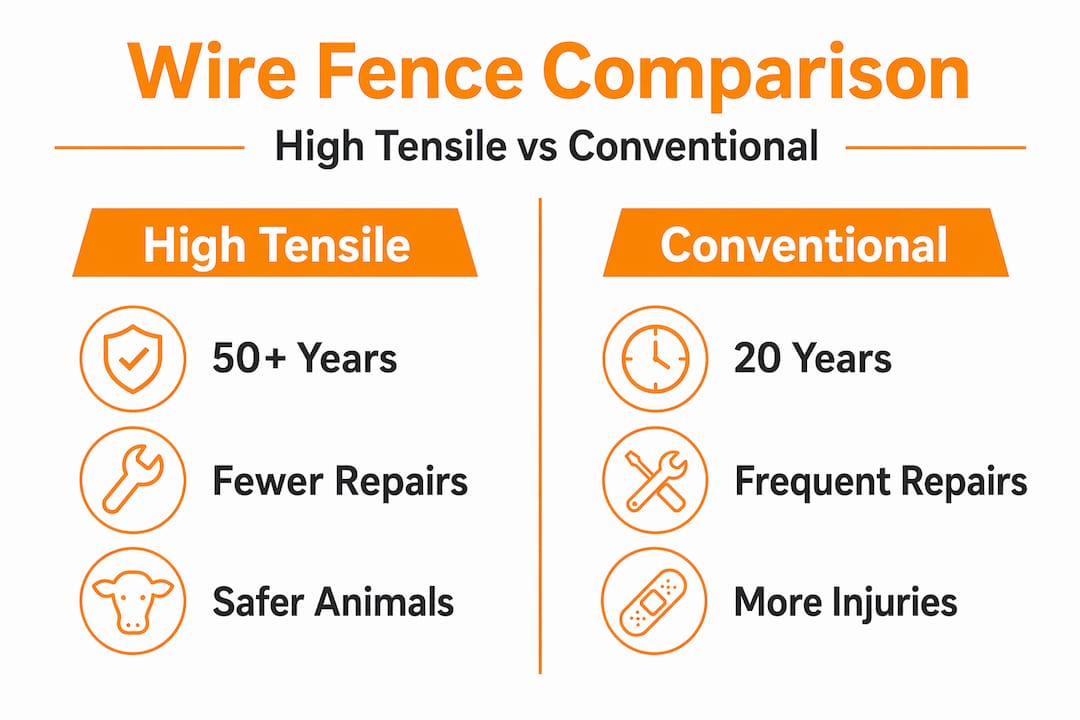
Durability that outlasts the alternatives. Galvanized high tensile wire resists rust for 50-plus years with a Class 3 zinc coating. That’s not a marketing claim. That’s a real reduction in total replacement cycles over the life of your farm. Standard low carbon wire starts showing corrosion within a decade in wet climates.
Maintenance drops substantially. The spring behavior of the wire keeps it taut through seasonal ground movement and livestock pressure. You’re not retightening wires every spring or replacing posts that got pushed out because the wire lost tension over winter.
Cost-efficiency that compounds over time. High tensile wire costs 20 to 30% more upfront than conventional wire, but fewer posts, less labor, and near-zero maintenance rebalance that math within a few years. Many producers report needing 30% fewer posts when switching from barbed wire. On a long fence run, that’s a significant material and installation saving.
Safer for animals. Barbed wire causes lacerations. High tensile wire with a smooth surface reduces livestock injury risk from cuts and punctures. For horses especially, this distinction is serious. A horse caught in barbed wire is a veterinary bill and a trauma risk. Smooth high tensile wire, properly tensioned, is far less likely to trap or cut.
Adaptability across rugged terrain. High tensile fencing allows longer spans on hilly or uneven land because the wire’s strength compensates for reduced post support. If you’re fencing creek banks, rocky hillsides, or rolling pastures, this matters more than almost anything else on this list.
Pro Tip: When calculating your fencing budget, factor in the full 20-year cost picture. Include labor for repairs, post replacements, and wire retensioning. High tensile wire almost always wins that comparison against barbed or soft wire.
The farm fencing market reflects this shift. Demand for high tensile wire is growing through 2035, driven by biosecurity concerns and the need for low-maintenance systems that hold up under modern stocking densities.
Installation: where the system wins or fails
This is where most conversations about high tensile wire advantages go wrong. People buy the right wire and then install it incorrectly. The results range from a fence that never holds proper tension to a catastrophic failure that destroys a full fence run.
Here’s what correct installation looks like in practice:
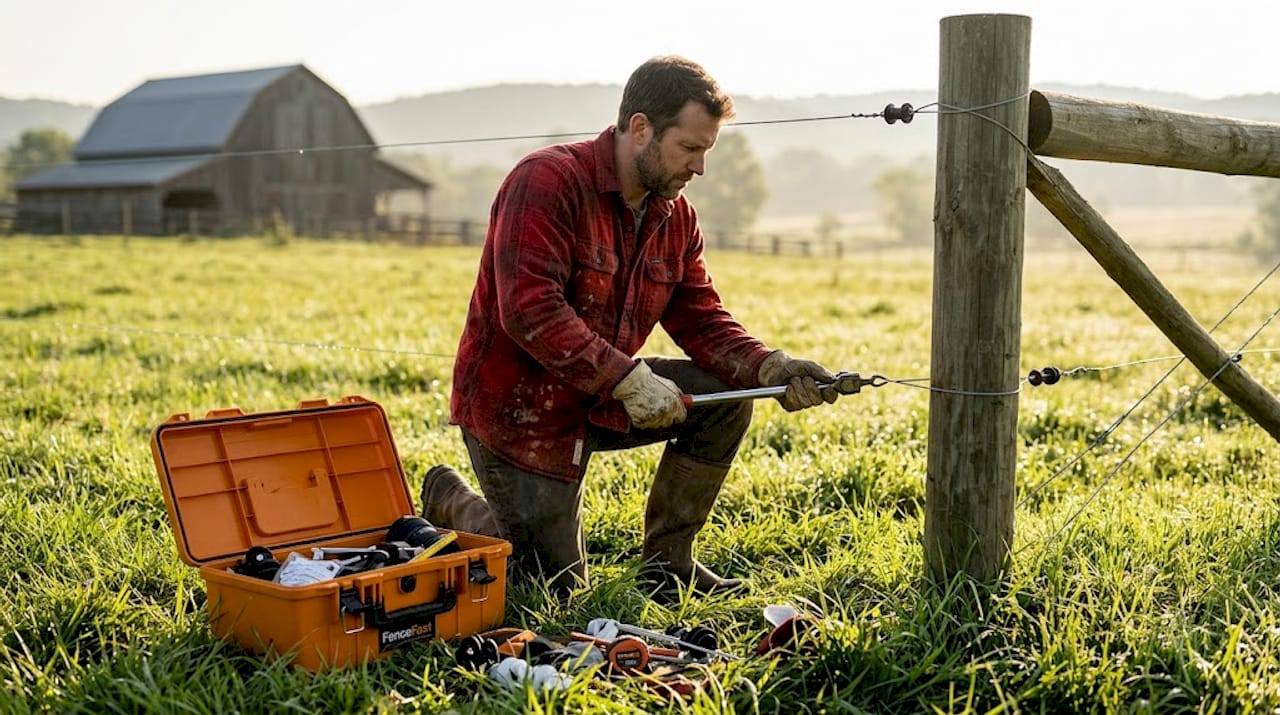
- Design your corner assemblies first. High tensile wire stores significant tension energy. Poor corner bracing can cause system failure when that stored energy releases. A corner post that would be adequate for soft wire is often completely insufficient for high tensile. Use brace assemblies rated for the load your wire will carry.
- Choose the right post spacing. Line posts can be spaced further apart than with conventional wire, but intermediate stays are still required to maintain wire spacing and prevent wildlife from pushing through. Spacing depends on terrain slope and livestock type.
- Tension methodically. Use a wire tension gauge. Over-tensioning creates brittleness risk. Under-tensioning eliminates the spring effect you’re paying for. Target tension levels are typically 150 to 250 pounds depending on wire gauge and application.
- Account for thermal expansion. Wire tightens in cold and loosens in heat. Your tensioning should account for seasonal changes to prevent stress relaxation or over-tension cracking during temperature extremes.
- Inspect corners after the first winter. Ground movement can shift corner post alignment. A first-season inspection costs nothing and prevents a cascading failure the following year.
Pro Tip: If you’re new to high tensile systems, spend the money on a professional to set your corners. You can do the line work yourself and save significantly on labor, but corner assemblies built wrong will cost more to fix than they would have to do right the first time.
The spring behavior of high tensile wire is one of its strongest selling points, but it’s also what makes installation errors costly. Wire deflects under pressure and returns to its original position when correctly installed and braced. That same stored energy, released by a failed corner, can take out a long stretch of fence in one event.
Comparing high tensile wire to other fencing options
Not every fencing scenario calls for the same material. Here’s how high tensile wire stacks up against the most common alternatives across the metrics that matter to working farms.
| Fencing type | Durability | Upfront cost | Maintenance | Animal safety | Best for |
|---|---|---|---|---|---|
| High tensile wire | 50+ years galvanized | Moderate to high | Very low | High (smooth) | Cattle, horses, large acreage |
| Barbed wire | 15 to 25 years | Low | Moderate | Low (injury risk) | Cattle, perimeter control |
| Welded wire | 20 to 30 years | High | Low to moderate | High | Goats, pigs, small livestock |
| Soft/low carbon wire | 5 to 15 years | Low | High | Moderate | Temporary or light duty use |
For cattle on large acreages, high tensile wire is almost always the right call. You get the strength to hold large animals, the durability to skip a decade of repairs, and the post savings to cover more ground without blowing the budget.
For horses, high tensile smooth wire or high tensile wire for goats and smaller livestock works well when combined with the appropriate number of strands and spacing. Horses need tighter spacing and more visibility in the fence line. Goats require a high strand count close to the ground.
For mixed operations, pairing high tensile structural wire with an electric fencing system for cattle gives you both the permanent boundary security and the psychological deterrent that keeps animals respecting the fence line without constant physical contact. That combination is increasingly common on modern operations because it reduces overall wire strand count while maintaining containment.
Looking at top fencing materials for Canadian farms confirms this pattern: high tensile consistently ranks at the top for durability and total cost of ownership across most livestock categories.
What experience has actually taught me about high tensile fencing
I’ve seen dozens of fencing projects where the wire choice was right and the fence still failed. Not because high tensile wire is a bad product. Because the installation treated it like soft wire.
The single biggest lesson: high tensile fencing rewards a systems thinking approach. The wire is only as good as the corner assemblies holding it. And the corner assemblies are only as good as the person who designed them. This isn’t forgiving material. It doesn’t hide mistakes by sagging gently. It stores energy and, when something gives way, it gives way hard.
That said, the high tensile fence pros are genuinely significant when the system is built right. I’ve watched a properly installed high tensile fence go through a Canadian winter with a full cattle herd pushing it, come out the other side needing nothing but a visual check. That doesn’t happen with soft wire or barbed wire on the same terrain.
My honest recommendation: if you’re covering more than 50 acres and your fencing budget matters to you, high tensile is worth serious consideration. Budget for corners done properly. Don’t cheap out on the brace assemblies. That’s where the investment either pays back or bleeds out. The wire itself is the easy part.
— Juiced
Get your high tensile fencing right with Fencefast

When you’re ready to move from research to a real fencing plan, Fencefast has the products and knowledge to help you get there. Fencefast carries a full range of agricultural fencing wire solutions for Canadian farms, including high tensile wire, corner hardware, and installation accessories built for the demands of large-scale livestock operations. Whether you’re fencing a new pasture or upgrading an existing system, the product catalog at FenceFast.ca covers everything from individual wire components to complete system setups. With 26 years of agricultural fencing experience and expert guidance available, you’re not just buying wire. You’re building a fence that lasts.
FAQ
What are the main high tensile wire benefits for farms?
High tensile wire offers greater durability, lower long-term maintenance, fewer posts per fence run, and improved animal safety compared to barbed or soft wire. Its spring behavior also helps it maintain tension through seasonal ground movement.
Why use high tensile wire instead of barbed wire?
High tensile smooth wire reduces livestock injury risk from cuts and punctures, lasts significantly longer with proper galvanization, and requires less ongoing maintenance than barbed wire over a comparable fence run.
How does high tensile wire cost efficiency work?
Although upfront costs run 20 to 30% higher than conventional wire, the reduced post count, lower labor requirements, and near-zero maintenance over a 50-plus year lifespan mean high tensile wire typically costs less per year of service life than cheaper alternatives.
Can high tensile wire be used for horses?
Yes, but strand spacing and count need to match horse-specific safety requirements. Smooth high tensile wire is actually preferable to barbed wire for horses because it eliminates the laceration risk that makes barbed wire dangerous for equine use.
What causes high tensile fence failure?
The most common cause of failure is inadequate corner bracing. High tensile wire stores significant tension energy, and when a corner assembly fails, that energy can release and damage a long section of fence. Correct corner design is the single most important factor in system performance.

