

TL;DR:
- Perimeter fencing is essential for livestock safety, property boundaries, and environmental protection on Canadian farms.
- Investing in quality permanent fencing offers long-term cost savings and reliable containment.
- Combining physical fences with virtual fencing provides flexible and effective livestock management solutions.
Keeping livestock safely on your land while protecting crops, waterways, and neighboring properties is one of the most demanding operational challenges Canadian farmers face. A single breach in your boundary can mean a lost animal, a damaged relationship with a neighbor, a regulatory fine, or worse. The right perimeter fencing system is not just a line drawn on a map. It is the physical backbone of every management decision you make on your farm, from rotational grazing plans to predator control to environmental compliance.
Table of Contents
- Why perimeter fencing is essential for Canadian farms
- Top benefits of farm perimeter fencing
- Comparing fencing types: Permanent, portable, and virtual
- Situational recommendations: Choosing the right perimeter fencing
- Our perspective: The real value of perimeter fencing in modern Canadian agriculture
- Find fencing solutions for your farm
- Frequently asked questions
Key Takeaways
| Point | Details |
|---|---|
| Long-term value | Investing in permanent perimeter fencing provides better lifetime savings compared to portable alternatives. |
| Livestock safety | Perimeter fencing is crucial for preventing escapes, reducing predation, and ensuring animal well-being. |
| Flexibility and innovation | While virtual fencing is promising, physical perimeter fences remain the mainstay for reliable control. |
| Environmental protection | Proper fencing helps buffer sensitive habitats and streamline responsible land management. |
| Tailored solutions | Choosing the right fence depends on livestock, terrain, and budget, ensuring optimal results for every farm. |
Why perimeter fencing is essential for Canadian farms
Perimeter fencing does more than mark your property line. It creates a controlled environment where you make the decisions about where animals go, what they eat, and when they rest. Without a solid outer boundary, every other management tool you use becomes less effective.
Livestock containment and safety are the most immediate concerns. Cattle that escape onto a highway, horses that wander into a neighbor’s crop field, or pigs that root through a riparian buffer create liability that can cost you far more than the fence ever would. In Canada, provincial regulations in many areas place legal responsibility on livestock owners when animals damage property or cause accidents. A reliable perimeter fence is your first layer of legal and financial protection.
Property disputes are another serious issue. Without a clearly defined and physically maintained boundary, disagreements with neighbors over grazing rights, crop damage, and drainage can escalate into costly legal conflicts. A permanent fence says exactly where your land ends and someone else’s begins, without room for argument.
Environmental stewardship is increasingly tied to funding eligibility and regulatory compliance. Many Canadian provinces require livestock producers to fence off waterways to prevent stream bank erosion and water quality degradation. Programs like OFCAF and BMP grants actually support farmers who install fencing to protect riparian (streamside) zones, meaning a well-planned perimeter fence can partly pay for itself through government funding.
When you look at raw numbers, permanent fencing costs $1.25 to $3.50 per foot, which sounds significant upfront but proves lower in long-term cost compared to repeatedly moving and replacing portable systems along the same boundary year after year.
- Prevents livestock from accessing roads and neighboring properties
- Creates a foundation for rotational grazing systems inside the perimeter
- Satisfies environmental compliance requirements for riparian buffer zones
- Reduces predator access to vulnerable animals
- Establishes legal property boundaries that reduce neighbor disputes
Pro Tip: Before you price out materials, walk your entire boundary with a notebook and GPS unit. Note every wet area, slope change, and access point. Farmers who skip this step often underestimate material needs by 15 to 20 percent and end up with a fence that creates problems instead of solving them.
“A fence is only as strong as its weakest post.” That old saying holds up in practice. Corners and gates are where perimeter fences fail most often, and reinforcing those points during initial construction saves expensive repair work within the first three years.
For anyone planning a new boundary installation, the installation guide for perimeter fences from FenceFast covers terrain-specific approaches that apply directly to Canadian conditions.
Top benefits of farm perimeter fencing
With the essential role established, let’s review the tangible benefits perimeter fencing offers in detail. Each of these benefits has a direct dollar value attached to it, which makes this an investment decision rather than just an infrastructure expense.
-
Reliable animal containment. The most obvious benefit is also the most financially significant. A single escaped dairy cow can lose a full day of milk production, require hours of labor to recover, and potentially injure itself or cause a vehicle accident. Multiply that risk across a herd of 80 or 100 animals, and the math for a permanent fence becomes clear very quickly.
-
Reduced predation risk. Coyotes, wolves, and bears are active across most of Canada’s agricultural regions. Perimeter fencing, especially when combined with electric wire at the top or bottom, dramatically reduces successful predator entry. For sheep and goat producers in particular, predation losses without proper perimeter protection can reach 5 to 10 percent of flock value annually.
-
Minimizes feed wastage and crop damage. When animals break through a perimeter, they often access crop fields or hay storage areas. Even a short breach event can result in significant feed loss. Beyond the feed itself, soil compaction from livestock in crop areas creates long-term productivity losses that take years to reverse.
-
Protects environmental zones. Fencing livestock out of streams, ponds, and wetlands protects water quality and prevents the bank erosion that degrades these systems over time. Many federal and provincial cost-share programs pay a portion of fencing costs specifically for this purpose, reducing your net investment.
-
Lowers insurance costs through risk mitigation. Some agricultural insurers in Canada offer reduced premiums for operations that demonstrate robust containment practices. A documented perimeter fence system with maintenance records signals lower liability risk, which can translate to lower annual costs on your policy.
Fencing type comparison at a glance:
| Fencing type | Upfront cost | Long-term cost | Flexibility | Best use case |
|---|---|---|---|---|
| Permanent wire | Moderate to high | Low | Fixed | Outer boundaries, cattle, horses |
| Portable electric | Low | Moderate | High | Interior paddocks, rotational grazing |
| Virtual (GPS collars) | High | Moderate | Very high | Large acreage, remote areas |
When you compare fencing materials for Canadian conditions, factors like freeze-thaw cycles, snow load on posts, and UV degradation of plastic insulators all affect which system holds up over a 10 to 20 year horizon. Choosing the wrong material for your climate zone can cost you significantly in premature replacements.
Selecting the right post material is equally important. Softwood posts rot faster in wet soils, while steel posts can shift in heavy clay. The guide on best fence post materials breaks down the trade-offs for specific Canadian soil types and livestock applications.
Comparing fencing types: Permanent, portable, and virtual
Having covered the major benefits, it’s crucial to understand how different types of fencing compare for specific needs. No single system is perfect for every situation, and most successful farm operations combine two or even three fencing approaches.
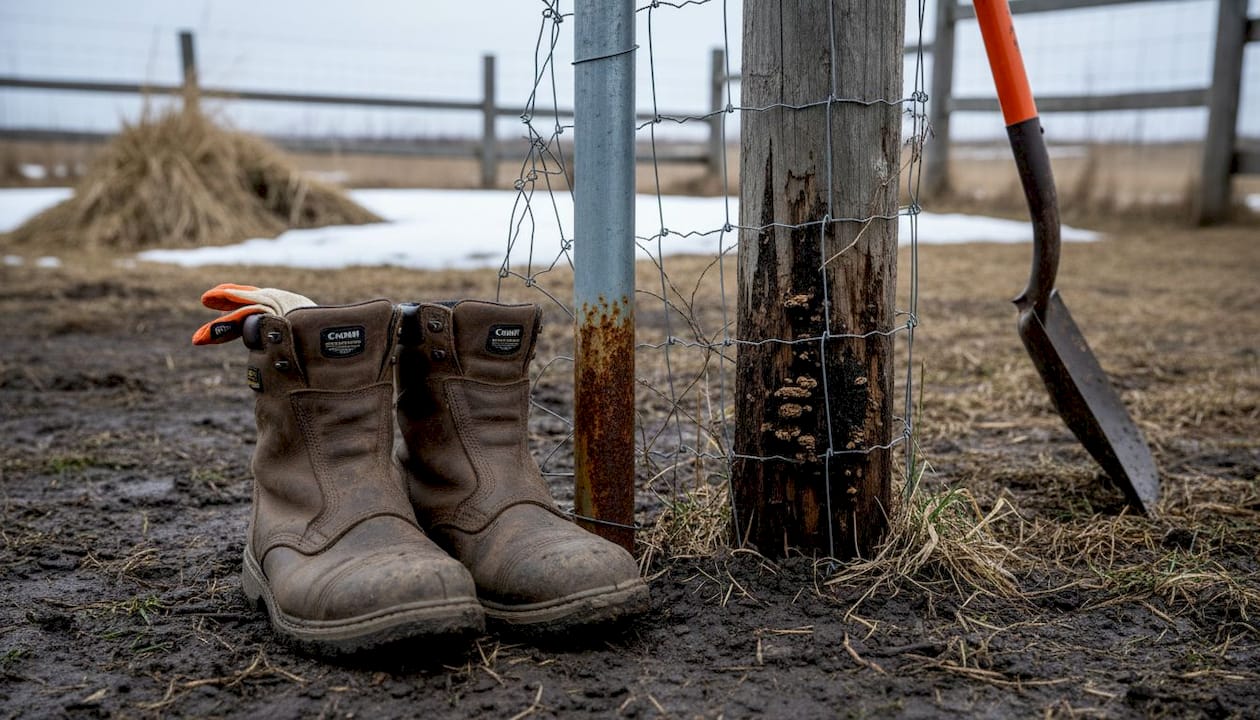
Permanent fencing is the gold standard for outer boundaries. Woven wire with a barbed or smooth wire topper, or high-tensile electric fence with permanent posts, provides decades of reliable containment with minimal maintenance once properly installed. The durability of permanent systems is unmatched. A well-built fence from quality materials, installed correctly, will outlast the original farmer who built it. The limitation is obvious. Once it’s in, it stays there. Terrain changes, drainage improvements, or land purchases can make permanent fencing a sunk cost if your property layout evolves.
Portable electric fencing fills the gap between the permanent outer perimeter and the flexible interior management system. Polywire, step-in posts, and battery-powered energizers let you divide pastures, set up temporary sacrifice areas during wet seasons, and manage grazing rotation without committing to permanent infrastructure. The trade-off is that portable systems require constant attention. Posts tip over, wire sags, and energizers need charging or battery replacement. Over a long boundary, the labor adds up fast.
The portable fencing benefits are most compelling when used inside a strong permanent perimeter rather than as a replacement for it.
Virtual fencing using GPS-enabled collars like the Gallagher eShepherd system represents the newest category. Animals wear solar-powered neckbands that deliver an audio and mild electric cue when they approach a digitally set boundary. You adjust boundaries through an app rather than physically moving wire. The technology is impressive and genuinely useful for large, remote acreages where traditional fencing is cost-prohibitive.
However, as research shows, virtual fencing requires training for animals to respond reliably, and physical perimeter fencing remains an essential foundation. Virtual systems work best as a management layer on top of a physical perimeter, not instead of one. Understanding virtual fencing costs upfront helps set realistic expectations for what is still a significant technology investment.
Pros and cons summary:
- Permanent fencing: Long lifespan, low maintenance, not flexible, higher upfront cost
- Portable electric: Flexible, low upfront cost, labor intensive, shorter lifespan per unit
- Virtual fencing: Maximum flexibility, requires training period, technology dependent, high initial investment
Situational recommendations: Choosing the right perimeter fencing
Next, let’s put this comparison into practice by helping you select what fits your unique situation. The best fence for your operation depends on at least four intersecting factors: livestock species, property size, terrain complexity, and available budget.
Matching fencing to livestock type:
- Cattle: High-tensile wire or woven wire with electric topper. Cattle respect electric fences quickly after conditioning, making them cost-effective for large perimeters.
- Horses: Smooth board, polymer rail, or high-visibility electric tape. Horses panic easily and can injure themselves severely on barbed wire. Never use barbed wire for horse perimeters.
- Sheep and goats: Woven wire with tight bottom spacing (2 to 4 inches at the base). Goats in particular are skilled escape artists and will find every gap.
- Pigs: Electric fence at pig nose height (about 8 inches from ground) combined with a physical board or wire barrier works extremely well. Pigs root under barriers, so bottom tension is critical.
- Poultry: Poultry netting or electric poultry mesh, with overhead protection in predator-heavy areas.
Terrain considerations: Rocky ground makes post driving difficult and expensive, favoring surface-mounted or cliff-anchored posts. Soft, wet soils require treated or steel posts with larger footings to prevent heaving during freeze-thaw cycles. Sloped terrain needs braced corners more frequently than flat ground, roughly every 300 feet rather than every 600 feet on a flat run.
As noted earlier, permanent fencing in the $1.25 to $3.50 per foot range represents long-term value that portable systems rarely match on a fixed boundary. That said, if your operation changes layout frequently, the flexibility premium of portable systems may justify the ongoing cost.
Budget sequencing strategy: Build your permanent perimeter first. Then add portable interior division fencing as cash flow allows. Consider virtual fencing only after the perimeter is secure and your animals have a stable home range to be managed within.
Pro Tip: Talk to a fencing specialist before you buy anything. Operations with unusual terrain, multiple livestock species, or ambitious grazing rotation goals can save thousands by getting the system design right before the first post goes in the ground. Reviewing expert fencing solutions can also help narrow your options before committing to a material type.
For farmers planning ahead to 2026 and beyond, the portable outdoor fencing guide covers how portable systems are evolving to better complement permanent infrastructure.
Our perspective: The real value of perimeter fencing in modern Canadian agriculture
After more than 26 years supplying fencing solutions to Canadian farmers and ranchers, we have a clear-eyed view of how the industry is changing and what genuinely holds true regardless of trends.
Virtual fencing technology is exciting. We carry the Gallagher eShepherd system and have seen it do remarkable things on large range operations where building physical fence is genuinely impossible. But we want to be direct with you: virtual fencing is an emerging alternative that requires real investment in animal training, technology infrastructure, and ongoing management. It is not a shortcut around physical fencing.
The farms we see thriving over the long term are the ones that invested early in a strong physical perimeter and then layered smarter management tools on top. They are not choosing between physical and virtual. They are using both, strategically.
There is also a mindset issue worth naming directly. Many producers we speak with think of fencing as a cost to minimize. That framing leads to decisions that hurt operations over 5 to 10 years. Under-built perimeters fail faster, invite predator pressure, create liability exposure, and erode the grazing management control that makes rotational systems profitable.
There are a lot of virtual fencing myths circulating right now, including the idea that it eliminates the need for physical boundaries entirely. It does not. The physical fence is the foundation. Everything else builds on top of it.
Our honest recommendation after working with thousands of operations: build the perimeter right the first time, with quality materials appropriate for your terrain and livestock, and do not cut corners on corners and gates. That single decision will pay you back for the next 20 to 30 years.
Find fencing solutions for your farm
If this article has helped you think through your perimeter fencing needs, the next step is finding the right products and expert support to turn that thinking into action.
At FenceFast, we supply Canadian farmers and ranchers with everything from permanent wire and post systems to portable electric setups and Gallagher eShepherd virtual fencing technology. We also help clients navigate government funding programs like OFCAF and BMP grants that can offset significant portions of fencing investment. Our team includes fencing specialists who can review your operation’s layout and livestock needs before you spend a dollar on materials. Whether you are building a new perimeter from scratch, upgrading aging infrastructure, or exploring virtual fencing as a management layer, we have the products, the knowledge, and the experience to help you get it right.
Frequently asked questions
How much does it cost to install permanent perimeter fencing in Canada?
Permanent fencing costs between $1.25 and $3.50 per foot, and while the upfront investment is significant, long-term expenses are lower than continuously maintaining portable systems along fixed boundaries.
Is virtual fencing a good replacement for physical perimeter fencing?
Virtual fencing is a powerful management tool, but physical perimeter fencing remains essential as the foundation because virtual systems require animal training periods and depend on technology reliability that physical fences do not.
What types of fencing are best for different livestock?
Cattle do well with high-tensile or woven wire with an electric topper, horses need smooth or polymer rail without barbed wire, and sheep and goats require tightly spaced woven wire at the base. Permanent fencing at $1.25 to $3.50 per foot is generally the best long-term choice for cattle perimeters specifically.
How does perimeter fencing help protect the environment?
Perimeter fences keep livestock out of streams, wetlands, and riparian zones, which prevents bank erosion, reduces water contamination from manure, and supports healthy aquatic ecosystems that benefit the entire watershed your farm sits within.
Recommended
- Portable fencing advantages for Canadian farms: boost efficiency – FenceFast Ltd.
- Agricultural fencing in Canada: choosing durable solutions – FenceFast Ltd.
- Perimeter Fence Installation Guide for Farms and Rural Sites 2025 – FenceFast Ltd.
- Best poultry fencing solutions for safe Canadian flocks – FenceFast Ltd.

