

TL;DR:
- The cost to install farm fences ranges from $2 to $30 per linear foot, depending on materials and terrain. Labor costs often account for half or more of the total expense and can vary significantly based on site complexity. Proper planning, material selection, and understanding hidden costs help property owners stay within budget.
The cost of installing farm fences runs from $2 to $30 per linear foot, depending on materials, labor, terrain, and fence type. Most rural property owners spend between $3,000 and $15,000 to fence a 10-acre perimeter. That wide range reflects real differences in what you’re building and where. Barbed wire on flat pasture sits at the low end. Premium wood post and rail on rocky ground sits at the high end. Understanding what drives your number is the fastest way to build a realistic fence installation budget.
What factors most affect the cost of installing farm fences?
Material choice is the single biggest cost lever in any farm fencing project. Barbed wire costs $1.50 to $3.00 per linear foot installed, while premium wood rail systems can reach $39 per foot. That gap is not just about aesthetics. It reflects post spacing, wire count, hardware weight, and how long the fence will hold up before needing repair.
Labor is the second major driver, and it often surprises first-time buyers. Professional labor represents 50% or more of total project cost on most installations. That means a $10,000 fence job could include $5,000 or more in labor alone. Terrain is what makes labor costs unpredictable. Rocky soil or heavy brush can increase labor cost by 35% or more compared to a flat, clear field.
Perimeter shape adds another layer of complexity. Irregular or multi-paddock layouts require more corner posts, more H-braces, and more specialized hardware than a simple rectangle. Each corner brace is a structural anchor that takes time and skill to set correctly. A property with six paddocks costs significantly more per foot than one with a single square perimeter.
Pro Tip: Sketch your fence layout before requesting quotes. A simple rectangular perimeter uses fewer posts and braces than an L-shaped or irregular boundary. Reducing corners by even two or three can cut material and labor costs noticeably.
Hardware costs are easy to underestimate. Gates typically cost $200 to $400 each, and brace sets, tensioners, staples, and post caps all add up beyond the raw per-foot estimate. A project with four gates and multiple paddock entries can add $1,500 or more in hardware before a single post is driven.
Key cost factors to track in your budget:
- Material type: barbed wire, woven wire, high-tensile electric, wood rail, or cattle panels
- Labor rate: varies by region, terrain, and project complexity
- Perimeter length: directly determines material volume and post count
- Corner and brace count: each H-brace adds material and skilled labor time
- Gates and hardware: often 10–15% of total project cost
- Site prep: clearing brush, grading, or removing old fence adds cost before installation begins
How do different farm fence types compare in cost and suitability?
Farm fencing cost per acre varies widely by fence type. Fencing one acre of land, which covers roughly 836 linear feet of perimeter, ranges from $1,250 to $10,900 for typical agricultural options. Premium framed hog wire can push that figure to $31,800 per acre. Choosing the right type means matching cost, durability, and livestock species.
The table below compares the most common livestock fencing types by cost, lifespan, and best use case.
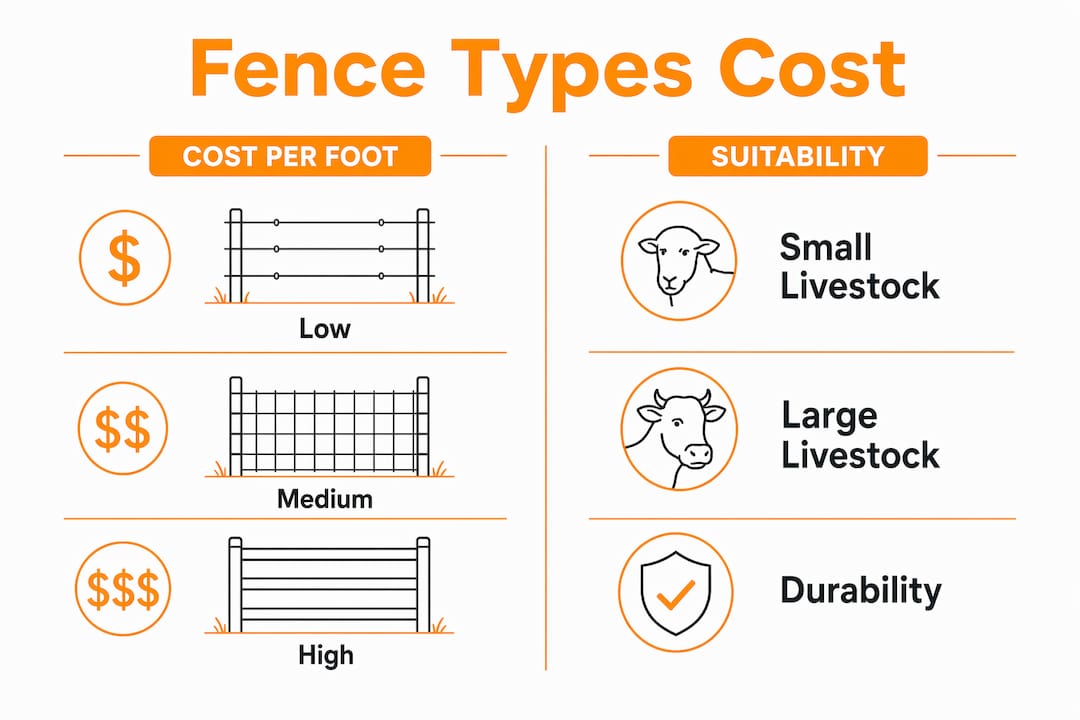
| Fence type | Cost per linear foot | Cost per acre (approx.) | Lifespan | Best use |
|---|---|---|---|---|
| Barbed wire | $1.50–$3.00 | $1,250–$2,500 | 15–20 years | Cattle, large pastures |
| Woven wire | $3.00–$6.00 | $2,500–$5,000 | 20–30 years | Sheep, goats, hogs |
| High-tensile electric | $1.50–$4.00 | Under $12,000 for 10 acres | 30+ years | Cattle, horses, multi-species |
| Wood post and rail | $10.00–$39.00 | Varies widely | 20–30 years | Horses, aesthetic properties |
| Cattle/hog panels | $15.00–$30.00 | $12,500–$31,800 | 20–25 years | Hogs, small paddocks, pens |
Barbed wire is the cheapest option upfront, but frequent repairs increase maintenance labor over its lifespan. It works well for large cattle pastures where containment is the primary goal and livestock pressure on the fence is low. It is not suitable for horses, which can injure themselves on the wire.
High-tensile electric fencing is the strongest value over time. Properly tensioned high-tensile wire can last 30 or more years with minimal upkeep. It uses fewer posts than woven wire, which reduces both material and labor costs. The trade-off is that livestock must be trained to respect the electric charge, and the energizer requires reliable power or a solar backup.
Woven wire is the go-to choice for sheep, goats, and hogs because it physically blocks animals rather than relying on a shock deterrent. It costs more per foot than barbed wire but holds up better under pressure from smaller, more persistent animals. For a full breakdown of fencing cost per acre by fence type, the differences become even more significant at scale.
What are labor and installation costs for farm fencing?
Labor costs are where most farm fencing budgets go wrong. Property owners focus on material prices and forget that installation is often the larger number. On complex projects with difficult terrain, labor can exceed material costs entirely.
Here is how a typical professional installation breaks down:
- Site assessment and layout: Measuring, staking corners, and marking post locations. This step determines post count and hardware needs before any digging begins.
- Post driving or setting: The most labor-intensive phase. Rocky or compacted soil requires pneumatic or hydraulic post drivers, which add equipment rental or contractor fees.
- H-brace construction: Corner bracing and H-braces are structural anchors that require precise placement and more materials than standard line posts. They are often overlooked in per-foot estimates.
- Wire installation and tensioning: High-tensile wire must be tensioned correctly to hold its shape and effectiveness. Improper tensioning leads to sagging and early failure.
- Gate hanging: Each gate requires level posts, heavy hardware, and careful alignment. A gate that sags or binds is a daily frustration and a security risk.
- Final inspection and adjustments: Checking tension, post plumb, and gate swing before the job is signed off.
Pro Tip: Get at least three quotes from local fencing contractors and ask each one to break out labor and materials separately. A contractor who bundles everything into one number makes it impossible to compare fairly or identify where costs can be trimmed.
DIY installation can reduce total project cost by 40% to 60% by eliminating labor fees. That saving is real, but it comes with conditions. You need access to a post driver, wire stretcher, and crimping tools. You also need the physical stamina for a multi-day project and the knowledge to set braces correctly. A poorly set H-brace will cause the entire fence line to sag within a season.
Steep or rocky terrain requires custom techniques like stepped fence lines, which increase labor time beyond simple linear foot estimates. If your property has significant grade changes, budget for the extra time. Flat ground is the exception on many rural properties, not the rule.
How can rural property owners reduce farm fence installation costs?
Smart planning before the first post goes in is the most effective way to control your fence installation budget. The decisions you make on paper cost nothing. The decisions you make mid-project cost double.
Practical ways to keep costs in check:
- Choose materials based on total ownership cost, not just upfront price. Barbed wire is cheap to install but expensive to maintain. High-tensile electric costs more upfront and delivers lower lifetime cost through reduced repairs and longer service life.
- Minimize perimeter length. A square or rectangular paddock uses less fencing than an irregular shape covering the same area. Every foot of fence you eliminate saves on both materials and labor.
- Do partial DIY where you have the skills. Many farmers hire professionals for post setting and H-brace construction, then handle wire stringing and stapling themselves. This hybrid approach captures meaningful savings without taking on the hardest technical work.
- Buy materials in bulk. Wire, staples, and insulators cost less per unit at volume. Buying for the full project upfront avoids mid-project price increases and delivery fees.
- Account for every hidden cost. Gates, energizers, corner braces, tensioners, and post caps are not optional extras. Budget for them from the start, not as afterthoughts.
- Set a contingency of 10–15% of total budget. Unexpected rock, buried debris, or drainage issues are common on rural properties. A contingency fund prevents a surprise from stopping the project.
For more detailed planning guidance, the rural property fence tips from Fencefast cover layout planning, material selection, and maintenance scheduling in practical terms.
Key Takeaways
The cost of installing farm fences ranges from $2 to $30 per linear foot, with materials, labor, terrain, and fence type determining where your project lands in that range.
| Point | Details |
|---|---|
| Cost range per foot | Farm fence installation runs $2–$30 per linear foot depending on material and terrain. |
| Labor is half the budget | Professional labor represents 50% or more of total project cost on most installations. |
| High-tensile electric wins long-term | Properly tensioned high-tensile wire lasts 30+ years, delivering the lowest lifetime cost. |
| Hidden costs add up fast | Gates, braces, tensioners, and hardware can add $1,500 or more beyond per-foot estimates. |
| DIY saves 40–60% | Removing labor fees cuts total cost significantly, but requires proper tools and skill. |
What I’ve learned about farm fencing costs after years in the field
The most common mistake I see rural property owners make is treating the per-foot price as the whole story. It is not. A $2 per foot barbed wire fence on a 10-acre property sounds like a bargain until you factor in three repair seasons, sagging wire, and livestock escapes that cost more in time and stress than the fence ever saved.
The second mistake is underestimating terrain. I have seen projects where flat-ground quotes were applied to properties with rocky outcroppings and significant grade changes. The final bill was 40% higher than expected. Walk your fence line before you get a quote. Know where the hard spots are.
My honest recommendation: spend more time on material selection than on negotiating labor rates. A contractor who does quality work at a fair price is worth more than the cheapest bid on a fence that fails in year three. And if you are considering high-tensile electric fencing, take the time to understand energizer sizing and livestock training. The fence only works if the animals respect it.
Total ownership cost is the right metric. Not install price.
— Juiced
Fencefast has the tools and supplies to get the job done right
Rural fencing projects demand reliable tools and quality materials. Cutting corners on equipment leads to loose wire, failed braces, and fences that need rework before the season ends.

Fencefast carries the Hayes Fencing and Crimping Tool, a professional-grade tool built for efficient high-tensile wire installation on farm and ranch projects. For electric fence systems, the Gallagher Live Lite energizer delivers consistent power for high-tensile and multi-wire setups. Fencefast ships nationwide across Canada and stocks fencing components, hardware, and accessories for cattle, horses, hogs, and more. Browse the full catalog at fencefast.ca to find what your project needs.
FAQ
What is the average cost to fence a 10-acre farm?
Most property owners spend between $3,000 and $15,000 to fence a 10-acre perimeter, depending on fence type, terrain, and whether installation is DIY or professional.
What is the cheapest farm fencing option?
Barbed wire is the least expensive option at $1.50 to $3.00 per linear foot installed, but it requires more frequent repairs than high-tensile or woven wire alternatives.
How much does labor add to farm fence installation price?
Labor typically represents 50% or more of total project cost. Difficult terrain, rocky soil, or complex layouts can push labor costs even higher.
Does DIY farm fencing actually save money?
DIY installation can reduce total project cost by 40% to 60% by eliminating labor fees, but requires access to proper equipment like a post driver and wire stretcher.
What hidden costs should I budget for in a fencing project?
Gates, corner braces, tensioners, staples, and energizers are common costs that fall outside basic per-foot estimates. Budget a 10–15% contingency on top of your material and labor quotes to cover site surprises.
Recommended
- How to Install Fence Wire: Guide for Landowners & Farmers 2025 – FenceFast Ltd.
- How to Build a Field Fence for Livestock and Property – FenceFast Ltd.
- Fence installation steps for Canadian farms: A practical guide – FenceFast Ltd.
- How to Build a Fence: Step-by-Step Guide for Rural Properties 2025 – FenceFast Ltd.


Looking for game fence 1.8m× 400metres