

TL;DR:
- Goat-proof fencing requires at least 48 inches in height and 2x4 inch woven wire mesh to prevent escapes and injuries. Incorporating electric wire, secure gates, and proper installation techniques enhances containment and predator deterrence effectively. Regular maintenance, strategic design, and environmental considerations ensure long-term goat safety and fence durability.
If you’ve raised goats for more than a season, you already know the truth: a standard livestock fence is basically an obstacle course they’re eager to beat. Applying real goat proof fencing tips means thinking beyond basic wire and posts. Goats climb, push, test weak spots, and exploit every gap. And while escapes are frustrating, predator losses are devastating. This guide covers the materials, designs, and installation methods that actually contain goats and protect them from what’s hunting them at night.
Table of Contents
- Key takeaways
- What makes fencing truly goat proof
- Comparing your best fencing options
- Installation mistakes that let goats escape
- Predator deterrence built into your fence design
- My honest take on goat fencing investments
- Build better goat fencing with Fencefast
- FAQ
Key takeaways
| Point | Details |
|---|---|
| Height and mesh matter most | Use at least 48 inches of height and 2x4 inch mesh to stop jumping and head entrapment. |
| Woven wire outperforms welded | Woven wire knots flex under pressure, while welded wire pops at seams when goats stand on it. |
| Electric wire does double duty | Strands placed inside and outside the fence train goats and deter predators simultaneously. |
| Installation depth prevents digging | Bury fence bases 1 to 2 feet deep or use a flat wire apron to stop goats and predators from digging under. |
| Gates are your biggest weak point | Goats can work open standard latches, so invest in secure, goat-resistant gate hardware. |
What makes fencing truly goat proof
Most farmers learn the hard way that the fencing rules for cattle or horses do not transfer to goats. Goats are wired differently. They probe, lean, and test every inch of a fence line looking for a way through or over it.
The single most important spec is height. Your fence needs to stand at least 48 inches tall to stop the average goat from jumping over. For larger or more athletic breeds like Boer or Nubian, going taller is worth the extra cost.
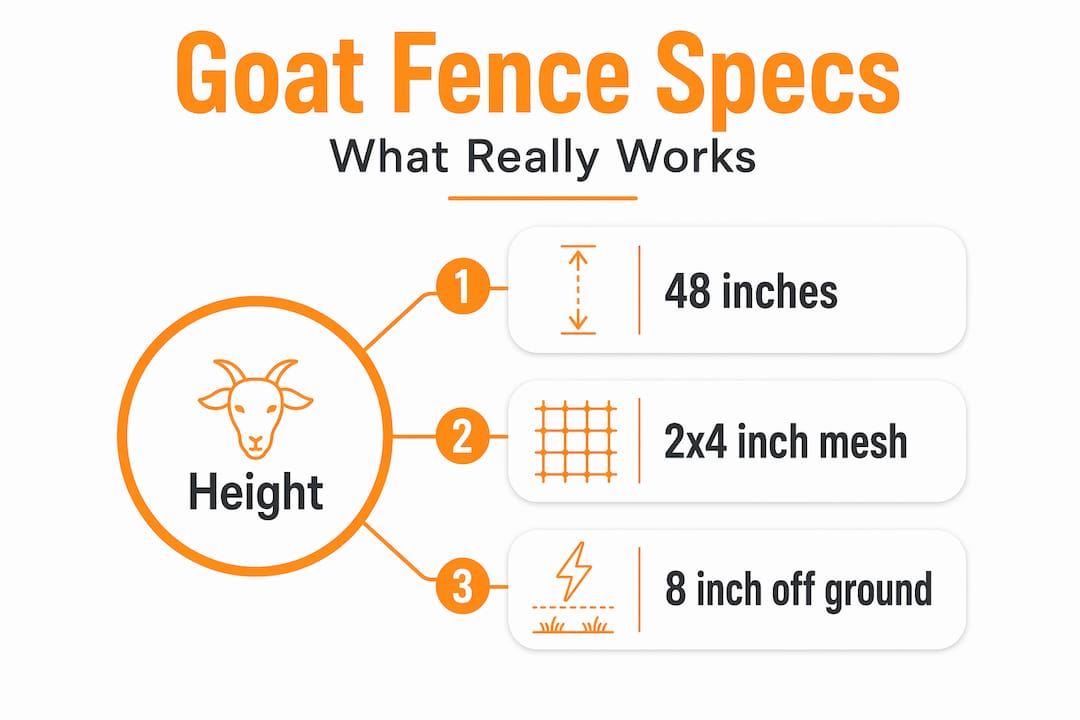
Mesh size is where a lot of setups go wrong. 4x4 inch squares trap goats’ heads, especially kids and horned breeds, leaving them exposed to predators and injury. Stick with 2x4 inch spacing or smaller across the full run of your fence. This spec alone eliminates a major failure point that catches even experienced farmers off guard.
Material strength matters just as much as geometry. Goats stand on fences constantly, and welded wire cannot handle repeated lateral pressure. The seams pop and the fence sags. Woven wire with flexible field knots holds under that same pressure because the knots move instead of breaking. This is not a marginal difference. Over two or three seasons, welded wire in a goat pen looks like it lost a fight.
Here is a quick checklist for a good goat fence baseline:
- Minimum 48 inches of fence height
- 2x4 inch mesh or no-climb woven wire throughout
- Sturdy corner bracing and properly tensioned line posts
- No gaps at gates, corners, or low spots in terrain
- Electric hot wire strands inside and outside the fence perimeter
Pro Tip: Add a single strand of electric wire about 8 inches off the ground on the inside of your fence. It trains goats to respect the fence line without depending entirely on the physical barrier to do all the work.
Comparing your best fencing options
Choosing the best fencing for goats comes down to your budget, terrain, herd size, and predator pressure. No single option wins on every front. Here is how the major types stack up.
| Fence Type | Durability | Cost | Best For |
|---|---|---|---|
| Woven wire (field fence) | Good | Moderate | Large pastures, uneven ground |
| Cattle/hog panels | Excellent | Moderate-High | Pens, high-traffic areas |
| Chain link | Excellent | High | Small, high-security enclosures |
| High tensile smooth wire | Excellent | Low-Moderate | Large acreage with electric |
| Electric net fencing | Good | Moderate | Rotational grazing, temporary use |
Woven wire is the most popular choice for large pastures. It’s flexible enough to follow uneven terrain and reasonably priced per linear foot. The key is getting the right gauge and mesh size. It works best when you add electric hot wire to handle the behavioral side of containment.
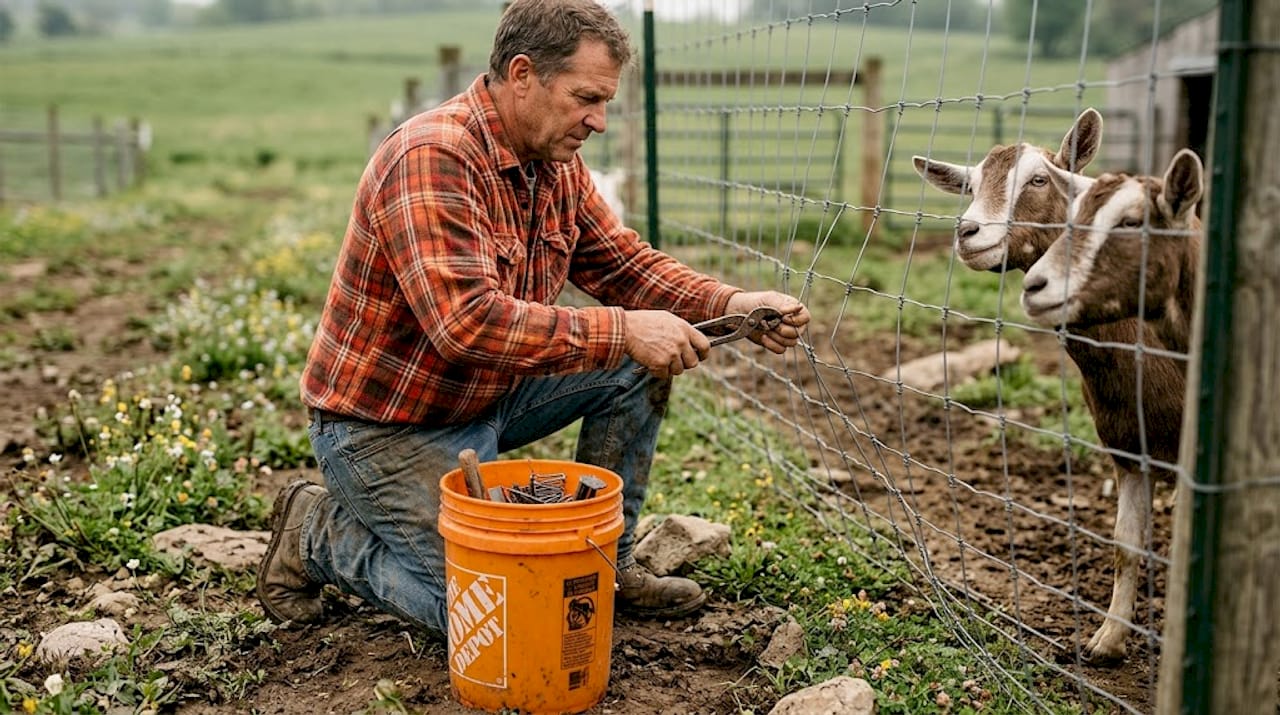
Cattle and hog panels made from heavy gauge steel are nearly indestructible. Panels keep goats contained effectively and handle constant rubbing and pressure without bending. The trade-off is cost and the fact that they come in fixed lengths, which makes them less practical for large or irregular perimeters. They shine in sacrifice lots, kidding areas, and any high-traffic pen.
Chain link is the most durable fencing option on the market but the price per foot makes it impractical for anything beyond a small, high-security pen. Think of it for buck pens or areas where breakouts are chronically expensive.
High tensile smooth wire has the longest service life of any fencing material when properly tensioned and electrified. Electrified high tensile wire lasts decades with minimal maintenance. The catch is that it requires proper energizer sizing and regular vegetation management to keep the fence charged. You can explore the specifics of high tensile wire setups for goats before committing to this approach.
Pro Tip: If your budget is tight, run woven wire for the main barrier and invest the savings into a quality energizer and two strands of electric wire. That combination outperforms expensive fencing without added protection.
Installation mistakes that let goats escape
A good fence built badly is still a bad fence. The installation details are where most goat enclosure solutions fail in the field.
-
Bury the base or use a wire apron. Burying the fence 1 to 2 feet deep prevents both goats and predators from going under. If digging is impractical, bend the bottom of the fence outward along the ground and stake it flat. Predators that try to dig hit wire immediately and typically give up.
-
Set posts at the right spacing. Line posts every 8 to 12 feet keep tension consistent and prevent sagging. In soft soil, go closer. Sagging sections are an open invitation for a determined goat to push through or belly under.
-
Tension woven wire correctly from the start. Loose wire sags faster and creates gaps at ground level. Use a fence stretcher and work in sections. Poorly tensioned fence is one of the most common reasons an otherwise good fence fails within the first year.
-
Check and maintain fasteners regularly. Staples pull out, clips loosen, and gates shift off-plumb over time. Goats work gate latches skillfully and will figure out a poorly secured gate faster than you expect. Walk your fence line once a month and fix small problems before they become breakouts.
-
Address terrain transitions. Creeks, ditches, and slopes create natural gaps at ground level. These spots need extra attention during installation. Use ground staples, extra wire, or concrete to close off anything a goat could exploit.
Pro Tip: Carry a spool of baling wire and a pair of pliers on every fence inspection. Small repairs take two minutes on the spot and save you from a full escape response two weeks later.
Predator deterrence built into your fence design
A fence that keeps goats in but lets predators through is only half a fence. A single determined dog can destroy an entire goat herd quickly, and that threat is real whether you’re dealing with domestic dogs, coyotes, or wolves depending on your region.
Electric hot wire on both sides of the fence is the most effective predator deterrent you can add to any physical fence. Place one strand on the inside at goat shoulder height to keep goats off the fence, and one or two strands on the outside at predator nose height, roughly 6 to 10 inches off the ground. A coyote that gets shocked investigating the fence will typically avoid that area long-term.
Here are the core strategies for predator-resistant fencing:
- Use electric wire on the outside of the fence at predator nose height
- Close any gaps at the base with buried wire or flat wire aprons
- Install self-closing, predator-proof gate hardware that cannot be nudged open
- Avoid designs with horizontal rails or ledges that give predators a climbing assist
One challenge specific to Canadian farmers is winter grounding. Standard electric fence grounding fails when the ground is frozen or snow-covered because the circuit cannot complete. Alternating positive and negative wire setups solve this completely. When an animal touches two adjacent wires, the circuit completes through the animal rather than the ground. This keeps your fence effective all winter without any special energizer modifications.
Your electric fence is only as reliable as its energizer and grounding system. Test voltage weekly during high-risk seasons and after any significant storm. A fence that reads zero volts is the same as no fence at all.
For rotational grazing setups, electric net fencing for goats provides a flexible option that combines predator deterrence with easy pasture rotation. It is not a permanent solution, but for managed grazing, it covers a lot of ground efficiently.
My honest take on goat fencing investments
I’ve watched a lot of farmers build the cheapest fence that seemed like it might work, only to spend twice as much repairing it after escapes and predator losses. The math never pencils out in favor of the shortcut. Replacing even a handful of does to a coyote attack costs more than the electric wire that would have stopped it.
What I’ve found is that electric fencing does something physical fencing alone never can. It teaches goats to respect the boundary. A goat that has been shocked once near a fence line changes its behavior around that fence permanently. That behavioral change reduces wear, reduces testing, and reduces the cumulative damage that eventually creates gaps. Thinking of the electric component as a training tool, not just a barrier, changes how you invest in it.
I’ve also learned that fence maintenance culture matters more than fence quality. The best woven wire in the world fails if nobody walks the line regularly. Build the inspection habit early. Fix small problems immediately. The farms I’ve seen hold their herds through multiple winters are not always the ones with the most expensive fencing. They’re the ones where someone checks the gate latch every single morning.
If you’re in a high-predator-pressure region or dealing with harsh freeze-thaw winters, do not treat those conditions as edge cases. Design your fence for your actual environment from the start. Adapting later costs more than building right the first time.
— Juiced
Build better goat fencing with Fencefast
If you’re serious about keeping your herd safe and contained, the materials and equipment you use matter as much as the installation. Fencefast carries woven wire, cattle panels, and electric fencing products specifically suited for goat operations across Canada, along with quality energizers, grounding systems, and gate hardware built for year-round performance in tough climates.
Whether you’re building a new perimeter or reinforcing an existing setup, Fencefast’s product catalog gives you access to durable, proven options without the guesswork. You can browse the full range online, compare specifications, and order with nationwide shipping. If you need guidance on the right combination for your property size, predator pressure, or breed, Fencefast also offers design consulting to help you build a fence that actually holds.
FAQ
What is the best type of fence for goats?
Woven wire with 2x4 inch spacing paired with electric hot wire strands is the most practical setup for most farms. Heavy gauge cattle panels work better for smaller pens or high-traffic areas where durability is the priority.
How high does a goat fence need to be?
A minimum of 48 inches is recommended for most breeds. Athletic or large breeds like Boer goats may require 60 inches to reliably prevent jumping.
How do you stop goats from digging under fences?
Bury the fence base 1 to 2 feet deep or bend the bottom of the fence outward along the ground and stake it flat. This works against both goats and digging predators.
Does electric fencing work in winter for goats?
Standard grounded electric fences lose effectiveness when soil freezes. Using a positive/negative alternating wire setup maintains reliable shocks in winter because the circuit runs through the animal rather than the ground.
How often should you inspect a goat fence?
Walk your fence line at least once a month and after any major weather event. Pay particular attention to gates, corners, and any low spots where the terrain creates a natural gap.

