

TL;DR:
- Choosing the correct fence post material, size, and installation method ensures a durable, long-lasting fence. Proper depth, appropriate reinforcement, and soil analysis are critical to preventing rot and failure over time. Regular inspections and maintenance extend post lifespan and prevent costly replacements.
Getting your fence posts wrong is the fastest way to watch a perfectly good fence lean, rot, or collapse within a few years. Knowing how to choose fence posts correctly comes down to three factors: material, size, and how you install them. Choose wisely and your fence stands straight for decades. Choose poorly and you are re-digging holes and buying replacement lumber before your neighbors have even noticed your fence. This guide covers everything you need to make a smart call, whether you are building a simple yard boundary or a heavy-duty perimeter for a working property.
Table of Contents
- Key takeaways
- How to choose fence posts: understanding your material options
- Post sizing: what dimensions actually matter
- Installation methods and soil conditions
- Common mistakes that shorten fence post life
- Keeping fence posts performing long-term
- What I have learned from years of watching fences fail
- Get the right posts for your project with Fencefast
- FAQ
Key takeaways
| Point | Details |
|---|---|
| Material drives longevity | Match post material to your soil type and climate to prevent premature rot or corrosion. |
| Size posts for load, not just height | Use 6x6 posts at corners, gates, and exposed locations where lateral stress is highest. |
| Embedment depth is non-negotiable | Bury at least one-third of post length underground, deeper for taller or wind-exposed fences. |
| Concrete can backfire | Improperly shaped concrete collars trap moisture and accelerate wood rot at the post base. |
| Maintenance extends lifespan | Regular inspection and treatment add years to even average-quality posts. |
How to choose fence posts: understanding your material options
The material you choose sets the ceiling on how long your fence lasts. No amount of careful installation will save a post made from the wrong material for your conditions.
Wood posts
Pressure-treated wood is the most widely used post material for good reason. It is cost-effective, easy to cut and install, and widely available. Not all treated wood is equal, though. AWPA UC4B and UC4C ratings indicate whether the wood is rated for standard ground contact or for high-hazard, high-moisture environments. If your fence is going near water, in heavy clay, or on a property with consistently wet soil, UC4C is the right call.
Hardwoods like cedar and black locust offer natural rot resistance without chemical treatment, but they cost significantly more and can be harder to source. For a Canadian farm setting, pressure-treated posts with proper ratings typically offer the best balance of cost and performance.
Metal, vinyl, and concrete posts
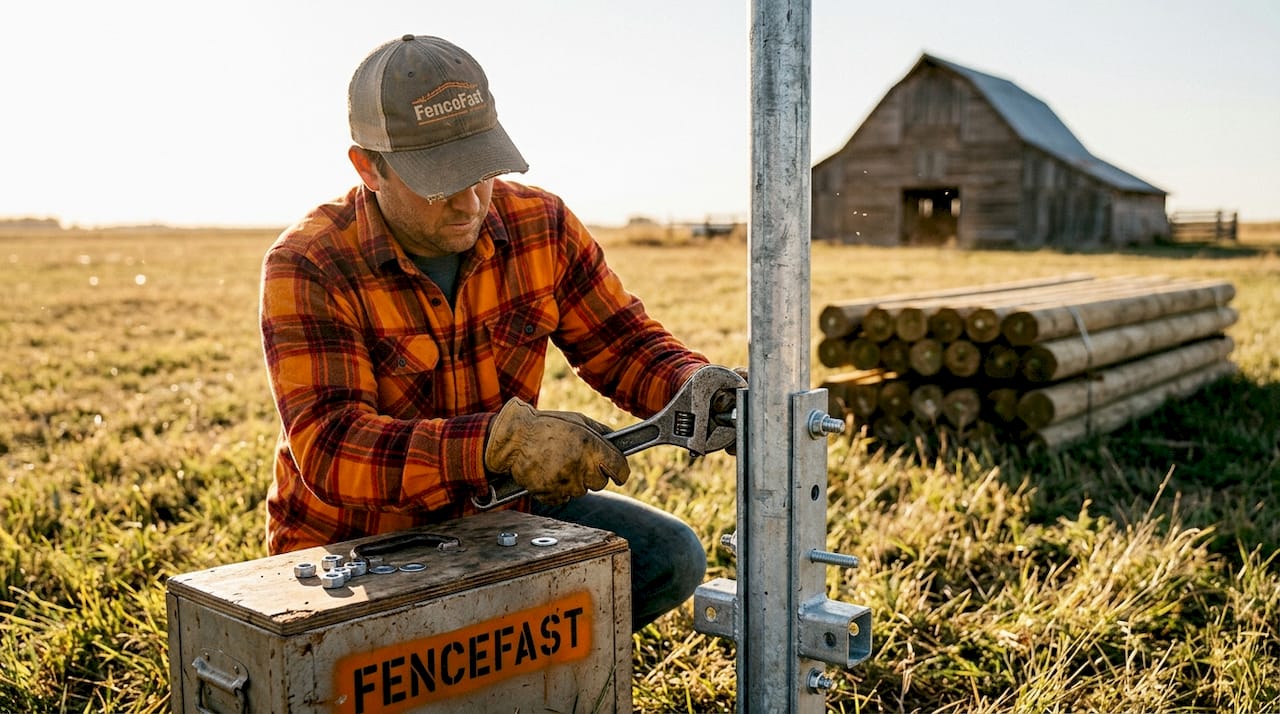
Galvanized steel posts are exceptionally strong and work well in high-wind zones or where livestock pressure is a concern. They do not rot, and they handle heavy loads without flex. The trade-off is cost and the challenge of cutting them to custom lengths on site.
Vinyl posts last 20 to 25 years and resist fading, rot, and pests. They are gaining popularity among homeowners who want low maintenance and clean aesthetics. The catch is that vinyl can lack internal reinforcement unless you specifically check for it. A vinyl post that looks solid can actually flex significantly under load without a steel insert inside.
Concrete posts offer excellent moisture resistance and weigh over 40 kg, which makes installation physically demanding. They are most practical for humid or coastal environments where wood decay would be a recurring problem.
| Material | Durability | Maintenance | Best For |
|---|---|---|---|
| Pressure-treated wood | 20-40 years | Low to medium | General residential and farm use |
| Galvanized steel | 40+ years | Low | High-wind, livestock, heavy-load fences |
| Vinyl/PVC | 20-25 years | Very low | Residential, aesthetic-focused projects |
| Concrete | 50+ years | Very low | High-moisture, coastal environments |
| Hardwood (cedar, locust) | 20-30 years | Medium | Natural appearance, moderate budgets |
Pro Tip: If you are building near poorly drained clay soil, skip standard wood posts entirely. Clay soils accelerate wood decay faster than almost any other condition. Steel or composite posts are a smarter long-term choice in those spots.
Post sizing: what dimensions actually matter
One of the most common fence post buying guide mistakes is defaulting to whatever size the lumber yard has stacked up front. Post size has a direct relationship to fence height, load, and the specific location along your fence line.
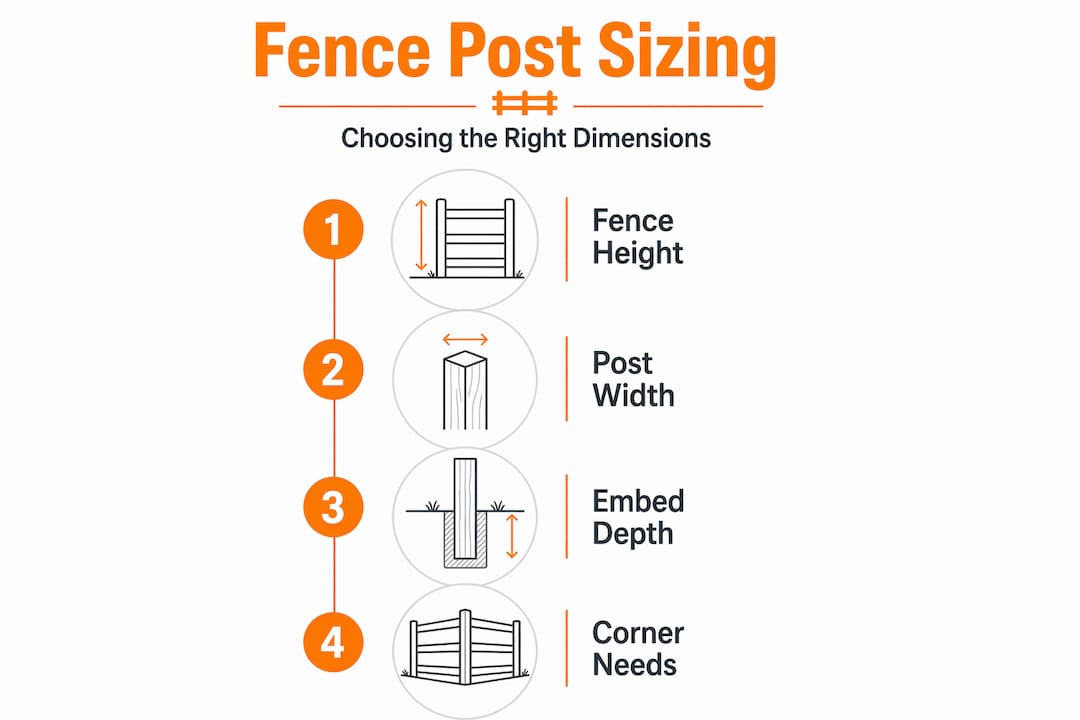
For standard residential fences up to 1.5 meters tall, a 4x4 post works fine along straight runs. But at corners, gate openings, and any exposed location facing prevailing winds, you want to step up. 6x6 posts at corners and gates offer greater strength and a longer service life. The extra wood cross-section resists the rotational and lateral forces that cause posts to lean over time.
Embedment depth rules that actually work
Getting the depth right is where a lot of homeowners cut corners, literally. The reliable rule of thumb is burying at least one-third of the total post length. In practice, this means:
- Fences up to 1.2 meters high: bury at least 600mm
- Fences between 1.5 and 1.8 meters: bury 750 to 900mm
- Gate and corner posts: always add 150 to 200mm beyond the standard depth
Frost line depth matters too. In colder regions, posts set above the frost line will heave over winter. Your local building department can tell you the frost depth for your area. Do not guess on this one.
Pro Tip: For a site-specific approach, account for both soil bearing capacity and local wind speed rather than relying on generic depth tables. Site-specific analysis consistently outperforms standard rules of thumb for long-term fence stability.
Post shapes matter depending on application. Round posts work well for agricultural and ranch fencing where aesthetics are secondary to function. T-posts are widely used for wire fencing because they drive quickly and resist lateral movement from wire tension. Square posts suit residential and decorative applications and pair naturally with wood or vinyl panel systems. For a closer look at how these differences play out in practice, the post and rail fencing guide from Fencefast breaks down options by project type.
Installation methods and soil conditions
Even the best post, made from the right material and cut to the right size, will fail early if installed incorrectly. Installation technique is where many otherwise well-planned fencing projects fall apart.
Here is how to approach the main installation decisions in the right order:
- Assess your soil first. Sandy soil drains well but holds posts loosely. Clay soil holds posts firmly but stays wet, which accelerates wood rot. Poorly drained ground of any type favors steel, composite, or concrete posts over wood.
- Choose between direct burial and concrete encasement. Direct burial with compacted gravel at the base works well for steel and composite posts. For wood posts, concrete encasement provides lateral strength. However, concrete can trap moisture at the wood base and cause rot faster than expected if the collar is not shaped correctly.
- Shape and position the concrete collar properly. If you use concrete around a wood post, extend it slightly above grade and slope it away from the post so water sheds outward. This single step dramatically reduces rot at the most vulnerable point on any buried wood post.
- Use a gravel base regardless of method. Placing 100 to 150mm of gravel at the bottom of any post hole improves drainage and reduces the moisture exposure that causes decay.
- Surface mount posts for hard surfaces. When your fence runs across a concrete pad, deck, or paved surface, flange posts are the right solution. Flange posts bolt directly to the substrate and allow for straightforward replacement without breaking up the surface. Anchor quality and slab thickness determine load capacity, so do not skimp on the hardware.
Gate posts and corner posts need deeper footings and, in many cases, diagonal bracing. These two locations carry more stress than any straight section of fence. Treat them differently from the start.
Pro Tip: Always check your fence installation steps before you set a single post. What happens underground determines everything above ground.
Common mistakes that shorten fence post life
Knowing the right approach is only half the equation. Recognizing what goes wrong on real projects gives you a fighting chance to avoid repeating those errors.
- Using undersized posts at high-stress points. A 4x4 post at a gate opening carrying a heavy gate will lean within a few seasons. Undersized posts at corners or gates are among the most common causes of early fence failure.
- Shallow footings that ignore frost depth. A post set at 400mm in a region where the frost line drops to 700mm will move every winter and never fully recover.
- Letting concrete collar water pool at the post base. Flat or inward-sloping concrete creates a moisture trap. This is the single most preventable cause of wood post rot in concrete-set installations.
- Ignoring soil drainage. Choosing pressure-treated wood in a spot where water sits for days after rain is a slow-motion failure. The treatment buys time but does not eliminate the problem.
- Skipping bracing at corners and gates. Even correctly sized posts can lean if there is no diagonal bracing or reinforcement to manage lateral forces at these high-load locations.
Recognizing these patterns before you break ground saves both time and money. The best fence post buying guide advice is deceptively simple: oversize where it matters most and never cut depth to save time.
Keeping fence posts performing long-term
Getting posts in the ground correctly is the hard part. Keeping them performing well is straightforward if you stay consistent.
- Inspect wood posts at ground level every spring and fall. Preventative treatments and inspections extend post service life beyond what the material alone provides. Press a screwdriver firmly against the wood at and just below grade. Soft spots mean decay has started.
- Apply a penetrating wood preservative to the above-grade sections of wood posts every two to three years. Pay extra attention to the cut tops of posts, where end-grain absorbs moisture rapidly.
- For metal posts, check for surface rust at the soil line annually. Wire-brush any rust spots and apply a rust-inhibiting primer before the problem spreads.
- Vinyl posts need little more than occasional cleaning. Check that any internal steel reinforcement is still doing its job by testing for flex. Unexpected give in a vinyl post usually means the insert has shifted or corroded.
- After a hard winter, walk your entire fence line and check for leaning. A post that has moved 5 degrees is a warning. A post that has moved 15 degrees needs immediate attention before it transfers stress to adjacent sections.
Pro Tip: Mark any leaning posts with flagging tape during your inspection walk. This way, you can address all repairs in one focused session rather than making multiple trips back to the same area.
What I have learned from years of watching fences fail
I have seen expensive fences fail in under five years and modest fences standing straight after twenty. The difference almost never comes down to the panels or rails. It comes down to what is in the ground.
The most persistent myth I run into is that more concrete automatically means a stronger post. I have watched that logic backfire repeatedly. When concrete is poured flat around a wood post and left to collect water, it accelerates exactly the rot it was supposed to prevent. The fix is simple but almost nobody does it during installation because it takes two extra minutes. Shape the collar to shed water. That is it.
The second thing I would push back on is the idea that standard embedment tables cover every situation. If your property sits in a wind corridor, or your soil drains poorly, generic rules underserve you. Spend ten minutes researching your specific conditions before you settle on post size and depth. You will recalibrate your decisions in ways a generic chart never would.
Aesthetics matter too. I have seen homeowners choose vinyl because it looks clean and low maintenance, which is true, then install it without internal reinforcement and wonder why their fence looks wavy within a few seasons. Get the structural part right first. The appearance follows.
— Juiced
Get the right posts for your project with Fencefast
Choosing the right fence posts is only the first step. Sourcing quality materials that match your specific application makes all the difference in how long your fence actually lasts.

Fencefast carries a wide selection of fencing posts, accessories, and components suited to everything from residential yard fences to heavy-duty agricultural perimeters across Canada. Whether you need pressure-treated posts for a standard installation, steel options for a high-load zone, or guidance on what works best in your soil and climate, Fencefast has the product range and the expertise to point you in the right direction. Visit Fencefast to browse the full product catalog, or check out the top fencing materials comparison to narrow down your options before you buy. Nationwide shipping means the right materials reach you wherever your project is located.
FAQ
What is the right depth for fence post installation?
Bury at least one-third of the total post length. For fences between 1.5 and 1.8 meters tall, that means 750 to 900mm of depth, with gate and corner posts going deeper for added load resistance.
Are 4x4 or 6x6 posts better for fences?
4x4 posts work for standard straight runs on residential fences, but 6x6 posts are stronger and recommended for corners, gate openings, and locations exposed to high wind or lateral load.
Does concrete make fence posts stronger or cause problems?
Concrete adds lateral stability, but it can trap moisture at the base of wood posts and accelerate rot if the collar is poured flat. Sloping the concrete collar away from the post at grade level prevents this problem.
Which fence post material lasts longest?
Concrete and galvanized steel posts offer the longest lifespan, often exceeding 40 to 50 years. Vinyl posts typically last 20 to 25 years with very little maintenance. Pressure-treated wood with UC4B or UC4C ratings is the most practical choice for most residential and agricultural applications.
How do I know when a fence post needs replacing?
Press a screwdriver into the post at ground level. If the wood is soft or punky, decay has progressed enough to compromise structural integrity and the post should be replaced before it fails and stresses adjacent sections of fence.

