

Every livestock watering system boils down to three basic types: direct access, gravity flow, and pressure/pump systems. Direct access works for a small herd near a year-round creek; gravity flow suits hilly ground with a spring above the pasture; pressure systems, from solar pumps to nose pumps to portable tanks, cover everything else, including remote paddocks, rotational grazing cells, and winter climates where freeze protection matters as much as flow rate.
TL;DR:
- Gravity flow systems depend on site elevation and work best where a natural drop of at least 10 feet exists; otherwise, they are unsuitable.
- Pressure systems, such as solar, wind, or fuel-powered pumps, require careful sizing to meet peak demand, especially during hot weather peaks.
- Proper pipe sizing, including using at least three-quarter-inch or one-inch diameter after a few hundred feet, is critical to maintaining adequate water flow.
- Cold climates demand frostdrop protection through insulated troughs, buried supply lines, and protected float valves to ensure water availability year-round.
- Moving water to animals through piping or hauling significantly reduces stream degradation and pasture erosion, improving grazing distribution across the farm.
Table of Contents
- Types of Livestock Watering Systems, With Real Examples
- Sizing a System: How Much Water Your Herd Actually Needs
- Choosing a Power Source for Off-Grid Water Systems
- Installing for the Long Haul: Freeze Protection and Water Quality
- Moving Water With the Herd: Quick-Move and Wagon Systems
- Lessons From the Field: What Works and What Trips People Up
- Why Moving Water to Livestock Pays Off
- Get the Right Equipment to Build Your System
- Sources
- FAQ
Types of Livestock Watering Systems, With Real Examples
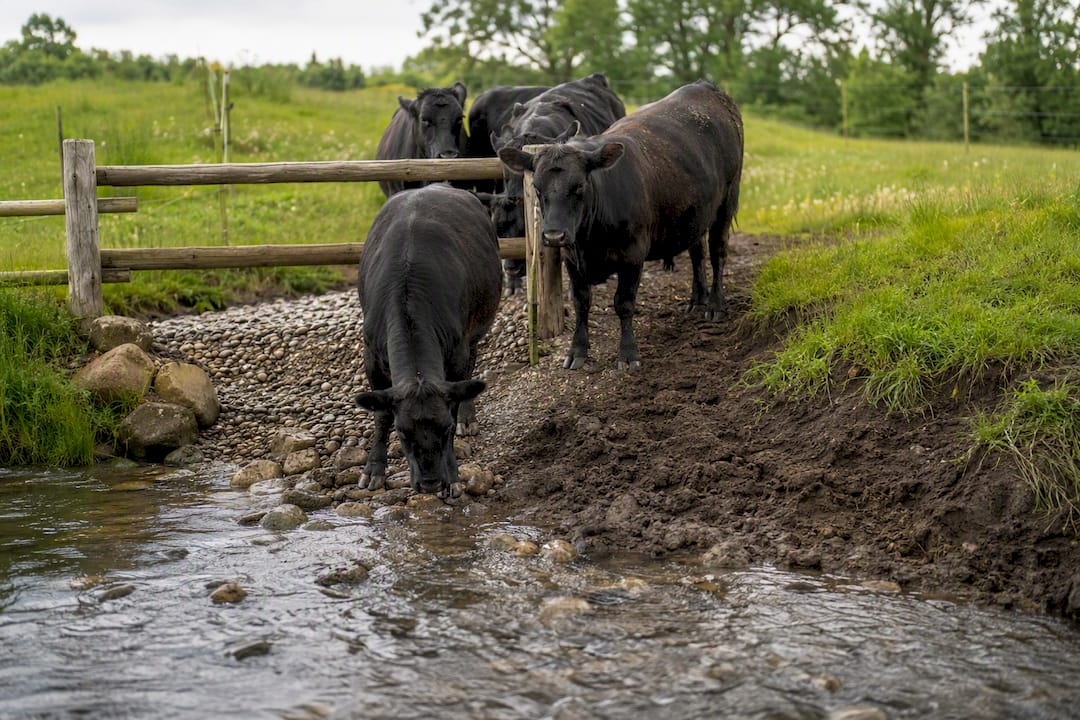
Direct access means the animals walk to the water, whether that’s a pond, creek, or dugout. It’s the cheapest option to set up and the worst for water quality and erosion — hooves churn stream banks, manure lands in the water, and algae blooms follow warm weather. A hardened access point (gravel pad, limited-entry ramp) reduces the damage without eliminating it, but most extension programs now recommend excluding livestock from the water entirely and piping water to a trough instead.
Gravity flow systems skip the pump altogether. A spring or elevated storage tank feeds troughs downhill through buried pipe, using nothing but elevation to push water. These work best where the terrain cooperates, a farm with a hillside spring fifty feet above the grazing paddocks can run a gravity system for decades without a moving part to maintain. The tradeoff is site dependency: no elevation drop, no gravity system.
Pressure systems cover the largest and most varied category, and this is where most working farms end up.
- Submersible and AC pumps pull from a well or pond and push water through pipe to storage or directly to troughs, sized to herd demand and distance.
- Solar pumps run on photovoltaic panels, often paired with a battery or a header tank for cloudy-day backup, and fit remote paddocks with no utility power nearby.
- Wind-powered pumps (classic windmills or modern wind pumps) still work in areas with consistent wind, though output varies day to day.
- Gas or diesel pumps handle high-volume, short-duration needs, useful for filling large storage tanks quickly rather than running continuously.
- Nose pumps let cattle pump their own water by nudging a lever, typically serving 20 to 30 head per unit and costing around $400, with no power source required at all.
- Ram pumps and sling pumps use the energy of flowing water itself, no electricity, no fuel, but they need a real stream and a drop in elevation to work.
Ram pumps deserve a closer look because they trip up a lot of first-time buyers. They only pump 2% to 20% of the water flowing into them, and they need a minimum driving head of roughly 10 feet to function at all. A rancher with a creek running through a flat pasture won’t get anywhere with a ram pump. Someone with the same creek dropping through a ravine might run one for years without touching a switch. Sling pumps operate on a similar principle but anchor in the stream itself, spinning a small impeller to generate lift.
Portable tanks and quick-move setups round out the list. These are typically poly tanks in the 14 to 60 gallon range, light enough to drag or wheel between paddocks, fed by hose from a central water point. Wagon-haul systems go a step further, mounting a larger tank on a trailer and physically hauling water to animals with no plumbing at all. It’s labor-intensive, but for a small herd on rented ground with no infrastructure, hauling water three times a week can beat installing a system you’ll only use for one season.
Sizing a System: How Much Water Your Herd Actually Needs
Get the math wrong here and everything downstream, literally, fails. Extension guidance sets the baseline at 30 gallons per day per 1,000 pounds of live weight at 90°F, with systems designed to meet peak demand within a 12-hour window rather than a flat daily average.
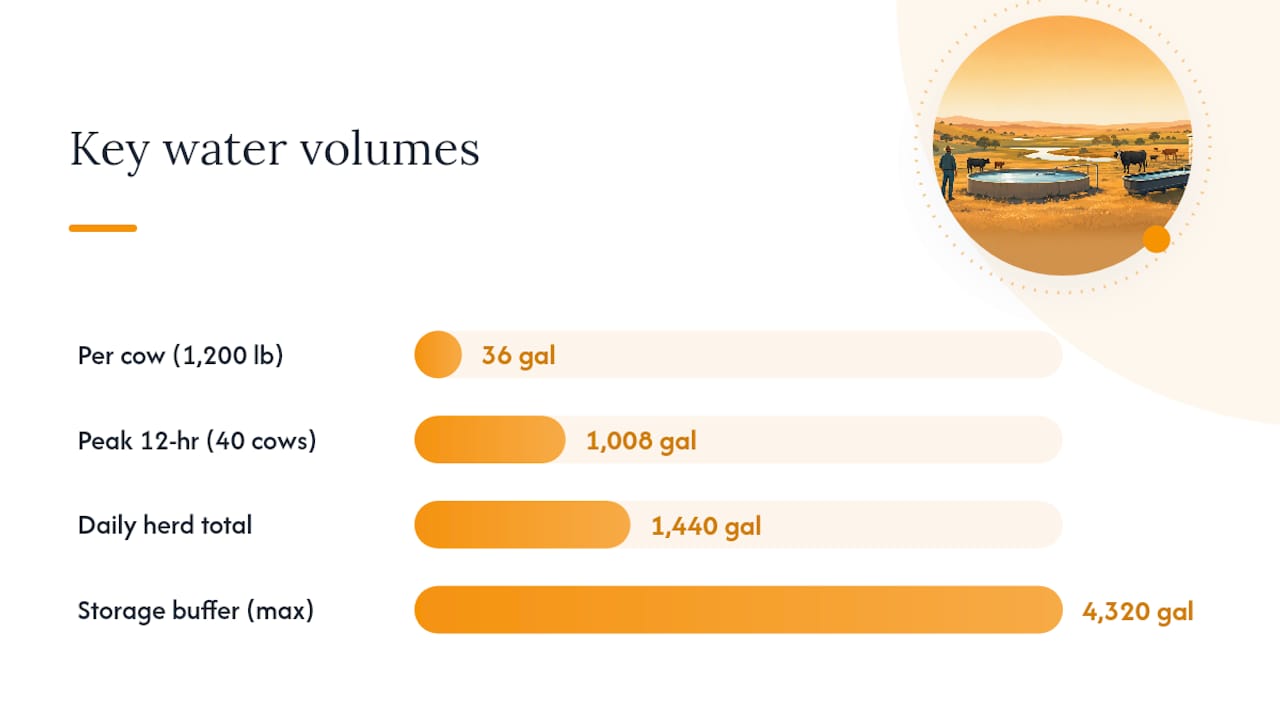
Statistic Callout: A 1,200 pound cow on a 90 degree day needs roughly 36 gallons daily. Multiply that by herd size, then check your pump and tank against peak, not average, demand.
Here’s a worked example for a 40 head cow herd averaging 1,200 pounds each:
- Daily need per animal: 36 gallons (1,200 lb ÷ 1,000 × 30 gal)
- Herd total: 40 × 36 = 1,440 gallons per day
- Peak 12-hour demand: assume 70% of daily intake happens in a 12-hour window, so roughly 1,008 gallons
- Required flow rate: 1,008 gallons ÷ 12 hours ÷ 60 minutes = about 1.4 gallons per minute, though the 2 gpm per drinking space rule means you size pump output to the number of animals that can physically drink at once, not the herd average
- Storage buffer: add 1 to 3 days of capacity for solar or weather backup, pushing tank sizing toward 1,440 to 4,320 gallons total
Pipe diameter matters more than most people expect over distance. A half-inch line loses pressure fast past a few hundred feet; anything beyond that, especially with elevation gain, generally needs three-quarter-inch or one-inch pipe to maintain flow. Before ordering components, gather your site data: distance from source to trough, elevation change, herd size and weight class, peak temperature for your region, and whether power is available on-site. Skip this step and you’ll either oversize (wasted money) or undersize (dry troughs at 2 p.m. in July).
Choosing a Power Source for Off-Grid Water Systems
The right power option depends on distance from the grid, sun exposure, wind reliability, and how much you’re willing to maintain.
- AC utility power is the simplest choice when a line already reaches the site, and it runs pumps continuously without worrying about weather.
- Solar pumps fit remote paddocks well, but success depends on siting, not the panels themselves. Poor placement and undersized storage cause more solar failures than the technology itself, according to Penn State Extension.
- Wind pumps work in consistently breezy regions but produce inconsistent output day to day, so they usually pair with storage tanks rather than direct-to-trough delivery.
- Gas or diesel pumps suit high-volume, short-burst filling rather than steady supply, and they carry ongoing fuel and maintenance costs the other options don’t.
Pro Tip: Before you invest in a bigger battery bank for your solar pump, price out a larger header tank instead. Gravity-feeding troughs from elevated storage often cuts battery needs and pump run-time more cheaply than adding storage capacity in batteries.
Winter sun angle changes panel output more than most first-time buyers plan for, and shading from a single tree line can gut production for months. A 24-volt system with battery backup tends to hold up better through cloudy stretches than a 12-volt setup running on panel output alone. Whatever power source you pick, plan for the maintenance reality: solar panels need periodic cleaning and battery checks, wind pumps need mechanical upkeep, and gas pumps need fuel logistics that solar and gravity systems simply don’t.
Installing for the Long Haul: Freeze Protection and Water Quality
Winter is where cheap installations fail. Lines buried below the local frost line, insulated troughs, and heated bowls with float valves keep water moving when temperatures drop, and circulation strategies matter as much as insulation since standing water freezes faster than moving water.
Trenching depth depends on regional frost lines, but pipe should also sit deep enough to avoid livestock and equipment traffic above it. Float valves belong in a protected housing, exposed float mechanisms are a common point of winter failure.
- Bury supply lines below frost depth for your region
- Insulate exposed troughs or switch to heated bowls in cold climates
- Protect float valves in an enclosed, accessible housing
- Exclude livestock from streams and ponds to protect water quality
- Inspect pumps, lines, and float valves each season before demand peaks
Statistic Callout: A 30 gallon per day per 1,000 pound benchmark still applies in winter, cold weather doesn’t reduce intake as much as many assume, so undersized winter systems fail just as often as summer ones.
Moving Water With the Herd: Quick-Move and Wagon Systems
Rotational grazing depends on getting water to wherever the animals are that week, not building one permanent trough and hoping the herd walks back to it.
- Set up the hose network. Quick-disconnect fittings let you move a portable poly tank between paddocks in minutes rather than tearing down plumbing.
- Match tank size to grouping behavior. Cattle tend to water as a group when paddocks run large; herds within about 900 feet of a water point will often cluster and drink together, so undersized tanks or slow recharge rates leave the back half of the herd waiting.
- Size recharge rate to concurrent demand, not herd average, using the 2 gpm per drinking space rule from the sizing section above.
- Consider hauling instead of piping when the paddock is used only briefly or when terrain makes permanent lines impractical. For a small herd rotating fast, a wagon tank hauled behind a truck can cost less over a season than trenching pipe to a spot you’ll use twice.
Quick-move systems take a beating from hooves and equipment, so keep hose runs off main travel lanes and anchor tanks against tipping. A rotational grazing plan built around water placement, not just fence lines, tends to hold up better long-term.
Lessons From the Field: What Works and What Trips People Up
A combined system, pumped water into a header tank, then gravity-fed to multiple troughs downhill, shows up often on farms that outgrew a single pond years ago. The pump runs only long enough to refill the header tank, gravity handles the rest, and the farm gets redundancy: if the pump fails overnight, stored water keeps troughs full until someone notices.
Producers who install movable or distributed water points often see better grazing distribution and reduced stream degradation, and many say they wish they’d made the switch years earlier.
Three mistakes come up again and again. Nose pumps need a training period. Cattle don’t intuitively understand the nudge mechanism, so budget a week or two of adaptation and consider installing two units at a busy site to cut competition. Solar systems fail more often from poor panel siting than bad equipment. Pump sizing gets underestimated when herds are calculated on daily average instead of peak 12-hour demand.
Pro Tip: If you’re unsure whether your site can support a gravity or ram-pump setup, Fencefast’s design consulting can walk through elevation and flow numbers before you buy a single pipe fitting.
— Juiced
Why Moving Water to Livestock Pays Off
Piping or hauling water to animals, rather than letting them walk to it, consistently improves grazing distribution and cuts the erosion and manure loading that come with streambank access. That’s not a minor efficiency gain. It changes how evenly a herd uses a pasture and how much bank damage a creek takes over a decade.
Direct surface access still makes sense in a few cases, a single small herd on a short-term lease, for instance, where fencing off water isn’t worth the cost. Even then, a hardened access point limits the damage.
The real next step isn’t picking a pump model. It’s walking your site, measuring elevation and distance, and running the sizing math before you order anything.
Get the Right Equipment to Build Your System
Once you know which system fits your ground, the equipment side comes down to a handful of categories: power, structure, and fittings. Fencefast’s solar chargers and power gear cover the off-grid side of watering setups, especially useful if you’re already running electric fence off solar and want to consolidate power sources on one paddock. For the physical build, the fence equipment catalog carries the hardware for anchoring troughs and protecting exposed pipe runs, and the fence tools and fasteners collection covers the smaller connectors and anchors that installation always seems to need more of than you planned.
If you’re not sure which power option or pipe layout fits your terrain, Design consulting can walk through the site numbers with you before you buy anything, and the team can point you toward relevant grant programs for virtual fencing and infrastructure upgrades where available. Browse the Fencefast product catalog or request a site consult to get a sizing check started.
Sources
These extension publications back most of the sizing rules and examples covered above:
- Pumps and Watering Systems for Managed Beef Grazing | MU Extension
- Bulletin #7129, Watering Systems for Livestock | University of Maine Extension
- PB1641: Livestock Watering Systems (University of Tennessee extension)
- Watering systems for grazing | MSU Extension
Local NRCS offices and extension agents can adapt these general rules to your specific climate, water rights, and local codes.
FAQ
What Is the Best Portable Water System for Cattle?
For most rotational grazing setups, a portable poly tank in the 14 to 60 gallon range fed by hose with quick-disconnect fittings offers the best balance of mobility and reliability, provided the recharge rate matches the number of animals drinking at once.
What Are the Three Types of Water Supply Systems?
Livestock water systems fall into three basic categories: direct access (animals drink from a pond or stream), gravity flow (elevation-fed troughs with no pump), and pressure systems (pumps powered by electricity, solar, wind, or fuel).
What Are Some Examples of Different Types of Animal Waterers?
Common examples include nose pumps, solar-powered pumps, ram pumps, sling pumps, submersible AC pumps, gravity-fed header tanks, and portable poly tanks used in quick-move grazing systems.
How Much Water Does a 1,000 Pound Cow Drink a Day?
At 90°F, a 1,000 pound cow needs roughly 30 gallons of water per day, though intake scales up with body weight, heat, and lactation, and systems should be sized for peak 12-hour demand rather than the daily average.
Are Ram Pumps a Good Option for Every Farm?
No. Ram pumps only work with flowing water and a minimum driving head of about 10 feet, and they deliver just 2% to 20% of the water flowing into them, so they fit specific terrain rather than every setup.

