

TL;DR:
- Effective rotational grazing relies on management, including timing, rest periods, and water access, rather than just fencing.
- Canadian ranchers can see varied benefits such as increased stocking rates and pasture health, but results depend on local conditions and management patience.
More fences do not automatically mean better pastures. Many Canadian ranchers invest heavily in paddock divisions only to see modest or disappointing results, because the real engine of rotational grazing is management, not hardware. Getting livestock moved at the right time, giving paddocks enough rest to recover properly, and solving water access challenges are what separate thriving operations from those spinning their wheels. This guide walks through the actual mechanics, the honest numbers, and the fencing technologies, including virtual fencing, that help you make smarter decisions for your land and your herd.
Table of Contents
- What is rotational grazing and how does it work?
- Key benefits and challenges for Canadian ranchers
- Fencing technology: Portable, electric, and virtual solutions
- Essential management lessons: Avoiding common pitfalls
- Why Canadian results defy one-size-fits-all grazing advice
- How FenceFast can help you upgrade your grazing system
- Frequently asked questions
Key Takeaways
| Point | Details |
|---|---|
| Rest and regrowth matter | Rotational grazing only works when paddocks are rested enough for full forage recovery, not just by dividing pasture with fencing. |
| Results depend on local factors | Stocking gains and cost savings vary widely with species, soil, and water availability—there is no universal outcome. |
| Water access is critical | Even perfect fences cannot overcome the limits imposed by poor water distribution or inadequate supply. |
| Tech boosts, but does not replace, management | Virtual fencing and advanced systems help, but require careful planning and monitoring to deliver real benefits. |
| Plan for realistic payback | Economic returns can take multiple years, and smart grant use and cost tracking are vital for Canadian operations. |
What is rotational grazing and how does it work?
Rotational grazing means systematically moving livestock through a series of smaller paddocks so each grazed area gets a rest period before animals return. Instead of turning cattle out on a single large pasture all season, you divide the land into paddocks and move the herd on a schedule that matches forage regrowth rates.
The concept sounds simple, but the mechanics run deeper. Forage plants need time to rebuild root reserves and leaf mass after grazing. Graze them again too soon and you weaken the stand, reduce root depth, and eventually invite weeds or bare soil. Give them enough rest and you build density, drought resilience, and higher carrying capacity over time. The practical connection between rotational grazing and pasture health is well-documented, but it only materializes when rest periods are actually respected.
A key design parameter in rotational grazing is the relationship between the amount of forage removed during each grazing period, the time animals stay in a paddock, and the regrowth time required for recovery. That three-way relationship is your management lever. Pull it correctly and you get compounding gains. Pull it wrong and you get the same overgrazing problems in a more complicated package.
Here is the basic sequence every rancher should follow:
- Plan paddock layout based on total forage area, herd size, and target grazing days per paddock.
- Establish water access in each paddock, or at minimum, rotate water sources alongside animals.
- Set initial rotation schedule based on local forage species and expected regrowth time, typically 21 to 60 days depending on season and climate.
- Move animals when forage hits target grazing height, not by calendar date alone.
- Monitor regrowth in resting paddocks and adjust move timing if plants are recovering slower or faster than expected.
- Reassess seasonally because summer growth rates differ sharply from spring flush or fall slowdown in Canadian conditions.
“Rotational grazing is not about the number of paddocks you build. It is about whether those paddocks are resting long enough to justify the cost of building them.”
That mindset shift from fence-first to management-first is what separates operations that see real gains from those that spend money without results.
Key benefits and challenges for Canadian ranchers
With the basics defined, Canadian ranchers need to weigh the benefits and hurdles before diving in.
The headline benefit is a higher stocking rate, meaning more animals on the same land, or the same animals on less land. Stocking rate improvements are possible, but real-world results vary widely, from roughly 5% to over 60%, depending on forage species, stand age, soil type, fertility, and moisture. Benchmark modeling for Canadian cow-calf operations using portable electric fencing in year one typically models a 10% improvement, but that middle number can be misleading. On degraded pastures with good moisture and fertility inputs, gains can be dramatic. On already well-managed continuous pasture, gains are more modest.
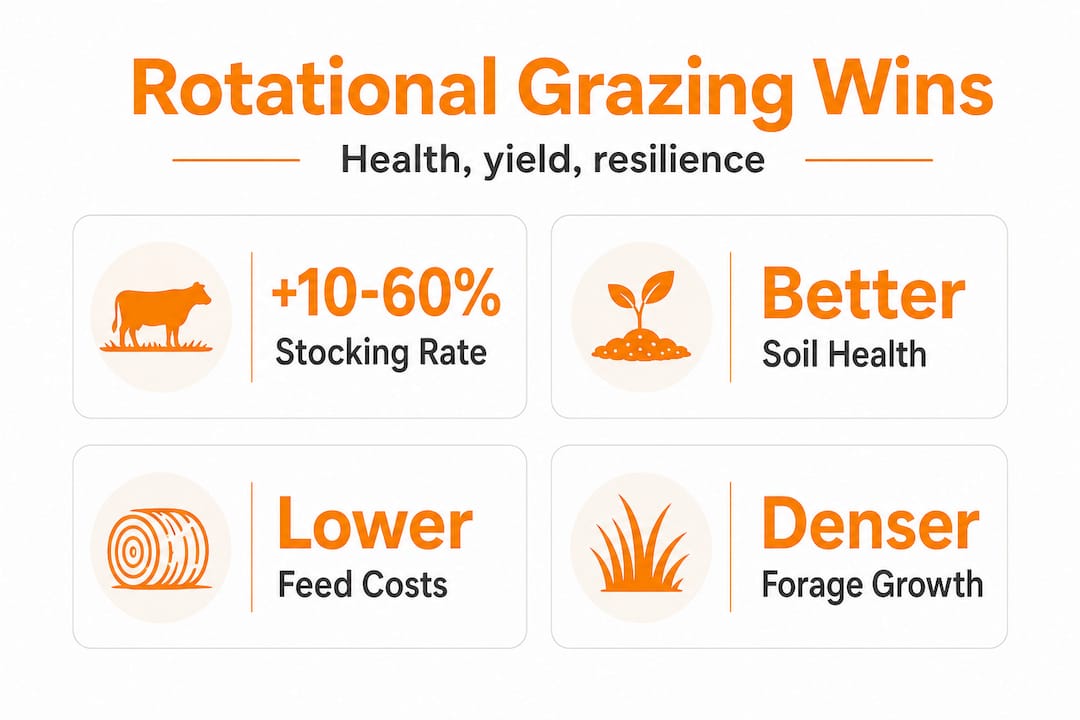
Here is a realistic look at benefits and challenges side by side:
| Factor | Benefit | Challenge |
|---|---|---|
| Stocking rate | 5% to 60%+ potential gain | Variable and not guaranteed |
| Pasture condition | Reduced overgrazing, better stand density | Requires strict rest period discipline |
| Forage utilization | Less waste from selective grazing | Frequent moves increase labor |
| Soil health | Improved organic matter over time | Benefits take years to show |
| Water infrastructure | More distributed access reduces trailing | Significant upfront cost |
| Economic returns | Higher output per acre long-term | Cost recovery may take several years |
Key challenges worth planning around:
- Water is often the binding constraint. Without a water source in each paddock, cattle bunch near existing water, defeating the purpose of division.
- Short-term production dips are real. When you first add rest rotation and restrict access, animals may have less total forage available until the system establishes.
- Labor scales with move frequency. Small herds doing frequent moves can find the time investment disproportionate to the gains.
- Soil fertility is not optional. Rotating over low-fertility ground speeds up degradation rather than recovery.
Pro Tip: Use portable fencing to trial rotational strategies on one section of your operation before committing to permanent infrastructure. This lets you prove the concept on your specific soil and forage type with minimal upfront risk.
Economic returns depend heavily on your baseline. If you are coming from heavily overgrazed continuous pasture, returns can arrive quickly. If your current pasture is already in decent shape, the cost recovery math may take three to five years even with efficient fencing.
Fencing technology: Portable, electric, and virtual solutions
Maximizing the benefits of rotational grazing depends on the right tools. Let’s break down what technologies are available and what they actually deliver.
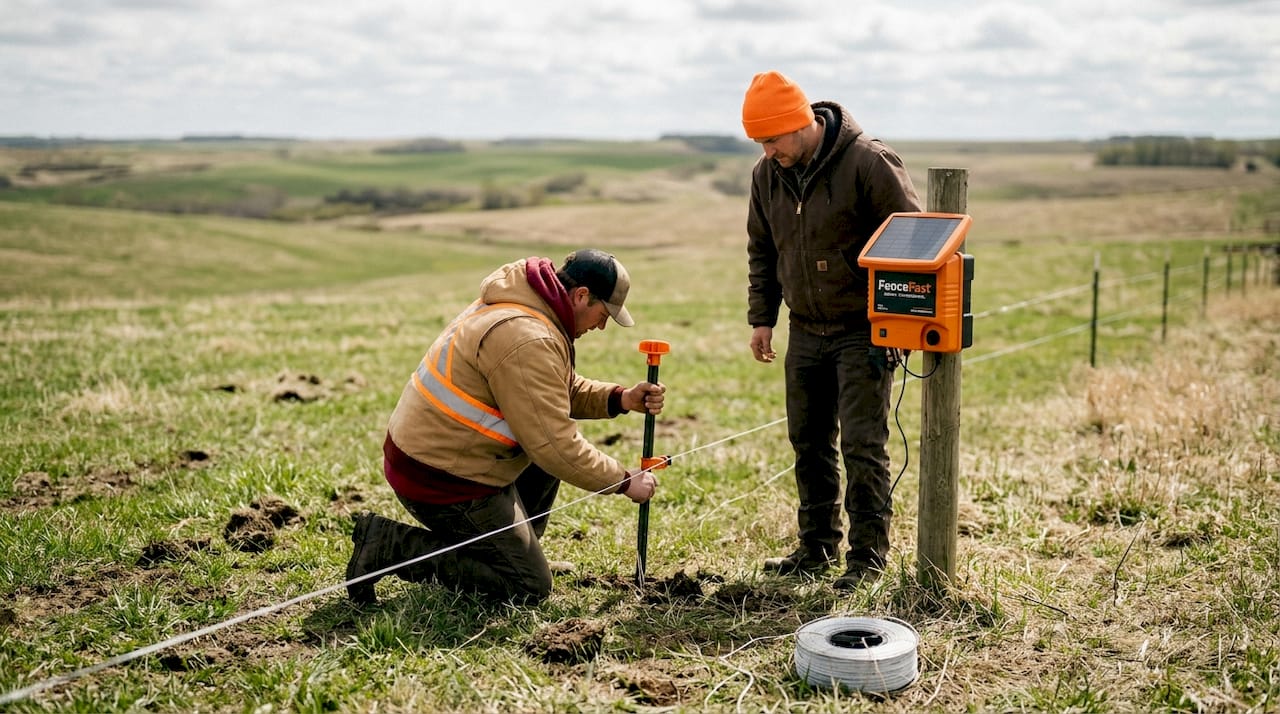
Portable electric fencing is the entry point for most ranchers. Polywire or polytape strung between step-in posts can be moved in minutes. It is affordable, flexible, and allows you to test paddock configurations without permanent commitment. The tradeoff is time. Someone has to physically move it, check for shorts, and keep energizers working.
Semi-permanent electric systems use steel or fiberglass posts with high-tensile wire and permanent energizers. They cost more upfront and require more installation labor, but they are durable, low-maintenance, and work well for long-term paddock systems. Understanding the full range of portable electric fence systems helps you match the right setup to your terrain and rotation schedule.
Virtual fencing is the newest option and the one generating the most buzz in Canadian agriculture. Virtual fencing uses GPS collars and digital boundaries that can be adjusted from a smartphone app, with real-time alerts for boundary breaches and individual animal monitoring. Collar costs run around $350 per head, plus roughly $2.50 per head per month for data service. The system requires a base station and cellular or satellite connectivity.
Here is how the main fencing technologies compare for rotational grazing:
| Technology | Upfront cost | Move flexibility | Labor per move | Grant eligible |
|---|---|---|---|---|
| Portable electric | Low | Very high | 20 to 60 minutes | Partial |
| Semi-permanent electric | Medium to high | Low | Permanent setup | Yes |
| Virtual fencing | High (collars) | Instant, app-based | Minutes | Up to 70% via OFCAF |
Virtual fencing grant eligibility through Canada’s On-Farm Climate Action Fund covers up to 70% of system costs, which dramatically changes the math. A system that costs $35,000 to equip 100 head becomes roughly $10,500 out of pocket with maximum funding. That is a fundamentally different investment than the sticker price suggests.
Understanding the true picture of virtual fencing costs in Canada requires factoring in grant offsets, data subscription costs over multiple years, and the labor savings from eliminating physical fence moves. For large, rugged pastures where moving portable wire is genuinely difficult, the value proposition is strong.
Pro Tip: Virtual fencing streamlines rotation in large or topographically complex pastures but does not solve water distribution, forage quality, or rest period timing on its own. Think of it as a precision tool for virtual fencing herd control, not a replacement for good grazing management decisions.
Essential management lessons: Avoiding common pitfalls
While technology and design matter, real-world headaches often trip farmers up. Here is how to avoid the most common pitfalls.
The single most underestimated constraint is water. Water access can limit utilization in ways that fencing cannot fix. When cattle have to walk more than about 800 meters to water, intake drops, trailing increases, and the areas around water points get pounded into bare, compacted ground. You can have the most sophisticated paddock layout on the block and still see poor results if water is centralized and animals cluster around it.
The second pitfall is getting rest periods wrong. Regrowth should be adequate before animals re-enter a paddock, and some systems that look like rest rotation can actually reduce short-term production if rest is insufficient or if animals graze too tightly before moving. Leaving inadequate residual cover when exiting a paddock sets back recovery significantly.
Labor is a third practical issue many ranchers underestimate. On a small operation with frequent moves, one person can spend hours per week simply relocating fences, checking connections, and moving water. That time has real value. If your move frequency is high enough that it strains your labor capacity, you will start cutting corners, which breaks the whole system.
Here is a practical checklist to protect your rotation from common failures:
- Plan water access first. Every paddock needs a realistic water source before animals arrive. Temporary water tanks or pipeline extensions are valid solutions.
- Match rotation to regrowth, not the calendar. Check plant height and density before re-entry. Do not assume last year’s schedule applies this year.
- Monitor and record. Track forage height at entry and exit, days rested, and any signs of stand decline. Data beats intuition every time.
- Watch labor requirements realistically. If your move schedule is creating burnout, consider larger paddocks or virtual fencing to reduce physical moves.
- Keep fertility in the equation. Forage recovery is slower on low-fertility ground. If rotation is not producing results, test your soil before blaming the schedule.
“Water, not fencing, is often the limiting factor separating rotational systems that work from those that struggle on paper but fail on the ground.”
Many of these lessons are being learned in real time across Canada. Operations that have worked through the challenges in detail, including on British Columbia range land, show how virtual fencing on BC ranches can reduce trailing and overgrazing pressure near water points by repositioning the herd more precisely than traditional fences allow.
Why Canadian results defy one-size-fits-all grazing advice
After working through the mechanics and pitfalls, the honest conclusion is uncomfortable for anyone looking for a simple formula: rotational grazing in Canada resists standardization in ways that textbooks rarely acknowledge.
The modeling numbers are real. Economic outcomes depend on both capital expenditures for fencing and water, and agronomic drivers like forage species, soil fertility, stand age, and moisture. Benchmark modeling suggests potential stocking rate gains, but variance is wide and fencing cost recovery can take multiple years on farms with lower baseline pasture quality or in regions with shorter growing seasons.
What the textbooks often skip is the financial patience required. Pasture improvement is measured in years, not months. A rancher who invests in fencing, water infrastructure, and virtual collars in year one may not see full cost recovery until year four or five, even with grant support. That is not a reason to avoid the investment. It is a reason to plan cash flow carefully and not expect a short-term production boost that the agronomics simply cannot deliver in year one.
The bigger lesson is about adaptive management. Your neighbor’s rotation schedule was built for their soil, their forage species, and their herd. Copying it wholesale is a reasonable starting point and a poor finishing point. The most successful operations we see are the ones that start with a documented baseline, make one or two changes at a time, measure results across full seasons, and adjust from there. That is slower than copying a template, but it builds real, durable understanding of your specific land.
The combination of good forage science, well-chosen fencing technology, realistic grant planning, and patience is what produces lasting results. Rotational grazing case studies from operations across Canada consistently show that the biggest differentiator is not the fence type. It is whether the manager is willing to monitor, adjust, and hold firm on rest periods even when short-term pressure pushes against it.
How FenceFast can help you upgrade your grazing system
If you’re planning to invest in better fencing or want to explore virtual grazing, FenceFast can support your goals.
Whether you are starting with portable electric wire on one paddock or planning a full virtual fencing rollout across thousands of acres, the right equipment and guidance make a measurable difference. At FenceFast, we carry pasture health upgrades across the full range of fencing technologies, from step-in post systems and high-tensile energizers to the Gallagher eShepherd virtual fencing platform, backed by our 26-year partnership with Gallagher.
We also help you work through grant eligibility under OFCAF and BMP programs, so you are not leaving funding on the table when upgrading to virtual or advanced electric systems. Our team can help you size a system, estimate payback periods, and connect you with the right products for your specific herd size, terrain, and rotation goals. Reach out or browse our catalog at fencefast.ca to take the next step toward a smarter, more productive grazing system.
Frequently asked questions
How does rotational grazing improve pasture health?
By giving paddocks time to rest and regrow after grazing, rotational grazing prevents overgrazing and supports denser, healthier forage stands. The forage recovery relationship between grazing period, paddock time, and regrowth duration is the core driver of pasture improvement.
What is the typical increase in stocking rate with rotational grazing in Canada?
Modeling suggests stocking rates can improve by about 10%, but actual gains range from 5% to over 60%, depending on local factors. Results vary widely based on forage species, stand age, soil type, and moisture.
Can virtual fencing fully replace traditional fencing for rotational grazing?
Virtual fencing supports rotation using GPS collars and adjustable digital boundaries, but it does not solve water access or forage quality constraints. Physical infrastructure for water distribution remains essential regardless of the fence type used.
How long does it take to recover fencing costs under rotational grazing?
About half of benchmark farms recovered fencing costs within five years, though actual time varies significantly by stocking rate improvement and total investment level. Grant funding through programs like OFCAF can shorten that recovery window considerably for virtual fencing adopters.
Recommended
- Rotational Grazing Fence: Boosting Pasture Health and Herd Control – FenceFast Ltd.
- Rotational Grazing Fencing: Maximizing Pasture Health – FenceFast Ltd.
- Boost Pasture Health with Rotational Grazing and Virtual Fencing – FenceFast Ltd.
- Understanding the Benefits of Rotational Grazing for Livestock – FenceFast Ltd.

