

For most livestock operations, the right starting point is a self-contained solar energizer with a 12 to 50 watt panel and a 12 volt lithium battery, sized to deliver 1 to 3 joules of output for a multi-wire fence. Small homestead setups with a single strand and calm animals can run on a lower-output unit closer to the 6 watt range. Cattle operations running three to five wires over long distances, or anyone dealing with predator pressure, need to size up toward the higher joule and wattage end.
Three things drive that recommendation: off-grid independence from wall power or generator runs, dramatically lower maintenance than lead-acid systems, and a battery that survives years of freeze-thaw cycles without babying. Before you buy anything, walk the fence line and count wires.
- Off-grid units eliminate the labor of hauling batteries to town for recharging.
- Lithium batteries handle cold snaps and partial discharge far better than lead-acid.
- A correctly sized solar panel electric fence unit needs almost no attention once it’s grounded and running.
The single biggest mistake buyers make isn’t picking the wrong brand. It’s sizing the energizer to the fence length instead of the total wire length, which leaves multi-wire cattle fences chronically underpowered.
Key Takeaways
Correctly sizing a solar panel electric fence unit means matching energizer joules to total wire length, not fence distance, and pairing it with a lithium battery reserved for at least three sunless days.
| Point | Details |
|---|---|
| Count total wire length | Multiply fence distance by wire count before matching to a joule rating. |
| Prioritize low-impedance units | These hold voltage through vegetation contact better than older high-impedance models. |
| Choose lithium where budget allows | Lithium batteries last roughly 300% longer than lead-acid in manufacturer testing. |
| Plan reserve days, not just daily charge | Size battery capacity for three or more sunless days depending on your climate. |
| Buy from an authorized dealer | Fencefast’s 26-year Gallagher partnership backs energizer and battery packages with manufacturer warranty support. |
Table of Contents
- How Do You Size a Solar Panel Electric Fence Unit?
- What Do Joules, Voltage, and Range Claims Actually Mean?
- How Do You Size the Solar Panel and Battery?
- What Do You Need to Know Before Installing a Solar Fence Unit?
- How Do You Maintain and Troubleshoot a Solar Fence System?
- What Accessories and Configurations Should You Consider?
- Frequently Asked Questions
- Sources
How Do You Size a Solar Panel Electric Fence Unit?
Sizing starts with a number most buyers skip: total conductor length, not fence length. A 5 wire cattle fence running 4 miles isn’t a 4-mile fencing job for energizer purposes. It’s 20 miles of wire, because the energizer has to push a pulse down every strand simultaneously. Virginia Cooperative Extension’s fencing guidance makes this the first calculation for a reason: skip it, and you’ll buy a unit that reads fine on the shelf tag but can’t hold voltage across the whole system.
Here’s the process in order:
- Measure your fence run in miles or kilometers.
- Multiply by the number of wires to get total conductor length.
- Classify your animals. Poultry and hogs need higher voltage at the fence to penetrate feathers or bristle; cattle and horses respond well to standard joule ranges; predator deterrence generally calls for the top end of output.
- Match total conductor length and animal class to a joule rating using the table below.
- Add 20 to 30 percent headroom for vegetation contact and future fence expansion.
Before finalizing a number, check three things on the ground: how much brush or grass will contact the lower wires, whether the fence is new and tight or old and leaky, and whether your soil is sandy or dry (both reduce grounding efficiency and call for more ground rods, not a bigger energizer).
Pro Tip: If a single fence line is pushing past 30 to 40 miles of total conductor, it’s often more reliable to split the load between two mid-range energizers on separate sections than to run one massive unit off a single ground system. You isolate faults faster and lose less of the fence if one unit fails.
What Do Joules, Voltage, and Range Claims Actually Mean?
Joules measure stored energy released per pulse. Voltage measures how hard that energy pushes through resistance, including vegetation, dry ground, and rust on old wire. Joules predict real-world performance better than peak voltage because a high voltage reading on an unloaded fence tester means little once grass and moisture are pulling current to ground.
Low-impedance energizers matter here specifically because they can still deliver a usable pulse even when weeds are shorting part of the circuit, where older high-impedance units bog down and lose the fence entirely. This is why two energizers can share an identical “10,000 volt” spec sheet and behave completely differently in a weedy pasture.
Range or “miles” claims are the most misleading number on the box. They’re calculated under ideal lab conditions with dry, weed-free, well-grounded fence. Real range depends on total wire count, vegetation, soil moisture, and fence age.
- A 20-mile rated unit on a 5-wire, 4-mile fence is already running near its ceiling once you account for total conductor length.
- Manufacturer pulses commonly run in the 5,000 to 10,000 volt range, delivered as short discharges rather than continuous current.
- That pulsed delivery is what trains animals through repeated brief contact rather than one prolonged shock.
Quick example: a 5-wire fence covering 4 miles equals 20 miles of total conductor. An energizer rated for “25 miles” sounds generous until you remember it’s now working close to capacity, with no headroom for a wet spring or a few dozen feet of new fence next year.
Remember: joule ratings are calculated against total wire length, never against the physical distance your fence posts run.
How Do You Size the Solar Panel and Battery?
Every energizer has a daily energy draw, standby drain plus the power spent firing pulses. Your panel has to replace that draw on your worst realistic sun day, and your battery has to carry the fence through several days when the panel can’t keep up at all.
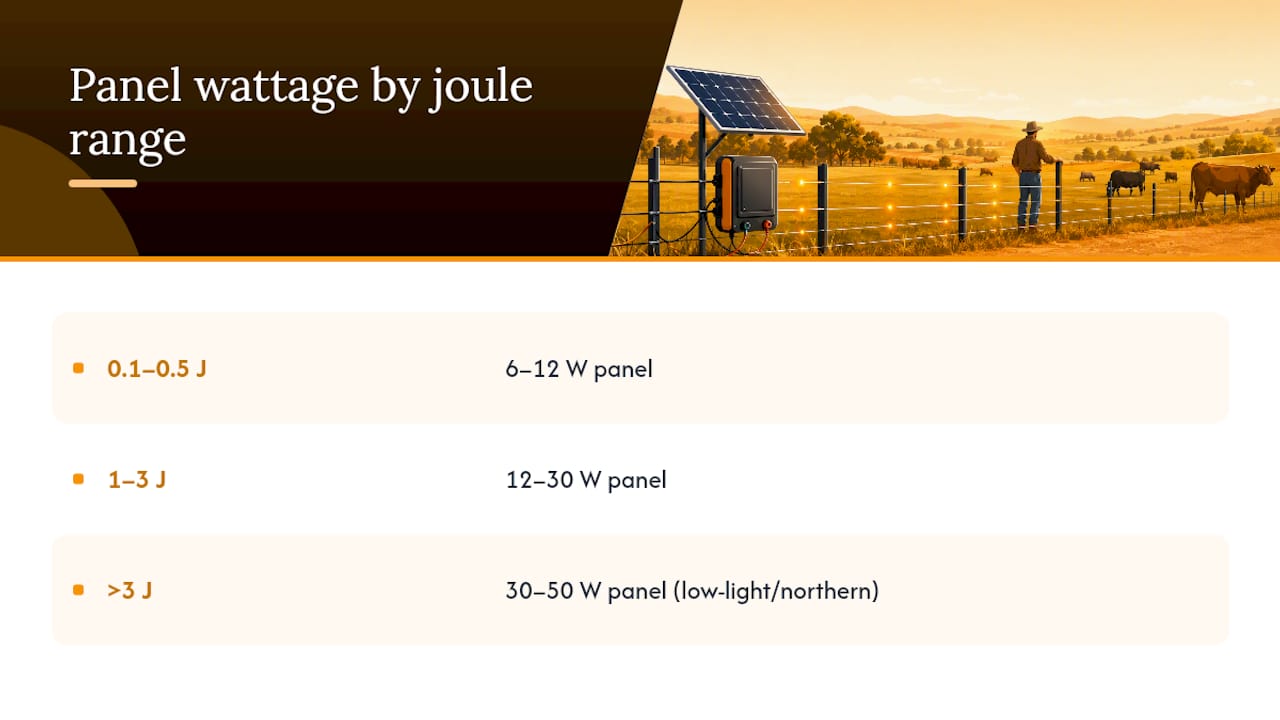
As a rule of thumb, small homestead units in the 0.1 to 0.5 joule range typically pair with 6 to 12 watt panels. Mid-size cattle fence energizers in the 1 to 3 joule range usually need 12 to 30 watt panels. Anything above 3 joules, or units running in low-light northern climates, often calls for 30 to 50 watt panels paired with a larger battery bank.
Plan for reserve autonomy, not just daily balance. Retail sizing guidance commonly recommends a minimum of three sunless days of stored charge, and cloudier regions or heavily wooded pastures do better planning for five to seven days of reserve.
Battery chemistry matters more than most buyers expect. Manufacturer technical data indicates lithium batteries deliver roughly 300 percent longer lifespans than lead-acid equivalents, alongside higher energy density and lower internal resistance, meaning less voltage sag when the fence is under heavy load. Lead-acid batteries are cheaper up front but lose capacity faster in freezing temperatures and degrade quickly if left partially discharged over winter, which is exactly the scenario a remote pasture fence tends to create.
Pro Tip: Reposition the panel seasonally if you can. A panel angled for summer sun often underperforms badly once the sun’s angle drops in late fall, and a few degrees of tilt adjustment or moving the mount out of a tree’s winter shadow can add meaningful charging hours without spending a dollar.
What Do You Need to Know Before Installing a Solar Fence Unit?
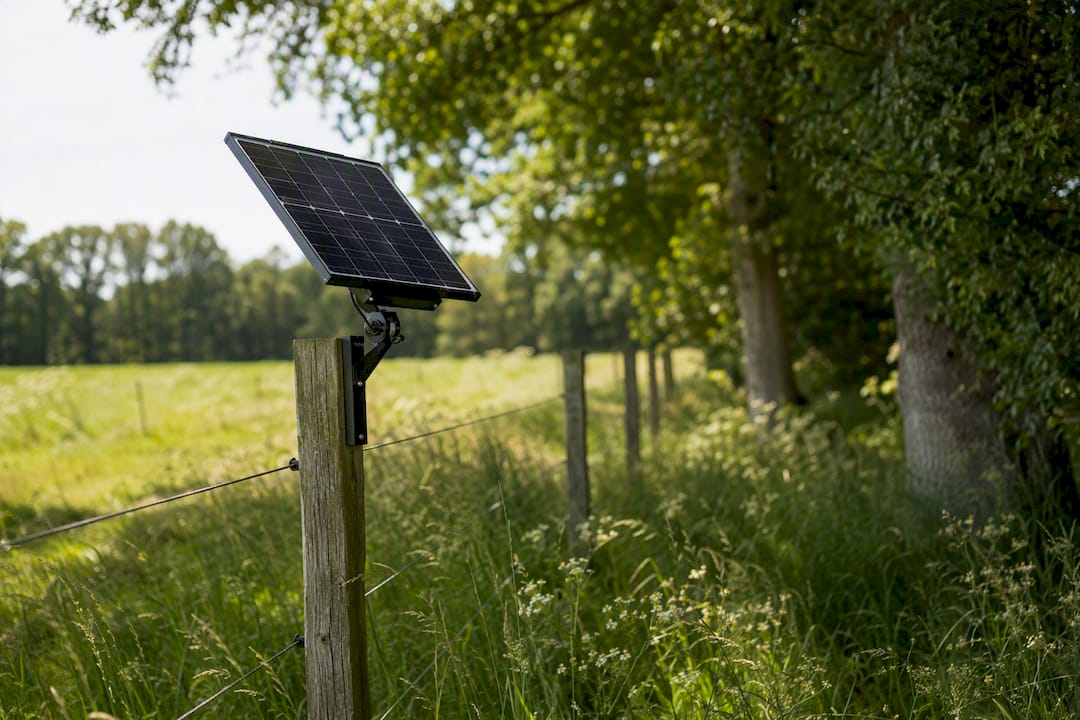
Panel placement determines charging performance more than almost any other installation decision. Self-contained units need the whole housing oriented toward maximum southern (or northern, in the southern hemisphere) sun exposure, while separate-panel systems give you flexibility to mount the panel away from the energizer box, useful when the best fence-post location and the best sun exposure aren’t the same spot.
Grounding is where most underperforming systems actually fail, not the energizer itself. One installation reported powering roughly 12 hectares (30 acres) of paddocks supporting several hundred sows, but that kind of reliability depends entirely on adequate grounding, generally three or more galvanized ground rods spaced at least 10 feet apart in moist soil.
Before you energize the fence:
- Test soil conductivity, dry sandy soil needs more ground rods than clay.
- Confirm insulator spacing matches your animal type and wire count.
- Check every splice for a clean, corrosion-free connection.
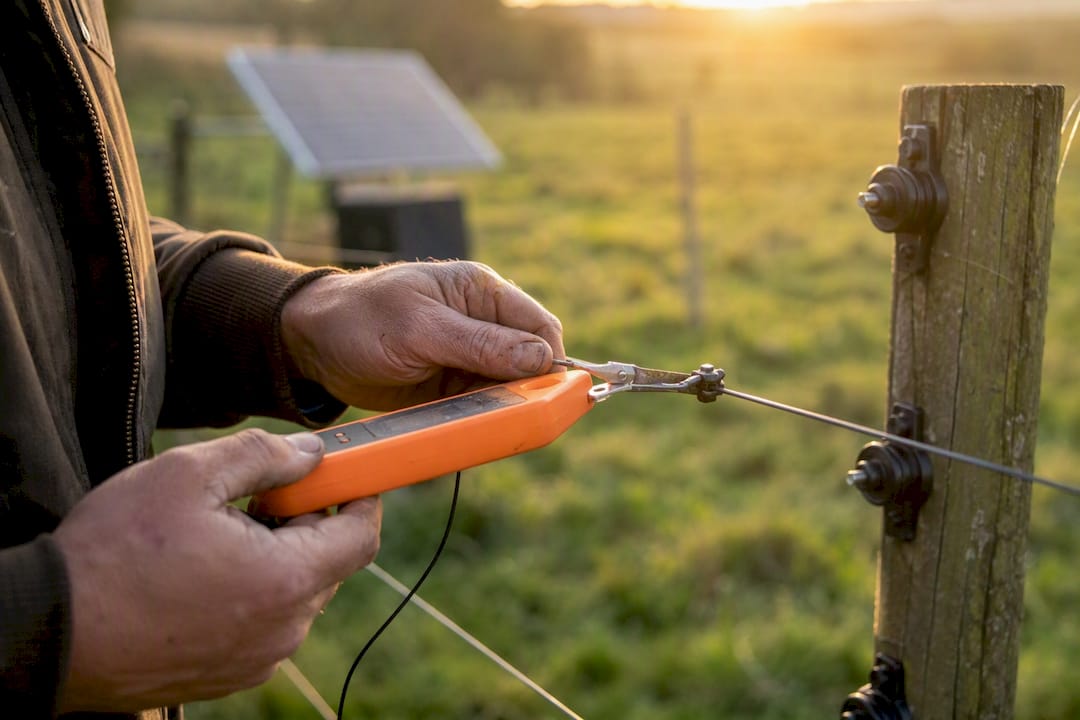
- Run a fence tester at the far end before turning animals in.
- Post required warning signage where local rules apply, and keep children away from the energizer box during setup.
How Do You Maintain and Troubleshoot a Solar Fence System?
Most voltage complaints trace back to three culprits: a shorted wire touching vegetation, a corroded terminal, or a cracked insulator letting current leak to a post. Wipe the panel clean of dust and bird droppings monthly, since a dirty panel charges slower and drains your reserve faster on marginal sun days.
Work the troubleshooting flow in this order:
- Check the energizer’s output meter first, most modern units show voltage right on the box.
- Test at the fence near the energizer, then move outward section by section.
- A sharp voltage drop between two test points means the fault sits between them, usually vegetation or a break.
- Inspect ground rods for corrosion or loose connections if voltage is low everywhere.
- Call your dealer if voltage stays low after a full line check, that usually points to the energizer itself or a battery nearing end of life.
Walk the entire line seasonally, and do a full pre-winter check: tighten connections, trim brush back from the bottom wire, and confirm the battery holds charge before the days get short.
What Accessories and Configurations Should You Consider?
A single energizer rarely covers everything a working farm needs. Common add-ons include external pole-mounted panels for units placed in shade, larger external battery banks for extending autonomy, remote fence testers you can check without walking the line, and predator-specific kits with tighter wire spacing and higher voltage output.
Portable solar packs make sense for rotational grazing, where paddocks shift every few days and running permanent wiring doesn’t pay off. Fixed installations suit permanent perimeter fencing or predator exclusion zones that don’t move season to season.
A dealer bundle worth asking about typically includes the energizer, a matched panel, a lithium battery, a fence tester, and a mounting kit, which covers most first-time buyers in one order without guessing at compatibility between parts bought separately.
A Dealer’s Note on Common Buying Mistakes
The mistake we see most often is buyers sizing to fence length and forgetting wire count entirely, then wondering why a “20-mile” energizer struggles on a 4-mile, 5-wire fence. Run the numbers above, and reach out if anything doesn’t add up. Warranty support and setup help are part of the purchase, not an afterthought.
How Fencefast Supports Your Solar Fence Purchase
Picking the right joule rating and panel size is only half the job. Getting a unit that’s backed by real support when a battery underperforms or a fence tester reads wrong is the other half.

Fencefast has worked as an authorized Gallagher dealer for 26 years, which means the energizers, panels, and lithium battery packages sold come with direct manufacturer warranty backing, not a third-party reseller shrug when something fails. Beyond Gallagher, Fencefast stocks a range of solar energizer classes from entry-level homestead units through high-output ranch systems, plus the grounding accessories and mounting hardware that determine whether a correctly sized unit actually performs in the field. Design consulting is available if you’re staring at a multi-paddock layout and aren’t sure where wire count and joule targets intersect.
If you’ve walked your fence line, counted your wires, and landed on a joule range from the sizing table above, the next step is simple: browse Fencefast’s solar energizer selection and talk to the team about matching a panel and battery package to your exact fence length and animal type.
Frequently Asked Questions
Can you run an electric fence entirely off a solar panel? Yes. A properly matched solar panel electric fence unit charges a battery during daylight, and the battery powers the energizer around the clock, including through several sunless days if sized with adequate reserve.
What size solar panel do I need for my fence? It depends on your energizer’s joule output and daily draw. Small homestead units typically need 6 to 12 watt panels, while multi-wire cattle fences in the 1 to 3 joule range usually need 12 to 30 watt panels.
Is lithium worth the extra cost over lead-acid? For most working fences, yes. Lithium batteries handle cold weather and partial discharge cycles better and last significantly longer, which offsets the higher purchase price over several seasons.
How do I know if my energizer is underpowered? If voltage drops sharply along a multi-wire fence, especially after rain or heavy vegetation growth, your energizer is likely undersized for the total conductor length. Recalculate using total wire count, not fence distance.
How often should I service a solar electric fence unit? Check the panel, battery terminals, and output meter monthly, walk the full fence line seasonally, and do a complete pre-winter inspection to catch issues before cold weather stresses the battery.
Sources
- How farm-designed solar energiser powers fencing year-round - Farmers Weekly
- Portable power revolutionizes off-grid fencing — Gallagher Knowledge Hub
- Virginia Cooperative Extension fencing guidance (SPES-689)
- Science/technical paper on electric fence performance

