

A solar powered fencer is a reliable, practical choice for most off-grid livestock containment when you size it correctly. The single rule that matters most: choose by output joules and low-impedance load handling, not by the advertised miles rating.
Quick verdict by use case:
- Small portable paddocks and rotational strip grazing: An integrated all-in-one unit with 0.1–0.3 output joules handles polywire netting and temporary setups. Move it with the herd.
- Medium grazing perimeters (multi-strand cattle or horse fencing): Step up to 0.6–1.2 output joules. A dedicated panel and sealed lead-acid or lithium battery gives you the reserve capacity to handle cloudy stretches.
- Large permanent perimeters or high predator pressure: Go 1.8 joules or higher. You need a modular system with a substantial battery bank and a panel sized for your worst winter sun days.
The miles rating on the box? Treat it as a ceiling under perfect, vegetation-free conditions. Real fields rarely cooperate.
Table of Contents
- What a solar fence charger is and how it powers your fence
- How to size a solar fencer: joules, miles ratings, and real-world load
- Grounding essentials: how many rods, how deep, and why it matters
- Solar panel placement, charge control, and battery choices
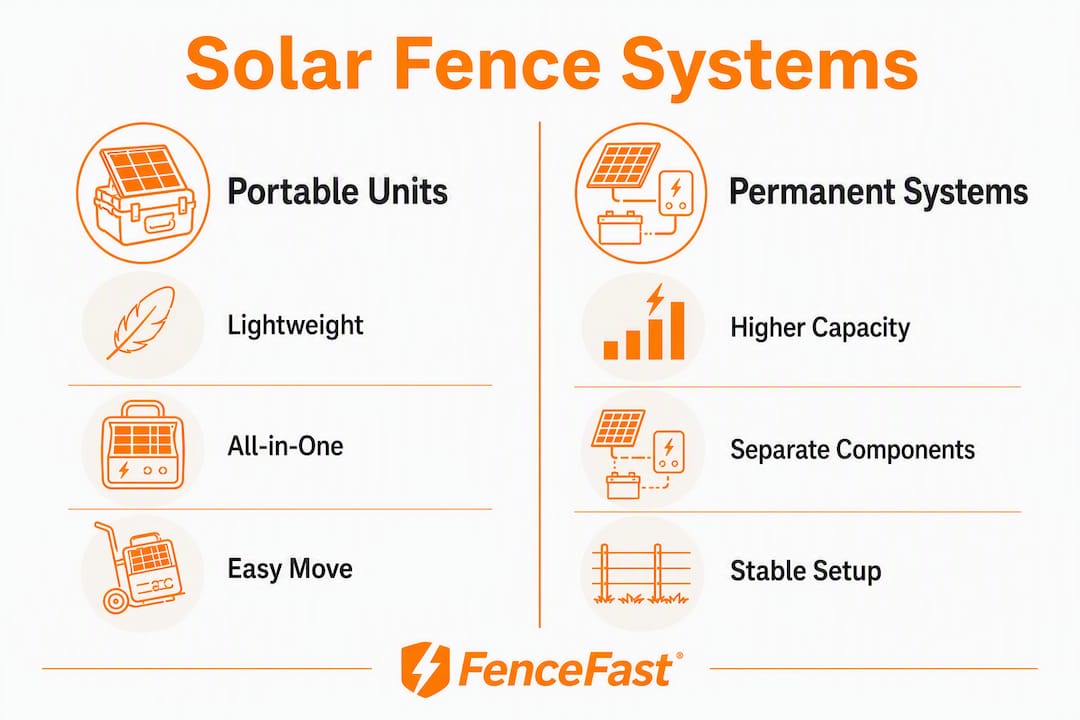
- Portable integrated units vs. dedicated permanent systems
- Installation checklist and routine maintenance
- Safety, legal, and livestock welfare considerations
- Research-backed tips and common misconceptions
- Key Takeaways
- What we advise farmers we work with
- Fencefast can help you spec the right solar fencing system
- Sources and further reading
What a solar fence charger is and how it powers your fence
A solar-powered fence charger, also called a solar energizer or solar fencer, combines a solar panel, a charge controller, a battery, and an energizer into one system that delivers high-voltage, low-amperage pulses along a fence wire without any grid connection. You can find this as a single integrated unit or as separate components wired together.
Here is how the energy flows: sunlight hits the panel → the charge controller regulates the current and protects the battery from overcharge → the battery stores energy → the energizer draws from the battery and converts it into a timed pulse (roughly once per second) → that pulse travels along the fence wire → when an animal touches the wire and completes the circuit through the ground, it receives a brief, safe shock → the current returns to the energizer through the ground rods.
Core components and their roles:
- Solar panel: Converts sunlight to DC electricity; wattage determines how fast the battery recharges.
- Charge controller/regulator: Prevents overcharging and matches panel output to battery chemistry.
- Battery: Stores energy for nighttime and cloudy-day operation; chemistry (lead-acid vs. lithium) determines reserve capacity and lifespan.
- Energizer/transformer: Converts stored battery power into the fence pulse; joule rating determines effectiveness under load.
- Fence conductor: Carries the pulse; wire gauge and material affect resistance over distance.
- Grounding system: Completes the circuit; poor grounding is the most common cause of a weak fence.
Some manufacturers, like Gallagher, integrate earthing directly through the mounting post and seal the circuit board against moisture and insects, which improves field reliability considerably. Learn more about solar fence system components and how they work together.
Pro Tip: If you move the unit frequently for rotational grazing, choose an integrated all-in-one unit. If the fence is permanent and the load is heavy, buy a modular system so you can upgrade the panel or battery independently without replacing the whole unit.
How to size a solar fencer: joules, miles ratings, and real-world load
Output joules is the number that actually matters. Stored joules is what the capacitor holds before firing; output joules is what reaches the fence wire. A charger can fail to hold voltage the moment green grass touches the wire, even if it is rated for long miles under ideal conditions.
Practical joule heuristics by livestock type and fence complexity:
- 0.1–0.3 output joules: Polywire netting, sheep, poultry, small temporary paddocks with minimal vegetation contact.
- 0.6–1.2 output joules: Multi-strand cattle or horse fences, moderate vegetation, perimeters up to a few miles of wire.
- 1.8–2.4+ output joules: Large permanent perimeters, predator pressure (coyotes, bears), heavy vegetation, or long multi-strand runs.
These are heuristic ranges, not guarantees. A 1-joule unit powering a clean, well-maintained fence will outperform a 2-joule unit on a fence choked with weeds. The AKO S1000, for example, lists a theoretical range of 35 km under ideal conditions but drops to 2.5 km with medium vegetation and just 1 km under heavy growth. That gap is not a flaw in the product; it is physics.
Low-impedance circuit design is what separates a charger that holds voltage under load from one that collapses. When you shop, look for “low impedance” in the spec sheet, not just a high mileage claim.
Grounding essentials: how many rods, how deep, and why it matters
Grounding is where most fence problems actually live. An animal touching the wire completes a circuit through the soil back to the energizer’s ground terminal. If that ground connection is weak, the shock is weak, and your livestock learns the fence is optional.
Step-by-step grounding checklist:
- Choose rod size by unit output. Small portable units can use an 18-inch stake. High-output permanent energizers require one 6–8 foot ground rod for a reliable circuit; use additional rods for harder soils or if ground resistance is high.
- Space rods at least 10 feet apart. Rods too close together share the same soil resistance zone and do not add meaningful capacity.
- Drive rods vertically to full depth. Angled rods reduce contact surface area.
- Connect rods in series with galvanized ground wire, not aluminum, to avoid corrosion at the clamp.
- Test ground effectiveness. With the energizer running, use a fence voltmeter to measure voltage at the ground rod. If it reads above 200 volts, your ground is inadequate. Add another rod.
- Troubleshoot dry or rocky soil. In arid conditions, wet the soil around the rods during installation and consider adding a third rod. Some installers bury a horizontal wire grid when vertical rods cannot reach moist soil.
- Keep ground rods away from buried utilities, water lines, and phone lines by at least 50 feet to avoid interference and safety hazards.
Pro Tip: Run a dedicated ground wire from the energizer to each rod rather than daisy-chaining them. A single bad clamp in a daisy chain kills the whole ground system.
For a detailed solar fence charger setup guide covering grounding in different soil types, Fencefast has a step-by-step resource worth bookmarking.
Solar panel placement, charge control, and battery choices
Panel placement and maintenance
Face the panel due south and tilt it at roughly 50° to maximize winter sun capture across most continental U.S. latitudes. In summer you can flatten the angle slightly, but the winter position matters more for reserve capacity when days are shortest. Keep the panel completely clear of shade between 10 AM and 4 PM. Even partial shading from a fence post or tree branch can cut output dramatically. Clean the panel surface monthly; dust, bird droppings, and snow all reduce charging efficiency.
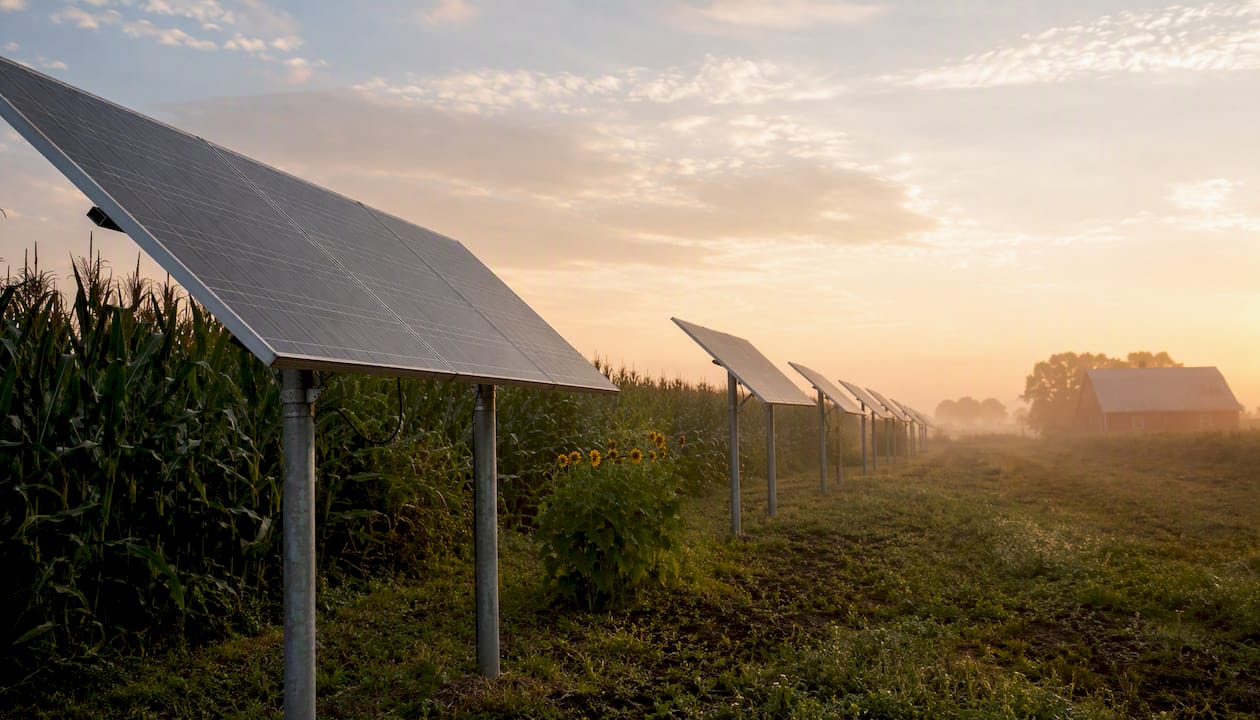
Modern high-efficiency panels with smart charge controllers can harvest useful energy on overcast days, provided the angle is correct and the system components are matched to the battery chemistry.
Battery comparison: sealed lead acid vs. lithium iron phosphate
| Feature | Sealed Lead Acid (SLA) | Lithium Iron Phosphate (LiFePO4) |
|---|---|---|
| Charge speed | Slow | 3x faster than SLA |
| Cycle life | 200 cycles | — |
| Cold-weather performance | Degrades noticeably | Handles cold better |
| Maintenance | Minimal | None |
| Upfront cost | Lower | Higher |
| Replacement cadence | Every 1–2 years | Every 5–7+ years |
LiFePO4 batteries tolerate deeper discharge cycles and recharge faster, which matters on a fence that runs 24 hours a day in variable sun. The higher upfront cost typically pays back over the battery’s longer lifespan. SLA batteries remain a practical choice for lower-output portable units where replacement is easy and the budget is tight.
Key battery considerations:
- Match the charge controller to the battery chemistry; a controller calibrated for SLA will undercharge a lithium pack.
- A well-sized system like the SolarStop 240, which uses a 30-watt panel and a 12V 22Ah SLA battery, can provide reserve energy for roughly three sunless days when fully charged.
- Many modern energizers include adaptive energy-saving modes that reduce pulse rate when battery charge drops, keeping containment functional through extended low-sun periods.
Portable integrated units vs. dedicated permanent systems
The right choice comes down to how often the fence moves and how much load it carries.
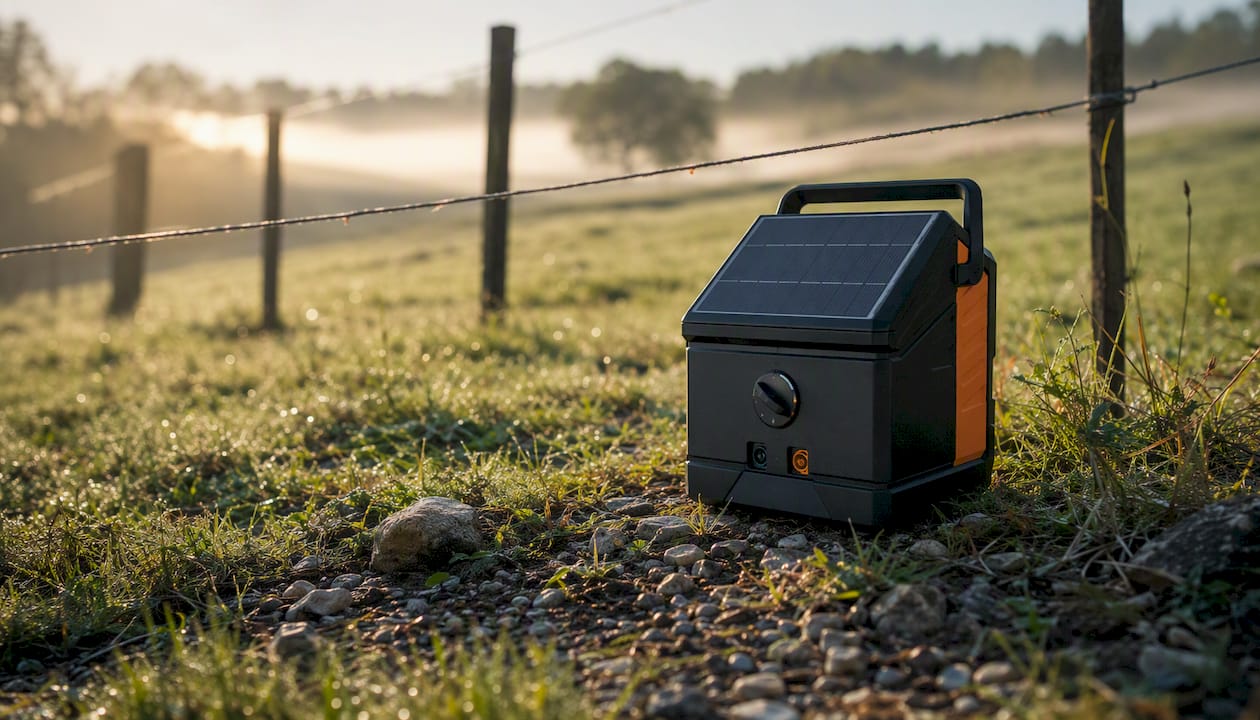
Portable integrated units pack the panel, battery, and energizer into one housing. They are light, fast to set up, and require no external wiring. The Gallagher S12 Lithium and similar compact units are purpose-built for strip grazing and temporary netting. The trade-off is peak power: compact lithium-based energizers are ideal for portability but are usually not suitable for permanent perimeter fences under heavy vegetation or predator pressure. The Gallagher LiveLite is a good example of a lightweight energizer suited to this kind of rotational work.
Modular dedicated systems use a separate panel, charge controller, battery, and energizer. They are heavier and take longer to install, but they let you size each component independently. Need more reserve capacity? Add a larger battery. Getting poor winter charging? Swap in a higher-wattage panel. This upgradeability is why permanent perimeter fences almost always use modular systems.
Choose a portable integrated unit when:
- You practice rotational strip grazing and move the fence weekly or more.
- The fence is temporary polywire or netting.
- The paddock is small and vegetation contact is manageable.
- Simplicity and speed of setup outweigh peak power needs.
Choose a modular dedicated system when:
- The fence is permanent or semi-permanent.
- You face predator pressure or heavy vegetation.
- The perimeter is long and multi-strand.
- You want the ability to upgrade components over time.
Installation checklist and routine maintenance
First-time installation steps:
- Site the energizer where the panel gets unobstructed southern exposure from 10 AM to 4 PM.
- Mount the panel at a 50° tilt on a sturdy post, oriented due south.
- Drive ground rods to full depth, spaced at least 10 feet apart, and connect them with galvanized ground wire.
- Wire the energizer to the ground system and to the fence line, following the manufacturer’s terminal labeling.
- Power on and wait for a full initial charge before connecting livestock.
- Test fence voltage with a digital fence tester at multiple points along the line. Aim for at least 3,000 volts at the far end under load.
Routine maintenance schedule:
- Monthly: Clean the panel surface, check wire connections for corrosion, visually inspect fence line for vegetation contact.
- Seasonally: Adjust panel tilt for winter or summer sun angle, clear any new shade sources (tree growth, new structures), cut back vegetation touching the wire.
- Annually: Test battery health with a load tester, inspect ground rods for corrosion at the clamps, check all insulators for cracking or UV degradation.
Troubleshooting low or intermittent voltage:
- Low battery charge: check panel orientation and clean the surface first.
- High ground resistance: add a ground rod or wet the soil around existing rods.
- Fence short: walk the line looking for vegetation contact, a broken insulator, or a wire touching a metal post.
- Weak pulse: confirm the energizer’s stored joules with a joule meter; a failing battery often mimics an underpowered energizer.
Integrated portable energizers cost less upfront, but expect ongoing battery replacement costs over the system’s lifecycle. Budget for SLA replacement every 1–2 years or LiFePO4 every 5–7 years.
Safety, legal, and livestock welfare considerations
Electric fences are safe when installed correctly, but a few non-negotiable practices apply everywhere in the U.S.
Safety and compliance basics:
- Post “Electric Fence” warning signs at regular intervals, especially near roads, public paths, and property boundaries.
- Never run a fence along a public right-of-way or footpath where a person could contact it unexpectedly.
- Keep energizer housings locked or secured when children or unauthorized individuals are nearby.
- Use appropriate joule levels for the species: lower outputs for sheep and poultry, higher for cattle and horses, and the highest for predator deterrence.
- Check your county and state codes before installation. Rules on fence placement, voltage limits, and signage vary by jurisdiction; a quick call to your local extension office or county code office takes 10 minutes and can save a legal headache.
Livestock welfare tips:
- Introduce animals to a new electric fence gradually. A single, clear shock from a properly powered fence teaches respect; repeated weak shocks from a poorly grounded fence just frustrate animals and erode the deterrent effect.
- Test animal response by observing the first contact. A sharp, brief reaction followed by the animal backing away is the correct outcome.
- If a fence borders shared or public land, notify neighbors and consider liability coverage under your farm policy.
Research-backed tips and common misconceptions
The most persistent myth in electric fencing is that a higher miles rating means a better energizer. It does not.
Industry guidance is clear: choose a charger by joule rating and its ability to handle vegetation load, not by mileage. A charger rated for long miles can fail the moment green grass touches the wire. Source: Premier1Supplies
Low-impedance circuit design is what keeps voltage up when the fence is dirty. High-mileage ratings are measured on a resistive load in a lab, not on a pasture fence in July.
Field tips backed by product research:
- Prioritize low-impedance energizers for any fence where vegetation contact is likely, which is most real-world fences.
- Adjust panel tilt seasonally. A 50° winter tilt on a south-facing panel can meaningfully extend your charging window during short December days.
- LiFePO4 batteries charge up to 3x faster than lead-acid equivalents and last significantly longer, making them the better long-term choice for off-grid systems that cycle deeply every night.
- Smart charge controllers and high-efficiency panels allow systems to harvest useful energy on cloudy days, provided the panel angle and battery chemistry are correctly matched.
- For cattle-specific sizing guidance, Fencefast’s solar fencer for cattle resource covers species-appropriate joule levels in practical detail.
Key Takeaways
A solar fence energizer works reliably off-grid when you size by output joules and low-impedance load handling, not by the advertised miles rating.
| Point | Details |
|---|---|
| Joules beat miles | Choose by output joules and low-impedance design; miles ratings assume vegetation-free conditions that rarely exist. |
| Grounding determines effectiveness | Use a 6–8 foot ground rod for high-output permanent systems; add more rods in difficult soil or when field tests show resistance is high. Test ground resistance before trusting the fence. |
| Battery chemistry matters | LiFePO4 charges 3x faster and lasts significantly longer than SLA; worth the upfront cost for permanent off-grid use. |
| Panel placement is critical | Face due south at roughly 50° tilt; even partial shading between 10 AM and 4 PM cuts charging output sharply. |
| Fencefast for specification help | Fencefast, an authorized Gallagher dealer, offers design consulting and product selection support for sizing any solar fencing system. |
What we advise farmers we work with
The gap between what a solar energizer promises on the box and what it delivers in a real pasture is almost always a grounding or sizing problem, not a product defect. At Fencefast, the first question we ask any farmer is not “how many miles of fence do you have?” It is “what is touching your wire, and how often does it change?”
For a rotational strip-grazing operation, a compact lithium integrated unit is usually the right call. It moves with the herd, sets up in minutes, and handles clean polywire netting without drama. The moment that same farmer asks about a permanent perimeter with predator pressure, the answer changes completely: a modular system with a high-output low-impedance energizer, a LiFePO4 battery, and a panel sized for the shortest days of the year.
The other thing farmers consistently underestimate is the value of a proper solar fence energizer comparison before they buy. Spending 20 minutes matching joule output to actual fence load and vegetation conditions is worth more than any mileage rating on any box.
Fencefast can help you spec the right solar fencing system
Choosing the wrong energizer costs you twice: once when you buy it, and again when your livestock tests the fence and walks through it. Fencefast carries a full range of solar fence energizers from portable lithium units for strip grazing to high-output modular systems for permanent perimeters, backed by 26 years as an authorized Gallagher dealer.

Whether you need help sizing a system for a 10-acre rotational setup or a large permanent perimeter with predator concerns, Fencefast’s design consulting team can walk you through joule requirements, battery chemistry, panel sizing, and grounding specs. Nationwide shipping is available, and warranty support comes with every purchase. Contact Fencefast at fencefast.ca to get a specification recommendation before you buy.
Sources and further reading
- Solar IntelliShock 30 Energizer, Premier1Supplies — joule vs. miles rating guidance and vegetation load impact
- SolarStop 240 Fence Energizer, Premier1Supplies — reserve capacity, cloudy-day charging, and adaptive energy-saving modes
- Gallagher S12 Lithium Solar Fence Energizer, Gallagher United States — portable lithium unit specs and use-case guidance
- Gallagher S30Li Lithium Solar Energizer, Electric Fence Online — LiFePO4 charging speed and cycle life comparison
- Cyclops Stallion Solar Energizer Kit, Cyclops Fence Chargers — ground rod specifications for high-output units
- AKO S1000 Solar Energizer, Styx Solutions NZ — real-world range reduction under vegetation load
- 9 Advantages to Solar Fence Chargers, Zareba Systems — total cost of ownership and battery replacement lifecycle
- Solar Panel Electric Fence Charger Guide, Fencefast — system selection and application overview
- Solar Fence Charger Setup Guide, Fencefast — grounding and installation step-by-step

