

TL;DR:
- Electric netting uses psychological deterrence through electrical pulses to contain and protect livestock without physical barriers. Proper setup, grounding, and animal conditioning are essential for system effectiveness, especially against predators. It offers portability, flexibility, and cost-effective rotational grazing solutions for various farm operations.
Most farmers assume a fence works because an animal physically can’t push through it. Electric netting flips that assumption entirely. What is electric netting, exactly? It’s a portable, mesh-style fencing system that uses brief electrical pulses to condition animals to stay away from the boundary. No barbed wire. No heavy posts. The fence works on psychology more than physics, and once you understand that distinction, everything about setup, maintenance, and troubleshooting starts to make more sense.
Table of Contents
- Key takeaways
- What is electric netting and how does it work
- Types and design features of electric netting
- Benefits of electric netting for livestock management
- Troubleshooting and maintaining your electric netting
- Real-world applications of electric netting
- My take on what most farmers get wrong about electric netting
- Get the right electric netting from Fencefast
- FAQ
Key takeaways
| Point | Details |
|---|---|
| Psychology over physics | Electric netting deters animals through learned avoidance, not brute physical containment. |
| Grounding determines success | Poor grounding is the leading cause of fence failure, not the netting itself. |
| Portability drives flexibility | Lightweight mesh design supports rotational grazing and temporary paddock setups. |
| Predator protection included | Properly energized netting deters coyotes, raccoons, and bears with no physical barrier needed. |
| Training livestock first | Conditioning animals to the fence before full deployment reduces breaches and injuries. |
What is electric netting and how does it work
Electric netting, also called electric mesh fencing or electrified net fencing, consists of horizontal conductive wires woven into a vertical mesh of non-conductive strands, typically polyethylene. Integrated vertical posts are spaced along the mesh for quick setup without additional hardware. The system connects to an energizer, which sends high-voltage, low-amperage pulses through the conductive wires at regular intervals.
The circuit completes only when an animal touches the live wire and the ground simultaneously. That contact sends a pulse through the animal and back to the energizer’s negative terminal through the grounding system. The result is a sharp, memorable shock. It won’t injure the animal, but it will absolutely get their attention.
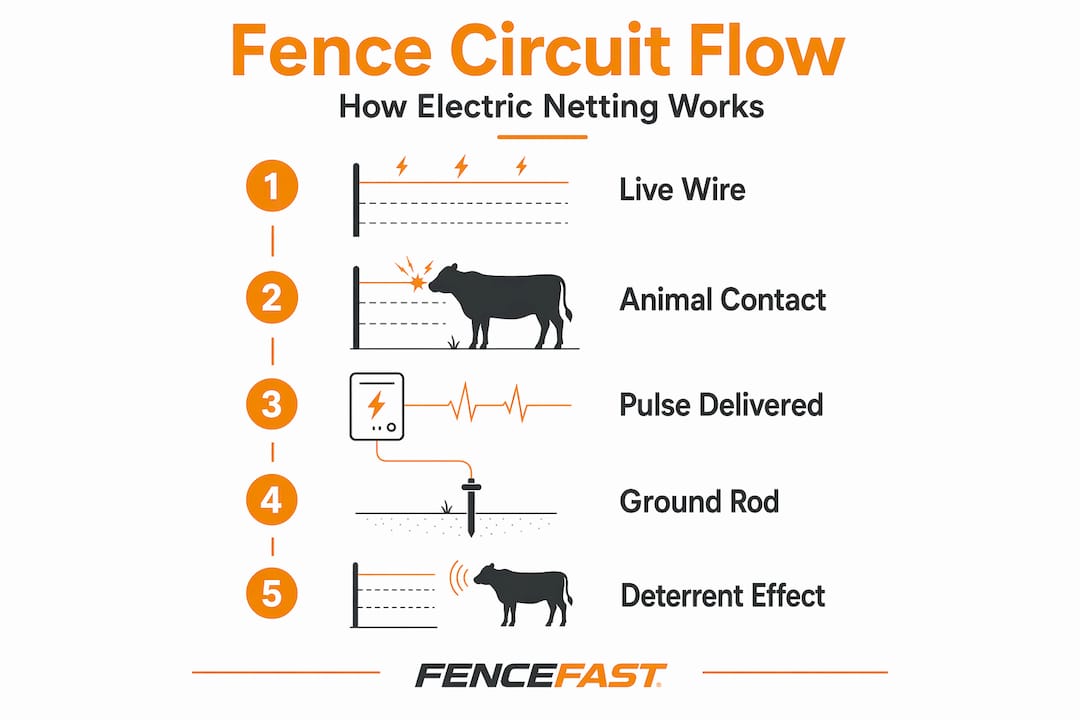
Here’s what makes this different from a traditional wood or wire fence. A wooden fence contains animals by creating a physical obstacle they can’t move through. Electric netting contains animals by creating a psychological obstacle they choose not to challenge. That difference matters enormously when you’re picking fence height, mesh size, and energizer power.
Key components every electric netting system needs:
- Energizer: Powers the pulse. Can be AC-powered, battery-operated, or solar-powered. Energizer quality directly determines fence reliability.
- Grounding rods: Drive into moist soil to complete the circuit. Most systems require multiple rods spaced at least 10 feet apart.
- Conductive mesh: The netting itself, with stainless steel or aluminum wires woven through polyethylene strands.
- Voltage tester: A non-negotiable tool for confirming the system is live and performing correctly.
Circuit completion depends heavily on energizer quality and grounding setup. Skimp on either, and you end up with a fence that looks functional but delivers an underwhelming shock. Animals learn quickly when a fence is weak, and they don’t forget.
Pro Tip: Install grounding rods in areas with consistently moist soil. Sandy or dry soils dramatically reduce conductivity, which weakens the pulse an animal receives.
Types and design features of electric netting
Not all electric netting is built the same, and the differences matter when you’re matching the fence to specific animals or terrain.
| Feature | Electric netting | Permanent wire fence | Temporary poly tape |
|---|---|---|---|
| Portability | High | None | High |
| Predator resistance | Moderate to high | Low to moderate | Low |
| Setup time | 15 to 30 min | Hours to days | Under 15 min |
| Animal-specific sizing | Yes | Limited | Limited |
| Cost upfront | Moderate | High | Low |
Electric netting comes in specific heights and mesh sizes for different livestock. Poultry netting typically runs 42 to 48 inches tall with small mesh openings to stop birds from squeezing through and to block ground predators. Sheep and goat netting generally runs 35 to 42 inches with medium mesh. Cattle netting can reach 48 to 60 inches with larger openings since you’re relying more on the shock than on physical containment.
The materials that separate durable netting from cheap netting are the conductive wire gauge and the post material. Stainless steel wire resists corrosion better than aluminum over multiple seasons. Fiberglass posts flex without snapping under tension and hold up far better than plastic posts on uneven ground.
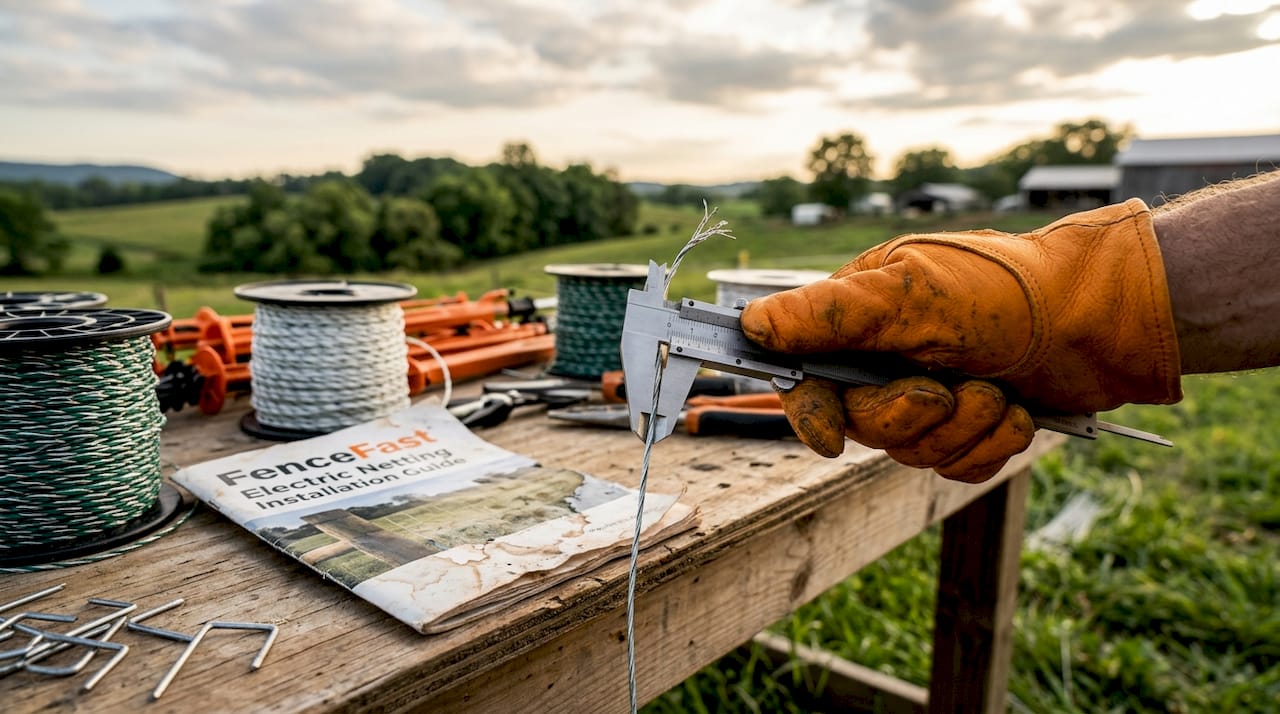
Portable electric netting is designed for quick setup and flexibility in pasture management. A standard 164-foot roll can be moved, reset, and redeployed dozens of times per season. For an operation running rotational grazing across multiple paddocks, that portability is the whole value proposition.
Benefits of electric netting for livestock management
The benefits of electric netting go beyond just keeping animals in a field. When farmers and ranchers weigh traditional fencing against portable electrified mesh, several advantages consistently tip the decision toward netting.
- Predator deterrence: Electric netting deters coyotes, raccoons, bobcats, and bears effectively when properly energized. Most ground predators test a fence with their nose first, which lands on the live wire. One shock is usually enough to redirect them permanently.
- Rotational grazing support: Moving animals through a series of fresh paddocks is dramatically easier with portable netting. You can set up a new paddock in under 30 minutes and break down the previous one in the same window.
- Lower long-term costs: Upfront cost per foot is higher than basic wire, but electric netting for goats and rotational grazing replaces fencing infrastructure that would otherwise require permanent posts, gates, and labor-intensive installation.
- Adaptability to terrain: Netting conforms to rolling or irregular ground better than rigid fence panels. You can adjust post spacing to follow contours without gaps at the base that predators exploit.
- Fewer physical constraints: No H-braces. No corner posts requiring heavy equipment. A single person can configure a full paddock without tools.
The one honest limitation worth naming is that electric netting works only when it’s properly energized. A dead battery or a faulty connection turns your fence into a suggestion. Animals that have discovered a fence is off will test it again, sometimes repeatedly.
Troubleshooting and maintaining your electric netting
Most electric fence failures trace back to a handful of fixable issues. The good news is that voltage testing and grounding inspection resolve the majority of them without replacing any hardware.
- Test voltage first. Use a digital fence tester at multiple points along the netting. You want at least 3,000 volts for sheep and goats, and at least 2,000 volts for most poultry setups. Lower readings indicate a problem upstream.
- Check for vegetation contact. Vegetation touching the fence bleeds off voltage continuously. Walk the fence line after rain when growth accelerates. Trim anything within two inches of the live wire.
- Inspect grounding rods. Pull them and check for corrosion. Multiple rods in moist soil improve circuit completion significantly. In dry conditions, water the soil around the rods to restore conductivity.
- Trace the energizer connections. Loose clamps or corroded terminals at the energizer reduce output dramatically. Clean connections with a wire brush and retighten every season.
- Look for mesh damage. Animals occasionally catch hooves or horns in netting, pulling conductive wires loose from their strands. Walk the full perimeter after any livestock incident.
For a detailed breakdown of fault-finding on complex systems, the electric fence repair guide at Fencefast covers step-by-step diagnostics.
Pro Tip: Train new livestock before deploying them in a fully netted paddock. Walk animals into a small conditioning area with a single live strand so they experience the shock in a controlled setting before encountering the full fence.
Proper livestock training reduces fence breaches significantly. An animal that has learned to respect the fence through conditioning will almost never test it again. An animal that discovers the fence during a panic or a predator encounter might push straight through it.
Real-world applications of electric netting
Understanding the technology is one thing. Seeing where it actually fits in a working operation is where the decision becomes clear.
- Poultry protection: A ring of 42-inch poultry netting around a mobile chicken coop creates a predator barrier that relocates as easily as the coop itself. The low mesh prevents aerial predators from landing inside and blocks ground threats at the base.
- Sheep and goat rotation: Portable netting supports rotational grazing, which improves pasture recovery by keeping animals moving across fresh sections every few days. One or two additional netting rolls let you pre-configure the next paddock before opening the current one.
- Temporary exclusion zones: Seeded areas, wetlands, or recently renovated pasture sections can be temporarily fenced off with netting until recovery is complete, then reintegrated with zero permanent hardware left behind.
- Integrating with permanent systems: Many operations use permanent perimeter fencing for the outer boundary and electric netting for internal subdivision. This approach keeps infrastructure costs low while giving you flexible paddock configurations throughout the season.
The broader takeaway: electric netting isn’t a replacement for every fencing need. It fills the gap between permanent infrastructure and no fence at all, and it fills that gap remarkably well for operations that need to move animals frequently.
My take on what most farmers get wrong about electric netting
I’ve worked with farmers who set up electric netting, got a breach on day three, and wrote the whole system off as ineffective. Almost every time I’ve dug into what actually happened, the problem wasn’t the netting. It was the energizer, the grounding, or untrained animals encountering live wire for the first time in a stressful situation.
What I’ve seen consistently is that farmers who succeed with electric netting treat it as an electrical system first and a fence second. They buy an energizer rated above their minimum needs, they drive grounding rods properly into moist soil, and they spend time conditioning their animals before expecting the fence to hold under pressure.
The other thing I’d push back on is the assumption that electric netting is only for small operations or temporary use. I’ve seen it run as the primary containment system on mid-scale sheep and goat operations across multiple seasons. The durability of quality netting with stainless wire and fiberglass posts surprises most people who haven’t priced out a full permanent installation. The flexibility it provides for managing livestock in rotating paddocks is genuinely difficult to replicate any other way. If you approach electric netting with realistic expectations and proper setup, it earns its keep fast.
— Juiced
Get the right electric netting from Fencefast
If you’re ready to set up electric netting on your property, Fencefast carries a full selection of electric fencing systems and components suited to Canadian farms and ranches. From energizers and grounding hardware to complete netting rolls sized for poultry, sheep, goats, and cattle, the product catalog covers what you need for both temporary and seasonal setups.

Fencefast also provides design consulting and expert support, so you’re not sorting through specs alone. Whether you’re configuring a rotational grazing system or building predator protection around a mobile coop, the team can point you toward the right combination of netting, energizer power, and accessories. Explore the full fencing catalog and get set up right the first time.
FAQ
What is the difference between electric netting and wire fencing?
Electric netting is portable mesh fencing that uses electrical pulses to deter animals psychologically, while traditional wire fencing creates a permanent physical barrier. Netting sets up and relocates in minutes without posts, braces, or specialized tools.
How much voltage does electric netting need to work?
Most livestock applications require at least 2,000 to 3,000 volts at the fence line to deliver an effective deterrent. Poultry and small animals can be controlled at the lower end, while larger or more stubborn animals benefit from readings above 4,000 volts.
How do I stop electric netting from losing power?
The two most common causes of voltage loss are vegetation touching the live wires and inadequate grounding. Clear growth regularly along the fence line and drive multiple grounding rods into moist soil to maintain consistent circuit completion.
Can electric netting stop predators like coyotes and foxes?
Yes. Electric netting deters a wide range of predators including coyotes, raccoons, and foxes when the system is properly energized. Most predators nose-test fences before attempting entry, which brings their face into contact with the live wire.
How do I train livestock to respect electric netting?
Livestock training uses structured conditioning where animals first encounter the fence in a controlled, low-stress setting. Walk them into a small area with a single live strand so they receive the shock without panic, then transition them to full netting after they’ve learned to avoid contact. A detailed walkthrough is available in the livestock training guide at Fencefast.

