

TL;DR:
- Choosing fence materials requires matching species-specific containment needs, site conditions, and long-term costs to ensure durability and safety. It involves evaluating environmental factors, installation quality, and maintenance commitments to select a system that balances upfront investment with lifespan performance. Proper assessment and system design are essential to prevent costly failures and optimize livestock safety and investment longevity.
Choosing fence materials is the process of matching a fencing system to your specific livestock species, terrain, climate, and budget so that animals stay contained, stay safe, and your investment holds up over decades. No single material wins across every situation. Wood, vinyl, composite, woven wire, high-tensile wire, barbed wire, chain link, and steel each carry distinct trade-offs in upfront cost, lifespan, maintenance load, and species suitability. The right decision starts with understanding those trade-offs clearly, not with picking the cheapest option at the supply store.
How to start choosing fence materials for your property
The fence material selection process is a structured evaluation, not a gut-feel purchase. Before you price a single post, you need four pieces of information: what animals you are containing, what terrain and climate you are working with, what your total budget is over a 10 to 20 year horizon, and what level of maintenance you can realistically commit to. Miss any one of these and you will either overspend on a system you do not need or underspend on one that fails in year three.
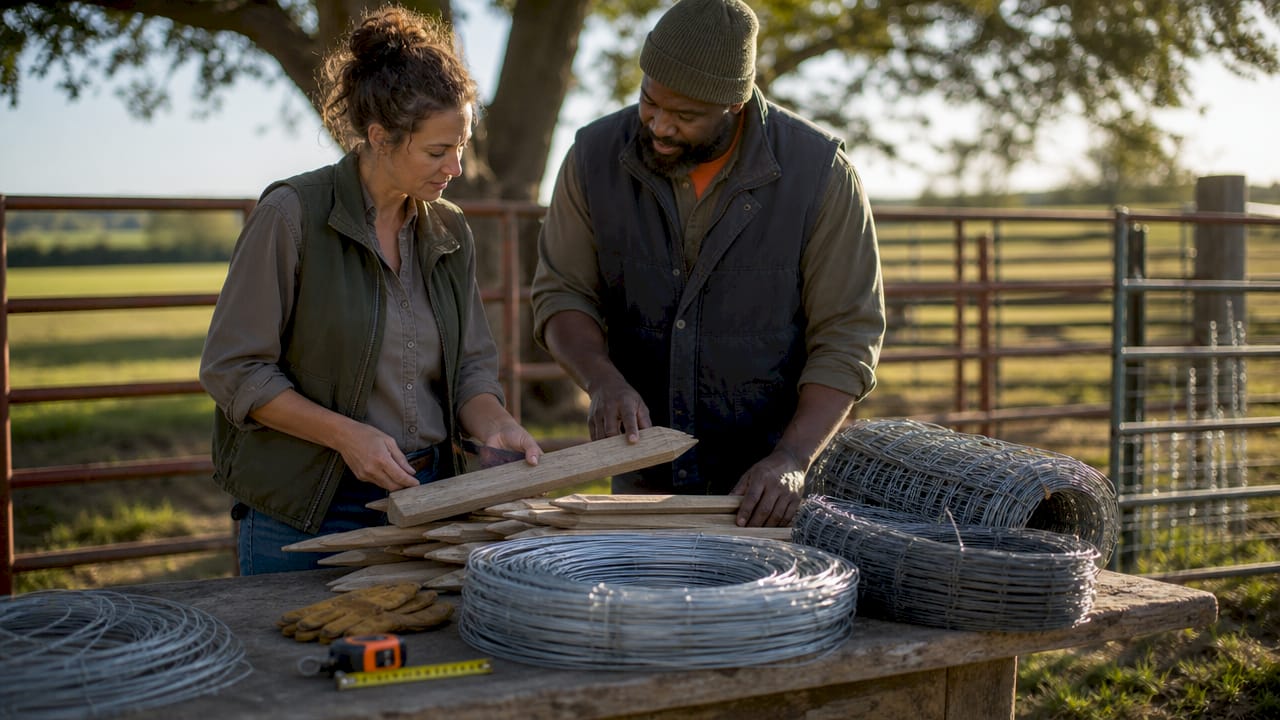
Agricultural fencing basics consistently show that the most expensive mistake property owners make is treating fence material selection as a one-time cost decision rather than a system design decision. The fence panel or wire is only one component. Posts, tensioning hardware, corrosion protection, and vegetation management all determine whether a fence performs for 10 years or 30. Proper fencing longevity depends on the entire system, not just the material you can see from the road.
How do animal type and behavior influence the choice of fence materials?
Animal species is the single most important variable in any fence material comparison. Each species has distinct escape behaviors, injury risks, and containment requirements that directly dictate material, height, and construction style.
Fence height for livestock should be at least 1.5 times the animal’s shoulder height to prevent jumping escapes. That rule translates to roughly 54 inches for cattle, 60 inches or more for horses, and 36 to 48 inches for sheep and goats depending on breed. Getting this wrong means repeated escapes regardless of how good your material is.
Species-specific design matters beyond height alone. Different animals have distinct escape behaviors that fence material must directly address:
- Cattle respond well to multiple strands of barbed wire or woven wire mesh. They lean and push, so posts need to be set deep and spaced no more than 12 feet apart.
- Horses require smooth wire or board fencing. Barbed wire causes severe lacerations on horses that panic and run into fences. High-visibility materials like white vinyl or painted wood boards reduce collision risk.
- Goats and sheep are escape artists. They squeeze through gaps, push under wires, and test every weak point. Tighter mesh woven wire, such as 2x4 no-climb horse fence, or electric fencing with closely spaced strands is the standard solution.
- Pigs root aggressively. A bottom board or buried wire apron is non-negotiable. Electric wire at snout height stops rooting before it starts.
- Poultry need predator exclusion as much as containment. Hardware cloth with openings no larger than half an inch outperforms standard chicken wire against raccoons, foxes, and weasels.
Pro Tip: Before you buy any material, watch your animals along your existing fence line for a week. Their specific escape attempts tell you exactly what your new fence needs to stop.
What are the main fence material options and their pros and cons?
The best fence materials for livestock fall into five broad categories. Each has a clear use case, and none is universally superior.
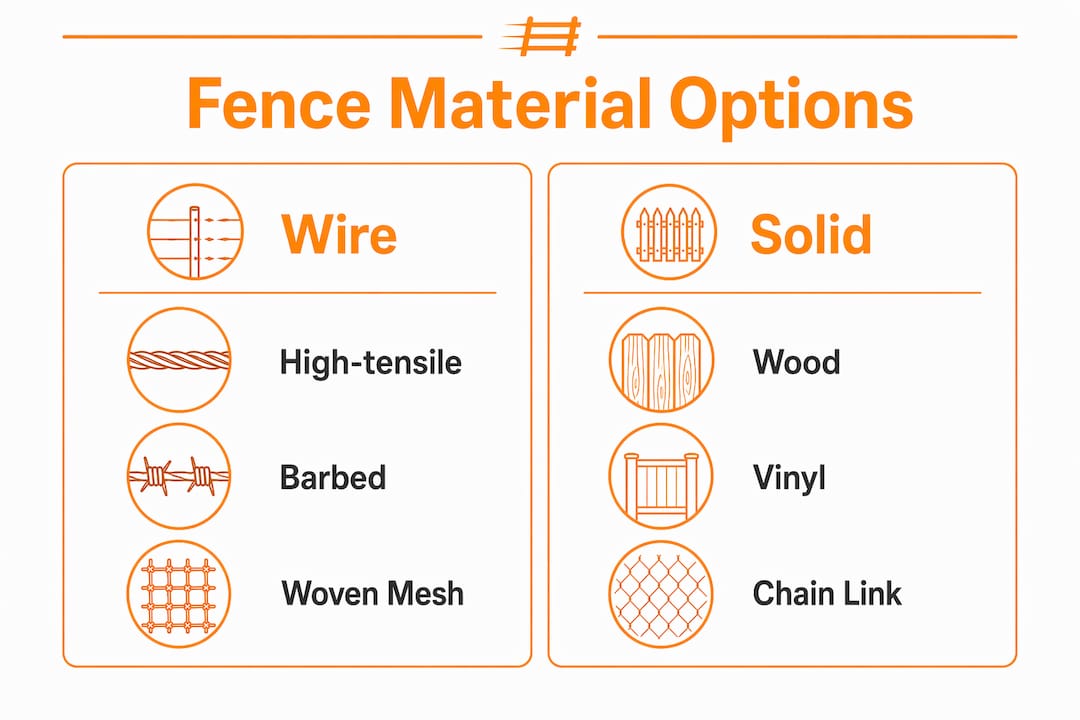
| Material | Typical lifespan | Maintenance level | Approx. cost per foot | Best use case |
|---|---|---|---|---|
| Pressure-treated wood | 10 to 20+ years | Moderate | $17 to $45 installed | Horse paddocks, property borders |
| Hardwood (cedar, oak) | 20 to 30+ years | Low to moderate | $20 to $50 installed | Perimeter fencing, high-visibility areas |
| PVC/vinyl | 15 to 25 years | Very low | $20 to $35 installed | Horse facilities, residential-adjacent farms |
| Composite | 20 to 25+ years | Low | $25 to $45 installed | Mixed-use farms, long-term installations |
| Woven wire / high-tensile | 20 to 40 years | Low to moderate | $1.50 to $4 per foot (materials) | Cattle, sheep, goats, large pastures |
| Barbed wire | 15 to 25 years | Low | $0.50 to $2 per foot (materials) | Cattle perimeter, large acreage |
| Chain link | 15 to 25 years | Low | From $8 per foot installed | Dog runs, small animal enclosures |
Wood fencing costs roughly $17 to $45 per linear foot installed, while chain link starts around $8 per linear foot. That gap looks significant upfront, but wood requires repainting, re-staining, and board replacement that chain link does not. Pressure-treated softwood lasts 10 to 20 years with moderate maintenance, while composite fencing stretches to 20 to 25 years with minimal upkeep.
Vinyl deserves special attention in the wood vs vinyl fencing debate. Vinyl fencing costs $3,000 to $5,250 for 150 linear feet upfront but requires almost no maintenance. Over 25 years, vinyl typically costs less overall than wood once you factor in staining, repairs, and board replacement. For horse facilities or any property where appearance matters alongside function, vinyl is a strong long-term choice.
Pro Tip: For large pastures, high-tensile wire with a single strand of electric at nose height for cattle gives you the best containment-to-cost ratio of any fence material option available.
How do environmental and terrain factors shape material selection?
Your site conditions can eliminate entire categories of fencing before you even compare prices. Environmental factors like rocky soil and wind exposure directly dictate post installation techniques and material selection for long-term durability.
Key terrain and climate factors to assess before committing to any material:
- Rocky soil makes post driving impossible. You will need to drill or blast holes, which increases labor cost significantly. Lighter materials like high-tensile wire with fewer posts become more attractive in rocky terrain.
- Sandy or loose soil reduces post holding strength. Wider, deeper posts or concrete footings are required. Heavier panel systems that distribute load across more posts perform better here.
- Freeze-thaw cycles (common across most of Canada) heave posts out of the ground over time. Setting posts below the frost line, typically 4 to 5 feet deep in northern regions, is mandatory. Vinyl and composite handle freeze-thaw better than untreated wood.
- High UV exposure degrades untreated wood and lower-grade vinyl rapidly. Look for UV-stabilized vinyl and pressure-treated or naturally rot-resistant wood like cedar in high-sun regions.
- Salt air and humidity accelerate corrosion on metal components. Galvanized or polymer-coated wire and hardware are non-negotiable in coastal or high-humidity environments.
- Predator pressure from coyotes, wolves, or bears requires additional design measures. A buried wire apron extending 12 inches outward from the base of the fence stops digging predators that standard fencing ignores entirely.
Matching your material to your site conditions is not optional. A vinyl board fence that performs beautifully in southern Ontario will crack and fail in northern Alberta without the right UV and cold-temperature ratings.
What are the cost factors and maintenance demands over a fence’s lifespan?
Upfront cost is only part of total ownership cost. The material that looks affordable at purchase can become the most expensive option over a 20-year horizon once you add labor, repairs, and replacement cycles.
Here is how the major fence material options stack up on total cost of ownership:
| Material | Upfront cost (per foot, installed) | Annual maintenance cost | Expected replacement cycle |
|---|---|---|---|
| Wood (pressure-treated) | $17 to $45 | Moderate (staining, board replacement) | 10 to 20 years |
| Vinyl | $20 to $35 | Very low (washing only) | 15 to 25 years |
| Composite | $25 to $45 | Low (occasional cleaning) | 20 to 25+ years |
| High-tensile wire | $1.50 to $4 (materials) | Low (re-tensioning, vegetation control) | 20 to 40 years |
| Barbed wire | $0.50 to $2 (materials) | Low (strand replacement, post checks) | 15 to 25 years |
| Chain link | From $8 | Low | 15 to 25 years |
Labor typically represents 50 to 60 percent of total installed fence cost. This means that a material requiring more posts per foot, more complex installation, or more frequent repairs will cost significantly more over time even if the material itself is cheap. High-tensile wire, for example, requires fewer posts than woven wire but demands proper tensioning equipment and knowledge. Done wrong, it sags and fails within a few seasons.
Pro Tip: Budget for a fence renovation fund from day one. Set aside 1 to 2 percent of your total fence installation cost annually for maintenance and repairs. Properties that do this avoid the expensive shock of full fence replacement.
For a deeper look at extending the life of any fence system, Fencefast’s guide on fence longevity practices covers tensioning, post treatment, and vegetation management in practical detail.
How to make the final decision on fence materials
A clear decision framework prevents the most common mistake in fence material selection: choosing based on one factor while ignoring the others. Follow this sequence:
- Define your containment requirement first. What species are you fencing, and what are their specific escape and injury risks? This determines your minimum acceptable material and design standard.
- Assess your site conditions. Soil type, climate zone, frost depth, and predator pressure will eliminate options that cannot perform in your environment.
- Calculate total cost of ownership, not just purchase price. A 25-year cost comparison almost always changes the ranking of materials compared to a purchase-price-only comparison.
- Match maintenance commitment to material. If you cannot commit to annual staining and board checks, do not install wood. If you want a set-it-and-forget-it system for a large pasture, high-tensile wire with electric is your answer.
- Plan for future changes. Rotational grazing systems, herd expansion, and pasture subdivision all require fence flexibility. Temporary electric fencing combined with a permanent perimeter gives you the most management options.
- Get installation right. The entire fencing system, including posts, tensioning, and corrosion protection, determines performance. The best material fails without proper installation.
Consulting local extension services or an experienced fencing contractor before finalizing your material choice is worth the time. Regional knowledge about soil conditions, frost depth, and local predator pressure is not something any product catalog can replace. Fencefast’s tips for choosing livestock fencing also provides a practical checklist for working through this decision step by step.
Key takeaways
Choosing fence materials correctly requires evaluating animal species, site conditions, total cost of ownership, and installation quality as a system, not as separate decisions.
| Point | Details |
|---|---|
| Animal species drives design | Match fence height, material, and mesh size to your specific livestock’s escape behaviors and injury risks. |
| Total cost beats purchase price | Vinyl and high-tensile wire often cost less over 20 to 25 years than wood despite higher upfront prices. |
| Site conditions eliminate options | Soil type, frost depth, UV exposure, and predator pressure must be assessed before selecting any material. |
| Installation quality is non-negotiable | Posts, tensioning, and corrosion protection determine whether a fence lasts 10 years or 30. |
| Plan for future management needs | Combining permanent perimeter fencing with temporary electric gives the most flexibility for rotational grazing. |
What I have learned after years of watching fences fail
The most consistent pattern I see is property owners who chose their fence material based on what their neighbor used, without accounting for differences in livestock species, soil type, or management style. A neighbor running stocker cattle on well-drained loam does not have the same fencing needs as someone running dairy heifers on clay-heavy ground with a coyote problem.
The other pattern is underestimating the cost of doing nothing. A fence that is “good enough for now” becomes a liability the first time an animal escapes onto a road or gets injured on a failing strand of wire. The liability and replacement cost of a fence failure almost always exceeds what proper material selection would have cost upfront.
I am genuinely impressed by how far coated wire and composite materials have come in the last decade. UV-stabilized polymer-coated high-tensile wire now holds up in environments that would have destroyed galvanized wire in five years. Composite board fencing has closed most of the performance gap with wood at a price point that makes the 25-year math work clearly in its favor.
My honest recommendation: do your site assessment first, price out the 25-year total cost for your top two or three material options, and then make the call. The answer is almost never the cheapest material at the counter.
— Juiced
Find the right fencing materials with Fencefast
Fencefast carries the full range of fencing materials and hardware that Canadian property owners and livestock managers need, from high-tensile and woven wire to electric fencing systems and Gallagher components. Whether you are building a new perimeter, subdividing pastures, or upgrading an aging system, Fencefast’s team brings 26 years of agricultural fencing expertise to help you match the right material to your specific animals, terrain, and budget. Explore the full fencing catalog to compare products, request a consultation, and get your project moving with confidence.
FAQ
What fence material is best for cattle?
Woven wire mesh or multiple strands of high-tensile wire are the most effective materials for cattle containment. Posts should be spaced no more than 12 feet apart, and fence height should reach at least 54 inches to prevent jumping.
How do wood and vinyl fencing compare for livestock use?
Wood costs less upfront but requires regular staining and board replacement, while vinyl costs more initially but needs almost no maintenance. Over 25 years, vinyl typically delivers a lower total cost, making it the stronger long-term choice for horse facilities and high-visibility areas.
What is the most affordable fencing option for large pastures?
Barbed wire and high-tensile wire are the most affordable fencing options for large acreage, with material costs starting below $2 per foot. High-tensile wire with a strand of electric at nose height gives the best containment performance at that price point.
How does climate affect fence material selection?
Freeze-thaw cycles require posts set below the frost line, UV exposure degrades untreated wood and low-grade vinyl, and salt air accelerates corrosion on uncoated metal. Matching material specifications to your climate zone is as important as matching them to your livestock species.
How long does livestock fencing typically last?
Lifespan varies widely by material. High-tensile wire lasts 20 to 40 years, composite fencing 20 to 25 years, and pressure-treated wood 10 to 20 years. Proper installation, tensioning, and ongoing maintenance are what determine whether any material reaches the top of its expected range.

